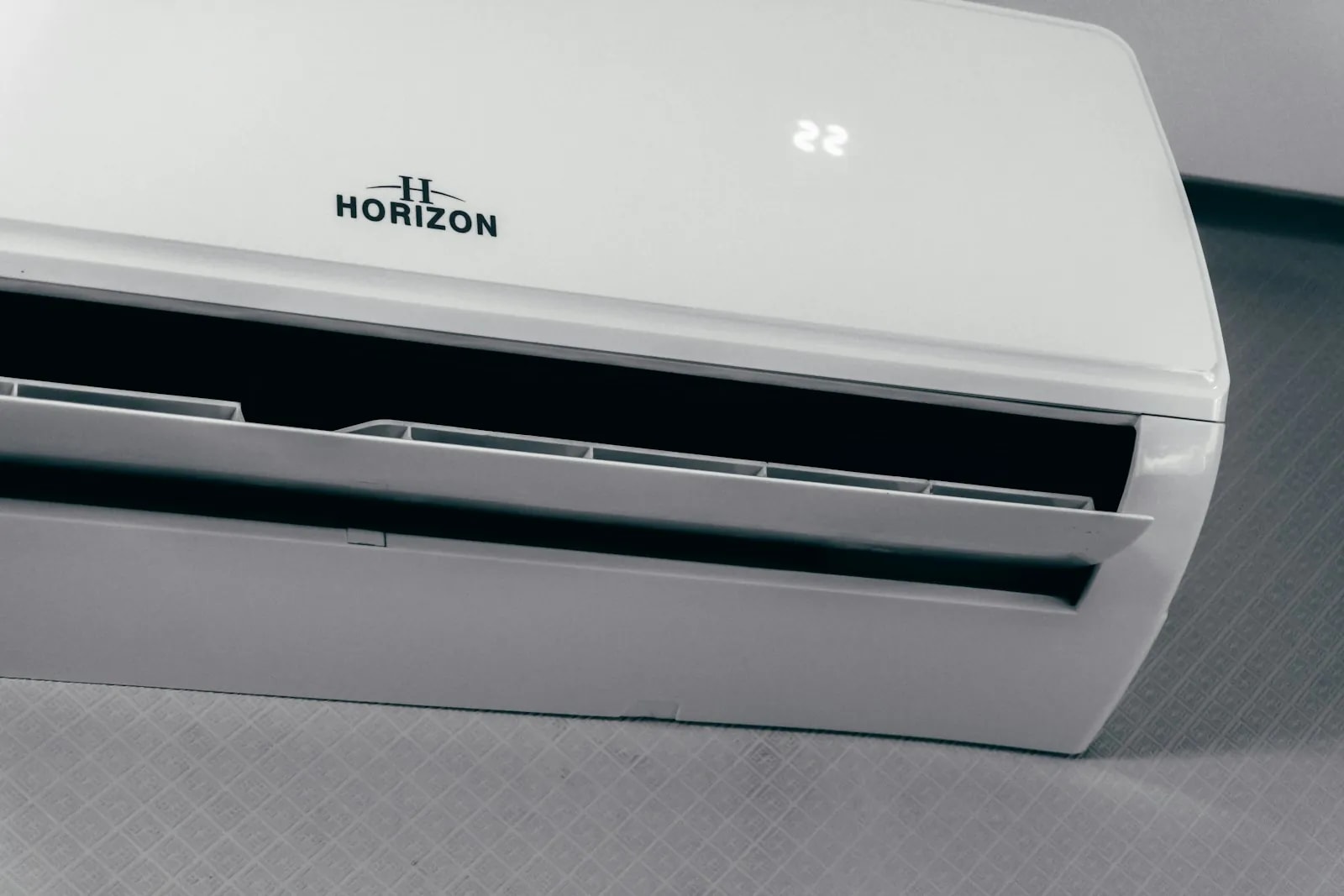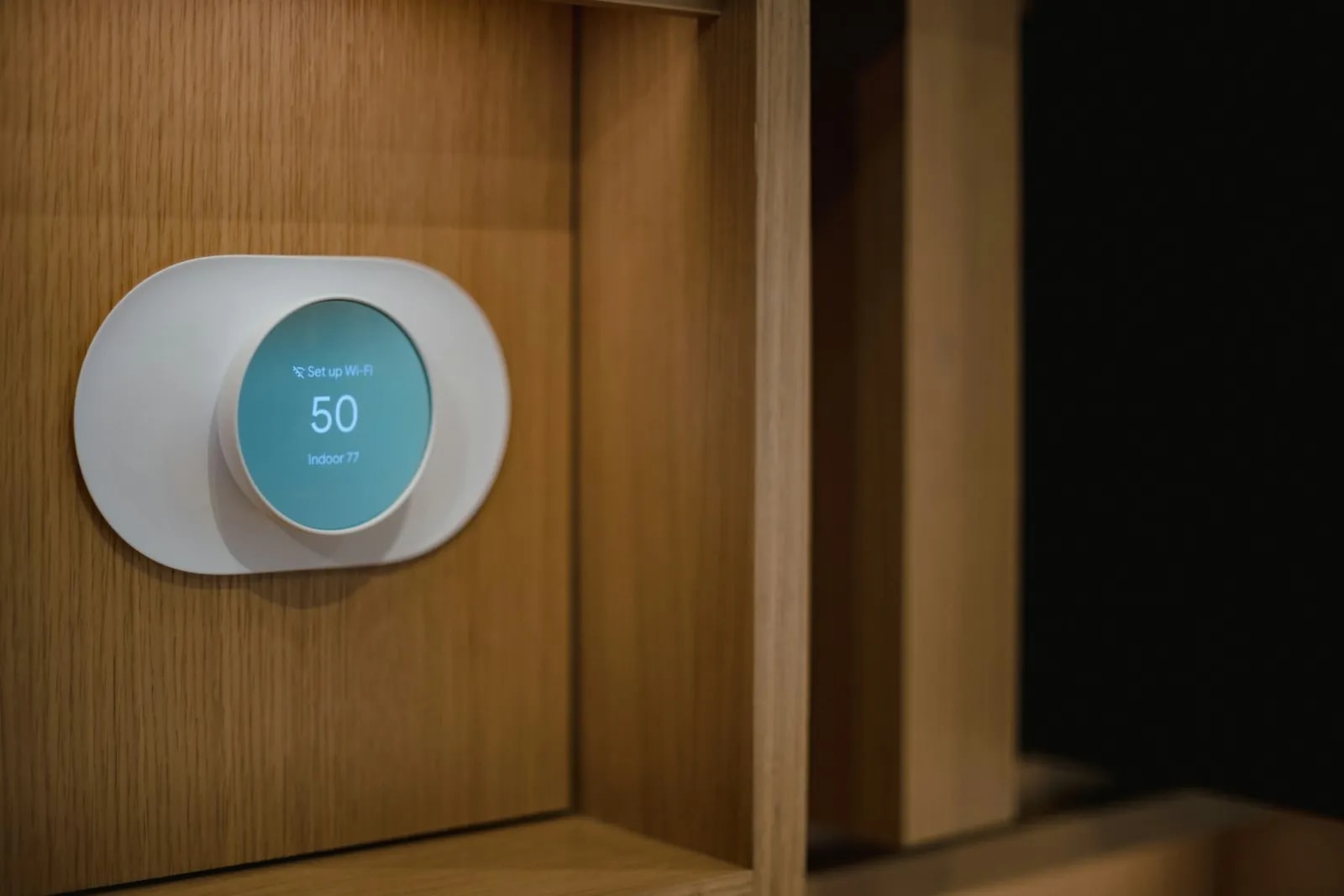
If you live in a Dubai apartment served by Empower, Emicool, or Tabreed, that Nest box on your shelf is likely to stay there. District cooling apartments have no compressor for a normal smart thermostat to switch on.
Your wall panel controls two things: a chilled water valve and a fan set to low, medium, or high. Nest, Ecobee, and Sensibo were built for a different job. This guide covers what actually works, what it costs, and what it can and cannot save.
Real talk: a smart thermostat cannot touch the fixed capacity charge on your cooling bill. It moves the consumption half only. We say that first because most pages selling you a thermostat never say it at all.
What is district cooling, and how is it different from a normal Dubai AC?
District cooling makes chilled water at one large plant and pipes it to your building. A split AC makes cold air inside your home with its own compressor. District cooling moves the compressor off-site, into a central plant run by Empower, Emicool, or Tabreed.
The chain runs like this. The plant chills water. Underground pipes carry it to an Energy Transfer Station (ETS) inside your building. From the ETS, water flows to a fan coil unit (FCU) in your ceiling or service cupboard. A fan blows room air across the cold coil, and that is your cool air.
FCU in plain English: a metal box holding a coil of chilled water pipe and a fan. No refrigerant gas. No outdoor unit. Nothing to compress.
That single difference decides every device recommendation in this article. A thermostat for a split AC sends a start signal to a compressor. A thermostat for an FCU opens a water valve and picks a fan speed. Those are two different electrical jobs.
District cooling in Dubai is licensed and regulated under Executive Council Resolution No. 6 of 2021, with the Regulatory and Supervisory Bureau setting the rules for providers, tariffs, and the customer relationship.[1]
One point that matters later: this service is billed by your cooling provider, not by DEWA. Your DEWA invoice covers electricity and water.[2] If electricity is what you want to cut, our guide on reducing a DEWA bill with a smart home covers that separately, and none of its figures apply here.
How do I know if my apartment is on district cooling?
Check two things: your balcony and your bill. No outdoor condenser box on the balcony or bolted to the building wall means you are almost certainly on chilled water. A separate monthly invoice from Empower, Emicool, or Tabreed settles it.
What to check:
- Outdoor unit: a split AC has one per indoor unit. A district cooled apartment has none.
- The bill: look for RT and RTH on the invoice instead of kWh.
- The wall panel: FCU panels usually show a fan icon with three speed bars next to the temperature.
- Handover papers: the provider name sits in your tenancy contract or handover pack.
Some Dubai buildings are described as chiller free. That means the landlord pays the cooling provider and folds the cost into rent or service charges. The hardware in your ceiling is still an FCU, so the thermostat question is identical.
If you did find an outdoor unit, you have a split or ducted system and this is the wrong article. Read how to automate air conditioning in Dubai, or our roundup of the best smart thermostats in Dubai.

Why doesn't my Nest, Ecobee, or Sensibo work with a fan coil unit?
Nest, Ecobee, and Sensibo are built to start a compressor, and a district cooling apartment has no compressor to start. That is the whole answer.
Nest and Ecobee are designed around 24V control wiring for furnaces, heat pumps, and similar equipment. The thermostat closes a circuit, the compressor or burner runs, the room temperature changes.[4] Neither publishes a chilled water or fan coil compatibility category covering valve position and three fan speed outputs. This is an architecture mismatch, not a bad product.
What an FCU panel has to drive:
- A valve output: open or close the chilled water valve, often labelled V1 and V2 on the terminal block.
- Three fan speed outputs: low, medium, and high, usually labelled F1, F2, and F3.
- Mains power: UAE fan coil panels run at 220V to 240V, not off a 24V transformer.
Sensibo is the clearest failure case. Sensibo's own compatibility page states its devices need an air conditioner with an infrared remote control. It does not cover systems that only have a wired thermostat and no remote.[3] A district cooling wall panel is exactly that: wired, no remote, no infrared receiver. The Sensibo has nothing to point at and nothing to copy.
Ecobee sits in the middle. It needs a C-wire and can sometimes be wired into a very simple FCU set up for a standard thermostat connection. It still offers no native three-speed fan or modulating valve control, so treat it as a partial fit rather than the right tool for the job.
2-pipe or 4-pipe: why it changes which device you buy
A 2-pipe FCU has one flow pipe and one return pipe, so the thermostat drives a single valve. A 4-pipe FCU has separate chilled and hot water circuits, so the thermostat drives two valves. Most Dubai apartments run cooling-only 2-pipe units.
Get this wrong and the room either never reaches setpoint or a valve stays open and your consumption charge climbs. A 2-pipe thermostat wired onto a 4-pipe coil leaves one circuit with nothing controlling it.
How to tell: count the insulated pipes running into the FCU box above your ceiling hatch. Two pipes plus a condensate drain is a 2-pipe unit. Four pipes plus a drain is a 4-pipe unit. If the hatch is sealed, an installer confirms it during the survey.
Valve type matters just as much. Some FCUs use a simple on and off actuator. Others use a modulating valve driven by a 0 to 10V signal, which opens partway and holds a steadier room temperature. A thermostat that only switches on and off cannot drive a 0 to 10V valve properly, and you feel the difference as temperature swing.
Fan wiring is the third check. Older Dubai towers use three-speed fans with separate live taps. Newer units may use an EC fan taking a 0 to 10V speed signal.
Which smart thermostats are built for a chilled water FCU?
Three devices cover most Dubai apartment retrofits: the Salus FC600, the Aqara Smart Thermostat S3, and a Tuya-platform FCU panel sold under brands such as Moes. All three drive a valve and a multi-speed fan, and all three reach your phone through a gateway.
- Salus FC600: a Zigbee fan coil thermostat with stated 2-pipe and 4-pipe support, F1, F2, and F3 fan terminals switching at 230V, plus V1 and V2 valve outputs. App control runs through the Salus Universal Gateway.[5] Zigbee is a low-power wireless mesh: no drilling, and devices relay signal for each other.
- Aqara Smart Thermostat S3: Zigbee 3.0 with Matter support, running at 220V to 250V, with three relay circuits rated 100W each for valve-type loads. Aqara lists water system fan coil units and central air conditioning among the systems it supports.[6] Matter is a shared standard from 2022 that lets one device work with Apple, Google, and Amazon together.
- Tuya-platform FCU panels: sold under brand names including Moes. They offer 2-pipe and 4-pipe support, on and off or 0 to 10V valve control, and three fan speeds. Control runs through the Tuya Smart or Smart Life app with a Zigbee gateway.
- Honeywell TF428WNM/U: a Modbus RTU communicating thermostat built for 2-pipe and 4-pipe coils, with three-speed fan and valve control plus freeze protection.[7] This is building-management grade. It needs a gateway before any phone app can see it.
Naming warning: the Aqara Smart Thermostat S3 is a different product from the Aqara S3 wall control panel. Only the thermostat carries the relay circuits an FCU needs. Read the model name on the box, not the shelf label.
| Device | Works with a chilled water FCU? | Valve and fan control | Phone or voice control | The short reason |
|---|---|---|---|---|
| Sensibo Sky, Air, Air Pro | No | None | Yes, but with nothing to command | Needs an AC with an infrared remote. An FCU panel is wired, with no remote. |
| Google Nest Learning Thermostat | No, not natively | No published chilled water category | Yes | Built around a 24V compressor or heat pump call, not valve plus three-speed fan. |
| Ecobee | Partial at best | No three-speed fan, no modulating valve | Yes | Can wire into a simple FCU with a C-wire, but was not designed for this. |
| Salus FC600 | Yes | V1 and V2 valve, F1 to F3 fan, 2-pipe and 4-pipe | Yes, via the Salus Universal Gateway | A purpose-built Zigbee fan coil thermostat. |
| Aqara Smart Thermostat S3 | Yes | 3 relay circuits for valve-type loads, 220V to 250V | Yes, Zigbee 3.0 plus Matter | Manufacturer lists water fan coil units as a supported system. |
| Tuya-platform FCU panel (Moes and similar) | Yes | On and off or 0 to 10V valve, 3 fan speeds | Yes, Tuya Smart or Smart Life app with a gateway | The budget route. Build quality and support vary by seller. |
| Honeywell TF428WNM/U | Yes, professional grade | 2-pipe and 4-pipe, 3-speed fan, valve control | Only through a Modbus gateway | Speaks Modbus RTU for building management systems. |
| HDL KNX FCU controller (M/FCU01.10.1) | Yes, professional grade | High, medium, low fan, heating and cooling, 0 to 10V option | Through the KNX system app | A KNX bus device set up in ETS software. |
| Lutron myRoom FCU Controller and HomeWorks QS Palladiom | Yes, professional grade | 4-pipe with 0 to 10V valve and 0 to 10V fan | Through the Lutron system app | Pairs with a Palladiom thermostat inside a Lutron system. |
We quote hardware after the survey rather than printing prices that age badly. The wiring requirement in column three does not change.
The professional route: KNX, Lutron, and BMS-grade FCU control
If you own the apartment and want every room on its own schedule, the wired route holds up better over 10 years. KNX is a wired standard that keeps running without the internet, with a working life measured in decades rather than product cycles.
Six manufacturers publish KNX fan coil actuators: HDL, Theben, ABB, Eelectron, Interra, and EAE Technology. The HDL M/FCU01.10.1 handles high, medium, and low fan speed plus heating and cooling control, with a 0 to 10V option, configured through the KNX ETS software.[8]
Lutron takes the same job into a lighting and shading system. The myRoom Fan Coil Unit Controller and the HomeWorks QS Palladiom HVAC solution state 4-pipe support. Both give 0 to 10V valve control and 0 to 10V fan control, paired with a Palladiom thermostat.[9] That suits a penthouse where climate, blinds, and lighting keypads all sit on one system.
Where Intesis fits: building-grade thermostats like the Honeywell TF428 speak Modbus, not KNX. An Intesis Modbus RTU to KNX gateway from HMS Networks brings those devices into a KNX system as native devices.[10] That is the standard bridge when a Dubai building already has Modbus fan coil controls installed by the developer.
This is not theoretical here. The KNX Association lists a private villa project in Meydan, Dubai built with KNX valve drive and fan coil control, with individual room control.[11] We do the same integration on our smart lighting and climate control projects, where zone AC control sits alongside Lutron and KNX lighting. Ask for a site survey if you want the wiring checked before you commit to a system.
Do I need Empower's or Emicool's permission to change the thermostat?
You usually do not need Empower's or Emicool's permission to change the thermostat, because the fan coil unit and its wall panel sit on your side of the system. The provider owns the primary side: the underground network, the ETS, the heat exchangers, and the meter.
Empower's own documentation places the primary side system design inside its scope. The building's internal chilled water distribution and the fan coil units fall outside that scope, which puts them with the building or the owner.[2] An Empower e-NOC is aimed at work touching the ETS room, primary pipework, or metering equipment.
Be careful with that reading. We are describing the ownership split, not handing you a legal guarantee. Buildings set their own house rules, and a facilities manager can require sign-off for any work inside a common ceiling void. Ask building management in writing before an installer opens a hatch.
The wider framework is Executive Council Resolution No. 6 of 2021, which set out how district cooling is provided and billed across Dubai, including free zones, with the Regulatory and Supervisory Bureau licensing providers and setting tariff and customer rules.[1]
Renting on district cooling: what you can and cannot swap
Ask your landlord before you buy anything. The FCU and its wall panel are usually landlord or building property, and Dubai tenancy law (Law No. 26 of 2007, Article 19) requires the landlord's written consent before a tenant alters a fixed installation.
What renters can usually do without touching wiring:
- Temperature and humidity sensors that log room conditions, so you see the pattern before you spend anything.
- Motorised curtains or blinds fitted to the existing track, which cut the solar heat load on a west-facing Marina apartment.
- Occupancy sensors that trigger scenes on other devices you already own.
What needs written consent: replacing the FCU wall panel, running new cable in the ceiling, or fitting a valve actuator. All three count as alterations to landlord property, and all three are easy to reverse if you keep the parts.
Our guide to a smart home in a rented Dubai apartment covers the reversible options in more detail. Keep the original panel in a labelled box. You will want it at move-out, and a missing panel is an easy deduction from a deposit.
How am I billed, and what is an RTH?
A district cooling bill has two halves: a fixed capacity charge for the capacity reserved for your apartment, and a consumption charge for the cooling you actually used, metered in refrigeration ton hours (RTH).
RTH in plain English: one refrigeration ton of cooling delivered for one hour. It is the chilled water equivalent of a kWh on a DEWA electricity bill, and it is the only line a thermostat can move.
Empower charges AED 0.568 per RTH for consumption and AED 750 per refrigeration ton per year for capacity, billed monthly.[2][12] A 2-bedroom apartment allocated 7 RT therefore carries roughly AED 437 a month in capacity charges before it uses a single RTH.
| Provider | Consumption charge | Capacity or demand charge | Other fees you may see |
|---|---|---|---|
| Empower | AED 0.568 per RTH | AED 750 per RT per year, billed monthly | Meter maintenance AED 30 a month, connection AED 2,000, admin AED 1,000, security deposit AED 2,000 for an apartment |
| Emicool | About AED 0.56 per RTH | Set per project. Ask Emicool for your building's figure. | Activation AED 200, reconnection AED 100, late payment AED 100 |
| Tabreed | About AED 0.57 per RTH | About AED 700 to 850 per RT per year, varies by project | Meter rental AED 30 to 50 a month, security deposit around 8 months of capacity charges |
All charges carry 5 percent VAT, and Empower's capacity charge also reflects fuel surcharge adjustments under its agreement with DEWA. Fees change by provider and by project, so read your own invoice rather than any table on the internet, this one included.[13]
The capacity charge does not move. Leave a Dubai apartment empty for a month and you still pay AED 750 per refrigeration ton per year on the Empower tariff. Only the RTH half answers to a thermostat.
Will a smart thermostat lower my district cooling bill?
A smart thermostat lowers only the consumption half of a district cooling bill. Scheduling, setback, and occupancy control reduce the RTH you burn. The capacity charge is tied to the refrigeration tons allocated to your unit and ignores anything you do at the wall panel.
Our internal estimate is a 25 to 35 percent drop in the consumption portion over a summer. It comes from Dubai Smart Home projects where we fitted per-room schedules and valve actuators to fan coil units.[16] Treat that as an estimate we make at quote time after seeing your wiring and your last three invoices, not a promise.
Quick math: say your monthly cooling bill is AED 900, and AED 400 of that is consumption. A 30 percent cut on that half saves about AED 120 a month. The other AED 500 stays exactly where it is. Anyone quoting you a percentage off the whole bill is quoting the wrong number.
Where the saving actually comes from:
- Setback while you are out: holding 26°C from 8am to 6pm instead of 21°C, then pre-cooling 30 minutes before you get home.
- Room-by-room control: a closed guest bedroom does not need an open valve in July.
- Night schedules: a slightly higher setpoint after 2am, when the outdoor load drops.
- Shading: blinds closed on a west face before 3pm cuts the heat the coil has to remove in the first place.
- Fan speed discipline: holding medium instead of high once the room is at setpoint, which most manual panels never do.
None of this touches your DEWA electricity bill, which arrives from a separate body on a separate invoice. If lighting, appliances, and standby load are what you want to cut, read how a smart home reduces a DEWA bill. For whole-home monitoring, solar, and battery storage, see our energy management and solar page.
Which Dubai communities are on Empower, Emicool, or Tabreed?
Empower serves most of Dubai's tower districts, Tabreed runs the Downtown Dubai network, and Emicool covers the communities it names on its own projects page. The reliable check is still the header on your invoice.
| Community | District cooling provider | What to check |
|---|---|---|
| Palm Jumeirah | Empower | Empower serves most Dubai tower districts. Check your invoice header. |
| Business Bay | Empower | Check your invoice header. |
| Dubai Marina | Widely reported as Empower, not confirmed on Empower's own list | Check your invoice header. |
| Jumeirah Beach Residence (JBR) | Empower | Check your invoice header. |
| Jumeirah Lake Towers (JLT) | Empower | Check your invoice header. |
| Dubai Silicon Oasis | Empower | Check your invoice header. |
| Downtown Dubai | Tabreed | Tabreed lists the Downtown Dubai network on its own site. |
| DAMAC Hills | Emicool | Named on Emicool's own projects page. Phased communities can vary, so check your bill. |
| Dubai Investment Park | Emicool | Named on Emicool's own projects page. |
| Dubai Motor City | Emicool | Named on Emicool's own projects page. |
| Dubai Sports City | Emicool | Named on Emicool's own projects page. |
| Anywhere not listed here | Confirm before you buy | Ask your developer, your facilities team, or the provider printed on your invoice. |
The mapping comes from the providers themselves: Emicool's projects page,[14] Tabreed's own site,[15] and Empower's published coverage.[12]
Common mistake: assuming a whole master community runs on one provider. Large multi-phase developments can differ by phase, and a plot sold in 2015 may not share a network with a plot sold in 2023. If your community is not in the table, confirm with your developer or the provider named on your bill. We do not guess on this.
Building a picture of what is installed where before you buy a property? Our overview of smart home ready communities in Dubai covers the wider set.
What does a professional FCU retrofit look like?
A professional FCU retrofit takes four steps, and the first is not shopping. A survey confirms what is in your ceiling before anyone recommends hardware.
- Survey: open the ceiling hatch, count the pipes, read the terminal block on the existing panel, and note the valve type (on and off, or 0 to 10V). Photograph the wiring before anything is disconnected.
- Consent: landlord approval if you rent, plus building management sign-off for ceiling work. Nothing goes near the ETS room or the meter, which stay with the provider.
- Install: fit the FCU thermostat, wire the fan speed and valve terminals, and add the Zigbee or KNX gateway. Test every fan speed and valve position by hand before the ceiling closes.
- Commission: set room-by-room schedules, link the panel to the app and to voice control, and hand over the original panel in a box.
Timing is short. A single apartment usually takes a day. A full apartment automation covering lighting, curtains, and climate together runs AED 8,000 to 15,000 and 2 to 4 days on site.
Gateways and app control need a network that holds up. Zigbee meshes and KNX IP gateways both sit on your home network. That is why our home networking work usually goes in first on tower apartments, where the 2.4GHz band is crowded by 200 neighbours.
Our team has worked on smart home automation projects across Dubai, UAE since 2016, and each project we take on is designed by us and coordinated around how your building is cooled. We are rated 4.9/5 by Dubai homeowners, and sales enquiries are answered within 2 hours. Book a site visit, or send us a photo of the model number on your wall panel over WhatsApp.
Common mistakes when buying a district cooling smart thermostat
Five errors cost Dubai residents the most money and time. All five are avoidable in ten minutes of checking.
- Buying an infrared controller. Sensibo and similar devices need an AC with a remote. Your wired FCU panel has neither a remote nor a receiver.[3]
- Assuming a smart thermostat means Nest or Ecobee. Those are the right answer for a different system, covered in our smart thermostat roundup for Dubai.
- Expecting the whole bill to drop. The capacity charge is fixed. Only the RTH half moves, so plan around that AED figure, not the total.
- Skipping landlord and building sign-off. Asking costs nothing. Putting the original panel back at move-out is a paid call-out plus half a day of your time.
- Ordering before checking 2-pipe or 4-pipe. A 2-pipe thermostat on a 4-pipe coil leaves one valve with no controller.
One more worth naming: buying the cheapest unbranded panel from an online marketplace. Tuya-platform panels do work, but the seller matters. A panel that ships with no manual and no support becomes a dead rectangle on your wall the first time the gateway firmware changes.
And a Dubai-specific one. Do not price your saving off a DEWA electricity article. District cooling is a separate bill from a separate provider, with different units and different tariffs.
What should I do next?
Start with two photographs. One of your cooling invoice header, one of the terminal block behind your existing wall panel. Those two images answer most of the questions above without anyone visiting your apartment.
From there the choice is simple. A Zigbee FCU thermostat like the Salus FC600 or the Aqara Smart Thermostat S3 suits a single apartment on a modest budget. KNX or Lutron suits an owner who wants every room, plus lighting and curtains, on one wired system that keeps working when the internet drops.
New to all of this? Our smart home guide for Dubai covers the basics first, then come back to this page for the fan coil detail.
Send us the two photos and we will tell you what fits. Sometimes the honest answer is that your existing panel is fine and a schedule is all you need. Get a free consultation or message us on WhatsApp. Our smart lighting and climate control team handles fan coil retrofits across Dubai, UAE.