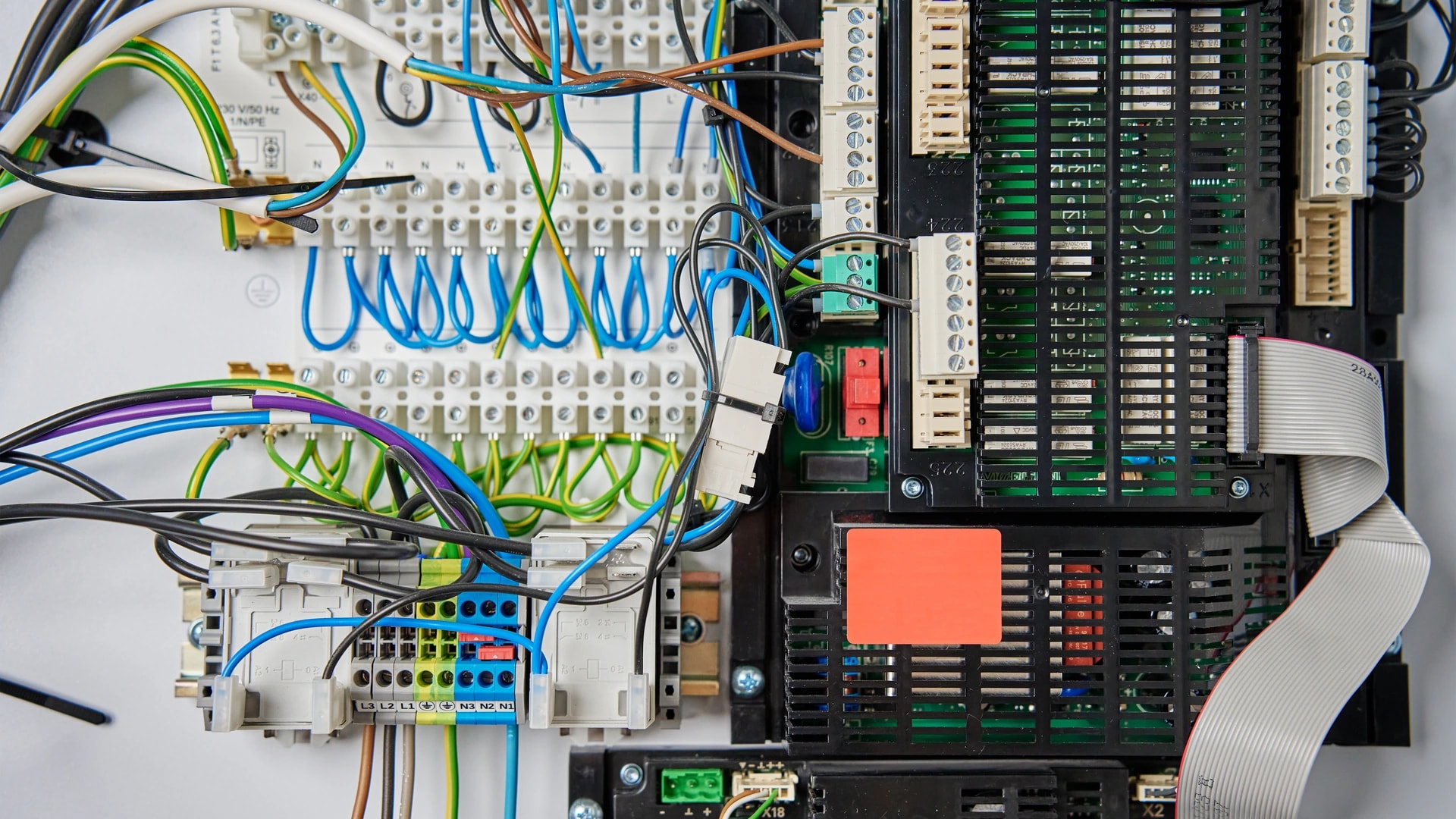
Cooling is the biggest line on a Dubai DEWA bill in summer. So getting your AC to run only when you need it, at the right temperature, is the fastest saving in the whole home. This guide shows you how to automate your air conditioning, step by step, for the three kinds of AC found in Dubai and UAE homes.
We install and support climate control across Dubai, from Marina apartments to Dubai Hills villas, and we have done so since 2016. Everything below is written from the install side. If you want the wider picture first, start with our complete smart home guide for Dubai, then come back here for the AC detail.
How do you automate AC in a Dubai home?
You automate AC in a Dubai home by finding your AC type first, then matching it to the right device. A split unit takes a clip-on infrared (IR) controller with no wiring. A villa's central AC takes a wired smart thermostat. An apartment on district cooling controls the fan and water valve, not a compressor.
Get that order right and the rest is easy. Get it wrong and you buy the wrong device. A common example is a renter ordering a Google Nest for a split-unit apartment, then finding it will not fit. So we start with the diagnosis, not the shopping.
Quick take: smart AC and lighting control cut cooling costs 20 to 30 percent[9]. A villa paying AED 4,000 a month to DEWA in summer can save AED 800 to 1,200 a month[9]. That is the prize, and it is why AC is the first thing most Dubai homes should automate.

Step 1: which AC do you have?
Dubai homes are cooled by one of three AC types, and each one automates differently. Look at how your home is cooled.
- Split or wall unit. An indoor unit mounted high on the wall, with its own handheld remote. This is most apartments and many villa bedrooms.
- Ducted or central AC. Vents in the ceiling, fed by ductwork, run from a wall thermostat. This is most villas, often a VRF system (variable refrigerant flow, one outdoor unit feeding several rooms).
- District cooling. No outdoor condenser of your own. Chilled water arrives from a central plant run by Empower, Emicool, or Tabreed, and a fan coil unit (FCU) in your home blows cool air.
Do this first: if you are not sure, check for an outdoor unit and check who bills you for cooling. A separate cooling bill from Empower or Emicool, not DEWA, means district cooling. Your own outdoor condenser means a split or ducted system. This one check decides everything that follows.
Automating a split or wall AC
Use a clip-on IR smart controller. It is a small box that sits on a shelf or wall near the indoor unit, and it copies the same infrared codes your handheld remote already sends[7]. No wiring, no electrician, and it comes off clean when you move.
Popular models in the UAE are Sensibo, Cielo, Tado, and Aqara-based hubs. The better ones hold a target temperature with their own sensor, like a real thermostat, and cycle the AC to keep it. Tado alone works with more than 3,000 AC models across 200 plus brands, because it reads the remote, not the wiring[8]. Cheaper models simply replay a saved command on a schedule, with no feedback loop.
For Dubai, pick a closed-loop model with a humidity sensor. The air here is humid, and a controller that watches only temperature can leave a room feeling clammy at a correct setpoint. A humidity-aware controller holds a comfort band instead, so the AC does not over-run chasing degrees alone. Sensibo, Cielo, and the higher Aqara models all offer this.
Install takes minutes. You mount the controller in line of sight of the AC, connect it to your Wi-Fi, and load your remote in the app. That is the whole job.
Renters, note: this is your category. Nothing is drilled, nothing is rewired, and you do not need the landlord's sign-off. When you move, you unplug it and take it with you. Our renter smart home guide covers the no-drill setup room by room.
Automating a villa's ducted or central AC
Use a wired smart thermostat, fitted by a technician. Villa central and VRF systems run on a 220 to 240 volt control circuit. Most smart thermostats, like Google Nest and Ecobee, are built for the 24 volt wiring common in the US, so they do not fit a UAE system out of the box.
The Dubai catch: the fix is a small bridging adapter (a Dropair Mini6 is the common one) that sits inside the AC's electrical panel and translates the signal. That lets a Nest or Ecobee run a UAE AC. It is a 60 to 90 minute job per unit for a licensed technician, not a DIY swap. Wiring a 24 volt thermostat straight to a 220 volt circuit is the single most common way people damage the unit.
For a whole villa, the better path is a gateway that ties every zone into one system, so each room runs its own schedule from one app or wall keypad. This is a wired backbone, close to how KNX works, and it lasts as long as the villa. If you own the villa, you can commission this directly. Our villa owners upgrade guide maps the full room-by-room plan.
The brands you will meet in Dubai villas are Daikin, Mitsubishi, LG, and Samsung. Each has a matching gateway or adapter, so almost any ducted system can be brought onto one app. The work is choosing the right bridge for your unit, which is why a site survey comes before any hardware.
Zone control is where a villa really saves. An empty guest room or majlis does not need to cool at the same rate as an occupied bedroom. On a large home, that room-by-room control is often the difference between a modest saving and the full 20 to 30 percent.
Automating district cooling (the big Dubai nuance)
Yes, you can automate it, but only the fan and the water valve, not a compressor. On district cooling there is no compressor in your home. A central plant chills water and pumps it to a fan coil unit (FCU) in your apartment, which blows cool air[4].
So a smart FCU thermostat or Zigbee panel can still schedule cooling, ease back the temperature when you are out, and manage the fan for humidity. It just cannot cycle a compressor, because there is not one to cycle. The saving comes from not running the fan and valve wide open in an empty room.
District cooling is common in many Downtown Dubai, Business Bay, and Jumeirah Beach Residence high-rises through Empower[4], and in areas like Dubai Investment Park and Motor City through Emicool[5]. Coverage is set by the master developer, not chosen by you, so check your own bill to confirm which provider serves you.
The Dubai catch: your cooling here is billed separately from DEWA, by Empower or Emicool, as a fixed capacity charge plus a variable consumption charge[4]. Automation cannot touch the fixed part. It can trim the consumption part, the same way it trims a split unit's electricity. A one-bedroom often runs a few hundred dirhams a month in peak summer, so the consumption side is worth managing.
Empower runs its own monitoring on the plant side, and its app lets you view and pay bills and track your consumption[4]. That is the utility watching its side of the system. Your smart FCU panel watches yours. The two do different jobs, and only the in-home one lets you schedule and set back the cooling in your own rooms.
Renters, note: the FCU and its wall thermostat are usually building or landlord property. Swapping either for a smart panel is an ask-first conversation with building management, not a plug-in job. Prefer to talk it through before you touch anything? Message an engineer on WhatsApp →
The AC type to automation method table
Here is the whole decision in one view. Find your row first, then read across.
| AC type | How you automate it | Wiring needed? | Renter OK? |
|---|---|---|---|
| Split or wall unit | Clip-on IR controller (Sensibo, Cielo, Tado, Aqara) that copies the remote | No, shelf or wall mounted | Yes, fully reversible |
| Ducted or central (VRF) villa AC | Wired smart thermostat plus a bridging adapter, or a gateway for full zone control | Yes, technician fitted | Owner yes, renter needs sign-off |
| District cooling (FCU) | Smart FCU thermostat or Zigbee panel controls the fan and chilled-water valve only | Touches existing wiring | Ask building management first |
The automations that actually save money
Set these in the order below. The first few are free and work on any AC. The later ones need more hardware but add more saving on top.
- A schedule. Cool the home only during the hours you are in it or about to be. This stops the biggest waste of all, cooling an empty home all day.
- Geofencing. The app uses your phone location to ease off when the house is empty, then cool again as you head home.
- Pre-cooling. Let the system reach 24 degrees before you arrive, instead of blasting it to the coldest setting when you walk in.
- Night setback. Raise the setpoint a few degrees, or use an eco mode, while you sleep. DEWA suggests 26 to 27 degrees overnight[2].
- Zoning. On a villa, cool only the rooms in use. Guest rooms sit in eco until someone needs them.
- Humidity control. A controller with a humidity sensor keeps the room comfortable without over-cooling. Dubai air is humid, so this matters more here than in most places.
- A door or window sensor. Pause the AC or send an alert when a balcony door is left open while it runs.
- Blinds that close in peak sun. Block the heat before the AC has to remove it.
That last one pays off more than people expect. Automated shading saves roughly 15 to 20 percent on cooling in a sun-facing room[9], because your AC never has to fight the heat in the first place. Pair it with our motorized curtains and blinds work, or plan the whole climate side with smart lighting and climate control.
| Automation | What it does | Typical saving |
|---|---|---|
| Hold the 24 degree setpoint | Stops the drift colder that manual habit tends toward | Up to 5 percent per degree, per DEWA[1] |
| Schedule and geofencing | Eases off cooling when the home is empty | Cuts the single biggest waste pattern |
| Smart AC plus lighting control | The combined effect across the home | 20 to 30 percent on cooling[9] |
| Motorized shading | Blocks solar heat before it becomes a cooling load | Roughly 15 to 20 percent[9] |
| Replace a 10 year old AC with a 4 or 5 star unit | A hardware upgrade, not automation, but the biggest single lever | Up to 25 percent, per DEWA[1] |
How much you actually save
The saving comes from using less cooling, not from a cheaper rate. DEWA has no time-of-use tariff, so there is no off-peak hour to shift to. You save by cooling less, and smart control is how you do that without thinking about it.
DEWA's own numbers back this up. Each degree above the 24 degree setpoint can save up to 5 percent on AC use[1]. Replacing a 10 year old unit with a 4 or 5 star one can cut cooling by up to 25 percent[1]. DEWA itself recommends a programmable or smart thermostat to control run-time[2]. DEWA also bills on a slab tariff, so the more power you use, the higher the rate band[3], which makes cutting cooling doubly worth it.
Quick math: a villa on AED 4,000 a month to DEWA that trims cooling by 25 percent claws back about AED 1,000 a month[9]. Across the hot months that is several thousand dirhams a year. A single split-unit controller usually pays for itself inside one summer.
Smart AC and lighting control cut cooling costs 20 to 30 percent. On a Dubai villa, that is often AED 800 to 1,200 back in your pocket every summer month.
Payback depends on how you cool today. A home that already holds 24 degrees saves less, because there is less waste to cut. A home that runs the AC cold and all day saves the most. Most Dubai homes sit closer to the second, which is why the saving tends to land fast, often inside the first year for an apartment.
Cooling is one lever. Solar and energy management are separate ones, covered on our energy management and solar page. Want the full room-by-room breakdown of the cooling saving? Our guide on cutting your DEWA bill with a smart home runs the numbers by home size, and the smart home cost guide shows what the system costs to install.
Which devices work in Dubai, and what they cost
These are approximate retail prices, and they change often, so treat them as a guide. They cover the device only, not a full professionally installed villa system.
| Device | AC type | Approx. price (AED) |
|---|---|---|
| Sensibo Sky or Air | Split or wall unit | Roughly 400 to 700 |
| Cielo Breez | Split or wall unit | Roughly 250 to 420 |
| Tado Smart AC Controller | Split or wall unit | Roughly 240 |
| SwitchBot Hub 2 | Split or wall unit | Roughly 220 |
| Aqara S3 wired thermostat | Wired or FCU panel | Roughly 735 |
| Google Nest with bridging adapter | Ducted or central | Roughly 900 to 1,900 with install |
| Ecobee Premium plus adapter | Ducted or central | Roughly 789 to 999 plus adapter |
| Dropair Mini6 bridging adapter | Ducted bridge | Roughly 600 to 790 plus install |
| VRF gateway (CoolAutomation type) | Whole villa zones | Quoted per project |
Buy from established UAE sellers like Amazon.ae, Sharaf DG, Noon, or a licensed installer. Any wireless device sold here should carry TDRA type approval, which is the supplier's job, not yours[6]. Buying local is the simple way to be sure. Not sure what fits your home? Our smart home buyer's guide for Dubai walks through the choice.
One more point. Every one of these devices leans on your Wi-Fi. If the network drops, remote control and schedules pause, though the AC keeps running at its last setting. A steady home network matters as much as the AC device itself.
Set it up in an afternoon: a step by step
For a split-unit apartment, you can do this in a single afternoon. A villa system is a booked install, but the planning steps are the same.
- Identify. Confirm your AC type using the check above.
- Choose. Match the device to the type from the table.
- Pair. Mount the controller, connect it to Wi-Fi, and load your remote's codes in the app.
- Set the core automations in order. Schedule first, then geofencing, then pre-cooling, then night setback.
- Tune over two weeks. Raise the setpoint one degree at a time. Watch your next bill for the change, and add a door sensor if someone always leaves the balcony open.
Prefer someone to handle the wiring and the setup? Book a free site visit and quote →
Renter or owner: the answer changes
Renters should stay wireless. Owners can go wired. That single split decides most of your choices.
Renters, note: a clip-on IR controller on a split unit is the safe, high-value move. It needs no permission, drills nothing, and moves with you to the next home. Avoid anything that touches a wall thermostat or an FCU in an apartment, since that is landlord property.
If you own a villa, a wired thermostat or a full zone system is worth it, because you keep the value and the saving for as long as you live there. It also reads as an asset to a future buyer or tenant, not a pile of gadgets to unplug. New to all this? Our smart home systems explained guide covers the basics in plain language, and smart home protocols explains how devices talk to each other, which decides what works together.
The one case that catches renters out is district cooling. An FCU panel looks like a simple wall thermostat, but it is wired into the building's chilled-water system, so it is not a device you swap yourself. On district cooling, keep automation to plug-in sensors and speak to building management before touching the panel.
Common mistakes to avoid
These are the ones we see most across Dubai homes.
- Setting it too cold. 16 degrees does not cool faster. It just overshoots and wastes energy. Hold 24 and let the schedule do the work.
- No schedule at all. A smart device left on a single fixed setting all day throws away most of the saving.
- Ignoring humidity. Chasing temperature alone leaves a room feeling clammy and the AC over-running.
- Buying a US thermostat for a split unit. A Nest will not fit a UAE split AC without the right adapter, and often not at all on a pure IR unit. Match the device to the type.
- Leaving the AC on full while out. Cooling an empty home for eight hours is the most expensive habit in a Dubai summer.
Common mistake: turning the AC off completely when you leave, then blasting it cold on return. In Dubai heat that often uses more energy than a sensible setback, and it lets humidity build. A higher hold, around 26 to 27 degrees while you are out, is the better default.
Two myths about smart AC
Myth: it voids your warranty. Not for a clip-on IR controller. It reads your remote's signal from outside the unit and changes nothing inside the AC[7]. There is nothing for a manufacturer to call an unauthorized change. A hardwired thermostat or adapter is a different case, so have a licensed technician fit that to keep the AC warranty intact.
Myth: you must rewire your AC. Not for a split unit. Most Dubai homes automate AC with an IR controller and zero wiring. Rewiring only comes up for a villa's ducted system, and even then a technician connects to an existing circuit through an adapter, rather than rewiring the unit itself.
How Dubai Smart Home automates your cooling
We handle the whole climate side: one app for every room, zone control on villa AC, and the wiring done properly the first time. Our engineers are in-house and based in Dubai, we do not subcontract, and every system works in English and Arabic.
Since 2016 we have completed 100+ projects across Dubai villas and apartments, and we are rated 4.9/5 by Dubai homeowners. We map your home, plan for the DEWA saving first, then set the schedules and zones that hold it. You can see the full smart lighting and climate control service, or read what Dubai Smart Home does across the whole home.
Ready to cut your cooling bill this summer? Book a free site visit and quote → or message our team on WhatsApp →. Enquiries are answered within 2 hours.