Your DEWA bill jumps every summer for one reason: cooling. The fastest way to reduce your DEWA bill with a smart home is to control that cooling. In the Dubai homes we have wired since 2016, smart AC and lighting control cut cooling costs by 20 to 30 percent[9]. Add automated shading and a little monitoring, and the whole bill drops by roughly 20 to 40 percent.
We will keep it honest. No single gadget cuts your bill in half. Every number below is either DEWA's own figure or measured across Dubai Smart Home's 100+ projects since 2016[9].
Why is your DEWA bill so high in summer?
Because your air conditioning runs almost non-stop. Cooling is commonly estimated at 60 to 75 percent of a Dubai home's summer electricity use. When the heat climbs, the bill climbs with it. Everything else, lights, the fridge, chargers, is small next to the AC. Villas feel this hardest, with more AC units, more glass, and often a pool driving the summer bill well above an apartment's.
Dubai treats cooling as a priority at the city level too. The Dubai Supreme Council of Energy runs a Demand Side Management strategy that targets at least 30 percent energy savings by 2030[7]. It even has a dedicated cooling programme. Your home bill follows the same logic: control the cooling, control the bill.
Common mistake: chasing lights and chargers first. They are the easy targets, but they are not where your money goes. Start with the AC.
How does the DEWA slab tariff make savings compound?
DEWA charges more per unit as you use more, so cutting usage saves you twice. As of 2026, the residential slab tariff starts at 23 fils per kWh for the first 2,000 kWh a month. It then rises to 28, 32, and 38 fils per kWh as you use more. On top sit a 6-fils fuel surcharge and 5 percent VAT[3].
Quick math: a villa sitting just above 6,000 kWh pays 38 fils on every extra unit. Trim your cooling load and you can drop into the 32-fils band, so the units you still use get cheaper too. The AED you save is bigger than the raw percentage suggests.
This is the part most guides skip. Cutting 20 percent of your usage can save more than 20 percent of your money. The last, most expensive units are the first to go.
How much does smart AC control save on a DEWA bill?
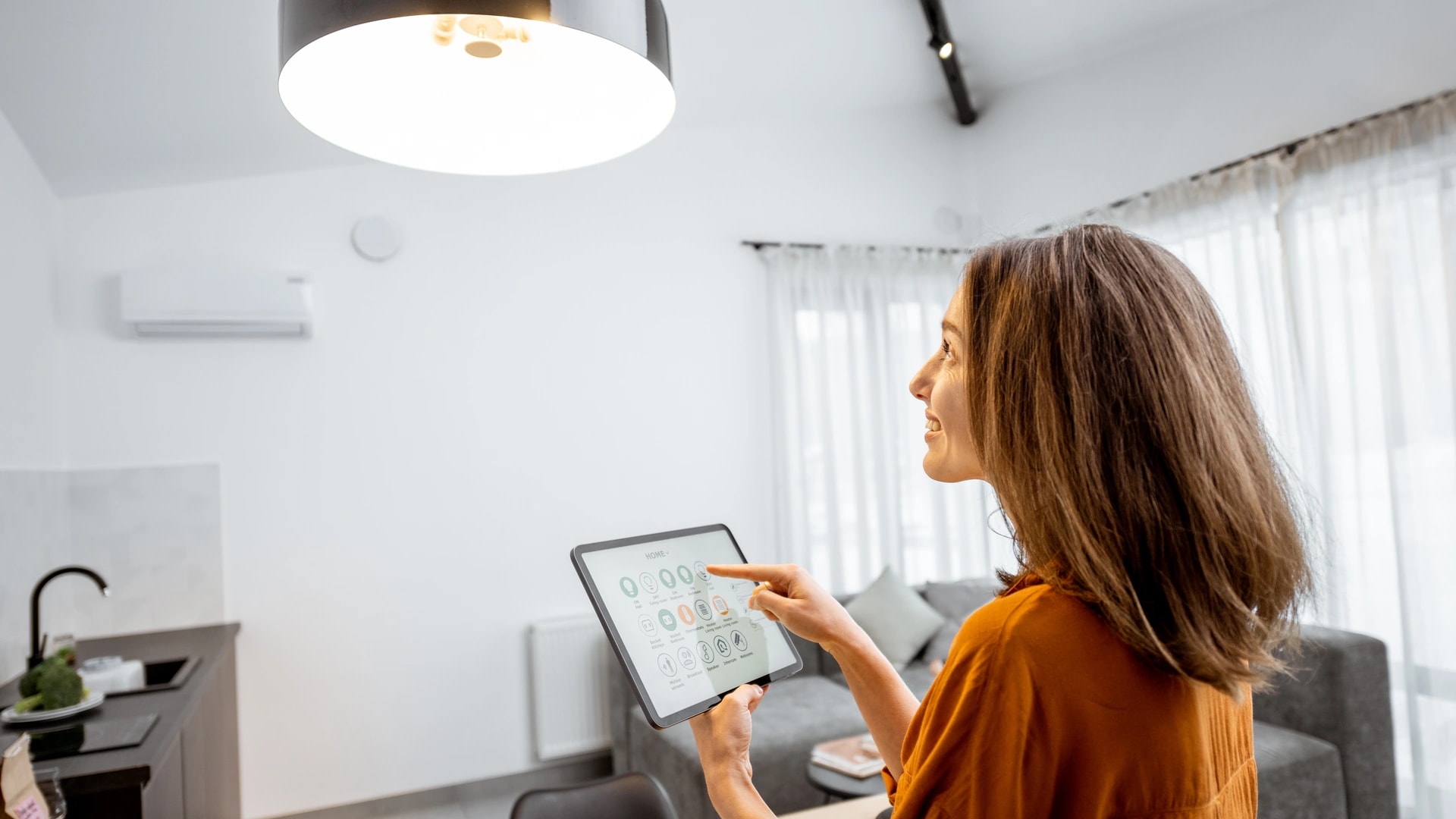
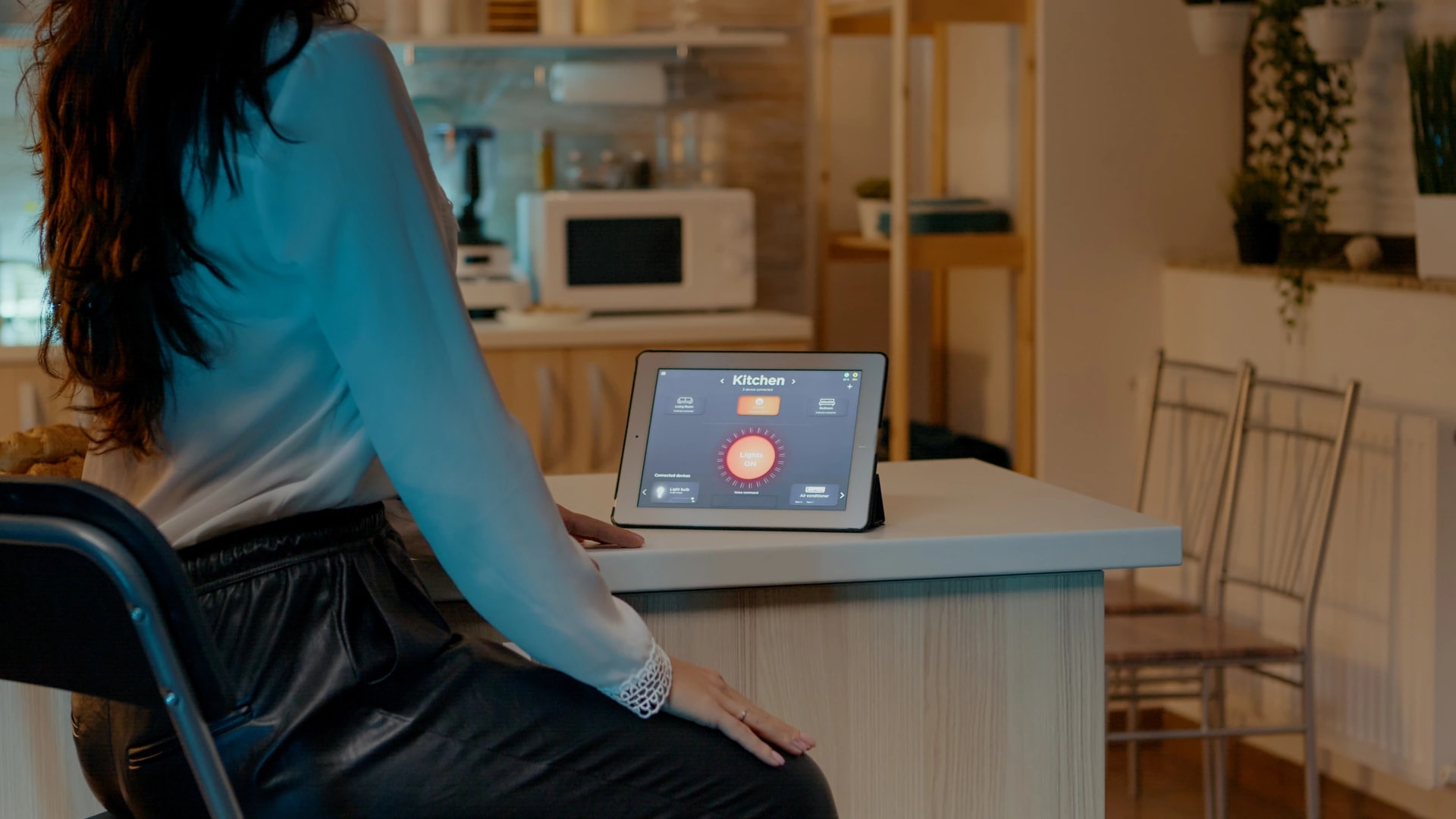
Smart AC and thermostat control cuts cooling costs by 20 to 30 percent in our projects, the biggest saving of any smart upgrade[9]. A smart thermostat is a wall control that sets and holds your temperature on a schedule. It does three simple things: holds a sensible temperature, stops cooling empty rooms, and eases off when you are asleep or out.
DEWA's own guidance backs this up. Each degree you set above 24°C saves up to 5 percent on AC use, and DEWA recommends 24°C or higher[2]. DEWA also recommends a programmable or smart thermostat to cut run-time[1]. Swapping an AC unit over ten years old for a 5-star model can save up to 25 percent more[1].
Zoning is the other half of the win. Instead of cooling the whole villa to one temperature, each area runs on its own schedule. Bedrooms cool at night, and living rooms cool by day. You stop paying to chill space no one is using.
Real talk: most homes run too cold out of habit, often 20 to 22°C. A smart thermostat holds 24°C for you, room by room, so you are not cooling a guest room nobody uses. See how we handle smart lighting and climate control.
Do motorized blinds and shading lower cooling costs?
Yes. Automated blinds and curtains cut cooling costs by roughly 15 to 20 percent by blocking the sun before it heats the room[9]. It is cheaper to keep heat out than to fight it with more AC.
The idea is simple. Blinds close on the sunny side of the house during the harsh midday hours, then open again when the sun moves off. DEWA lists curtains, blinds, and shades among its own cooling tips for this reason[1]. West-facing glass in a Dubai villa is a heat trap without it.
Our motorized curtains and blinds use Somfy and Lutron motors and can run on a sun schedule or a single tap. In a villa with a lot of glass, this is the second biggest lever after the AC itself. Want the sun handled for you? Book a free site visit →
Do smart lighting and plugs lower your electricity bill?
A little. Lighting and standby power are a small slice of a Dubai electricity bill next to cooling. So treat smart lighting and plugs as low-cost extras, not the main event.
Smart lighting trims waste in two ways. It dims and switches off lights in empty rooms. And it runs efficient LED scenes instead of everything at full. Smart plugs cut the trickle that TVs, chargers, and set-top boxes draw while idle. Both are cheap to add and worth doing once the AC and shading are sorted.
One more low-cost add-on earns its place: leak and water sensors. They will not cut a percentage off your bill, but they catch a burst pipe or a stuck valve before it runs for a month. A hidden leak shows up on the DEWA bill as a sudden spike, and a sensor that shuts the valve saves you that shock.
From our projects: owners who start with lights are often let down by the bill. Owners who start with AC and shading, then add lighting, see the number actually drop.
Which smart upgrades save the most on DEWA?
Smart AC control saves the most on a DEWA bill, followed by motorized shading[9]. Here is every lever ranked by how much it moves a Dubai bill, with the honest saving for each. Solar is a separate, larger project covered further down.
| Lever | Typical saving | Notes |
|---|---|---|
| Smart AC and thermostat control | 20 to 30% of cooling | The biggest lever; holds 24°C and skips empty rooms |
| Motorized blinds and shading | 15 to 20% of cooling | Blocks midday sun on glass before it heats the room |
| Smart lighting | Small | Dimming and empty-room switch-off; lighting is a minor share |
| Smart plugs and standby control | Small | Cuts idle draw from TVs and chargers; low cost, low impact |
| Leak and water sensors | Spike protection | Guards against a burst pipe or stuck valve, not a fixed percentage |
| Solar PV via Shams Dubai | Separate, larger | A bigger investment with a 5 to 8 year payback; see below |
Add the top two together and you lower your DEWA bill by an honest 20 to 40 percent, with no inflated claim. For the full picture on system pricing, see our guide to what a smart home costs in Dubai.
What are DEWA's free Smart Living and Away Mode tools?
They are free monitoring tools built into every DEWA smart meter, and they cost nothing to turn on[6]. The Smart Living dashboard shows your daily electricity and water use. It will not lower your bill on its own, but it tells you where the money goes.
Away Mode emails you consumption reports while you travel[6]. A stuck AC or a running valve then shows up in days, not on next month's bill. The High Water Usage Alert flags a suspected leak in near real time.
DEWA takes leaks seriously for a reason; its network Smart Ball tech alone saved AED 5.2 million by catching hidden leaks[8]. Still, DEWA's tools tell you after the fact.
A home system fixes the waste before it happens: your thermostat holds 24°C, and a leak sensor can shut the valve. The two work best together, one watching, one acting.
Do solar and batteries lower a DEWA bill in Dubai?
Yes, solar is the biggest lever of all, but it is a separate, larger investment, not part of the 20 to 40 percent automation figure. DEWA's Shams Dubai program has run since 2015[5]. It lets you fit rooftop solar and net-meter the output, so power you send to the grid is credited against what you use.
A typical villa system runs 5 to 15 kW. It costs roughly AED 3,500 to 5,000 per kW installed, with a payback of about 5 to 8 years[5]. How much it offsets depends on how big the system is next to your usage, so there is no single percentage. This is where bills can fall well past 40 percent, which is why honest guides keep solar separate from automation savings.
Common mistake: expecting a home battery to save money on off-peak power. Dubai has no residential time-of-use tariff. DEWA charges the same rate all day. It only asks you to shift use away from the 12pm to 6pm summer peak to ease the grid[4]. A battery's real value here is backup during outages and using more of your own solar, not chasing cheap hours. Our energy management and solar team sizes both to your actual usage.
What is a realistic monthly saving on a Dubai villa?
A villa paying AED 4,000 a month to DEWA in peak summer saves roughly AED 800 to 1,200 a month[9]. That comes from cutting the cooling-driven part of the bill by 20 to 30 percent with smart AC and shading.
A villa paying AED 4,000 a month on DEWA in summer saves AED 800 to 1,200 once smart AC and lighting control are in.
Quick math: a 25 percent cut on a AED 4,000 bill is about AED 1,000 a month in peak season. The saving is smaller in cooler months, when the base bill is lower, but the AC lever does the heavy lifting either way. That is fast enough to pay back a focused AC and shading setup inside a couple of years.
Villa bills run higher than apartments because there are more AC units, more glass, and often a pool. A mid-size apartment in Dubai Marina or Business Bay saves too, just on a smaller base. Prefer a number for your own bill? Get a free consultation →
How to start cutting your bill
Start with cooling, then work down the list. You do not need to wire the whole house at once.
- Set your AC to 24°C and add smart thermostat control to hold it, room by room.
- Automate shading on your sunny, west-facing rooms to block the midday heat.
- Turn on DEWA's free Smart Living dashboard and Away Mode to watch your usage.
- Add smart lighting and plugs once the big levers are in.
- If you own the roof and plan to stay, price a Shams Dubai solar system separately.
Every home is different, so the only real saving figure is the one built around yours. Dubai Smart Home is a smart home automation company in Dubai, UAE, with in-house engineers and 100+ projects since 2016[9]. We map your rooms on a free site visit, then give you one clear quote, usually within one business day.
Want a real number for your villa? Book a free site visit and quote → or message an engineer on WhatsApp →
Keep reading: for the wider view, see our complete smart home guide for Dubai and what a smart home costs in Dubai. Villa owners can plan the work with our villa upgrade roadmap.