A home cinema in Dubai lands in one of three price bands, and the gap between them is mostly construction, not electronics. A media room upgrade inside a room you already have runs AED 25,000 to 45,000. A dedicated, purpose-built cinema room runs AED 90,000 to 220,000. A reference build starts at AED 250,000 and can reach AED 2,500,000 on a flagship villa[9].
This guide shows where every AED goes: the screen, the speakers, the room shell, the cooling, and the approvals most quotes leave out. Every figure is either a price we publish and stand behind, or a range we mark clearly as an estimate from our team's project work since 2016.
If you want the wider picture first, start with our complete smart home guide for Dubai, then come back here for the cinema numbers.
How much does a home cinema cost in Dubai?
A home cinema in Dubai costs AED 25,000 to 45,000 for a media room and AED 90,000 to 220,000 for a dedicated cinema room. Even the entry band buys a real Dolby Atmos setup in an existing space; a reference build starts at AED 250,000. Here are the three tiers we quote, with what each one buys.
| Tier | Installed cost (AED) | What it covers | Best for |
|---|---|---|---|
| Media room | 25,000 to 45,000 | Atmos-capable 5.1.2 layout in an existing room, large display or entry projector, one-button control, measured calibration with a written report | Apartments and family rooms in Dubai Marina, Business Bay, or a villa's first floor |
| Dedicated cinema room | 90,000 to 220,000 | Acoustic treatment designed to the room's real dimensions, projection with an acoustically transparent screen, cinema lighting and star ceiling, fire-rated door and escape route on basements | A spare room or basement in a Dubai Hills Estate, Arabian Ranches, or Tilal Al Ghaf villa |
| Reference build | 250,000 and above, up to 2,500,000 | Room-within-a-room isolation, reference processing and amplification, full bass control, recalibration written into the contract | Emirates Hills, Palm Jumeirah, and Al Barari flagship villas |
These are the same three tiers published on our home cinema page[9]. Other Dubai integrators publish bands in the same neighbourhood for comparable scope, which is a useful sanity check when two quotes look far apart[8].
Real talk: the single biggest driver is whether you are treating a room or building one. Everything else moves the number by tens of thousands. That choice moves it by hundreds of thousands.
What do you get at each price tier?
Each tier is a different job, not the same job with better parts. Here is what actually changes as the budget climbs.
- Media room, AED 25,000 to 45,000. A 5.1.2 Atmos layout goes into the ceiling and walls of a room you already use. You get a large 4K display or an entry laser projector, a subwoofer, one-button control, and a calibration pass with a report you keep. There is no acoustic construction, so the room stays a family room by day.
- Dedicated cinema room, AED 90,000 to 220,000. The room becomes single-purpose. A 7.2.4 layout, absorption and bass traps sized to the room's own dimensions, a projector with an acoustically transparent screen so the front speakers sit behind the picture, dimmable cinema lighting, and a star ceiling if you want one. Basements add a fire-rated door and a proper escape route.
- Reference build, from AED 250,000. A 9.4.6 or larger layout inside a room-within-a-room shell that is structurally decoupled from the villa. Reference-tier processing of the kind Trinnov builds[4], JBL Synthesis or equivalent loudspeakers[5], dedicated bass management, and recalibration built into the support contract rather than sold later.
Whole-home smart systems price separately from all of this. A fully wired Dubai villa runs AED 150,000 to 250,000 and up before any cinema, and our smart home cost breakdown covers that ladder properly. Treat the cinema as one line item inside that budget, not a substitute for it.
Media room or dedicated cinema room, which do you need?
Pick the media room if the space has another daytime job. Pick the dedicated room if you want the lights off, the door shut, and sound that stays inside. The cost gap between them is almost entirely the building work.
| What you are comparing | Media room | Dedicated cinema room |
|---|---|---|
| Typical installed cost | AED 25,000 to 45,000 | AED 90,000 to 220,000 |
| Where the money goes | Mostly equipment and programming | Mostly room construction, isolation, and treatment |
| Picture | Large 4K display, or a projector if you can black out the room | Laser projector and a fixed or acoustically transparent screen |
| Speaker layout | 5.1.2, sometimes 7.1.4 | 7.2.4 and up |
| Acoustic work | Light touch, often none | Decoupled walls, floating floor, isolated ceiling, treatment |
| Build time | Days | Weeks to a few months |
| What it cannot do | Keep bass out of the rest of the house | Double as a living room |
Most Dubai homes we quote start as the first and move to the second years later, usually when a villa basement frees up. That is a sensible order. If you are planning a wider villa upgrade, our villa owner's roadmap puts the cinema in sequence with everything else.
Projector or TV for a Dubai room?
A TV wins in any room with daylight, and that describes most Dubai living rooms. Floor-to-ceiling glass and a 40-degree summer sun make a projector fight for contrast it will lose. An 85 to 100 inch 4K TV holds its picture with the curtains open.
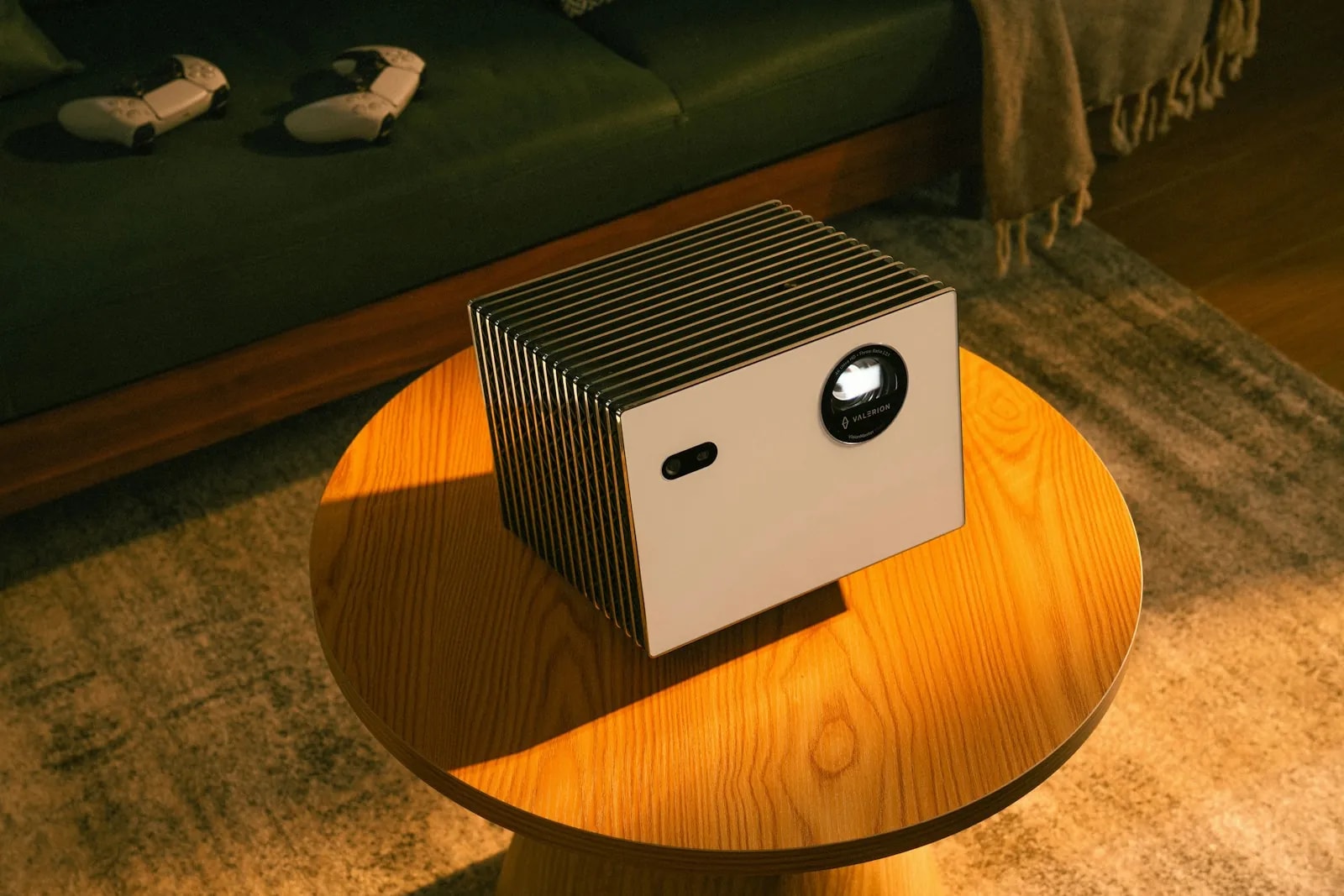
A projector wins the moment you can control the light. Blackout shading, no direct daylight, dark wall finishes, and the same money buys a far bigger image. A modern 4K laser projector uses a laser light source instead of a lamp, so there is no bulb to replace every couple of years[3]. That is the class of projector we specify at the dedicated-room tier.
Common mistake: buying a projector for a bright room, then adding an ambient-light-rejecting screen and a brighter unit to rescue it. By the time you have done that, the TV was cheaper and better. Decide the light first, the picture second.
If you do go for shading, motorised blackout curtains are the honest prerequisite, not an upsell. They also cut solar heat gain, which helps the cooling load in the same room.
What speaker layout do you actually need?
5.1.2 for a family room, 7.2.4 for a dedicated room, 9.4.6 and above for reference builds. The numbers are simpler than they look. The first is your main and surround speakers, the second is subwoofers, the third is the Dolby Atmos height channels above your seats[1].
Dolby Atmos is the format that adds those overhead channels, so a helicopter passes above you rather than around you. Dolby publishes placement geometry for the height speakers, and the angles matter more than the brand[2]. Get them wrong and an expensive layout collapses into ordinary surround sound.
Quick math: going from 5.1.2 to 7.2.4 adds four speakers, one subwoofer, more amplifier channels, and more cable runs. In our experience that step alone typically adds AED 20,000 to 40,000 before any room work, which is why layout is a design decision, not a shopping decision.
Wire for the layout you want in five years, even if you fit fewer speakers now. Pulling cable into a finished ceiling later costs more than the cable was ever worth.
Why does soundproofing cost so much in a Dubai villa or apartment?
Because Dubai builds in reinforced concrete with hard floors, and that combination is the worst case for cinema bass. Concrete blocks voices well, so you assume the room is quiet. Then a film with real low end starts, and the slab carries the vibration into the bedroom above.
Marble and porcelain floors make it worse inside the room too. Hard surfaces reflect sound instead of absorbing it, so dialogue smears and bass piles up in the corners. Neither problem is fixed by hanging foam on the wall.
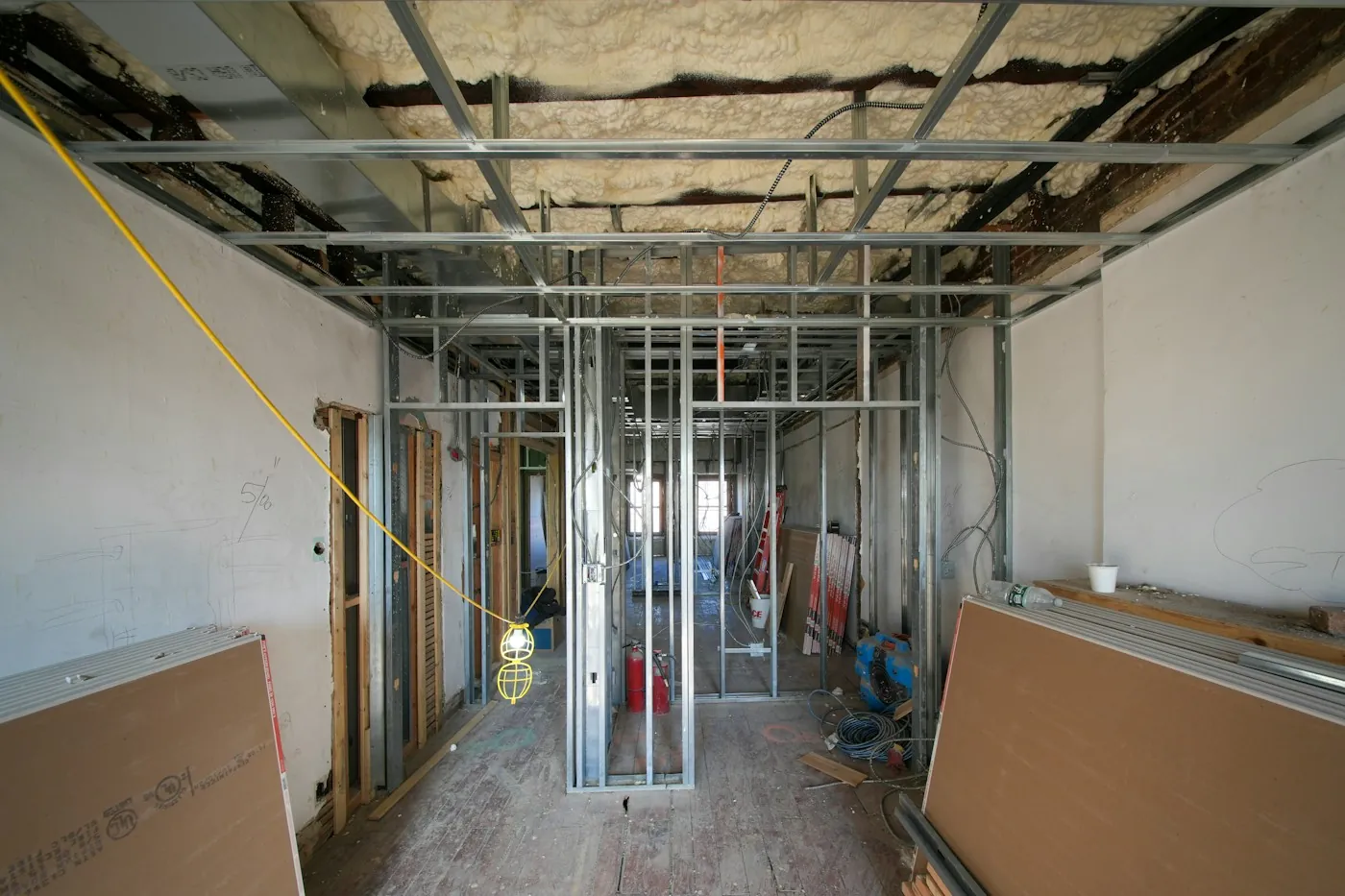
Doing it properly means three separate pieces of work: decoupling the walls so they do not pass vibration, floating the floor so the slab is not driven directly, and isolating the ceiling on resilient fixings. Then, and only then, treatment goes inside the finished shell to control what happens in the room.
There is a neighbour dimension too. Dubai Municipality publishes guidance on controlling noise in entertainment spaces, and the practical takeaway for a home is simple: a room in a villa compound or an apartment tower should keep its sound inside[6]. Isolation is not only about your own experience.
From our projects: apartment cinema rooms are the hardest brief in Dubai. You share a slab above and below, so bass control is the whole job, and the cost per square metre climbs. A well-treated media room usually gives an apartment owner far more value than a half-isolated dedicated room.
What does each component of a home cinema cost in Dubai?
Room construction and acoustic treatment typically take the biggest share of a dedicated cinema budget in Dubai, not the electronics. These are planning ranges from our own Dubai projects, not fixed prices, and the totals move with room size, finish level, and how much isolation the structure needs. Use them to sanity-check a quote, then get a site visit for a real number.
| Component | Typical AED range | What drives it |
|---|---|---|
| 4K laser projector | from 25,000, well past 100,000 at reference tier | Brightness, contrast, and native 4K panels. Projector or TV is an either/or choice, not both |
| Large-format 4K TV (85 to 100 inch) | 8,000 to 20,000 | Screen size and panel type. Cheaper than a projector, but it stops growing |
| Screen (fixed or acoustically transparent) | typically 8,000 to 25,000 | Width, gain, and whether speakers sit behind the picture |
| AV receiver or cinema processor | typically 15,000 to 90,000 and up | A step change, not a slope. A good receiver sits low, a reference processor with full room correction sits far higher |
| Speaker package for the Atmos layout | typically 20,000 to 70,000 and up | Channel count, in-wall versus freestanding, and how much amplification the layout needs |
| Acoustic treatment | typically 15,000 to 50,000 | Room volume, how hard the existing finishes are, and how much bass trapping the corners need |
| Room construction and isolation | typically 20,000 to 150,000 and up | Walls only at the low end, full room-within-a-room at the top. An acoustic door alone is a real line item |
| Seating | from 15,000, up to 120,000 and beyond | Seat count, tiered risers, and whether recliners are integrated into the room build |
| Cinema lighting and scene control | typically 8,000 to 25,000 | Dimming hardware and scene programming. A star ceiling is a separate finish choice on top |
| Calibration and handover report | included in our install price | Measured with a microphone, corrected per channel, and documented so it can be repeated |
| Control system integration | typically 8,000 to 25,000 | Optional. Only needed if the cinema joins a wider lighting and climate system |
Add those up and you land inside the AED 90,000 to 220,000 band for a dedicated Dolby Atmos room in the UAE. Push the isolation, the processor, and the seating to the top of each range and you are into reference territory.
Why do two rooms at the same price sound completely different?
Two cinema rooms at the same price sound different because of where the money went, almost never because of the gear. One installer put AED 60,000 into the room and AED 100,000 into equipment. The other did the reverse. The second room sounds better, every time.
A treated room with mid-tier speakers beats an untreated room with expensive ones. The room is the component you cannot upgrade later without opening the walls.
The second variable is calibration. A layout that is wired correctly still needs a measured pass with a microphone to time-align the channels, match levels, and tame the room modes that make bass boom in one seat and vanish in the next. Reference processors exist mainly to do that job properly[4].
The third is geometry. Screen size should follow your seating distance, not the width of the wall. An oversized screen in a small room is one of the most common overspends we see, and it makes the picture worse, not better.
Does a sealed cinema room need its own cooling?
Yes, a sealed cinema room in Dubai needs its own cooling plan, and it is the line item gear-led quotes miss most often. A blacked-out, isolated room still has to be cooled for the people in it and for the rack of equipment heating it up. Cooling is already the biggest part of a Dubai summer bill[7].
The catch is that a plain AC duct into a treated room leaks noise straight back in, so the supply needs a silencer and the airflow needs designing around the acoustics. The AV rack also wants its own ventilation. We have pulled access points out of Dubai ceilings that cooked through August because nobody planned airflow.
Smart AC and lighting control cut cooling costs 20 to 30 percent across the wider home, and our guide to cutting your DEWA bill has the full numbers. In the cinema specifically, treat cooling as a design input, not an afterthought.
One more electrical point. A dedicated room's AV rack belongs on its own circuit, installed through a licensed contractor under normal DEWA process, rather than sharing sockets with the rest of the floor[7]. It is routine work that prevents years of odd faults.
Want a real number for your room instead of a range? Book a site visit and we will measure the space before we quote, or send us the floor plan on WhatsApp.
Grey market or an authorised Dubai dealer, does it change the price?
Yes, going grey market changes the true cost, and usually not in the direction you expect. Grey-import stock is equipment brought into the UAE outside the brand's official channel. It is often cheaper on the invoice and carries no valid local warranty.
On a projector or a cinema processor, that is a real exposure. A fault means shipping the unit back to whichever market it was first sold in, at your cost, on that country's service timeline, with a six-figure room sitting dark while you wait. The saving on day one rarely survives that.
Real talk: we do not win every quote on price, and this is one reason. An authorised purchase means the brand's UAE service network honours the warranty and parts arrive here. On the exact items that fail expensively, that is the cheaper choice over the life of the room.
The same logic sits behind buying the install rather than assembling it yourself. Our DIY versus professional guide works through where self-install genuinely saves money and where it costs more.
Do you need Control4, Crestron, or Savant?
No. A cinema room runs perfectly well on its own remote or app, and plenty of excellent Dubai rooms have no home-automation platform at all.
A control platform earns its cost once the room stops being an island: one button that dims the lights, closes the blinds, drops the screen, and starts the film, then the same system running the rest of the villa. Which brand fits which home is a separate question, and our Control4 versus Crestron versus Savant comparison answers it properly.
What about whole-home audio and the network behind it?
Both are priced separately from the cinema, and both are worth scoping at the same time because the cable routes overlap. Whole-home audio runs from a stereo pair in the majlis up to a full villa zoned room by room, so it belongs in its own budget line rather than folded into the cinema figure.
The network matters more than people expect. Streaming 4K content, a control processor, and a rack of connected equipment all sit on the same home network, and a builder's basic router in a villa basement is where cinema nights go wrong. Wired connections to the rack, not Wi-Fi, are the fix.
How long does home cinema installation take in Dubai?
Home cinema installation in Dubai takes days for a media room and weeks to a few months for a dedicated room. The equipment is rarely the delay. What sets the programme is the building work, the approvals, and lead times on projectors and processors that are built to order.
A media room upgrade is close to a normal smart-home install. We survey the room, run cable, fit speakers and the display, program the control, then calibrate and hand over a report.
A dedicated room adds a construction phase in front of all that: framing, isolation, floating floor, ceiling, acoustic door, finishes. Only then does the AV go in. A reference build inside a villa still under construction runs alongside the main programme and takes longer again, which is also the cheapest time to do it.
The step-by-step build process, including how we handle basement work, sits on our home cinema service page rather than here.
What do approvals and compliance add to the cost?
Treat approvals as a real cost line with weeks of lead time, not a formality at the end. Two usually apply to a Dubai villa cinema.
- Community or developer approval. Structural work in most Dubai master communities needs a no-objection letter filed in the owner's name before anything starts. Fees are modest, the waiting is not, and it sits on the critical path.
- Civil Defence and fire safety on basements. A basement room with a single way in and out normally needs a fire-rated door plus compliant emergency lighting and exit signage before sign-off.
Common mistake: finishing the room, then discovering the door and the escape provision do not comply. The finishes come back out, and the rework costs more than doing it right would have. Check compliance at design stage, before anyone orders a screen.
What mistakes push the cost up later?
The expensive errors in Dubai cinema builds repeat themselves, and every one of them is cheap to avoid at design stage.
- Buying gear before designing the room. The box list is the easy part. If the room is not treated and isolated, the equipment cannot rescue it.
- Skipping calibration. An uncalibrated room is a wired speaker layout, not a cinema. Insist on a measured pass and a written report at handover.
- Grey-market equipment with no UAE warranty. The saving evaporates the first time something fails.
- Ignoring compliance until the end. Fire-rated doors and escape routes are not retrofit-friendly.
- Wiring for today's layout only. Adding overhead channels to a finished ceiling means opening it again.
- No cooling plan. A sealed room and a hot rack in a Dubai summer is a reliability problem waiting to happen.
Is a home cinema worth it, and how should you budget for one?
Whether a home cinema is worth it in Dubai comes down to use, not budget. A room the family watches in most weeks pays for itself in a way a special-occasion room never does. That is the honest test, and it matters more than which tier you can afford.
Budget in this order. Decide the room type first, because it sets the band. Protect the construction and treatment money next, because you cannot add it later without demolition. Then spend what is left on equipment, and calibrate whatever you end up with.
On resale, a properly built cinema reads as part of a finished, well-specified home rather than a bolt-on, and smart-enabled homes in Dubai do rent and resell at a premium. Our guide on smart homes and property value covers that side. If the vocabulary here is new, smart home systems explained is the plain-English starting point.
Our team has designed and supported smart home automation across Dubai, UAE since 2016, with 100+ completed projects. We are rated 4.9/5 by Dubai homeowners, we design each project and coordinate the work until handover, and sales enquiries are answered within 2 hours.
Ready for a real figure? Book a free consultation and we will measure your room, or message us on WhatsApp with a floor plan. The full build process is on our home cinema page[9].