Almost every page you find on this topic is written by a company that wants to install your smart home. Ours included. So here is the version we would give you over coffee instead: a lot of this you should just do yourself, and we will tell you exactly which parts.
We have installed and supported home automation systems across Dubai since 2016, in Marina apartments and Dubai Hills villas. That is also why we know where DIY stops working. New to the topic? Start with our complete smart home guide for Dubai, then come back to decide who does the work.
Should you install a smart home yourself in Dubai?
Yes, for most of it. Wireless, plug-in, and stick-on devices need no permission from anyone in Dubai, and plenty of residents run happy smart homes they built entirely themselves.
This is not a polite concession. A smart bulb, a plug, an IR controller for your split AC, a stick-on sensor: none of these touch a wire, a wall, or anything your landlord owns. No rule says a professional has to fit them.
The honest answer: the professional-only category is real, but narrower and more specific than most installer websites imply. It is not "smart homes are complicated." It is a short, checkable list of jobs that touch fixed wiring, structure, a shared building system, or a whole-home backbone.
The one-line rule that settles most of it
If a job needs a drill, a new circuit, or touches a shared system, hire a professional. If it is battery, plug-in, adhesive, or clip-on, DIY genuinely works.
That single line answers most questions people ask us. It is not about how smart the device is or what it costs. It is about whether the task changes the fixed fabric of the home, or sits on top of it.
- DIY side: it screws in, plugs in, sticks on, or clamps on. You could remove it in ten minutes and leave no mark.
- Professional side: it needs a wire changed, a hole drilled, a circuit added, a rail replaced, or a sign-off from DEWA, your landlord, or building management.
The Dubai catch: the second list is longer here than in many countries. District cooling, gated-community rules, and reinforced-concrete walls all push jobs from column one into column two.

What DIY genuinely handles well in Dubai
The whole wireless layer. Lighting, AC control on a split unit, sensors, curtains, basic security, and mesh Wi-Fi are all real DIY jobs with no permission needed and no trace left behind.
DIY this:
- Smart bulbs. They screw into your existing fitting. Keep the old bulb in a drawer and swap it back when you move.
- Smart plugs. They sit between the socket and a lamp, kettle, or heater. Zero wiring.
- Button-presser robots. A small adhesive unit that physically presses your existing rocker switch. It never touches the wiring, which is the whole point.
- IR AC controllers (Sensibo, Cielo, Tado, SwitchBot Hub 2). If your AC came with a handheld remote, this copies the same signals. It sits on a shelf. Roughly AED 220 to 700.
- Stick-on sensors. Door, window, motion, and water-leak sensors mount with adhesive or a magnet. A leak sensor under the sink is one of the cheapest useful things you can buy.
- Clip-on curtain motors (SwitchBot Curtain 3, Aqara E1, RYSE). They clamp onto the rail you already have. No rail swap, no wall damage.
- Retrofit smart locks. The kind that fits over the inside of your existing deadbolt. Your original keys still work. A screwdriver and ten minutes.
- Mesh Wi-Fi nodes. Plug one into a socket and it extends your existing router.
- Indoor cameras and doorbells pointed at your own space.
That covers most of what people want day to day, and if you are renting, nearly all of it. Our renter smart home guide goes deeper on the no-drill tier. If you have not picked an ecosystem, read the smart home buyer's guide for Dubai first. That decision prevents most DIY regret.
Buy UAE retail: this is the one DIY rule people break most. Devices sold in the UAE carry TDRA type approval and run on the right frequencies[7]. An imported bargain can turn into a paperweight.
What genuinely needs a professional
Anything touching fixed wiring, ducted or district-cooled AC, structural mounting, a shared building system, or a whole-home backbone. This is the short list, and it is worth reading closely.
Hire a pro for:
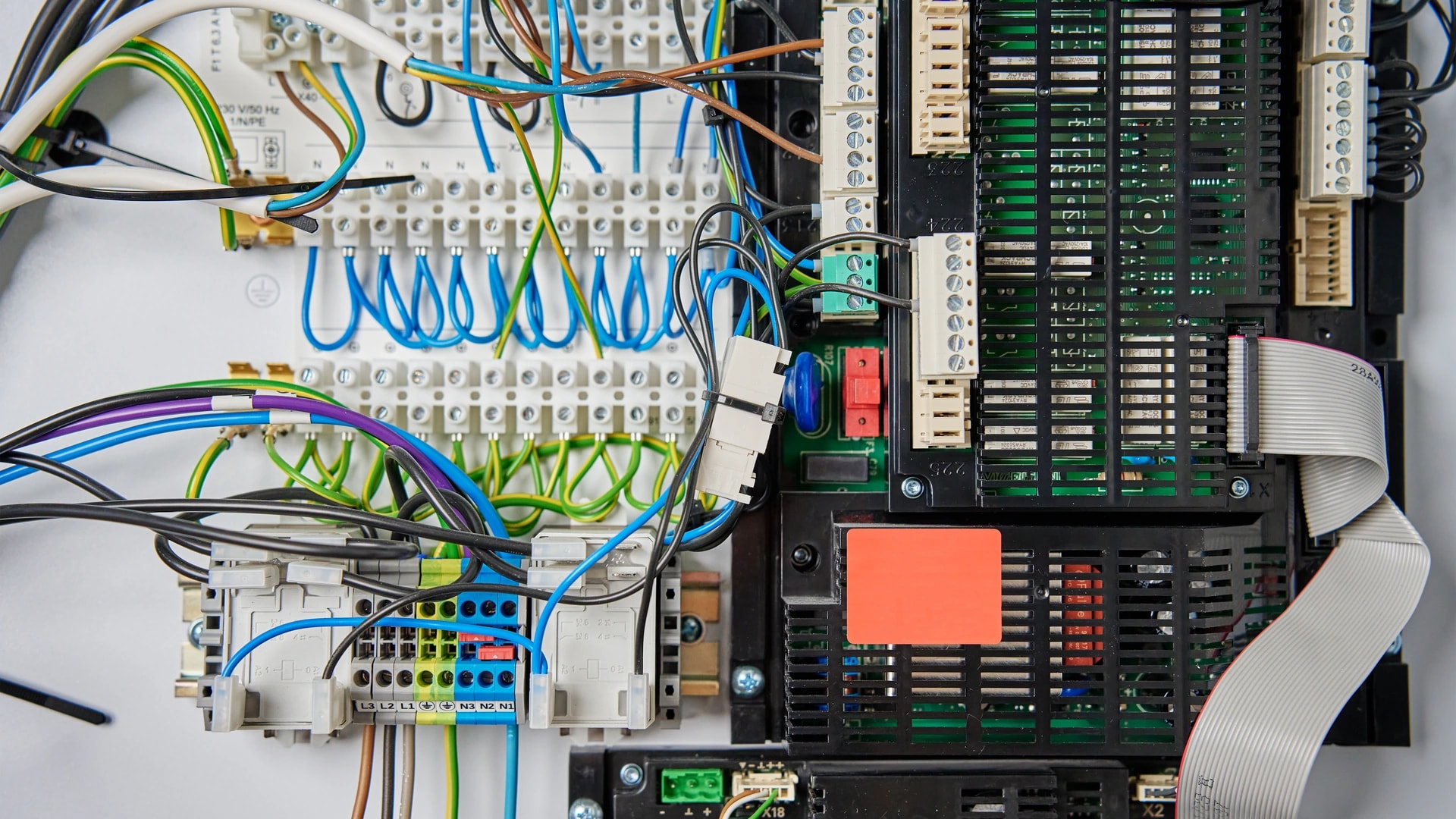
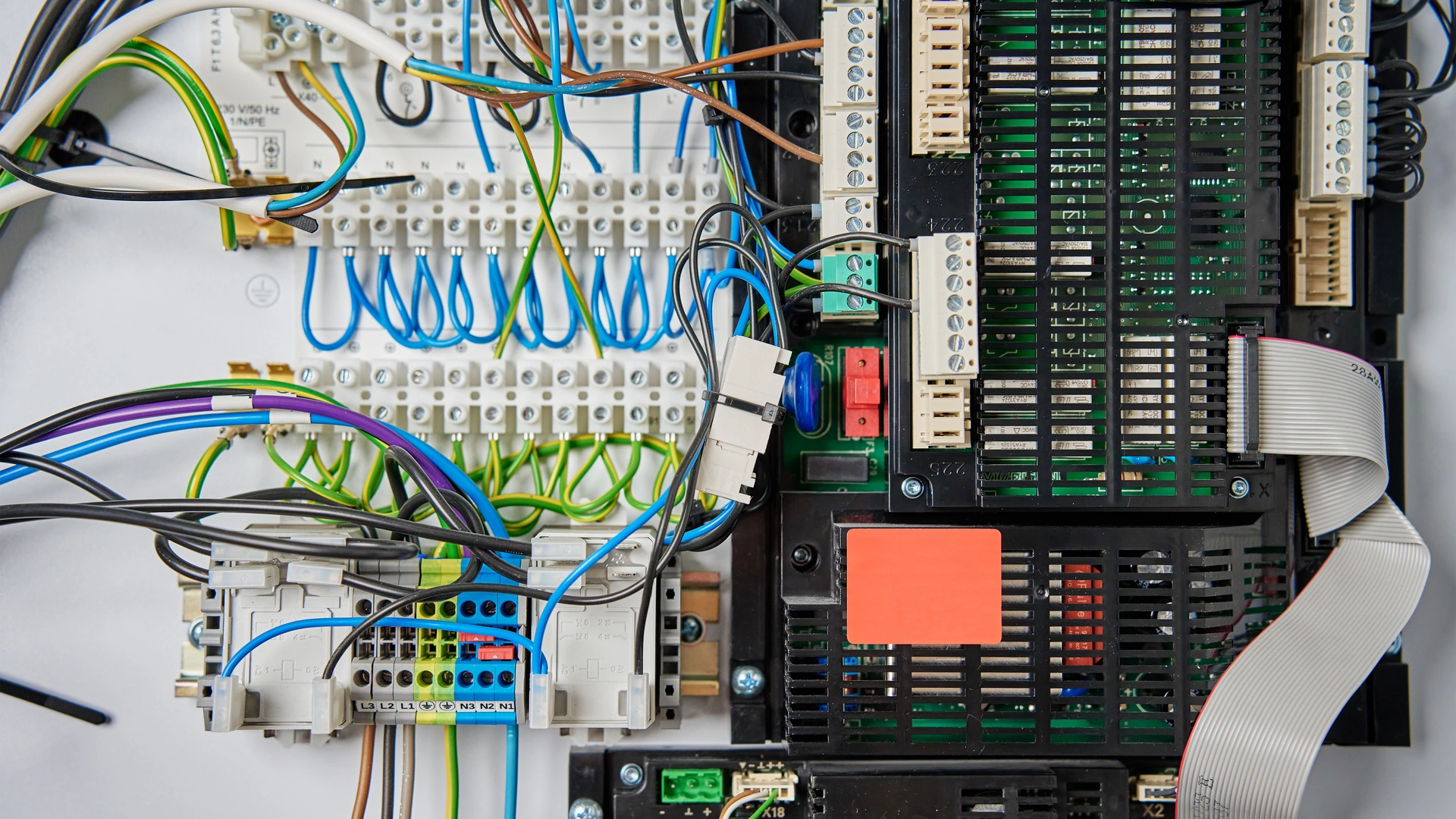
- Hardwired switches and dimmers, and any new circuit. Replacing a wall plate means touching fixed, DEWA-connected wiring. The box often lacks the neutral wire the smart switch needs.
- KNX, Control4, Crestron, and Savant. Dealer-installed platforms with licensed programming, and no consumer DIY path into any of them. KNX is a wired backbone that runs without the internet and lasts 30 years or more, but only if it is commissioned correctly. Our comparison of Control4, Crestron, and Savant covers Dubai pricing.
- Ducted or central AC thermostats. These need a 220 to 240V-to-24V adapter wired into the AC's control circuit. A wiring mistake risks the AC unit itself.
- District-cooling FCU control. In Downtown, Business Bay, or JBR your AC is likely a fan coil unit fed with chilled water from the building. It has no compressor to control and is usually building property, so a split-unit IR controller does not apply. Our guide to automating your AC in Dubai explains why.
- CCTV cabling and NVR systems. Real cable runs, correct camera angles so you are not filming a neighbour's window, and SIRA's 1080p HD minimum with 31 days of retention[8]. See our security and surveillance work.
- Structured cabling and network design. Cat 6A to every room, a managed switch, separate device networks. This is home networking as a build, not a gadget.
- Villa pre-wire. The one-time decision covered further down.
- Motorized rails for heavy drapery and any new wall or ceiling mount. Fabric weight, rail sizing, and a power feed at window-head height make this a fit-out job.
- Gate motors, video intercom, solar, EV chargers, Tesla Powerwall, and pool automation. Mains-powered, and several need a DEWA-enrolled contractor. Rooftop solar under Shams Dubai runs through an NOC, an enrolled solar contractor, and a DEWA inspection before the meter goes in[2]. You cannot self-connect to the grid. See energy management and solar.
- Community and building sign-off. Anything visible from outside a villa in a gated community usually needs an owners-association NOC.
CEDIA, the trade body for this industry, draws a similar line: hire a professional when the work spans multiple systems, needs cabling, or has to be designed rather than bought[4]. Villa owners can go deeper in our villa owner's upgrade roadmap.
The DIY vs professional matrix
Here is the whole thing on one screen. Find your task, read the reason, and you have your answer.
| Category | DIY-friendly | Professional-only | Why the line sits there |
|---|---|---|---|
| Lighting | Smart bulbs, smart plugs, button-presser robots over an existing switch | Hardwired switches and dimmers, keypads, a KNX or whole-home lighting backbone | A bulb screws in. A switch touches fixed, DEWA-connected wiring and often needs a neutral wire |
| Climate and AC | IR controller on a split unit that has a handheld remote (AED 220 to 700) | Wired thermostat on ducted AC, district-cooling FCU panel, VRF gateway integration | An IR controller copies the remote. A wired thermostat needs a 24V adapter in the control circuit; an FCU is building property |
| Curtains and blinds | Clip-on motors over your existing rod or rail | Motorized rail replacement, heavy drapery, new wall or ceiling mounts | Clamping on leaves no mark. A new rail means structural mounting plus a power feed |
| Networking | A mesh Wi-Fi node added to your existing router | Cat 6A structured cabling, managed switches, separate device networks, Ethernet backhaul in a retrofit | A node plugs in. Cable through closed concrete walls and a real network design do not |
| Security and access | Retrofit smart lock, indoor camera, doorbell facing your own doorway | CCTV cabling and NVR, gate motors, video intercom, anything wired into a shared building system | A retrofit lock is reversible. Cabling, camera angles, and shared systems carry privacy and ownership questions[8] |
| Whole-home backbone | Nothing | KNX, Control4, Crestron, Savant, villa pre-wire | Proprietary programming and dealer-supplied licensing. There is no consumer path in, at any budget |
| Energy, solar, EV | Nothing | Shams Dubai rooftop solar, EV charger, Tesla Powerwall, Span panel | Main-panel and grid-connected work. Solar needs an NOC, a DEWA-enrolled contractor, and an inspection[2] |
| Sensors and extras | Stick-on door, window, motion, and leak sensors; robot vacuums; voice hubs bought UAE retail | Pool and outdoor automation, wellness systems, circadian lighting control | Adhesive and plug-in versus mains-powered plant equipment and outdoor wiring runs |
Not sure which protocol your devices should use? Our guide to smart home protocols in Dubai covers Zigbee, Z-Wave, Thread, and Matter. If the terms above are new, smart home systems explained is the gentler start.
Is DIY electrical work illegal in Dubai?
No, and you should be careful with anyone who tells you it is. There is no blanket law that stops a homeowner touching a switch in Dubai. The real mechanism is different, and understanding it matters more than the scare story.
Here is how it works. Any work touching fixed, DEWA-connected wiring is meant to go through a DEWA-enrolled electrical contractor, who carries accountability for the inspection and sign-off[1]. That enrolment chain is the control, not a policeman at your door.
The Dubai catch: the consequences are practical, not criminal. Unapproved work can fail an inspection. A failed inspection can block a reconnection. And if a fault or fire follows work that never went through an enrolled contractor, an insurance claim gets complicated. None of that requires a law banning DIY. The chain does the work on its own.
The same shape applies elsewhere. Shams Dubai solar needs an enrolled solar contractor and a DEWA inspection before the bidirectional meter is fitted[2]. A rental adds another layer: under Dubai's Law No. 26 of 2007, as amended by Law No. 33 of 2008, changes and renovations need written landlord permission, and unauthorised structural alteration is a named eviction ground[3]. Wireless devices change nothing, so they need nothing.
Nobody is going to arrest you for fitting a dimmer. But a failed inspection, a blocked reconnection, and a complicated insurance claim are all real, and they are why the enrolled-contractor route exists.
Our guide to smart home laws in Dubai covers the permissions, the NOCs, and the tenancy rules in full.
The hybrid approach: DIY the devices, hire a pro for the backbone
This is the honest majority answer, and it is the one we recommend most often. Do the wireless layer yourself and bring in a professional for the wiring, the AC work, and the tie-together. You do not have to pick one path for the whole house.
A well-designed wireless retrofit delivers roughly 70 to 80 percent of what a fully wired system does[10]. That is why we are relaxed about telling people to DIY. Lighting scenes, AC schedules, sensors, curtains, and remote access all sit in that range.
The remaining 20 to 30 percent genuinely needs a professional. Whole-home reliability that does not depend on the cloud. Hardwired keypads your family can use without a phone. In-ceiling audio. A real network. Those are design jobs, not purchases.
Quick take: if you enjoy tinkering, keep the tinkering. Hand over the parts that are permanent, that touch a wire, or that you would have to open a wall to change your mind about. That split costs less than a full professional build and gets you more than a pure DIY one.
Want a second opinion on where your own line sits? Ask an engineer for a free site visit →
What it actually costs each way
At the device level, DIY is genuinely cheaper, and we will not pretend otherwise. A DIY apartment kit runs roughly AED 3,000 to 10,000 in hardware. A professionally installed full apartment runs AED 8,000 to 15,000[10]. The overlap is real.
What the professional number adds: the site survey, the kit choice, the labour, commissioning into one working app, and a warranty on the work. Those costs exist either way. In a DIY build you pay them in hours instead of AED.
| Scope | DIY device cost (approximate) | Professionally installed | What the difference buys |
|---|---|---|---|
| One room (starter) | About AED 600 to 1,500 in hardware | AED 2,000 to 5,000, same day to one day[10] | Mostly your evening back. DIY is a fair call here |
| Full apartment (1 to 3 bedroom) | About AED 3,000 to 10,000 in hardware | AED 8,000 to 15,000, 2 to 4 days[10] | Design, one commissioned app instead of five, correct kit, labour warranty, support |
| Villa (essentials) | No comparable DIY path once wiring is involved | From AED 30,000[10] | Scale, wired work, and a system designed as one thing |
| Villa (fully wired) | None | AED 150,000 to 250,000 and up, 5 to 14 days[10] | A wired backbone, commissioning, and a 30-year system life |
| Split AC control | AED 220 to 700 (IR controller) | Not needed. This genuinely is a DIY category | Nothing. Do this one yourself |
| Ducted AC control | Not a real DIY path | Adapter AED 600 to 790, plus install from AED 350, about 60 to 90 minutes per unit | Correct 24V wiring into the AC control circuit |
| District-cooling FCU | Not a real DIY path | Zigbee FCU panel around AED 735, plus wiring and commissioning | Fan and valve control on building-owned equipment, done with permission |
Quick math: say you DIY a full apartment for AED 5,000 in hardware and save AED 6,000 against a professional quote. Now count 25 evenings at two hours each, pairing and debugging. That is 50 hours, or about AED 120 an hour for your weekends. If you enjoy those hours, you won. If you resent them by hour ten, you did not.
At the top end there is no contest, because there is no DIY option. Dubai figures run from roughly AED 25,000 for a Control4 apartment to AED 1,000,000 and beyond for a Crestron estate, with KNX from about AED 40,000. Once you want one of those, the question becomes which installer. Our smart home cost guide for Dubai breaks every tier down.
The hidden costs of DIY
DIY has a price list too, it just does not arrive as an invoice. None of these make DIY a bad choice. They are the fine print to read before you commit.
Time. Every device needs pairing, naming, and an automation written by hand. Multiply by 10 to 20 devices, done in evenings, against a 2 to 4 day professional window[10].
The hobby-not-convenience problem. A smart home is supposed to remove friction. A half-finished DIY build does the opposite: it becomes a project one person has to keep nursing. If that person enjoys it, this is a feature, not a cost. Plenty of our clients tinker for fun and only call us for the wired parts. Just be honest about which one you are.
App fragmentation. The complaint we hear most is "I need 7 apps to control my house." It happens because DIY builds get assembled one purchase at a time, and each brand ships its own app. The fix is free: choose your ecosystem before you buy anything.
Region-lock rework. This one is specifically a Dubai problem and it costs real money. A US-bought Z-Wave device runs at 908.42 MHz. The UAE uses 868.4 and 869.85 MHz[6], so it will not pair at all. A US-region Echo loses several services here, and warranty follows the region of purchase, not where you live. An installer sources correct hardware by default. A DIY buyer chasing a marketplace bargain buys it twice.
No labour warranty. Your device carries the manufacturer's warranty. Your installation carries nothing, because you are the installer. If the mount is wrong or the placement kills the signal, there is no one to call.
Troubleshooting is yours. When a hub drops offline or a bulb factory-resets after a power cut, you are the support desk. This is the mirror image of the "installer disappeared" worry. With DIY there was never an installer to disappear.
Handover. A buyer or new tenant inherits a pile of accounts, apps, and pairings only you understood. A documented, working system reads as an asset. An undocumented one reads as a chore.
One honest note: a 2026 Security.org survey found 59 percent of Americans worry about making a mistake installing home security themselves[5]. That is a US attitudinal survey about home security, not a Dubai outcome rate. It names the feeling, not the risk. We have no credible Dubai failure-rate figure, and we will not invent one.
What a professional actually adds
A professional smart home installation in Dubai adds design, one commissioned app, correct kit, a warranty on the work, and someone to call. That is the honest list. Notice that "better devices" is not on it, because you can buy the same devices we do.
- A site survey and a design. Where the IR line of sight reaches. Where Dubai's reinforced concrete kills your Wi-Fi. Where a sensor sits so it does not trigger on the curtain.
- Correct kit selection. We install and support 12 systems, so the choice is what fits your home, not what a marketplace surfaced.
- One commissioned system. Scenes and automations that work on day one, in one app or panel. This is the biggest difference in practice.
- Workmanship warranty on top of the device warranty.
- After-sales support. This is the number one concern Dubai homeowners raise with us. Our engineers are in-house and Dubai-based, we do not subcontract, support runs 24/7, and enquiries are answered within 2 hours. Systems work in English and Arabic, which matters when the whole household uses it.
- Community and NOC handling. Owners-association approval and landlord permission are handled as part of the project, not discovered afterwards.
- Network segmentation. CISA's home-network advice is to keep smart devices off the same network as your laptops and phones[9]. Almost no DIY build does this, because consumer routers make it awkward. On a professional install it is part of the checklist.
To be fair: a professional install can be misconfigured too, and a careful DIYer who sticks to established brands and sets up 2FA is in better shape than a rushed professional job. The advantage is the commissioning pass, not magic.
Renter or owner, apartment or villa?
Renters should skew DIY, villa owners should skew professional, and apartment owners genuinely split down the middle. Your living situation decides more than your budget does.
| Your situation | The usual answer | Why |
|---|---|---|
| Renter, apartment | DIY, wireless only | No-drill devices need no landlord permission, come off clean at move-out, and protect your deposit[3] |
| Owner, apartment, one room or starter budget | Either works | DIY saves the labour. A fixed-price package from AED 2,000 saves the evenings and gets one app from day one |
| Owner, apartment, full comfort tier | Hybrid | DIY the device layer. Get help with the Wi-Fi design, because concrete walls are what most often goes wrong |
| Owner, villa, existing home | Hybrid, leaning professional | Wireless covers 70 to 80 percent. The wired 20 to 30 percent, plus any AC or electrical work, is professional-only[10] |
| Owner, villa, new build or off-plan | Professional, and early | The pre-wire window is about 10 days and is 60 to 70 percent cheaper than retrofitting later[10] |
| District-cooling apartment (Downtown, Business Bay, JBR) | Professional for AC control specifically | The FCU has no compressor and is usually building property. An IR split-unit controller does not apply |
Quick math for renters: a no-drill DIY kit costs roughly AED 1,000 to 3,000. Your deposit is typically 5 percent of annual rent unfurnished, or 10 percent furnished[3]. On an AED 60,000 to 90,000 rent, that is AED 3,000 to 9,000 sitting with your landlord. Staying wireless-only protects more than the kit cost. That is not a compromise, it is the right answer.
The villa pre-wire window
If you are building or buying off-plan, this is the one decision you cannot defer. Pre-wiring during construction is 60 to 70 percent cheaper than retrofitting a finished home[10], and the window to make it is roughly 10 days during the rough-in phase.
Once the walls close, that saving is gone permanently. Not reduced. Gone. Retrofitting the same cable means chasing plaster, repainting, and working around a home someone lives in, which is why the cost multiplies.
Common mistake: "I will DIY now and get it wired properly later." For the wireless layer that is fine; you can add a professional hub over your Zigbee devices any time. For the backbone it does not work. Cable routes, an equipment room, and a power feed for future blinds are decided before the plaster, or not at all.
This is the section where we are least neutral, and we know it. So: if you are not building, ignore it. If you are, talk to someone before the first fix, even if that someone is not us. The villa owner's roadmap lays out the sequence.
Your decision framework: four questions
Ask these in order. The first yes is your answer.
- Does it touch fixed wiring, structure, or a shared building or community system? A hardwired switch, a wired thermostat, a new circuit, CCTV cabling, a gate motor, anything visible from outside a villa. If yes: professional, and for DEWA-connected work, a DEWA-enrolled contractor[1].
- Is it whole-home rather than one room or one device? A KNX bus, a Control4 or Crestron system, structured cabling, a pre-wire plan. If yes: professional. This is a design job, not a shopping list.
- Do you want one app and one number to call? If you want a system that just works and someone accountable when it does not: professional. If you are happy running a few apps and doing your own debugging: DIY is a genuinely fine, common choice.
- Are you renting, or is this a starter budget? If yes to either: start with the no-drill wireless tier. It is reversible, needs no permission, and sits inside the AED 2,000 to 5,000 starter range[10].
If none of the four apply, either path works. It then comes down to how you value your own time against your own money, and only you know that number.
How Dubai Smart Home works with DIY-minded clients
We will happily take the backbone and leave you the fun bits. That is a real service, not a consolation prize, and one of the more common ways people work with us.
A typical version: we run the cabling, wire the switches, sort the network, and commission the system. You keep buying and pairing your own bulbs, sensors, and plugs on top. You get the wired reliability without paying us to screw in a bulb.
What we bring to that split: in-house engineers based in Dubai, no subcontracting, 12 supported systems, English and Arabic, 24/7 support, and a warranty on our work. Since 2016 we have completed 100+ projects across Dubai villas and apartments, and we are rated 4.9/5 by homeowners here. If we think you should DIY something, we will say so.
We work across lighting and climate, networking, security, and energy. If you are still deciding where your line sits, Dubai Smart Home will look at your home and tell you which parts you can handle yourself.
Want a straight answer for your own home? Book a free site visit and quote → or message an engineer on WhatsApp →. Enquiries are answered within 2 hours, and we will tell you what not to pay us for.