We sell smart home systems. We are also going to tell you that most of the categories we sell have no financial payback in Dubai. Both are true, and you deserve the second one before you spend.
This article grades 16 device categories on one question: does it pay for itself in Dubai? Six earn a yes. Ten do not. That does not make the ten useless. It means you buy them for time, security or comfort, not for the bill. For the wider picture, read our complete smart home guide for Dubai.
Is a smart home actually worth it in Dubai?
A smart home is worth it in Dubai for six categories and not for the other ten. Smart AC control, motorized shading, solar and leak detection all earn their money here. Smart lighting, plugs, voice assistants, robot vacuums, mirrors, locks, cameras and gates do not, on money alone.
A Dubai electricity bill is a cooling bill. Cooling is commonly estimated at 60 to 75 percent of a home's summer electricity use. So anything that touches the air conditioning moves real AED, and anything that does not moves almost nothing. Smart AC and lighting control cut cooling costs 20 to 30 percent across our projects since 2016[14]. A smart mirror cuts zero.
Real talk: "is a smart home worth it" is the wrong question. A smart home is not one purchase. It is 16 separate ones, with 16 different answers.
How we decided what is actually worth it
A category only earns a "worth it" verdict here if a real number backs it. That number comes from DEWA, from a cooling provider like Empower, or from our own installed projects. Where no such number exists, we say the payback is not calculable and explain what it depends on.
Three rules kept this honest:
- No invented paybacks. Where no Dubai figure exists, we print that instead of a percentage.
- Global numbers are labelled as global. United States standby power and irrigation figures appear below, clearly marked, because the mechanism travels even when the percentage does not.
- Billing type decides everything. A DEWA metered home and a district cooling apartment are two different money problems. A figure from one never applies to the other.
Common mistake: most "cut your cooling bill 30 percent" claims quote a DEWA split AC figure at a reader living on an Empower invoice.
The full smart home verdict table for Dubai
Here are all 16 categories, graded. Six pay back and ten do not, and two of the six come with heavy conditions.
| Category | Verdict | What it actually saves | Who it is for | If you skip it |
|---|---|---|---|---|
| Smart AC and zone climate control | Worth it | 20 to 30 percent of cooling costs. AED 800 to 1,200 a month on a AED 4,000 summer bill | Any DEWA metered home with its own AC | Nothing replaces it |
| Motorized shading and curtains | Worth it | Roughly 15 to 20 percent of cooling costs | Homes with real west or east facing glass | Manual blinds closed at midday, for AED 0 |
| District cooling smart thermostat | Worth it, with a hard ceiling | The consumption half only, by 25 to 35 percent. The fixed demand charge never moves | Empower, Emicool and Tabreed apartments | Holding 24 to 26 C by hand |
| Water leak detection | Worth it, for a different reason | No monthly saving. It avoids one large loss: a burst pipe caught in hours | Everyone, especially anyone who travels | DEWA's free High Water Usage Alert |
| Irrigation control | Worth it, but we cannot price it | No Dubai figure exists. The 20 percent minimum is a United States EPA number | Villa owners with a garden and wired valves | A timer with a moisture sensor |
| Solar PV under Shams Dubai | Worth it, as a separate project | AED 3,500 to 5,000 per kW, paying back in about 5 to 8 years | Roof owners staying 5 years or more | AC control and shading pay back faster |
| Smart lighting control | Not worth it for money | Small. No Dubai percentage exists | Anyone who wants scenes, dimming and one app | A motion sensor at AED 60 to 120 |
| Smart plugs on low draw devices | Not worth it for money | No Dubai figure. The plug draws 1 to 2 watts itself | Anyone scheduling one specific appliance | A basic timer switch |
| Voice assistants and speakers | Not worth it for money | Nothing. Any saving belongs to the device it controls | Hands free control and accessibility | A wall keypad or your phone app |
| Robot vacuums | Not worth it for money | Nothing. 40 to 65 watts while cleaning, a few AED a month | Anyone who wants cleaning time back | A normal vacuum and a schedule |
| Smart mirrors | Not worth it for money | Nothing. No source claims a payback | Buyers chasing a wellness feature | A normal mirror and a phone |
| Smart locks and access control | Not worth it for money | No UAE insurance discount found, and no utility effect | Villas with domestic staff or frequent guests | A deadbolt and a lockbox |
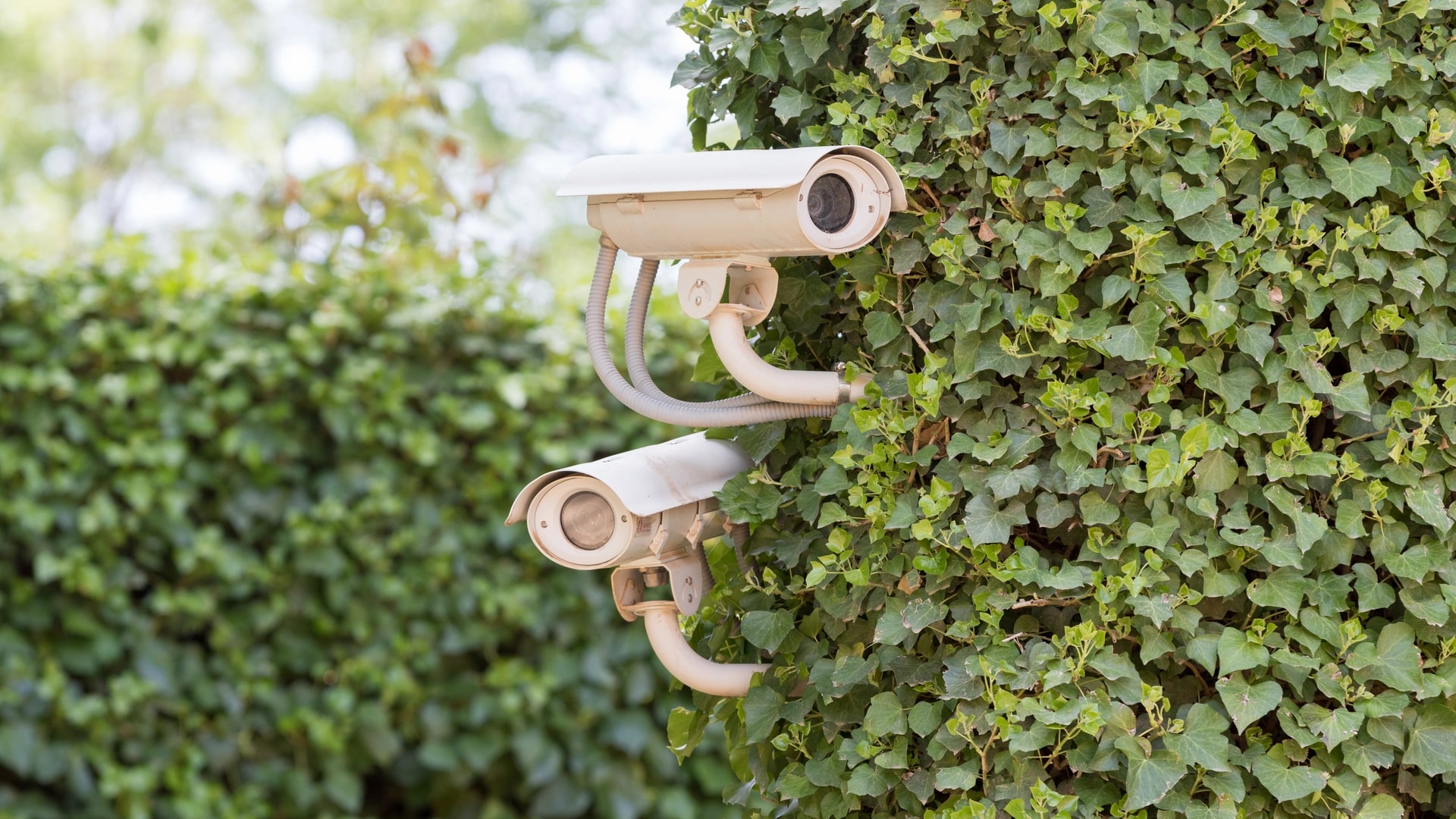
| Security cameras and CCTV | Not worth it for money | No sourced UAE payback. SIRA sets 1080p HD and 31 days | Anyone treating cameras as risk management | One doorbell camera on the main entrance |
| Water heater scheduling | Not calculable | Unknown for Dubai. The mechanism is real, the number is not | Villas with an electric storage heater | The timer built into the unit |
| Smart gate and driveway automation | Not worth it for money | Nothing measurable on any bill | Villas with deliveries or staff at the gate | A remote or a keypad at the gate |
| Whole home audio and cinema | Not a money category at all | Nothing, and no source claims otherwise | Anyone who wants it, once the list above is handled | Nothing. It never solved a bill problem |
Smart AC and zone control: the best ROI smart device in Dubai
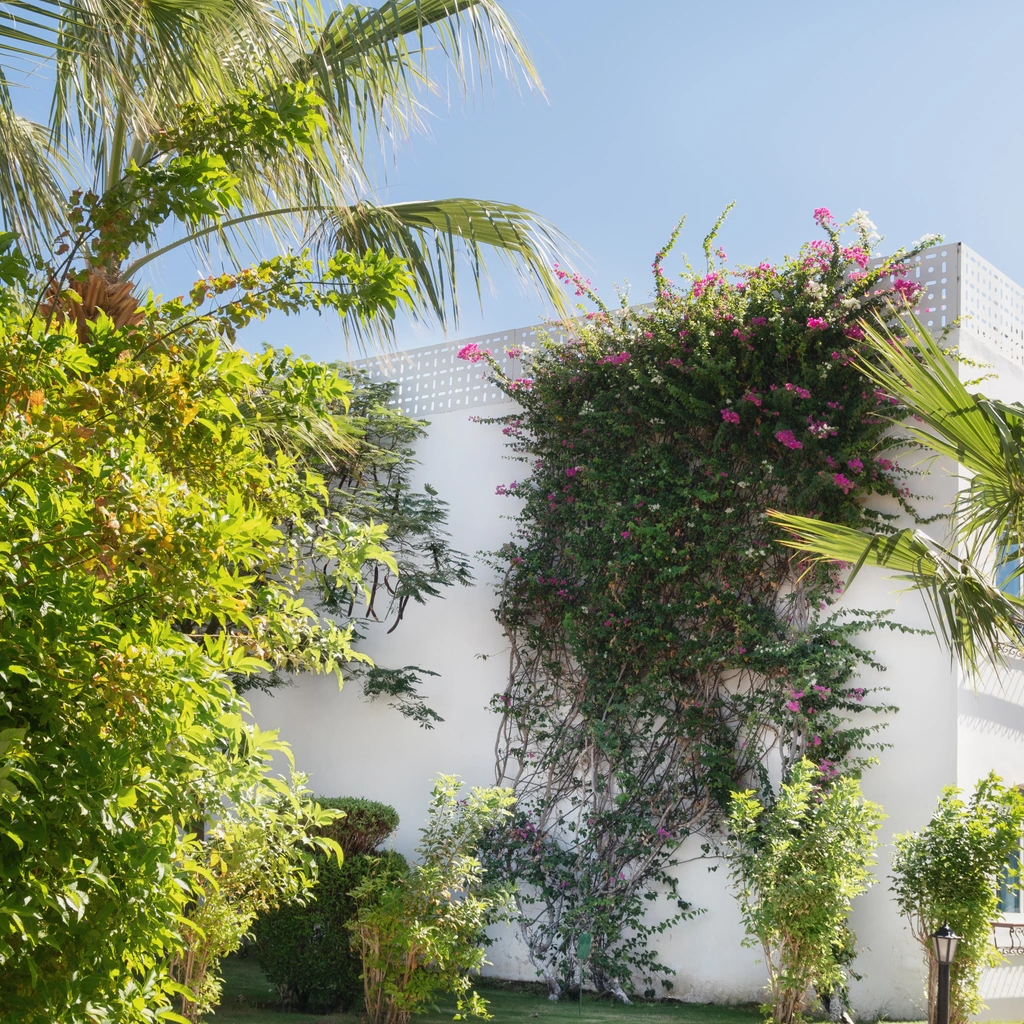
Smart AC and zone control is the best ROI smart device in Dubai, and the one category that clearly pays for itself. It cuts cooling costs 20 to 30 percent across the Dubai homes we have wired since 2016[14]. On a villa paying AED 4,000 a month in summer, that is AED 800 to 1,200 back every month.
The mechanism is not clever, it is just consistent. A smart thermostat holds a sensible temperature instead of drifting to 20 C out of habit. It stops cooling empty bedrooms and eases off while you are out. DEWA's own guidance backs the physics: each degree above 24 C saves up to 5 percent on AC use, and DEWA recommends 24 C or higher[1].
Quick math: DEWA's residential tariff is a slab, starting at 23 fils per kWh and rising to 38 fils at higher brackets, plus a fuel surcharge and 5 percent VAT[2]. Cutting usage strips off your most expensive units first, so the AED saved is often more than the raw percentage suggests.
This figure belongs to homes on DEWA metered electricity with their own AC, meaning split units or a compressor based ducted system. It does not apply to a district cooling apartment. Our guide on how a smart home reduces a DEWA bill puts the whole bill range at 20 to 40 percent once shading and monitoring are added.
Book a free site visit and quote → See how we handle smart lighting and climate control.
Motorized shading: the second biggest lever
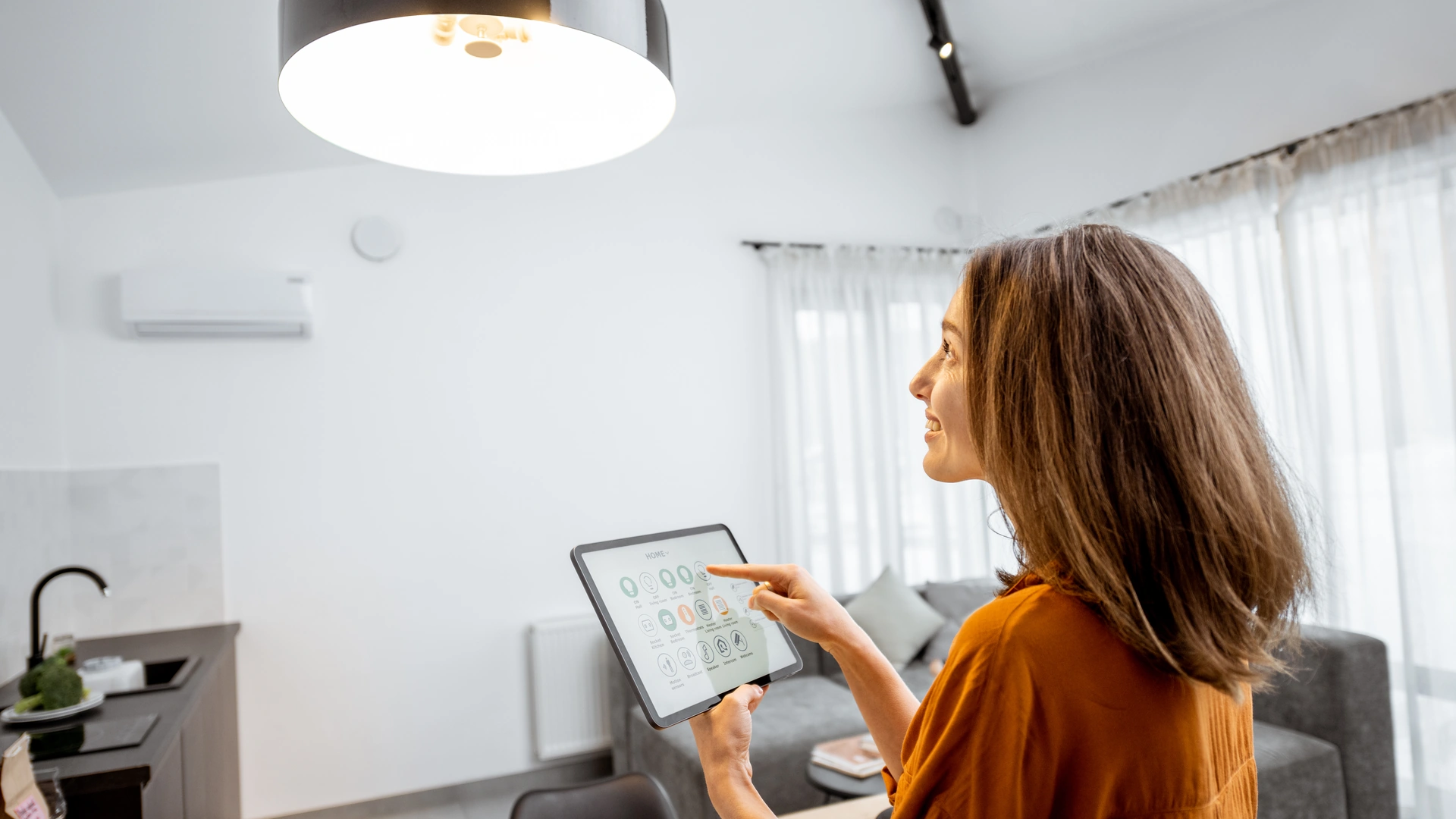
Yes, motorized shading really does cut cooling costs, by roughly 15 to 20 percent in our installed projects[14]. It is cheaper to keep heat out of a room than to fight it with more cold air.
DEWA lists curtains, blinds and shades among its own conservation tips for this reason[3]. Blinds close on the sunny face of the house through the harsh midday hours, then open when the sun moves off. In a villa with a wall of west facing glass, that one behaviour is worth more than every smart bulb in the house.
Real talk: this saving is proportional to your glass. A shaded, north facing apartment gets a fraction of what a west facing villa living room gets. If your home has little sun exposure, buy shading for comfort and light control, and expect the bill effect to be small.
Renters have the weaker case, since motor and track work is a bigger, less portable spend than a plug in device. Our motorized curtains and blinds use Somfy and Lutron motors and run on a sun schedule or one tap.
Does a smart thermostat cut a district cooling bill?
A smart thermostat cuts only part of a district cooling bill, and this is the most misunderstood number in Dubai smart home marketing. A district cooling bill is not a DEWA electricity bill, and the 20 to 30 percent cooling figure above does not apply to it.
Empower, Emicool and Tabreed bill your apartment in two parts. The consumption charge is metered and variable, priced per refrigeration ton hour. The demand charge is a fixed capacity charge of AED 750 per refrigeration ton per year, billed monthly in advance whether you use the cooling or not, alongside a small fixed meter fee[4]. District cooling is licensed separately under Executive Council Resolution No. 6 of 2021, overseen by Dubai's Regulatory and Supervisory Bureau[5].
A thermostat can only touch the consumption half. Our own retrofit data puts that cut at roughly 25 to 35 percent of the consumption portion over a summer[14].
On a AED 900 monthly cooling bill where AED 400 is consumption, a 30 percent cut saves about AED 120 a month. The other AED 500 stays exactly where it is, no matter what device you fit.
Common mistake: buying a Nest, Ecobee or Sensibo for a district cooled apartment. Those devices switch a compressor. Your wall panel opens a chilled water valve and picks a fan speed, which is a different electrical job, and Sensibo's own compatibility page is built around compressor based air conditioners[6]. Purpose built fan coil thermostats such as the Salus FC600 or the Aqara Smart Thermostat S3, or a KNX or Lutron fan coil controller, are what actually work.
So the honest verdict is a qualified yes. The saving is real, smaller than the DEWA figure, and capped by a charge no device can move. The device list and wiring detail sit in our district cooling smart thermostats guide.
Where solar and batteries fit in
Solar is the biggest financial lever available to a Dubai villa, but it is not a smart home device. A typical 5 to 15 kW rooftop system costs roughly AED 3,500 to 5,000 per kW installed and pays back in about 5 to 8 years under DEWA's Shams Dubai net metering programme[7][14]. That is a separate, larger project than automating your lights.
Automation does not make solar generate more. It shifts your heavy loads, the pool pump, the water heater, the EV charger, into daylight hours, so you use more of your own power instead of exporting it. That win only exists once the panels are on the roof.
Real talk on batteries: Dubai has no residential time of use electricity tariff. DEWA charges the same rate at every hour, so there is no cheap night rate to store and no arbitrage to run. Any article saying a battery pays for itself by buying off peak power is describing a United States or European tariff, not a Dubai one. A home battery here earns its place as outage backup and as a way to use more of your own solar.
If solar and load shifting are what you are after, that sits under energy management and solar, not under a smart plug.
Water: leak sensors pay, irrigation is honest but unmeasured
Leak sensors and irrigation controllers do not pay back the way a thermostat does. One is cheap protection against a large one off loss. The other has real value we cannot put an AED figure on.
Leak detection first. A leak sensor will not cut a percentage off your monthly bill, and any page that says it will is guessing. It catches a burst pipe, a stuck valve or a slow drip under a water heater in hours instead of a full billing cycle. At roughly AED 60 to 120 per sensor installed, it is cheap against one flooded ground floor. DEWA takes leaks seriously at network level too: its Smart Ball technology inspects underground transmission pipelines and saved millions of gallons of water in a single year[8]. That is city infrastructure, not a sensor under your sink.
DEWA also gives you a free High Water Usage Alert inside its Smart Living tools[9]. It is useful, but reactive: it flags unusual consumption after the water has run. A sensor paired with a shutoff valve acts the moment the valve sticks.
Now irrigation. No sourced Dubai figure exists for what a smart irrigation controller saves a villa garden, and we will not invent one. Our own villa community content already says so in writing, because a single percentage there would be a guess dressed as data. The mechanism is sound: watering on real soil moisture and weather instead of a fixed clock. The United States EPA certifies WaterSense labelled controllers to cut outdoor water use by at least 20 percent[10], and that is a United States figure, not a Dubai measurement.
Dubai water is priced far lower per unit than electricity, so even a genuine 20 to 30 percent cut is unlikely to move your bill. The honest value is plant health: no root rot from overwatering, no sprinklers running on a soaked bed. A controller retrofit on existing wired valves starts from about AED 6,800, and most Dubai villas already have those valves. That work sits under pool and outdoor automation.
| Water device | Payback type | What it actually protects or saves |
|---|---|---|
| Leak sensor with shutoff valve | Loss avoidance, not a recurring saving | Catches a burst pipe or stuck valve in hours. Protects flooring and ceilings below. AED 60 to 120 per sensor installed |
| Smart irrigation controller | Not calculable for Dubai | Waters on soil and weather, not a clock. The EPA's 20 percent minimum is a United States figure. Real value is plant health. From AED 6,800 |
| DEWA High Water Usage Alert | Free, and reactive | Flags unusual consumption after it happens. Useful backup, but it does not stop the water |
Smart lighting, plugs and voice: convenience, not savings
Smart lighting, plugs and voice assistants do not cut a Dubai bill in a way you will notice. They are the categories most often sold on savings, and the evidence is not there.
Smart lighting. The saving is small, and no sourced Dubai percentage exists to quote. Lighting and standby draw are a minor slice of a Dubai bill next to cooling. What smart lighting buys you is real, just not financial: scenes, dimming, one app instead of seven, and motion control in hallways nobody switches off.
Smart plugs. No sourced Dubai figure exists for what a smart plug saves a household here. United States data puts standby power at roughly 5 to 10 percent of a typical home's electricity[11], but that comes from homes where cooling is a much smaller share of the bill. In a cooling dominated Dubai home, the same percentage almost certainly overstates it. The plug also draws 1 to 2 watts of its own, and costs AED 60 to 150. Plugs are useful for scheduling one appliance you care about. As a general "cut my bill" purchase, they are not.
Voice assistants. These save nothing on their own. Every saving belongs to whatever the assistant is switching, and that is already counted in the AC or lighting row above. A speaker's own draw of 2 to 3 watts costs well under AED 20 a year at Dubai tariff rates, left on around the clock. Buy voice for hands free control and accessibility, which are worth real money to an older resident or a parent with full hands. Retail hubs bought outside the region also have patchy English and Arabic support, which is why whole home voice control is usually a professional job under voice control and AI.
From our projects: owners who start with lights are almost always let down by the next bill. Owners who start with AC and shading, then add lights for the usability, see the number drop. Device pricing for all three sits in our smart home starter kit guide.
Robot vacuums and smart mirrors: buy them for time, not money
Robot vacuums and smart mirrors are the two clearest zero payback categories on this list, and we would rather say that plainly than sell them badly.
A robot vacuum draws roughly 40 to 65 watts while cleaning, which works out to about 15 to 47 kWh a year depending on run time[12]. At Dubai's tariff of 23 to 38 fils per kWh[2], that is a few AED a month, not a line worth finding on your bill. No credible source frames a robot vacuum as an energy or money saving device. They all frame it as a time trade, and that trade is good if you accept the limits: rugs, thresholds, pet hair and stairs still need you.
Smart mirrors are the weakest category in this article. No credible source, Dubai or global, claims any energy saving or payback for one. It is a wellness product: skin analysis overlays, a workout video, weather on the glass while you brush your teeth. If that appeals and the categories above are handled, buy it. Otherwise a normal mirror and a phone on the counter do the same job for nothing.
Locks, cameras and gates: security value, not bill value
Smart locks, cameras and gates do not save you money directly, and we found no UAE insurance discount for any of them. They earn their place through risk and access control.
On locks, the Dubai case is domestic staff access. A temporary PIN you issue on Monday and cancel on Friday beats a shared key, and it removes the re-keying cost after a lost key or a staff change. That is an operational win, not a payback. On cameras, SIRA, Dubai's security regulator, sets 1080p HD with 31 days of footage retention for the premises it licenses[13]. No law sets a minimum for a private home, but that bar is a sensible one to copy. Dubai Police also offer optional Smart Home Security monitoring from around AED 147 a month, which is a cost, not a saving.
There is one indirect money angle, and it belongs to another article. Security is the second strongest driver of Dubai property value after energy and climate control, and villas with smart or green features rent for about 8 to 12 percent more and sell for about 4 to 7 percent more. Those figures come from our guide on whether smart homes increase Dubai property value.
| Security device | Bill or insurance saving | Real value | Typical cost |
|---|---|---|---|
| Smart lock | None found. No UAE insurer discount | Temporary PINs for staff and guests. No re-keying after a lost key | AED 400 to 1,200 for the device, plus about AED 250 to 350 to fit |
| Cameras and CCTV | None sourced for the UAE | Theft and package risk, proof in a dispute, SIRA's quality benchmark | Full security and surveillance from AED 15,000 |
| Smart gate and video intercom | None measurable on any bill | Open the gate for a delivery from anywhere. Access logs | Gate and access control from AED 4,500 |
If security is why you are here, see security and surveillance and smart gate and access control, and judge them on protection, not payback.
Water heater timers and whole-home audio
Water heater timers are a saving we cannot price, and whole home audio never pretended to be about money.
Water heater scheduling is not calculable for Dubai. The mechanism is real. A storage tank heater loses heat while it sits idle, so heating it only before the hours you use it cuts that loss. What does not exist is a Dubai number, and the mechanism changes with your home. Dubai apartments often run centralised or instant hot water with a different loss profile, while villas more often have an electric storage heater where the effect is larger. So the verdict is plausible but unquantified: buy it because you want hot water ready at 6am. The timer built into most units already does that for free.
Whole home audio and cinema save nothing, by design. No source claims otherwise and we will not be the first. It is a fine purchase on its own terms. It is just not a bill conversation, and anyone framing it as one is selling.
If you can only buy one or two things
Buy smart AC and zone control first, then shading, then a leak sensor. That order follows the evidence and nothing else.
- Smart AC and zone control. The only category with a large, sourced, repeatable payback: 20 to 30 percent of cooling costs[14].
- Motorized shading, if your home has real sun facing glass. Another 15 to 20 percent of cooling, and close to nothing if your glass is shaded or north facing.
- A leak sensor or two, at AED 60 to 120 each installed. Not a saving, but cheap cover against one expensive night.
Everything after that is a comfort, time or security decision, and should be judged that way. For the full sequencing by room and budget rather than by verdict, use our smart home buying order guide, and the AED ranges by home size in what a smart home costs in Dubai.
One thing changes the maths for anyone building or renovating: pre-wiring during construction costs 60 to 70 percent less than retrofitting a finished home[14]. If your walls are open now, getting cable in before they close matters more than the order above.
How Dubai Smart Home helps you spend well
We would rather sell you the two things that pay back than the ten that do not. That is how our quotes are built.
A site visit is free. Our engineers look at your AC type, your bill, your glass and your wiring before anyone talks savings, because a district cooling apartment and a DEWA metered villa get different answers. We are in-house across Dubai with no subcontracting, we have completed 100+ projects since 2016, we install and support 12 smart home systems, and our work runs in English and Arabic. Homeowners rate us 4.9 out of 5, and enquiries are answered within 2 hours.
If a category here will not pay you back, we say so in the meeting, not after the invoice.
Ready for a real number on your home? Book a free site visit and quote →
Prefer to ask one quick question? Message us on WhatsApp →