Our team has worked on smart systems in Dubai homes since 2016. One request has grown faster than any other. A family wants a parent to stay in their own home safely, without being watched all day. Those are two different jobs.
This guide covers the second one. The name for it is aging in place: staying independent in your own home as you grow older. It is about safety and convenience, never health care. Nothing here diagnoses anything, treats anything, or replaces a nurse. The aim is narrower and more honest. Remove the handful of moments where being alone is genuinely risky. Leave the rest of your parent's day as private as it already is.
Does my elderly parent's home in Dubai need to change, or just be watched more closely?
Neither, usually: the home needs about four small changes, and your parent needs less watching, not more. The changes that earn their place act on their own when nobody is present. Think of the walk to the bathroom at 2 a.m., a tap left running, or an iron left on.
Everything else is optional. A camera in a bedroom is not a safety upgrade. It is a decision with legal and personal weight, and it is covered properly in the consent section further down.
Real talk: families come to us asking for cameras. They leave with two motion-lit corridors, a radar presence sensor, and a leak valve on the mains. It costs less and it works better.
Start by naming the worry out loud. "I am scared she falls at night and nobody knows for six hours" is a solvable problem. "I want to keep an eye on Dad" is not, and it usually ends in a device nobody uses.
Who is this for: parents moving to Dubai, or parents already here?
Two groups, and they need different things. The first is a parent who moves to Dubai in later life, often on the UAE retirement visa. They land in a family member's villa, or in a nearby apartment. The second is an adult child based in Dubai whose parents are already here, or still overseas.
The retirement visa is a real route, and it shapes the brief. It brings people into the country at 55 or older, often with no local support network[2].
| Requirement | What it means |
|---|---|
| Minimum age | 55 years or older at the time of applying[2] |
| Work experience | At least 15 years, inside or outside the UAE |
| Financial condition (one of two) | UAE property worth at least AED 1 million plus savings of at least AED 1 million, or an annual income of at least AED 180,000 (AED 240,000 when applying in Dubai) |
| Residency granted | 5 years, renewable while the financial condition still holds |
For a parent who has just arrived, the first six months are the hardest. A new building, a new language at the door, and no neighbours who would notice a quiet day. That is exactly when a small amount of automation earns its keep. Families handling this alongside their own move will find more in our smart home guide for Dubai expats.
Where do the risky moments actually happen in a Dubai home?
Two rooms and one short corridor account for most risky moments: the bedroom, the living room, and the night route between bed and bathroom. That is also where Dubai's own older residents say they want help.
One survey asked 105 people in Dubai and the UAE where they wanted fall detection. The living room came first at 39.0 percent, then the bedroom at 25.7 percent[8]. The same study found 67.0 percent of respondents lived with a long-term condition, with diabetes the most common at 32.4 percent[8].
The night route matters for a plain reason. Sleep gets lighter with age and night waking becomes more common, which means more unlit trips across a tiled floor[7]. Worldwide, the World Health Organization identifies adults over 60 as the group most affected by serious falls[6].
Common mistake: starting with the villa's grand spaces. A staircase in a Dubai Hills Estate villa deserves a light, but the three metres between bed and bathroom is where the first money goes. Whole-villa planning is a bigger job, covered in our guide for villa owners.
Camera, radar, or wearable: what is the real difference for fall detection?
The difference is what the device actually captures. A camera records images of a person. A millimetre-wave radar sensor reads movement and body position from a reflected radio signal, with no image at all. A wearable watch or pendant sits on the body and reacts to a hard impact followed by stillness.
Millimetre-wave radar in plain English: a sensor that bounces a low-power radio signal around the room. It works out whether someone is standing, sitting, lying down, or has gone still. Aqara's Presence Sensor FP2 is the mainstream example[9]. There is no lens and no picture, so a bedroom stays a bedroom.
A wearable only works while it is worn. That sounds obvious, and it is the single most common reason wearables fail in practice. At 2 a.m. it is charging on the nightstand.
| Approach | What it captures | Where the data goes | Consent weight under PDPL | Best for |
|---|---|---|---|---|
| Millimetre-wave radar presence sensor (for example Aqara FP2) | Movement and body position. No image, no audio | The hub and the app. There is no footage to share, because none is created | Low. No identifying image is captured, though you still tell your parent it is there | Bedrooms, hallways, and any room where a camera would not be acceptable |
| Wearable watch or pendant | Impact and stillness at the wrist or neck, plus location if enabled | The wearer's own account, shared with whoever they add to it | Medium. Worn by choice, but location and health-linked data are personal | An active parent who will genuinely wear and charge it every day |
| Door and motion sensors only | Doors opening and movement in a zone. No fall detection at all | The hub and the app, as a plain timeline of events | Low. No image and nothing that identifies a person | A light touch that answers one question: is the day running normally? |
| Indoor camera | Video of the person and the room, and usually audio too | Cloud or a local recorder. Anyone with the app login can watch, live or later | High. Images that identify a person are sensitive personal data and need explicit, withdrawable consent[1] | Entrances and outdoor areas, agreed with your parent first |
Under UAE law these are not equivalent choices. Camera images used to identify a person sit in the sensitive personal data tier, alongside health data, and need explicit consent[1]. A radar sensor that stores no image carries much less of that weight.
Is a fall-detection sensor a medical device?
No. It is a notification tool. It can tell an app that something in a room looks like a fall, and that is the whole of its job.
Aqara states this in its own documentation for the FP2: the sensor is not a medical device and is for notification purposes only[9]. Every serious maker in this category says a version of the same thing, and we repeat it at every handover.
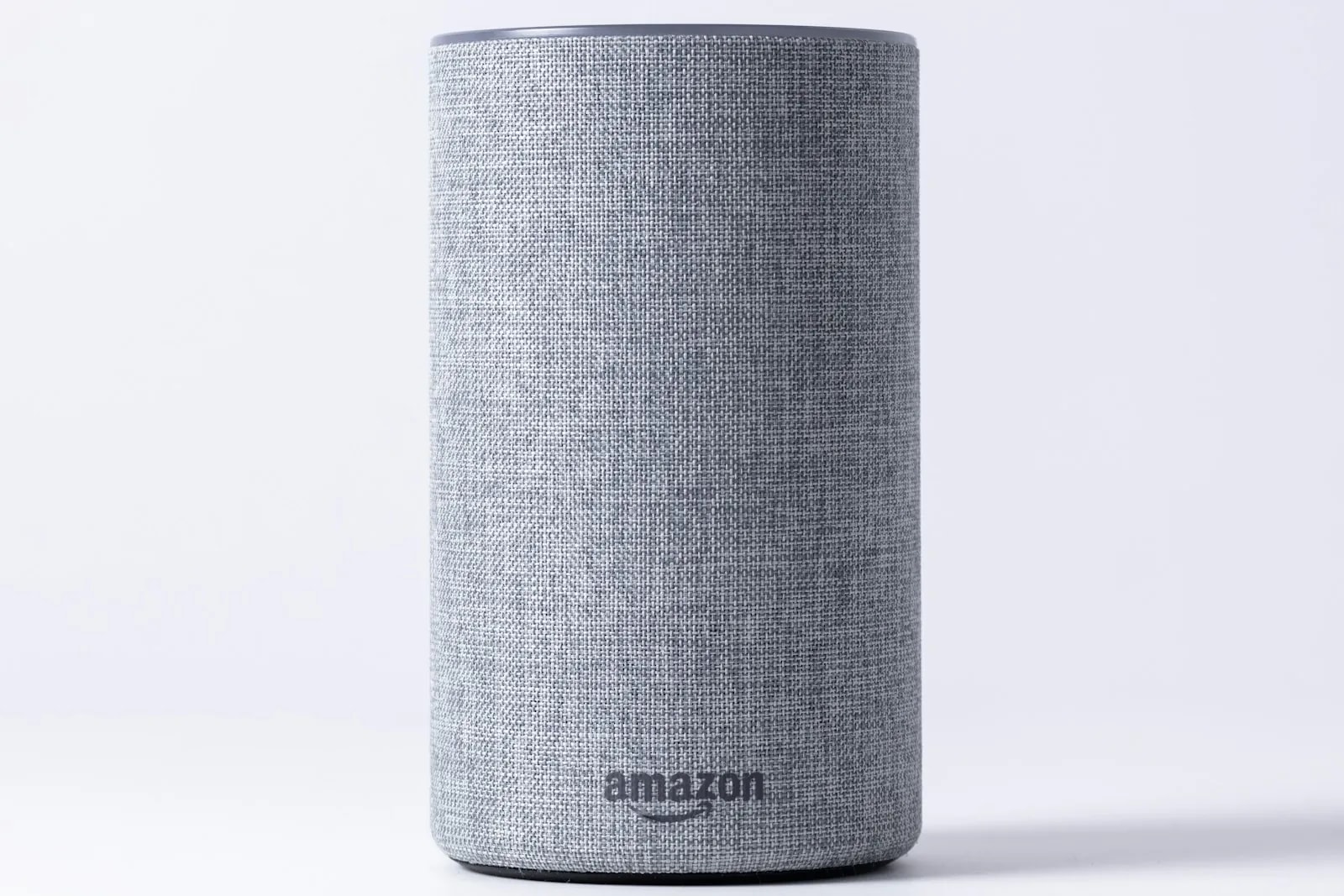
A presence sensor sends a notification. It does not prevent a fall, detect an illness, or replace professional care. Anyone who tells you otherwise is selling you something they should not.
This matters beyond the small print. If a family believes a sensor makes a home safe, they stop doing the things that help most. The grab rail. The rolled-up rug. The doctor's review. The daily call. Technology is the last layer, not the first.
What can a family learn without watching a live feed?
A family can learn more than most people expect, and none of it involves seeing your parent. A handful of contact and motion sensors can produce one useful sentence a day. The kettle was used. The bathroom door opened. The front door did not open at 3 a.m.
Set up well, the system stays quiet and only speaks when a pattern breaks. No movement in the kitchen by 10 a.m. on a normal weekday is worth a message. Everything else is noise, and noise is why families switch alerts off within a month.
From our projects: the setups still running a year later have fewer than three alert types. Ten alerts get muted. Two get answered.
The honest limit is worth stating. A pattern alert tells you something is unusual. It does not tell you what happened or why. It is a prompt to pick up the phone, not an answer.
Why does the path to the bathroom matter more than any other lighting decision?
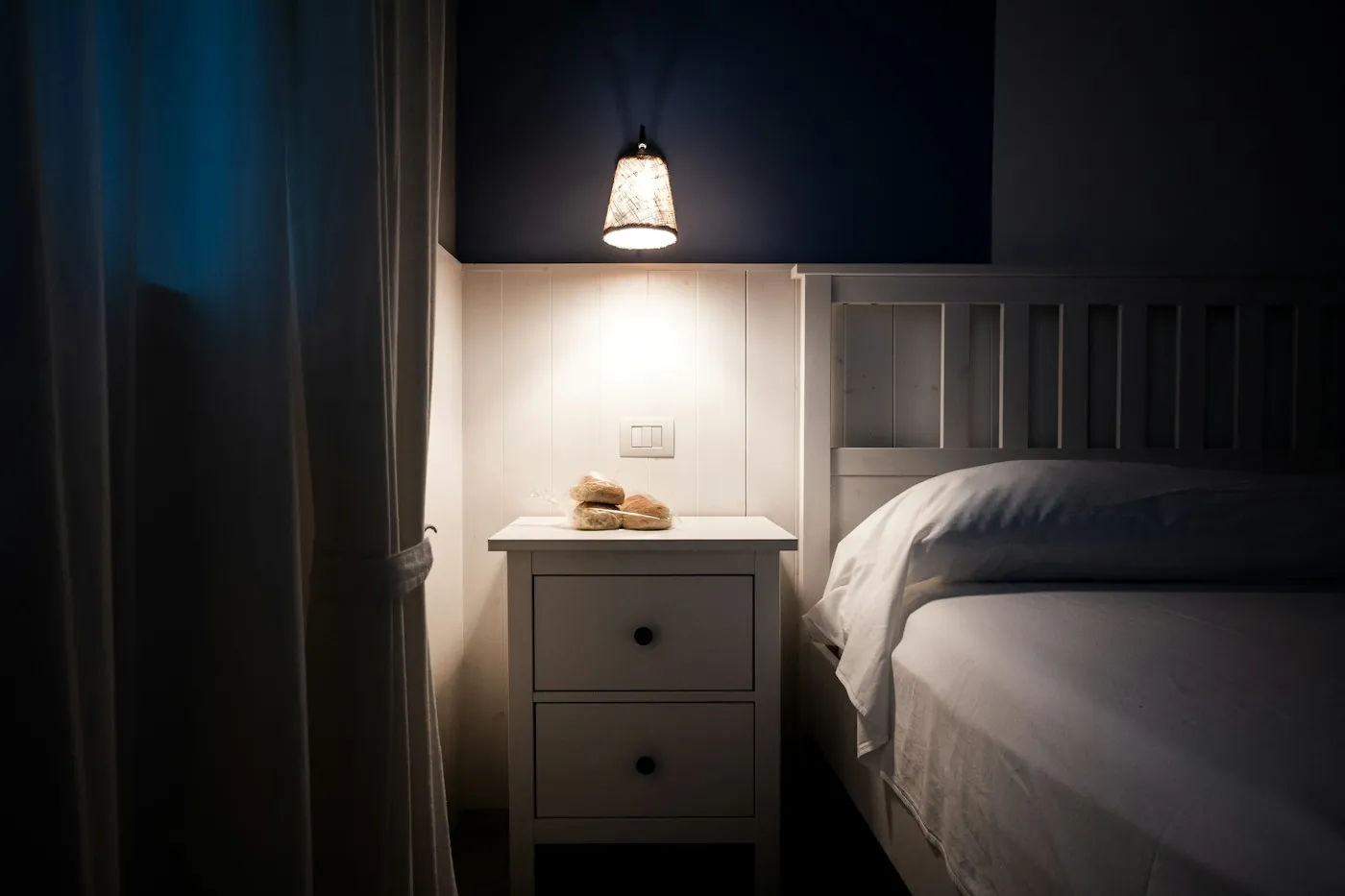
The night walk to the bathroom is the one moment that combines low light, a half-awake person, and a hard floor. A motion-triggered light on that route is the cheapest change in this whole article that makes a real difference.
Build it this way. Warm, low-level light at roughly 5 to 10 percent brightness, triggered by motion. Run it only between sunset and sunrise. Make it fade up over a second or two instead of snapping on. Bright white light at 2 a.m. wakes a person fully and makes getting back to sleep harder[7].
Skirting-level fittings beat ceiling lights here. The eye adjusts less, and the floor is the thing that needs lighting. In a rented apartment, battery motion sensors and plug-in fittings do the job with no drilling, which our rental apartment guide covers in detail.
This is a deliberately narrow use of smart lighting. For scenes, dimming, and whole-home design, read the best smart lighting guide for Dubai. We design this layer as part of smart lighting and climate control, from AED 4,500 including installation.
Does voice control actually help someone with limited mobility or poor eyesight, in Arabic too?
Yes. Voice control is often the feature that decides whether a parent uses the system at all. A voice command needs no reading, no small buttons, and no phone in hand. "Turn on the hall light" works from a chair.
Arabic matters here more than any spec sheet. Amazon launched Arabic Alexa in the UAE and Saudi Arabia from December 2021, built with local input so it handles Khaleeji phrasing[10]. Google Assistant and Siri also handle Arabic, with varying accuracy on dialect. A professionally set-up system is configured in your parent's own language on day one, not left in English by default.
One UAE caveat is worth knowing before you plan around it: some Alexa calling and messaging features have not been available in the UAE[11]. Do not build an emergency plan on a feature that may not work here.
Keep physical controls as well. A wall keypad by the bed still works when the internet drops. It also reassures a parent who does not want to talk to a speaker. The platform differences are covered in does Alexa work in Dubai, and we set up English and Arabic voice control as standard.
Can smart home technology help an elderly parent with medication reminders?
A smart home can remind. It cannot manage medication, and no honest installer will tell you otherwise. A spoken announcement at 8 a.m. and 8 p.m., or a light that changes colour, is a prompt and nothing more.
Reminders work best when they are spoken in your parent's own language and tied to something already in the routine, like the morning kettle. They fail when they arrive as a phone notification that nobody sees.
Anything past the reminder belongs to a doctor or a licensed nurse. Do not buy a device on the promise that it will keep someone on a treatment plan, because that is not what it does.
How do smart locks help a carer or a family member, not just the burglary story?
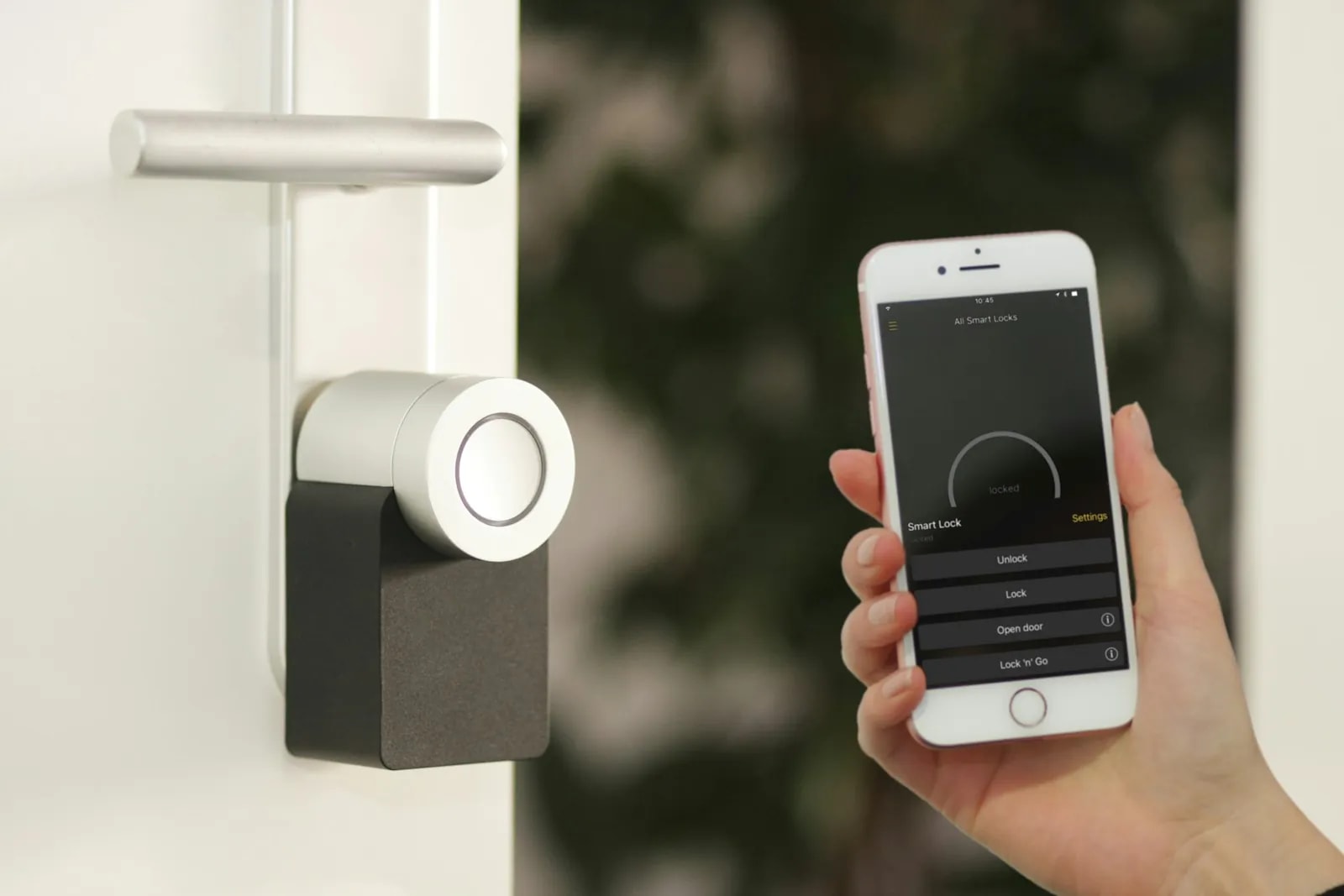
Smart locks end the spare-key problem. A carer, a cleaner, and a daughter who lives 20 minutes away each get their own code. Every entry shows in the access log with a time against it.
The wins are small and daily. No key to lose. No lock to change after a helper's contract ends. A code that works only on Tuesday mornings for the physiotherapist. And in an urgent moment, a family member or a paramedic can be let in remotely instead of waiting at a door nobody can reach.
Keep the physical key path working and make sure your parent can still open their own door the way they always have. Models and fitting detail sit in our smart locks guide. We design locks, video intercoms, and staff codes under smart gate and access control, from AED 4,500 with fitting included.
What does a video doorbell solve that a helper answering the door does not?
A video doorbell stops anyone having to rush to the door to find out who is there. Your parent sees the caller on a screen, or hears who it is from a chair, and then decides whether to get up at all.
That covers the two cases families actually worry about. An unfamiliar caller pressing for entry, and a delivery that turns into a hurried walk across a hall. A helper cannot answer the door on a rest day, and the doorbell still works.
A camera at an entrance is a different question from a camera indoors, and most parents agree to it without much discussion. Doorbells and entrance cameras are planned and installed as part of security and surveillance, from AED 15,000 for a full system.
What can shut itself off automatically while a parent is home alone?
Water, mainly, plus power to specific appliances. A leak sensor under the kitchen sink pairs with a motorised valve on the mains. It closes the water within seconds of a drip at 3 a.m., with nobody awake.
For cooking, be precise about what is on offer. A smart plug can cut power to an electric kettle, an iron, or an electric hob. Set it on a timer, or on nobody being detected in the kitchen. A gas hob is a different job and needs a gas shut-off valve fitted properly, not a plug bought online.
Smoke and carbon monoxide detection belongs in this layer too. An interconnected alarm can also push a message to two phones. That covers the hours when the only person at home may not hear it, or may not react quickly.
Quick math: a full 1 to 3 bedroom apartment with night lighting, sensors, leak protection, and a smart lock runs AED 8,000 to 15,000. It takes 2 to 4 days[12]. A single room starts at AED 2,000. Villa essentials start at AED 30,000. Send us the floor plan and we will mark the three rooms worth doing first: book a free consultation.
What does remote check-in for family actually look like, day to day?
At its best, remote check-in looks like almost nothing. One message in the morning saying the home is running normally, then silence for the rest of the day unless a pattern breaks.
What a good setup deliberately does not show matters just as much. No live video of a parent in their own living room. No log of every room they walked through. No record of how long they spent in the bathroom. None of that makes anyone safer, and all of it costs something real.
What families tell us they wanted all along is contact, not surveillance. In the Dubai study, video calling was the most requested living-room feature at 82.9 percent, ahead of every safety device on the list[8]. A screen your parent can answer with one tap does more for both of you than a camera you watch.
Why does Dubai's summer heat matter more for an older resident, and what should the AC do?
Dubai summers run at 45 to 50°C, with humidity often above 80 percent. The UAE government lists senior residents among the groups needing particular health attention[3]. The AC schedule that saves the most money is not always the one an older parent should live with.
The standard DEWA-saving setback lets an empty room drift warm through the day and pulls it back before anyone is home. In a room your parent actually occupies, that drift is the wrong trade. Set a narrower band, hold it steadily, and take the savings from the rooms that are genuinely empty.
Steady beats aggressive. Guidance for older people in hot climates is consistent on one point. Avoid sharp swings between very cold indoor air and outdoor heat. A room held at one comfortable setting beats a room that cycles hard.
The savings are still real elsewhere in the house. Smart AC and lighting control cut cooling costs 20 to 30 percent. A villa paying AED 4,000 a month to DEWA saves AED 800 to 1,200 in summer[12]. Those are general figures for a Dubai home, not an elderly-specific claim. The full mechanics are in how to cut your DEWA bill and district cooling and smart thermostats. Comfort, air quality, and circadian lighting sit under wellness and comfort.
Whose job is this: the domestic helper, the technology, or the family?
All three share it: the helper, the technology, and the family, each on a different shift. The clearest way to plan a setup is to write down every worry, then decide which of the three covers it. Most families find the technology column is shorter than they assumed.
The legal line matters in the UAE. A worker hired under the domestic worker framework supports daily living: helping someone move safely around the home, keeping the household running, being present. Clinical and nursing tasks sit outside that role and need someone separately licensed for it[5]. Technology does not cross that line either. It covers hours, not care.
| The real concern | What actually helps | Who or what covers it | Dubai note |
|---|---|---|---|
| The night walk to the bathroom | Motion-triggered warm path lighting at 5 to 10 percent, dusk to dawn | Technology, on its own | Works in a rented apartment with no drilling |
| Unwitnessed hours when the helper is off or asleep | Radar presence sensing plus one pattern alert, not ten | Technology | A helper's weekly rest day is exactly this gap |
| Medication timing | Spoken reminders in your parent's own language, tied to the routine | Technology reminds. A doctor or licensed nurse manages | A domestic worker cannot take on clinical tasks[5] |
| An unfamiliar visitor at the door | Video doorbell with an indoor screen or speaker | Technology first, helper or family second | Still works on the helper's rest day |
| A hob or iron left on | Smart plug cut-off for electric appliances, fitted valve for gas | Technology, with a proper install for anything gas | Ask for a gas valve, never a plug, on a gas hob |
| Summer heat in your parent's room | A steady setpoint instead of an aggressive empty-room setback | Technology, set by the family at handover | 45 to 50°C outside through July and August |
| Staying connected without daily check-up calls | One-tap video calling on a fixed screen your parent can reach | Family, made easier by technology | The most requested feature in the Dubai study at 82.9 percent[8] |
| Low confidence with technology, or limited English | Arabic voice control, plus wall keypads that always work | Technology, configured properly at handover | Gulf Arabic has been supported on Alexa in the UAE since December 2021[10] |
Dubai runs its own programmes alongside all of this. The Community Development Authority runs Homecare, known as Waleef, plus its Thukher programmes for senior citizens. Both are built around dignity and independence, not supervision[4]. Not sure which column your own worry belongs in? Message us on WhatsApp with the room and the concern.
What does privacy and consent actually mean when the person being monitored is your parent?
Privacy and consent mean your parent decides, not you. Under the UAE Personal Data Protection Law, Federal Decree-Law No. 45 of 2021, images that identify a person sit in the same sensitive tier as health data. Processing them needs consent that is clear, specific, informed, and possible to withdraw[1]. Silence or a pre-ticked box is not consent.
That law was written for organisations, and a family home is not a company. The principle still holds inside a family, and it holds more strongly for a parent, not less. An adult who owns property and holds a residency visa does not stop being an adult when a sensor is discussed.
The Dubai study makes the stakes concrete. Its respondents did not believe smart home technology could protect their privacy. Technology anxiety was one of the strongest factors holding them back[8]. Ignore that and you will pay to install a system nobody switches on.
So have the conversation before the install, not after, and put four things in writing:
- What each device senses: "this one sees no picture, it reads movement" is a sentence that changes minds.
- Who can see it: name the exact people with app access. Two is usually enough, and the list should be short enough to say out loud.
- What is off limits: agree the rooms with no camera. Bathrooms and bedrooms are the normal answer.
- How to switch it off: your parent must be able to withdraw consent and have a device removed, without having to argue for it.
Security is the other half of privacy. A sensor is also a device on your home network, so it needs its own strong password and regular updates like anything else. Our guide to securing a smart home from hackers covers that side properly. The wider setup basics sit in the complete smart home guide for Dubai.
Every system we hand over is set up with the resident in the room, in English or Arabic. We show them how to turn each device off themselves. Dubai Smart Home is rated 4.9/5 by Dubai homeowners, coordinates each job from the first survey to that handover, and answers sales enquiries within 2 hours. To plan smart home automation for a parent's home in Dubai, book a free consultation or message us on WhatsApp. Support runs 24/7 after handover.