Almost every "best smart lock UAE" search lands on a list written for an American front door. That door has a round deadbolt above the handle. Your Dubai door almost certainly does not, which makes the list useless before you reach the price column.
This guide runs in the order that saves money: your door first, then the lock type, then the brand. We fit locks, gates, and video intercom across Dubai villas and apartments, and have done since 2016. Where the data is thin, we say so. For the wider picture, our complete smart home guide for Dubai covers how locks sit in the rest of the system.
Which smart lock should you buy in Dubai?
Yale or Aqara for most Dubai homes, and check your door first: the door type decides the shortlist, not the brand. Most Dubai apartments use a euro-profile cylinder on a steel fire-rated door. Most villas use a mortise lock. Yale and Aqara both sell models built for those formats, which makes them the safest defaults here.
August is the clearest counter-example. Its own compatibility documentation states the lock will not work with mortise locks, double-cylinder deadbolts, or deadbolts needing more than a full turn[1]. Read that list again. It rules out the two door types Dubai homes use most.
Quick take: for a Dubai apartment, look at Yale first. For an Apple or Matter household, Aqara. For a villa door or gate, a mortise-body or heat-rated model. For anything imported, check the maker's own compatibility page before you pay.
Check your door first: what doors Dubai homes actually have
Two door formats cover most Dubai homes, and neither is American. Apartments run euro-profile cylinders on steel fire doors. Villas more often run mortise locks.
Apartments (Marina, JVC, Business Bay, Downtown, JLT). Almost all are heavy steel fire-rated doors with a euro-profile cylinder[8]. That is a slim, oval barrel that slides into a hole in the door face, held by one screw. It is the European standard, and the UAE follows it. The fire-door build is why: that door is manufactured around this cylinder.
Villas (Arabian Ranches, The Springs, older Jumeirah properties). These more often use a mortise lock, a full lock body recessed into the door edge. Very secure, very hard to force, and not a cylinder, so not a cylinder swap.
The ten-second fit test. Open your door and look at the face and the edge.
- Small oval keyhole insert on the door face: euro-profile cylinder. Most apartments.
- Lock body set into the door edge: mortise. Common in villas.
- Round deadbolt above a separate handle: a US single-cylinder deadbolt. Rare here.
| Your door | Where it is common | Lock type that fits | What to avoid |
|---|---|---|---|
| Euro-profile cylinder on a steel fire door | Most Dubai apartments | Cylinder-native retrofit or a euro-cylinder replacement (Yale ENTR, Aqara retrofit models, UAE-native brands) | Locks built around a US round deadbolt |
| Mortise body in the door edge | Many Dubai villas | A mortise-body smart lock, or a full mortise replacement | Clip-on retrofit units designed for a cylinder or deadbolt |
| Aluminium-frame door | Some newer villas and townhouses | Depends on frame depth; often needs a fitting bracket | Assuming a standard kit fits without checking |
| US-style single-cylinder deadbolt | Rare in the UAE | Most US-market locks, including August | Nothing, but confirm you actually have one first |
Newer communities like Dubai Hills Estate and DAMAC Hills are the grey area. Doors there take surface-mounted or mortise-body locks depending on the door and frame depth[8]. Some aluminium-frame doors also need a fitting bracket. Check before you buy.
Why August and many US locks do not fit Dubai doors
Because they are built around a door type Dubai barely has. August fits over a standard US single-cylinder deadbolt, and its own support documentation excludes mortise locks, double-cylinder deadbolts, and deadbolts requiring more than a full turn[1].
The Dubai catch: those excluded types are the normal ones here. A villa mortise lock is on the exclusion list. The reinforced double-cylinder deadbolt some villas use is on the exclusion list. And the euro cylinder in most apartment towers is not the deadbolt shape the lock mounts to at all.
This is not us criticising August. It is August telling you what its product is for. The problem is that global review sites never repeat that line, because the reviewer's own door is the one it was designed for. The buyer in Marina reads the review, orders the lock, and finds out at fitting.
Common mistake: treating a fit question as a compatibility question. Compatibility is about apps and hubs, and it is usually fixable. Fit is about metal and holes, and it is not.
August also has no confirmed UAE retail channel, so it turns up here mainly through import sites. Treat it as the clearest documented example of a US-designed lock that will not fit most Dubai doors.
The three types of smart lock, and which suits your door
There are three categories, and your door usually eliminates one or two immediately. Get the category right and the brand choice gets much smaller.
1. Retrofit, over the interior cylinder. A smart module clips onto the inside face of your existing lock. The outside face, the original keys, and the lock body stay as they are, and it comes off with a screwdriver. Expect roughly AED 400 to 1,200 for the device plus about AED 250 to 350 fitting, a locksmith-market figure rather than a fixed quote. This is the renter category, and it suits a euro-cylinder apartment door.
2. Full replacement. The lock body or cylinder comes out and a purpose-built smart lock goes in. Standard for an owner, ask-first for a tenant. It only works if the model is built around your format, a euro cylinder or a mortise body, not a US deadbolt.
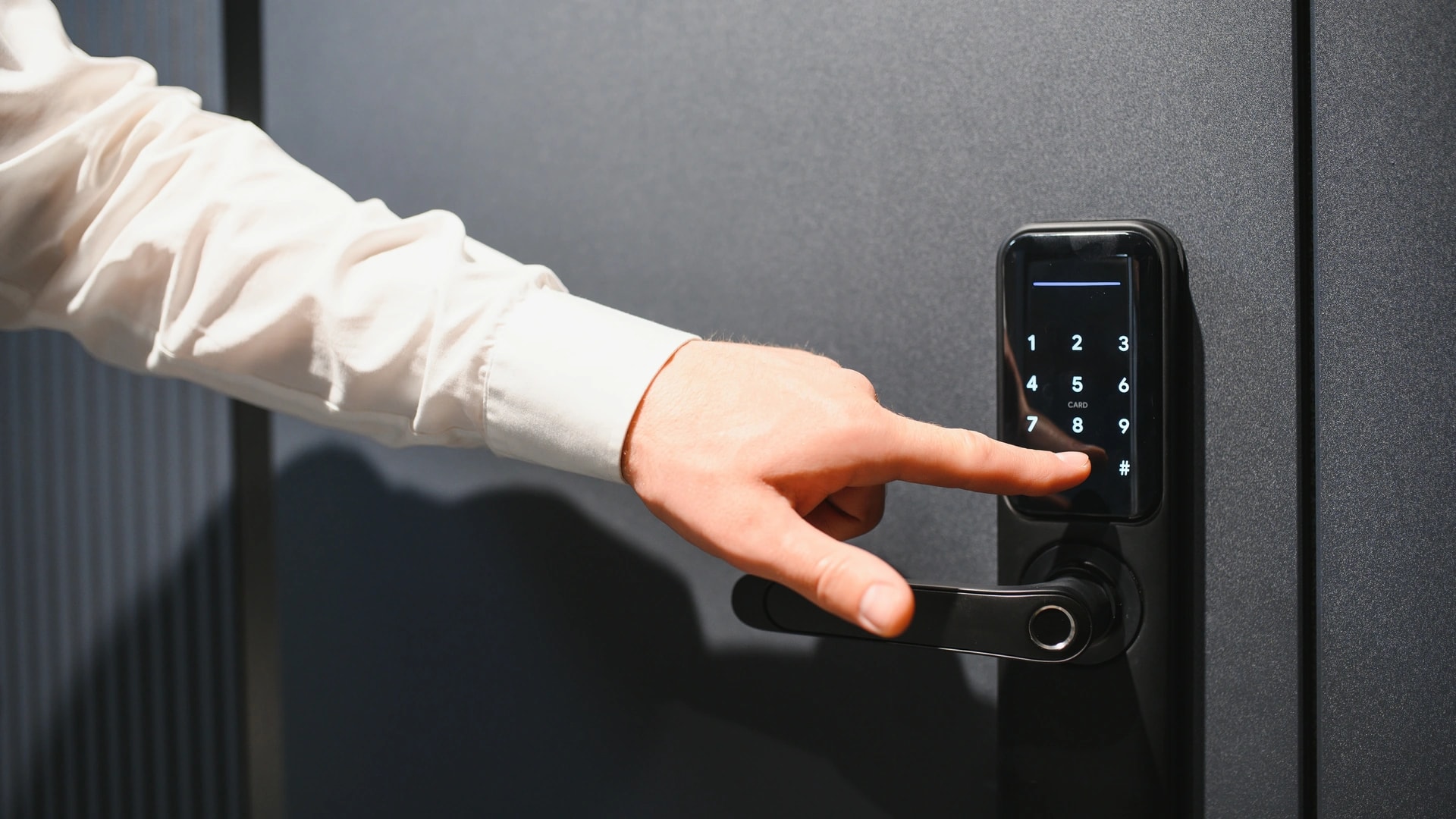
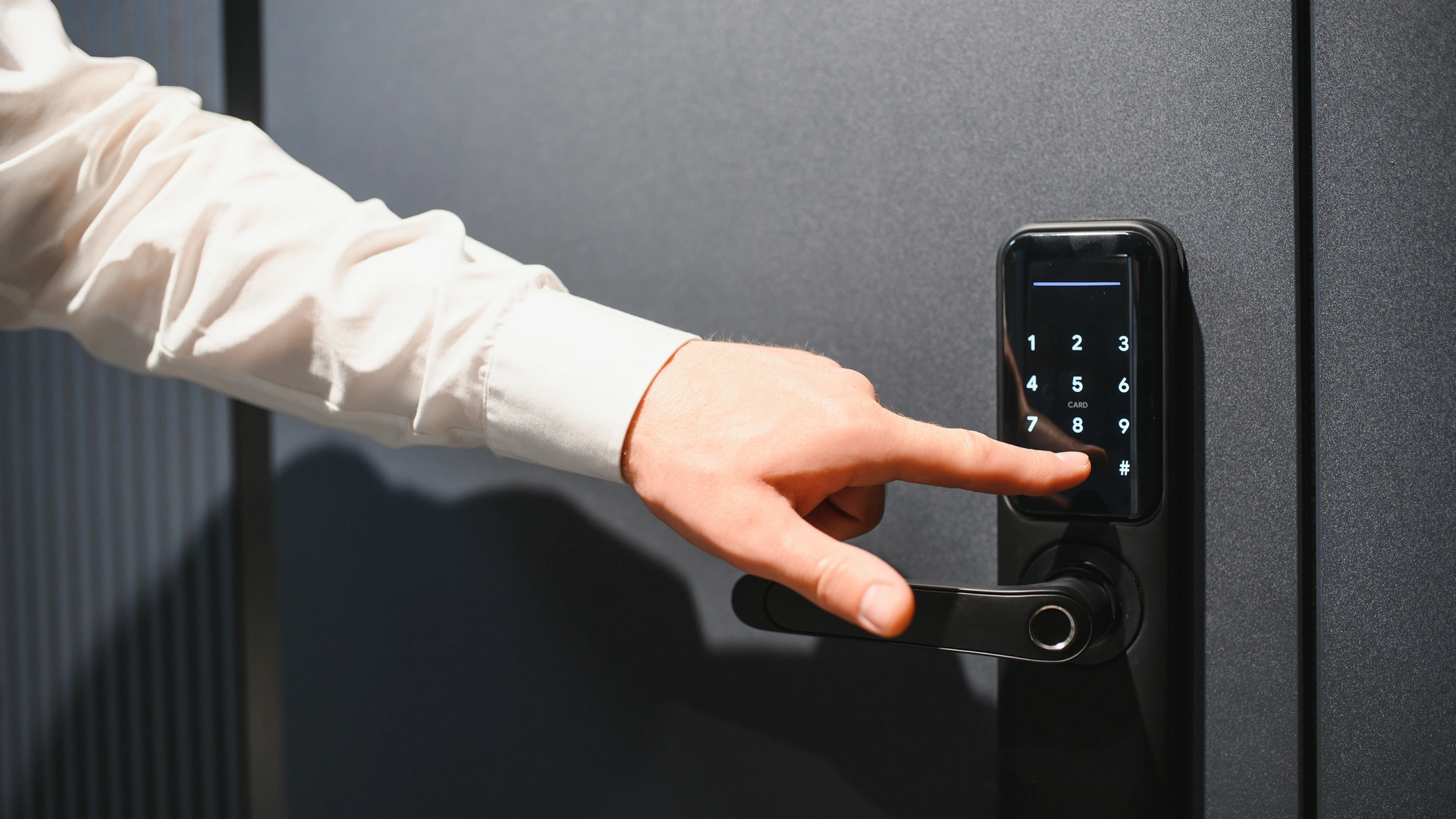
3. Fingerprint and keypad locks. Either category above, but with a fingerprint reader or PIN pad as the main way in instead of a phone. This is far more popular in the UAE than in the US or Europe, and nearly every brand sold here leads with it.
That last point matters. Keyless entry in a Dubai apartment usually means a code or a fingerprint, not an app, because the whole family needs to get in.
Smart lock brands compared for Dubai doors
Here are the four brands in the question, plus six actually sold widely in the UAE. The third column is the one that matters. Prices are approximate mid-2026 ranges that move with promotions, so check current pricing.
| Brand | Type | Fits UAE doors? | Connectivity | Approx AED | Best for |
|---|---|---|---|---|---|
| August | Retrofit over a US deadbolt | No. Its own spec excludes mortise, double-cylinder, and more-than-one-turn deadbolts[1] | Bluetooth, Wi-Fi via bridge | No confirmed UAE retail channel | A US single-cylinder deadbolt door only |
| Aqara | Retrofit (U200) and full replacement (U100) | Yes. Sold and installed here with region-appropriate kits[2] | Bluetooth, Wi-Fi via hub, Matter, Thread, Apple Home Key | Check current retailer pricing | Apple, Google, and Alexa households at once |
| Yale | Full replacement, plus euro-cylinder-native ENTR | Yes. ENTR is built around the euro-profile cylinder[3] | Bluetooth, Wi-Fi, keypad | About 400 to 1,200 for standard models | The safest single-brand default for an apartment door |
| Schlage | Full replacement, US ANSI deadbolt-centric | Unconfirmed. No euro-cylinder-native model found. Check the model before buying | Wi-Fi, Bluetooth | Not confirmed in AED | Someone who already owns Schlage hardware |
| eufy | Full replacement, fingerprint and keypad | Yes, widely sold | Wi-Fi, Bluetooth | About 299 to 1,059 | Budget to mid-range apartment fingerprint lock |
| Samsung | Full replacement, fingerprint and keypad | Yes, one of the most-installed in Dubai villas | Wi-Fi, Bluetooth, model-dependent | About 700 to 1,000 and up | Villa owners wanting a reinforced, heat-marketed body |
| Philips | Full replacement, including mortise-body models | Yes, and the strongest villa and mortise fit of the international brands | Wi-Fi, keypad, model-dependent | About 1,672 to 2,205 and up | Villa main doors, mortise doors, exterior mounts |
| Xiaomi | Full replacement, self-install | Yes, official UAE storefront | Bluetooth, Wi-Fi, Matter | Not confirmed in AED | Mi Home households |
| Lockly | Full replacement, shuffling keypad and fingerprint | Yes, dedicated UAE storefront | Bluetooth, Wi-Fi via bridge | Not confirmed in AED | Anyone worried about someone watching them type a PIN |
| Altix | Retrofit and full replacement, UAE-native brand | Yes, engineered around euro cylinders[8] | Bluetooth, Wi-Fi | About 200 to 3,535 across the range | Published local pricing and local fitting |
Real talk: the four headline brands are the four people search for, not the four on Dubai doorways. Philips, Samsung, eufy, and the UAE-native brands are on far more Dubai doors than August will ever be. Search volume is not market fit.
Yale: the safest apartment default
Yale is the safest single-brand default for a Dubai apartment door, and the reason is ENTR. It is built specifically around the euro-profile cylinder[3], the exact format in most Marina, JLT, and Business Bay doors.
Yale's other models, Assure Lock 2 and Linus, fit most standard timber and steel doors, though aluminium may need a bracket. Standard models run roughly AED 400 to 1,200. Yale also has the widest official UAE retail presence of the four headline brands, which means local stock, a local warranty path, and someone to call.
Best for renters: a cylinder-native Yale on a euro-cylinder door is the least risky choice available. The fit is documented, the parts are here, and a fitter has probably installed one this week.
The trade-off is ecosystem. Yale is a lock company first. If you want one credential set across Apple, Google, and Amazon, Aqara covers more ground.
Aqara: best for Apple and Matter households
Aqara is the pick if your home runs on Apple Home, or you want one lock that answers to all three platforms. The U100 and U200 both support Matter, the U200 supports Matter over Thread, and both work with Apple Home Key, so an iPhone or Apple Watch tap opens the door[2].
Matter is a shared standard from 2022: one certified device works with Apple, Google, and Amazon through one set of credentials instead of three brand apps. Thread is the low-power radio it can run over. If you own an Apple TV 4K or a HomePod mini, you already have a Thread border router, so no extra Aqara hub.
On fit, Aqara ships region-appropriate cylinder and deadbolt kits and is actively sold and installed here. The U200 is the retrofit-style unit, so it is the renter-friendly one. It is also a brand we install, so we see how it behaves over a Dubai summer rather than only on a spec sheet.
We could not confirm a current AED price this pass, so check the retailer listing rather than a number from a blog. Our guide to smart home protocols in Dubai explains Matter and Thread properly.
Schlage: an honest note on thin UAE data
Schlage's UAE fit is genuinely unconfirmed, and we will not pretend otherwise. The honest answer: check the specific model against your door before buying, which is this article's message anyway.
Schlage's core smart line, Encode and Sense, is built around the US ANSI deadbolt standard. UAE retail exists through Noon and some specialist installers, but it reads thinner and less door-type-adapted than Yale's. We found no euro-cylinder-native Schlage model and no confirmed AED price.
Real talk: that is a gap in the evidence, not proof of a bad fit. August states plainly that it excludes mortise and double-cylinder doors[1], so we can call that a fact. Schlage has published no equivalent line either way for this market, so a verdict would be invention.
Practically: if you already own Schlage hardware from a US home, take the model number to a Dubai fitter and have them look at your door before shipping anything. Starting from nothing, Yale and Aqara have clearer UAE door-fit.
Villa doors and gates: mortise bodies and outdoor heat
A villa is two problems, not one. The main door is usually a mortise body under partial shade. The gate is a fully outdoor, direct-sun installation. Different products, different budgets.
Best for villas: for a mortise main door, look at a genuine mortise-body lock. Philips has the clearest mortise-native range of the international brands sold here, plus IP65 and IP66 exterior lines, at roughly AED 1,672 to 2,205 and up. Samsung recurs for villa doors too, at about AED 700 to 1,000 and up, on a reinforced body marketed for heat. Do not try to solve a mortise door with a clip-on retrofit built for a cylinder. It will not mount.
The gate is a different tier. It is rarely a standalone lock: usually the lock, a video intercom, camera tie-in, and often the gate motor. Villa locks run roughly AED 300 to 2,000 or more per door, biometric up to about AED 1,500, and a custom integrated system runs AED 5,000 to 15,000 and up before install and maintenance[10]. Our smart gate and access control work starts at AED 4,500.
One villa detail worth knowing: on an integrated system the lock should be wired fail-open, defaulting to unlocked if power or the fire-alarm signal drops. That is a good question for anyone quoting you. Our villa owner upgrade roadmap covers where access control sits in the build.
The heat problem: what a Dubai summer does to a lock
Treat the temperature rating as a buying check, the same way you check the price. Dubai summers regularly pass 45 C air temperature, while many consumer smart locks are rated only for 40 to 50 C. Look for 60 to 70 C or higher on anything mounted outdoors[7].
Be clear what that figure is. It is a sensible bar, corroborated across independent sources for locks specifically[7]. It is not a certified engineering standard or a legal requirement. Nobody inspects your lock. It is a spec to ask for before you pay.
Quick take: a lock rated to 50 C ambient can hit its ceiling on a west-facing wall in August, because a fixture's surface in direct sun runs hotter than the air, in the 60 to 65 C range. That is why a gate lock needs a higher bar than an indoor apartment retrofit. The apartment door sits in an air-conditioned corridor. The gate does not.
Heat drains batteries faster, warps and fades plastics under UV, degrades circuits, and works dust and humidity into a poorly sealed housing as it expands and contracts daily. The buy signals are specific. Ask for an aluminium or marine-grade stainless body, an IP65 or IP66 rating, lithium rather than alkaline batteries, and a stated operating-temperature range. "Weatherproof" on a box is marketing. A number on a spec sheet is a spec. Our Dubai smart home buyer's guide uses the same checklist across every device.
Bluetooth, Wi-Fi, Zigbee, Z-Wave or Matter?
Pick Bluetooth if you never need to open the door from away, and Wi-Fi or Matter if you do. The trade-off is battery life against remote access.
- Bluetooth: about 30 feet of range, so it works at the door. Lowest power draw, typically 6 to 12 months on a battery, because it only wakes when your phone is close. No hub, no remote access.
- Wi-Fi: straight to your router, no hub, real remote access and voice control. Draws the most power, so batteries go fastest.
- Zigbee, via a hub: a wireless mesh sitting between the two on battery life. Needs a compatible hub to reach the internet.
- Matter: one certified lock, controlled from Apple, Google, and Amazon through one credential set. Aqara's U100 and U200 are the clearest examples[2].
The Dubai catch: Z-Wave is region-locked. The UAE follows the same regional radio band as Europe, 868.4 and 869.85 MHz, not the US 908.4 MHz[4]. A Z-Wave lock or hub bought for the US market will not pair with UAE or EU gear. That is a radio mismatch and cannot be patched. Wireless devices sold here are also expected to carry TDRA type approval for the local bands[5]. Most locks here are Bluetooth, Wi-Fi, or Matter, so this mainly bites on a US-sourced security system.
One more local point. Reinforced concrete cuts Wi-Fi harder than the timber-frame construction most reviews assume, so a Wi-Fi-only lock at the far end of a large apartment is asking for dropouts. If you want Wi-Fi, put a mesh node near the door. Our home networking team deals with this constantly.
Power, batteries, and the real lockout risk
Smart locks rarely fail, but people rarely plan the backup. Buy a lock with both a physical key override and a USB-C emergency port and you remove nearly all practical lockout risk.
Batteries typically last 6 to 12 months in normal conditions. Dubai heat shortens that on exterior and sun-facing doors, because heat speeds up self-discharge. Lithium batteries hold voltage across a wider temperature range than alkaline and are worth the extra dirhams outside.
The USB-C port is the feature most people do not know about until they need it. Most modern locks, including Aqara, Philips, and Lockly models, put an emergency power contact on the outside panel. If the batteries die, a phone power bank plugged in gives the lock enough power to accept your code and open the door.
Common mistake: a mechanical key override you cannot reach. Nearly every smart lock keeps a physical key slot, including retrofit models. That only helps if a spare lives somewhere reachable from outside: a lockbox, a trusted neighbour, your car. A spare key inside the locked apartment is not a backup.
Want the fit checked before you spend anything? Book a free site visit and quote →
Security and privacy: the app account is the weak point
The lock hardware is almost never what gets attacked. The app account behind it is. Someone who gets into your email or your lock app can open the door remotely without touching the metal.
This is documented, not hypothetical. The FTC's case against Ring set out how attackers reached household devices through account takeover, using passwords leaked from other sites[9]. A lock is the same problem with a worse outcome. Three fixes cover most of it: a unique password on the lock's app account, two-factor authentication on, and the linked email secured first, because whoever holds that inbox can reset everything else.
Prefer local control for the door. A Bluetooth or locally hubbed Matter lock has a smaller cloud-dependent surface than one that only works through a manufacturer's server. Our guide on securing your smart home from hackers has the full checklist, and the SIRA CCTV requirements guide covers cameras and video doorbells.
The Dubai catch: a fingerprint is biometric data, and UAE PDPL treats biometric data as sensitive personal data[6]. Consent is the operative principle. Anyone whose fingerprint you enrol, family, a cleaner, a driver, a long-term guest, should know it is stored. The realistic exposure for a household is a conversation you should have had, not a fine. Our Dubai smart home laws guide covers PDPL and permissions in detail.
Renters versus owners: what you can fit without asking
Renters should use a retrofit lock, because it comes off clean. Owners can replace the lock outright. The dividing line is whether anything permanent changes.
| Situation | What to fit | Permission | Approx cost |
|---|---|---|---|
| Renting an apartment | Retrofit lock over the interior cylinder, original keys still work | Not strictly required, but tell the landlord anyway | AED 400 to 1,200 device, plus about AED 250 to 350 fitting |
| Renting, want a full replacement | Cylinder or lock body swap | Ask first, in writing. This is a change to the property | Varies by brand and door type |
| Owner, apartment | Retrofit or full replacement, your call | Check building or owners association rules for anything on a shared entrance | From about AED 300 for a basic lock |
| Owner, villa door or gate | Mortise-body or heat-rated exterior lock, often part of an access system | Community or developer NOC, not a landlord conversation | AED 300 to 2,000+ per door; AED 5,000 to 15,000+ integrated |
Best for renters: a retrofit lock leaves nothing in the column a landlord can deduct from. No holes, no removed hardware, no broken fixture. A typical Dubai apartment deposit runs 5 percent of annual rent unfurnished or 10 percent furnished, roughly AED 3,000 to 9,000 or more on common Marina, JLT, and JVC bands, so the reversible option is not a small point.
Tell the landlord anyway. It is not strictly required, but it touches lock hardware, and a WhatsApp message with a photo closes off any "you changed my lock" argument at handover. Our rental apartment smart home guide sets out the full three-tier permission framework.
Owner-occupied villas are a different question. Rental law does not apply in your own home. The permission layer for a gate lock or exterior change is your community or developer NOC.
Common mistakes Dubai buyers make with smart locks
The mistakes are consistent, and most happen before anyone picks up a screwdriver. Here are the five we see most.
- Buying a US deadbolt lock for a mortise or euro-cylinder door. The biggest by far. August's own documentation excludes mortise and double-cylinder deadbolts[1], and that describes most Dubai doors.
- Ignoring the heat and IP rating outdoors. A 40 to 50 C-rated lock is undersized for a Dubai gate[7]. An indoor apartment lock gets away with it. A west-facing gate lock does not.
- Buying US-region Z-Wave gear. The UAE runs on the European 868 MHz band, not the US 908 MHz band[4]. It will not pair.
- No mechanical override, or a spare key nobody can reach. The lockout is almost never the lock failing. It is the backup nobody planned.
- Relying on Wi-Fi only through thick concrete. Dubai construction eats signal. A Bluetooth fallback or a mesh node near the door fixes it.
Two more worth naming. Enrolling a domestic worker's fingerprint without telling them is a consent issue under PDPL, not just bad manners[6]. And assuming holiday-home rules apply to you: reports that licensed short-term-rental operators need a SIRA-approved, Keyless-integrated lock come from smart-lock vendors, not a primary government document, and are scoped to a business permit. If you run a licensed holiday home, confirm it with your operator. In your own home, no such rule applies. Our 10 smart home mistakes in Dubai covers the wider set.
How Dubai Smart Home fits locks and access control
We start at the door, then work out to the system. Our engineers check the actual lock format on site before anyone quotes a brand, which is the step that prevents the expensive mistake this article is about.
Our smart gate and access control work covers gates, locks, video intercom, and staff PINs, from AED 4,500. That includes what most Dubai households actually want: time-limited codes, so the cleaner has access Tuesday 9am to 1pm and nothing else, with a logged history and instant revocation when staff change. No shared code passed around. Where cameras belong in the plan, our security and surveillance team handles that side.
Since 2016 we have completed 100+ projects across Dubai villas and apartments, and we are rated 4.9/5 by Dubai homeowners. Our engineers are in-house, we do not subcontract, and every system works in English and Arabic. On biometric locks we document PDPL consent for anyone enrolled[6], because that is the honest way to run a fingerprint reader in a home with staff.
If you are weighing a lock right now, the useful next step is not more reading. It is a photo of your door. Book a free site visit and quote → or message our team on WhatsApp →. Enquiries are answered within 2 hours. See the full range of what we install at Dubai Smart Home.