Parents ask us for a "child-safe" smart home after a near miss. A gate found open. A tap run too hot. The honest answer is narrower than most product pages suggest.
This guide splits every device into one of two jobs. A barrier stops something happening: a fence, a latch, a cordless blind, a mixing valve. An alert warns you after something has started: a contact sensor, a pool alarm, a camera. Both are useful, but selling one as the other is where child-safety marketing goes wrong. The wider picture is in our complete smart home guide for Dubai.
Can a smart home keep a child safe, or does it just feel that way?
A smart home adds a layer. It does not replace supervision, and no setup we design is meant to.
What automation does well is cover the unwatched minute. You are in the kitchen, the side gate opens, and a contact sensor tells you in a second or two.
What it cannot do is act. A sensor has no arms. It cannot close a gate, pull a child back, or turn off a ring already lit. So we plan in this order: the physical fix first, then the alert that tells you when it has been beaten.
Real talk: if a device makes you watch less closely, it has made your home less safe, not more.
What are the real hazards for young children in a Dubai home?
Seven hazards come up in almost every Dubai villa we survey. The pool, hot tap water, blind and curtain cords, gates, low sockets and the cooker, balconies and windows, and screens. Not all have a smart answer.
Water leads the list. Worldwide, drowning is the fourth leading cause of death for children aged 1 to 4 years, and children under 5 account for nearly a quarter of all drowning deaths globally[1]. Those are global World Health Organization figures, not Dubai figures. We looked for a current, dated Dubai child-drowning statistic and could not verify one, so we will not print one.
WHO's own advice on what helps is structural. It names fencing swimming pools, covering wells and using doorway barriers as ways to cut a child's exposure to water[1]. Every item on that list is a barrier. None is an app.
The Dubai-specific part is the housing. Private pools are common in villa communities, balconies in apartments, and hot water sits in a roof or cupboard tank that runs far hotter than a bath needs in summer.
Is a pool alarm a substitute for a pool fence?
No, and the standard that governs pool alarms says so itself. ASTM F2208 covers residential pool alarms, and its scope states that the specification is "not intended to replace other standard safety requirements that should be in place, that is, adult supervision, fences, gates, locks", and so on[2].
A pool alarm, a pool camera and a gate sensor are alerts. None of them stops a drowning. The fence, the self-latching gate, and an adult within arm's reach of a child near water are what do that job.
These devices detect entry into the water and raise an alarm[2]. Detection happens after entry, so an alarm is not a substitute for the fence or for supervision. That is why the fence comes first in every design we prepare for pool and outdoor automation.
The standard recognises four alarm types. Type A sits on the surface and Type B below it. Type C guards the pool perimeter and pairs with a gate contact. Type D is worn on the child and alarms on water contact[2]. All four are alerts. None is a barrier, and none removes the need for the fence or for supervision.
What does Dubai Municipality require for a private pool fence?
Dubai Municipality guidance for private swimming pools points to a barrier of at least 1.2 metres (1,200 mm) from finished floor level. The gate needs a self-closing and self-latching mechanism, and it should open away from the pool. No gap should be large enough for a child to pass through. This sits in the Municipality's Private Swimming Pools Safety Guidelines, DM-HSD-GU80, listed on its technical guidelines page[3].
We quote it as Dubai Municipality guidance corroborated across three independent sources. The Municipality's own PDF redirects to its homepage, so the reference above is the live page that lists the guideline by name.
One older figure floats around Dubai forums: a 90 cm minimum, from a 2018 news report on a different department's building standards. We do not use it. It is older, it is not the private-pool guideline, and it conflicts with the 1.2 m figure.
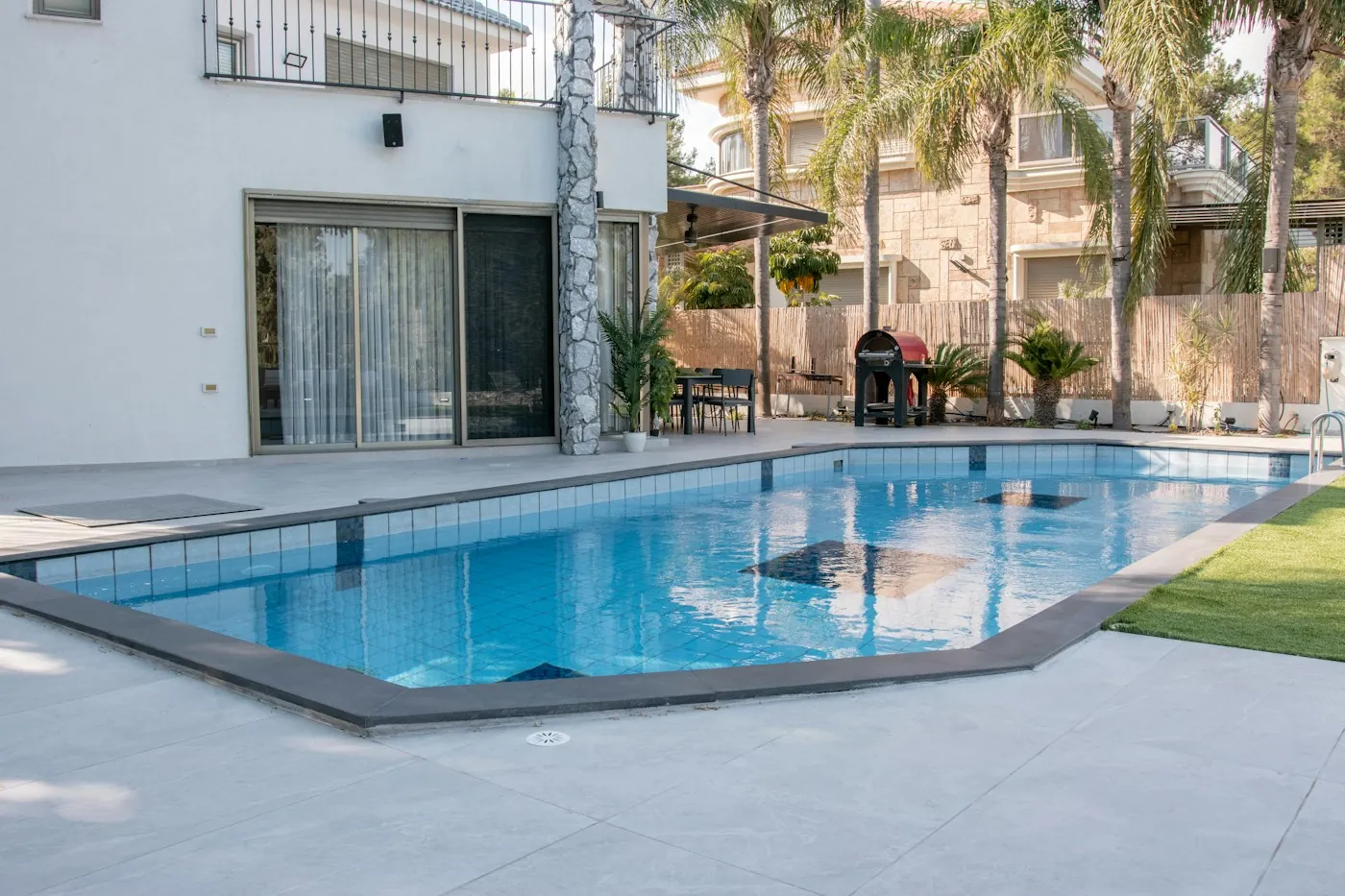
Three details get missed on site more than the height does. The gate has to latch by itself every time. The latch has to sit out of a child's reach. And the fence has to enclose the pool, not just the garden.
What can a pool gate sensor and a wearable alarm actually do?
A pool gate sensor and a wearable immersion alarm tell you sooner. That is the whole function, and it is worth having. It only works as a warning sitting on top of the 1.2 m fence, the self-latching gate, and an adult within arm's reach of a child near the water. Neither device stops a drowning, and neither reduces how closely the water needs watching.
A perimeter contact (Type C) suits a wired Dubai villa. A magnetic contact on the pool gate reports to your KNX, Control4 or Crestron system, and a notification lands on the phones you nominate. It is not a substitute for the fence or for supervision.
A personal immersion alarm (Type D) is worn by the child and sounds on contact with water. For a household with a non-swimming toddler, that is a second layer with a different failure mode from the gate contact. It still sounds after the child is in the water, and it still assumes the fence is up and an adult is present.
Common mistake: buying the sensor and postponing the fence because the sensor arrived first. That order gets it backwards.
How do door and gate contacts help with a wandering toddler?
A door or gate contact tells you a door has opened. That is all it does. It does not lock the door, it does not hold it, and it does not slow a child by one second.
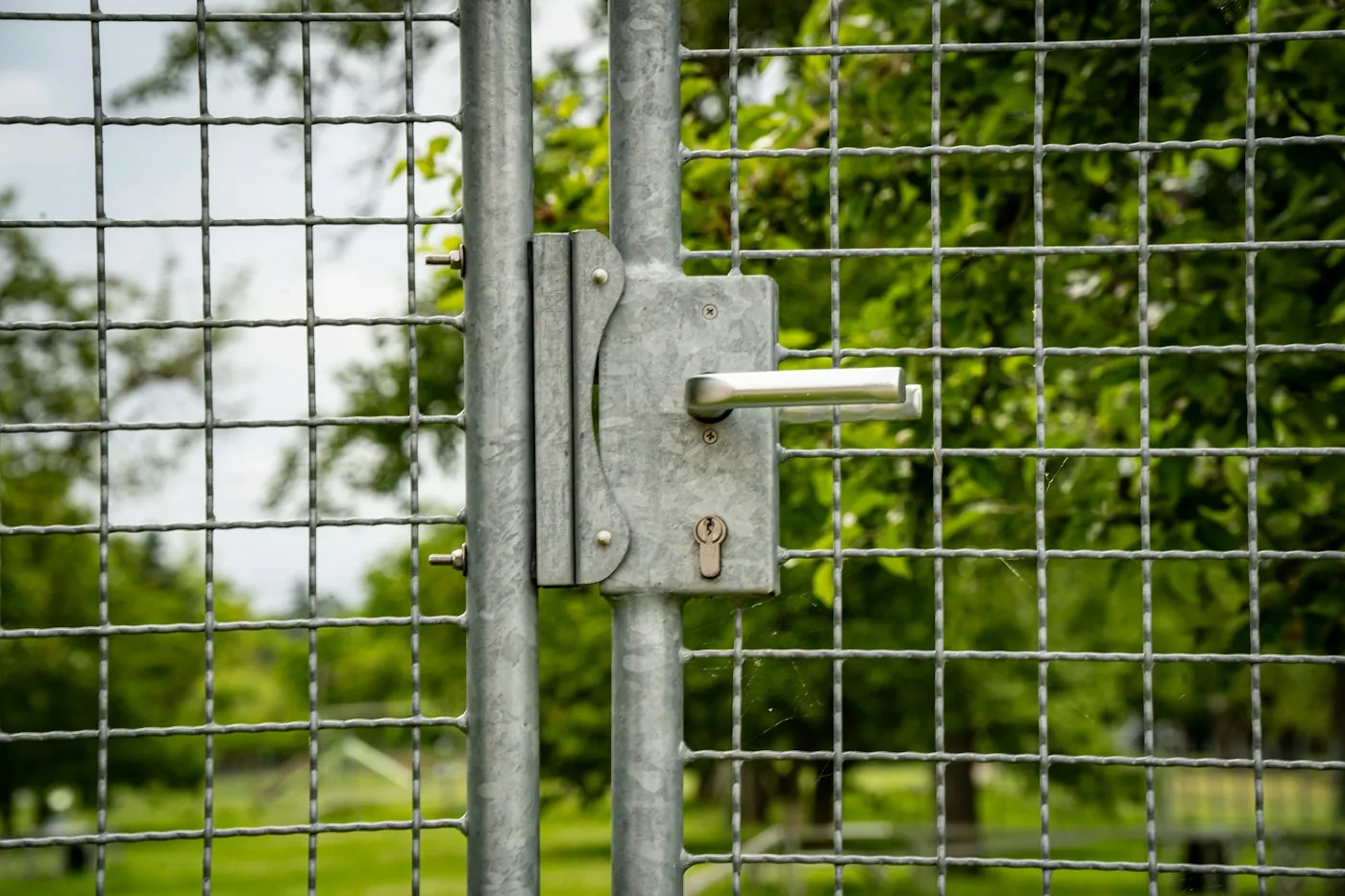
That is still useful. A contact on the front door, the side gate and the garage door notifies you when a child who has just learned to reach a handle uses it. In a large villa, that is the difference between noticing in two seconds and two minutes.
The barrier underneath it is ordinary hardware: a latch or bolt mounted high enough that a small child cannot reach or work it. Our guide to which smart lock fits your door covers perimeter locking, and contacts and keypads sit under smart gate and access control.
A front door opening at 4pm on a school day is normal. At 6am it is not. Time-based rules keep the alerts rare enough that someone still reads them.
Can you cut power to a socket or the cooker from a switch?
Yes. A relay wired into a KNX, Control4 or Crestron system switches a whole circuit off from a keypad button, a schedule or a scene. KNX is the wired standard we specify most in Dubai villas: it runs on a cable and keeps working when the internet drops.
The two worth doing are the cooker and any low socket in a room a young child uses alone. A "kids at home" scene drops power to both. The wiring sits under smart lighting and climate control.
Now the honest limits. A relay stops a circuit being switched on. It does nothing about a gas ring already lit. It covers only the circuits wired into that scene, so it does not childproof electricity across the home. And it does not replace physical stove-knob covers on a gas hob, which are the barrier here.
One rule we hold on every install: any isolation feature needs a physical fallback. A breaker or a normal wall switch the household can use if the app or the network is down.
What water temperature actually stops a scald?
The U.S. Consumer Product Safety Commission urges households to lower water heaters to 120 degrees Fahrenheit (49 degrees Celsius) to cut or remove the risk of most tap water scald injuries[4]. There is no UAE water heater temperature rule we could verify, so treat this as CPSC advice, not a Dubai regulation.
The number matters because of how fast a burn happens. These are CPSC's own figures for third-degree burns in adults[4].
| Water temperature | Time to a third-degree burn | What that means at the tap |
|---|---|---|
| 150 degrees F (66 degrees C) | About 2 seconds | Faster than a hand can be pulled back |
| 140 degrees F (60 degrees C) | About 6 seconds | Too fast to react to from across a room |
| 130 degrees F (54 degrees C) | About 30 seconds | A bath can reach this before anyone tests it |
| 120 degrees F (49 degrees C), the CPSC ceiling | About 5 minutes | The recommended setting, still hot enough to burn |
The barrier here is plumbing, not software: a thermostatic mixing valve, or the heater set to that ceiling. The smart layer is a relay or schedule holding it there. CPSC is blunt that supervision is the best defence and that you should always hand-test before bathing a young child[4]. No setting replaces your hand in the water.
What can a balcony or window contact actually alert you to?
A balcony or window contact can only tell you the door or window has opened. It does not stop a fall and does not restrict how far anything opens.
The barrier is a physical restrictor or guard, sized to the opening and fitted so a child cannot release it. In Dubai apartments this is the most important fix in the whole guide, and it is a hardware job, not an automation one.
The contact earns its place on doors that should stay shut: a balcony slider in a toddler's room, or a window on a landing. An alert is a warning about the restrictor, not a substitute for it.
Why do blind cords matter, and does motorising them fix it?
Blind cords matter because the hazard is documented, and motorising does fix it. The U.S. Consumer Product Safety Commission lists window coverings with cords among the top five hidden hazards in the home[5]. About once a month, a US child between 7 months and 10 years old dies from window cord strangulation, and another suffers a near strangulation[5]. That is US data, not a Dubai figure, but the mechanism is the same in any home.
CPSC names four cord hazards: pull cords, looped bead chains and nylon cords, the inner cords of Roman shades, and the lifting loops of roll-up blinds. It recommends cordless coverings in every home where children live or visit, plus keeping cots and climbable furniture away from windows[5].
This is the one place in this guide where the smart product is the barrier. Motorised shading from Somfy or Lutron, run from a wall keypad, has no pull cord, no looped chain and no lifting loop to reach. It removes the hazard instead of managing it. Cord cleats and tension devices reduce the risk, but they do not remove it. The work sits under motorized curtains and blinds, and the product side is in our curtains and blinds guide.
The whole guide, in one table. The last column is the part most product pages leave out.
| Hazard | The real barrier | What a smart layer adds | Do not claim |
|---|---|---|---|
| Pool drowning | A fence at least 1.2 m high with a self-closing, self-latching gate, plus an adult within arm's reach of a child near water | A gate contact that alerts your phone, and an immersion alarm worn by a non-swimming child | That any alarm, camera or sensor stops a drowning. ASTM F2208 says they do not replace supervision, fences, gates or locks |
| Front door or side gate | A latch or lock a small child cannot reach or operate | A contact that alerts a parent's phone the instant the door opens | That a door sensor locks anything. It reports an opening, after the fact |
| Hot water scald | A mixing valve or heater set to the CPSC ceiling of 120 degrees F (49 degrees C), plus hand-testing every bath | A relay or schedule holding the heater below that ceiling | That a setting replaces hand-testing. CPSC calls supervision the best defence |
| Cooker or hob left on | Physical stove-knob covers on a gas hob | A relay isolating the cooker circuit from a keypad or away scene | That a relay stops a gas ring already lit. It blocks future activation, not a live hazard |
| Accessible sockets | Socket height and covers wherever a toddler can reach | A relay cutting power to a chosen circuit | That it childproofs electricity. It covers only the circuits in that scene |
| Blind and curtain cords | Cordless or motorised shading, which removes the cord rather than managing it | Motorising corded blinds (Somfy, Lutron), leaving no cord | That cleats or tension devices fix it. CPSC recommends cordless |
| Balcony or high window | A physical restrictor or guard sized to the opening | A contact that alerts if it opens | That a contact stops a fall. It reports an opening, after the fact |
| Bedroom monitoring | An adult's own presence and judgment | Low-level, motion-triggered night-path lighting | No camera and no smart speaker microphone in a child's bedroom by default. A nursery monitor is a household decision, not a standard install |
| Health events such as choking or illness | A parent, a carer, or a doctor | Nothing. No device we specify detects a medical event in a child | That any camera, sensor or wearable detects a medical event. The home can measure the room, not the child |
| Screen time and unsuitable content | A household policy the parents set and hold | Network scheduling, a kids' segment, and Google Family Link or Apple Screen Time | That controls replace watching what a child views and who they talk to |
Should you put a camera or microphone in a child's bedroom?
Our default is no. No camera and no smart speaker microphone in a bedroom by default. A nursery monitor is a deliberate choice by the household, not something an installer adds as standard.
The reasoning is the consent principle, the same one we set out in our smart home privacy guide. UAE PDPL, Federal Decree-Law 45 of 2021, has been in force since 2 January 2022[6][7]. It bars processing personal data without the owner's consent, apart from defined cases such as protecting a public interest or carrying out legal procedures and rights[7]. A recording of an identifiable child is personal data, and a sleeping child cannot give consent. That is for the household to decide deliberately, not for an integrator to decide by default.
SIRA's CCTV benchmark governs premises SIRA licenses, not a private home's own cameras. A homeowner needs no SIRA permit for cameras on their own villa or apartment. Our SIRA CCTV requirements guide covers where the rules apply.
If a nanny or helper works in the home, the camera question is about notice. Tell her a camera exists and roughly what it covers, and never place one in her bedroom or bathroom. The full matrix is in our domestic staff access guide.
Finally, the claim we will not repeat. No device we specify is described as detecting a child's breathing, illness, or any other medical event, and no consumer baby monitor we have seen is a certified medical device. Same line we hold for adult wellness sensors: the home can measure the room, not the person in it.
What should you never automate around a child?
Five things. Each one removes a fallback, creates a privacy problem, or replaces something simple that already works.
| Item | Why leave it alone | What to do instead |
|---|---|---|
| Cameras or smart speaker microphones in a child's bedroom | Continuous recording of a child in a private space is a consent question under UAE PDPL, not a default safety feature | Night-path lighting and a bedside keypad. If a nursery monitor is wanted, the parents choose it and place it themselves |
| Complex multi-step scenes in a young child's room | A child will not trigger five clever scenes. A toddler needs one routine that works every night | One bedtime scene: lights off, safe temperature. Keep the room's automation boring on purpose |
| A smart lock as the only way to open an internal door | Locking a child in or out by app is a risk in a fire or an illness, and it removes the physical fallback | Standard hardware on internal doors. Keep smart locks for the perimeter, where a key or code is still the backup |
| App-only control of the cooker or water heater | If the app or network fails mid-use, there has to be a physical way to cut power at the appliance or breaker | Pair every relay with a normal switch or breaker the household can reach without a phone |
| One shared PIN for the whole household | You cannot tell who opened what, and you cannot revoke it for one person without changing it for everyone | Per-person codes on gates and locks. The full matrix is in our domestic staff access guide |
Parents push back hardest on "boring on purpose". A child's room needs fewer features than the rest of the house, not more. Our room by room villa guide sets the same baseline for bedrooms.
How do you manage screen time and internet access for young kids?
A household rule comes first, and the network holds it second. WHO guidance for children under 5 is specific. Screen time is not recommended for infants under 1 or for 1-year-olds. For 2-year-olds it should be no more than 1 hour a day, with less being better[8]. That guidance covers under-5s only. For older children there is no equivalent number to quote, so the limit is whatever the parents decide.
The home-side layer is a network job. A separate segment for children's devices lets you set a schedule, a bedtime cutoff and content filtering without touching the rest of the house. Google Family Link and Apple Screen Time handle the per-device limits. This is home networking and IT work, and our guide to securing your smart home from hackers covers the network side.
Federal Decree-Law No. 26 of 2025 on Child Digital Safety came into force on 1 January 2026[9]. Covered platforms and internet service providers have until 1 January 2027, and TDRA (the federal telecoms regulator) oversees it[9]. It regulates ISPs and platforms, including network-level filtering by providers. It does not regulate your home installation, and nobody, us included, can configure a home network to "comply with" it on your behalf.
None of this judges content. A schedule can end access at 8pm. It cannot tell you whether what a child watched at 6pm was suitable, or who they spoke to.
What does child-proof home automation cost in Dubai?
A child-safety layer added to an existing system runs AED 2,000 to 5,000, because the parts are small. The figures below are our standard project scopes[10], framed for this use rather than sold as child-safety packages.
| Scope | What is included | AED (installed) | Time |
|---|---|---|---|
| Added to an existing system | A few gate and door contacts, one relay for a cooker or socket circuit, notification rules on the family's phones | 2,000 to 5,000 | Same day to 1 day |
| Full apartment, children's zone included | Bedroom lighting scene, balcony and door contacts, socket isolation, a separate kids' network segment | 8,000 to 15,000 | 2 to 4 days |
| Villa essentials | Pool gate contact, cooker isolation, motorised shading in children's rooms, night-path lighting, door contacts | From 30,000 | Quoted after a site visit |
| Full villa system, every layer wired in | KNX or Control4 throughout, all contacts and relays, motorised shading, network segmentation, keypads in every room | 150,000 to 250,000+ | 5 to 14 days |
Two costs are missing from that table, and they matter more. The pool fence and gate are a fencing job, quoted by the contractor who builds it. Window restrictors and stove-knob covers are hardware you buy and fit. Those are the barriers, so spend there first. When you are ready to price the smart layer on top, contact us.
What mistakes do Dubai parents make child-proofing a smart home?
Four, and they repeat almost word for word on our site visits.
- Treating an alert as a barrier. The pool alarm is bought, the fence is postponed. The door sensor is fitted, the high latch is not. This is the mistake the rest of the list grows out of.
- Over-programming a child's room. Five scenes, a colour-changing strip and a voice assistant, where one reliable lights-off routine would have done the job. Complexity in a child's room fails quietly, at night, when nobody is checking.
- Skipping the physical fix because the smart layer feels like enough. Stove-knob covers, window restrictors and cordless blinds are cheap, dull and the actual protection. A keypad scene replaces none of them.
- One code for everyone. The same PIN for parents, children, the helper and the driver means no record of who opened what. Per-person codes cost nothing extra at install.
A fifth is quieter: assuming the alert gets read. If a phone buzzes forty times a day, it has stopped being a safety layer.
How do you set up a smart home for families in Dubai?
We start with a site visit and walk the house with you, room by room. Where the pool boundary sits, which sockets a child can reach, which blinds still have cords, which doors lead somewhere a toddler should not go. That list is the plan, and most of it is not automation.
Then we scope the layer that is ours. Contacts on the gates and doors that matter, relay isolation for the cooker and chosen sockets, motorised shading where cords exist, and a network segment for children's devices. We design KNX, Control4, Crestron and Lutron systems and see each one through installation to handover. Enquiries are answered within 2 hours. The Dubai Smart Home team has worked on 100+ projects since 2016, and we are rated 4.9/5.
If grandparents live in the villa too, the same layered thinking applies, and our guide to a smart home for elderly parents covers it. What we will not tell you is that a sensor makes a house safe. It makes a house better informed. The fence, the latch, the cordless blind and the adult in the room keep a child safe, and every device we specify supports them rather than standing in for them.
Book a consultation or message us on WhatsApp. We walk the house with you before a single sensor is quoted.