Two very different people search this topic. One is worried about a symptom and wants to know whether a house can spot it. The other wants cleaner air, steadier temperature, and better sleep, and has been sold the word "health" for it. This page separates them.
Real talk: most pages ranking for smart home health monitoring blend the two on purpose. Room sensors get described in the same breath as heart rate and fall alerts. That blur is the reason this page exists.
Can your smart home actually track your health?
No. A smart home tracks conditions in a room, not signals from a person. It can log PM2.5, CO2, humidity, temperature, and sound level minute by minute, then act on them. It has no way to read your heart, your lungs, or your sleep stage.
That is not a limit of budget or brand. It is a limit of what the hardware is. A sensor screwed to a bedroom wall is pointed at the air in that bedroom. Fit ten and it is still pointed at the air.
So the scope here is environmental and comfort automation in Dubai homes, with every benchmark sourced. If you came because of a symptom, the answer is a doctor, not an installer. For the wider picture of what a system does room by room, start with our complete smart home guide for Dubai.
Environmental monitoring, a wearable, or a medical device: what is the difference?
Three separate things get sold under one word. Environmental monitoring is fixed sensors reading a room, installed by an integrator. A wearable is a ring, watch, or mat a person buys and wears. A medical device is clinical equipment a doctor orders. Only the first is a smart home product.
Their claims are not interchangeable. A room sensor tells you the air in the room. A wearable tells the wearer about their own body, under whatever clearance that specific product holds. A medical device produces a result a clinician uses. Sliding between the three is how a comfort product ends up sounding like medicine.
| Layer | What it measures | Real examples | What it can honestly tell you | What it can never tell you |
|---|---|---|---|---|
| Environmental and comfort monitoring (what a smart home does) | PM2.5 and PM10 dust, CO2, VOCs, humidity, temperature, sound level | Wall or ceiling air quality sensors wired into KNX, Control4, Lutron, or a local hub | The air, humidity, and noise in that room right now, against published WHO, EPA, and ASHRAE benchmarks. It can trigger ventilation or filtration automatically | Anything about a person in the room: whether they are unwell, or any part of their health status |
| Personal wearables (a separate category, owned and worn by the person) | Heart rate, heart rate variability, skin temperature trends, movement and sleep estimates, blood oxygen trends | Apple Watch, Oura Ring, Withings mats. Bought by the person, not part of the home system we design | Personal trend data the wearer can act on or show a doctor. A few features hold a narrow clearance for notification | A diagnosis. Every cleared feature we checked says so in the maker's own words |
| Regulated medical devices (clinical equipment, never a smart home product) | Condition-specific clinical measures, such as an apnea-hypopnea index or glucose readings | A physician-ordered home sleep apnea test device, or a continuous glucose monitor | A clinical result a doctor uses to diagnose or manage a named condition | Nothing. This tier is the one that does the job the other two do not attempt |
Is a smart home sensor a medical device?
No, and we do not market one as though it were. An air quality sensor is sold and installed for comfort and awareness. It carries no diagnostic claim from us, and none appears anywhere on this site.
Our guide to smart homes for elderly parents in Dubai draws the same line about fall detection. A sensor sends a notification. It does not detect an illness or replace professional care. The wording changes by product. The rule does not.
No UAE regulator publishes a general wellness carve-out separating a low-risk comfort gadget from a registered medical device. We searched for one and did not find it.
So our position is simple and permanent. We make no diagnostic, screening, or treatment claim about anything we design or recommend. Not because we have confirmed an exemption, but because the claim itself is the thing to avoid.
What can an air quality sensor measure in a Dubai home?
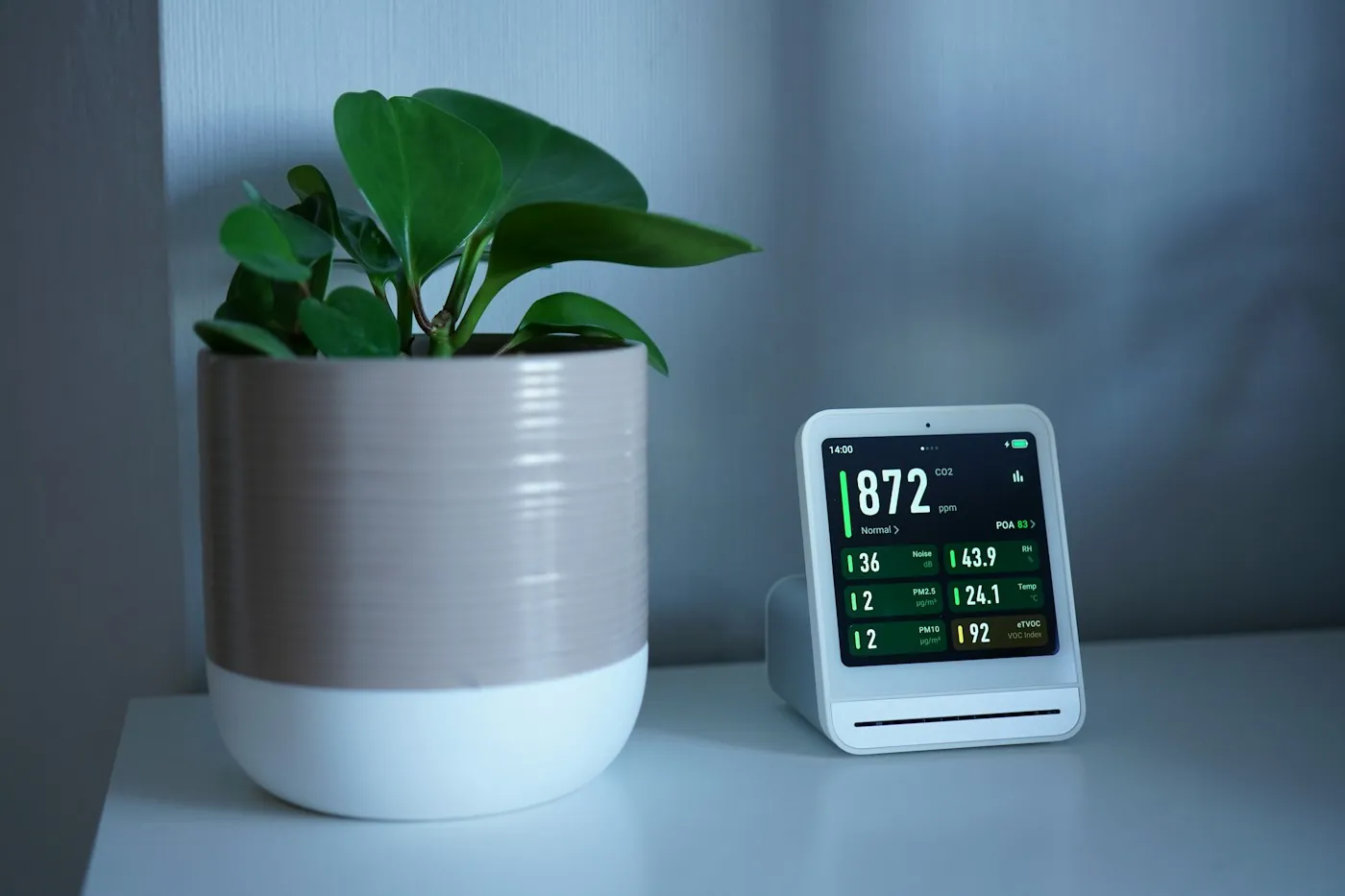
A professional-grade indoor sensor reads PM2.5 and often PM10 dust, CO2, VOCs, relative humidity, and temperature, continuously. That is the full honest list. Everything a smart home does with air starts from those readings and ends in a fan, a filter, or a fresh-air unit.
PM2.5 is the number worth learning. It means airborne particles under 2.5 microns across, small enough to stay suspended for hours. The World Health Organization's 2021 guidelines set the benchmark. An annual average of 5 micrograms per cubic metre, and 15 over 24 hours[1].
Dubai gives that reading more work to do than a temperate city would. Dubai Municipality runs its own ground-station air quality network across the city, so outdoor data exists[2]. What changes indoors is dust. The shamal is a hot northwesterly wind that raises dust across the region through the summer months. It is a documented seasonal feature here, not a rare event[3].
Be careful what you read next. We could not find a single government-published PM2.5 figure for a Dubai villa during dust season, and plenty of pages quote one anyway. We will not repeat a number we cannot trace. A sensor gives you the reading in your own room, on your own day. That is the only figure that applies to your house.
The Zennio Flat Sensato v2, a KNX sensor, is specified at plus or minus 0.5 degrees Celsius and 3 percent relative humidity[4]. That is a good instrument for a room and a useless one for a person.
What the automation does with it is simple: a rising particulate reading steps up filtration or runs the fresh-air unit harder. Dust events are covered in our guide to smart homes during a Dubai sandstorm.
Does CO2 in a room actually affect how you feel?
The honest answer is that the evidence is contested, and the standards body itself says so. What a CO2 reading reliably tells you is much simpler: the room needs more fresh air. That is the claim we make and the only one we can support.
Here is the full picture, because it is usually sold to you as settled. ASHRAE, the body that writes the ventilation standards, published a position document on indoor carbon dioxide in February 2025. It states that evidence for direct effects of CO2 on health, wellbeing, sleep, and work performance at normal indoor levels is inconsistent. That evidence does not justify changing ventilation standards[5].
The study everyone cites on the other side is real. Allen and colleagues, publishing in Environmental Health Perspectives in 2016, tested office workers under controlled ventilation. Cognitive scores were substantially higher on well-ventilated days near 500 ppm than on conventional days near 945 ppm[6]. It was an office cognition study, not a home study and not a medical one.
It has not reliably replicated. A Danish team exposed people to pure CO2 at 1,000, 3,000, and 5,000 ppm and found no matching drop in cognitive scores. A drop appeared only when CO2 rose along with the other things people exhale, which suggests those, rather than CO2 itself, may be doing the work. ASHRAE cites that result directly in the same 2025 document[5].
And the 1,000 ppm number? It is not a health limit and never was one. ASHRAE Standard 62.1 does not set a CO2 limit value at all[5]. It sat in an informative appendix to the 1989 edition, tied to a ventilation rate. It was pulled in 1999 because people kept reading it as a safety threshold. The idea traces back to Max von Pettenkofer, a 19th-century engineer, who offered it as a marker of adequate ventilation[7].
ASHRAE's own 2025 position is that the evidence linking indoor CO2 to health and wellbeing at normal indoor levels is inconsistent. Treat 1,000 ppm as an old ventilation rule of thumb, not a safety line.
Used properly, CO2 is still the most useful single number in a bedroom. It rises when a closed room is occupied and falls when air moves. That makes it an excellent trigger for a fresh-air unit or a fan, and a poor basis for any claim about your body.
What humidity range should a Dubai home hold?
Below 60 percent relative humidity, and ideally between 30 and 50 percent. That is the US Environmental Protection Agency's stated guidance for indoor humidity, and it is the band we design ventilation around[8].
The reason is moisture, not comfort alone. The EPA lists sustained humidity around 60 percent among the indicators of a moisture problem in a building[8]. Damp surfaces and damp air are what mould needs. Keep the air below that line and the conditions do not persist.
Outdoor humidity along the coast runs high for months, so every door opening imports moisture. Then the AC pulls it back out, which is why an unoccupied, unconditioned villa behaves so differently from a lived-in one.
Where it actually bites: bathrooms, laundry rooms, and any steam or wet zone. A humidity sensor driving the extract fan beats a timer, because it runs until the reading drops rather than for a fixed ten minutes. For how each room should be planned, see our room-by-room villa automation guide.
The sensor reads water vapour in the air, nothing more. It does not detect mould, and no home sensor we specify does. Confirming mould still needs eyes on the surface, or a lab.
Does bedroom temperature affect sleep?
Yes, and this one has genuine physiological research behind it. It is a sleep-quality and comfort finding, not a medical claim, and we keep it framed that way.
Okamoto-Mizuno and Mizuno reviewed the effects of the thermal environment on sleep and circadian rhythm in the Journal of Physiological Anthropology in 2012. Heat exposure increased wakefulness and reduced both REM and slow-wave sleep, and humid heat made the effect worse[9]. In Dubai, humid heat is most of the year.
The same review adds a useful caveat. With realistic bedding, no significant difference in sleep appeared across an ambient range of 13 to 23 degrees Celsius[9]. What people cover themselves with matters as much as the thermostat number.
The practical version is unglamorous: hold a steady overnight setpoint instead of letting a room swing. A thermostat that holds a band is addressing comfort, nothing more. See how to automate AC in a Dubai home for villas and split systems, and smart thermostats on district cooling for apartments on Empower, Emicool, or Tabreed. Zone-by-zone climate control sits under smart lighting and climate.
Does light timing matter for sleep?
Yes, and it is a lighting design question rather than a health one. Our article on circadian lighting in Dubai covers the mechanism, the tunable-white control systems, the wiring, and the real costs in full.
That article draws the same line we do: a lighting design choice, not a clinical device.
Does noise affect sleep, and can a smart home help?
Noise affects sleep enough that the World Health Organization sets numbers for it. WHO's 2018 environmental noise guidelines for Europe recommend night noise below 45 decibels Lnight for road traffic, 44 for railways, and 40 for aircraft. All three are strong recommendations[10].
Read those figures for what they are. They describe outdoor noise from a source, measured across the night, and they were written for European policy. They are a benchmark for how seriously to take night noise, not a setting you dial into a Dubai bedroom.
A sound sensor logs the decibel level in a room, in the same family as PM2.5 and humidity. It tells you whether the Sheikh Zayed Road side of a Business Bay apartment is louder at 2am than the courtyard side. That is worth knowing before you pick a bedroom.
What actually fixes it is mostly not electronics. Better glazing, heavier doors, soft surfaces, and quieter mechanical equipment do the work. Automation helps at the edges: closing motorised curtains adds a little absorption, and quieter overnight fan speeds help more than people expect.
Can a smart home tell you anything about your water?
Not about whether your water is safe to drink. No sensor we specify makes a claim about water quality, and we would not recommend one that did. Water regulation in Dubai sits with a regulator and a utility, not with a home automation panel.
The framework exists at two levels. The World Health Organization publishes the global reference framework for drinking-water quality[11]. In Dubai, the Regulatory and Supervisory Bureau publishes formal water quality regulations for the sector[12]. DEWA states that it tests supply regularly through its own central laboratory.
Neither of those is something a smart home reads. If you want your tap water tested, that is a lab sample, not a device on a wall.
What a smart home does with water is different. Leak sensors and flow meters protect the building. They catch a burst hose under a sink or a slab leak that would otherwise run for a weekend. That is property protection, and it says nothing about what is in the water.
What do wearables actually measure, and do we install them?
Wearables measure the person, and no, we do not include them in any system we design as a health feature. They are a separate product category, bought and worn by the individual, regulated on their own terms by their own makers. Their real claims are narrower than the marketing around them.
| Device | The maker's own claim | Regulatory status | Is this a Dubai Smart Home feature? |
|---|---|---|---|
| Apple Watch, Sleep Apnea Notifications | Flags possible signs of moderate to severe sleep apnea in adults without a prior diagnosis, framed by Apple as a prompt to see a doctor rather than a diagnosis[13] | FDA-cleared in September 2024, for notification only[13] | No. A watch the wearer buys and wears |
| Oura Ring | Heart rate, heart rate variability, skin temperature, and sleep staging. Oura's own words: "Oura is not a medical device"[14] | Wellness product. No medical clearance claimed[14] | No |
| Withings Sleep Analyzer (Europe) | Withings states it is "considered a medical device in Europe" and logs breathing-disturbance events in its own app[15] | CE-marked in the EU[15] | No. A mat the person buys, with its own maker, its own app, and its own clearance |
| Withings Sleep Rx (United States, separate product) | Positioned as an aid to a clinician assessing obstructive sleep apnea at home, and explicitly not a replacement for a full sleep study[16] | FDA 510(k) clearance K231667, prescription only[16] | No. Prescription-only, through a clinician |
| Home sleep apnea test devices (the clinical tier) | Produce a clinical index a sleep physician uses to diagnose[17] | FDA-cleared diagnostic devices, ordered by a doctor[17] | No. This tier belongs to medicine |
Notice the pattern. Even the cleared features describe themselves as a notification or an aid, not a verdict. The stricter the clearance, the more careful the wording gets.
If you already own one: we can show its app data on the same dashboard as your lighting and climate scenes, as a display convenience only. We make no claim about its accuracy, and nothing in your home acts on it. The data, and the responsibility for it, stay with the wearable's maker.
Anything tied to a named person's body or sleep timing is a more sensitive category of data than a plain motion sensor. Our guide to smart home privacy in Dubai covers what each device collects and the settings that cut it down. Keeping sensor data local rather than cloud-bound is a home network decision too.

Can my home detect a fall, a heart problem, or sleep apnea?
No to all three. These are the questions that bring most people to this page.
A fall. No. A presence or motion sensor can notice that a room has been still for an unusual length of time and send a notification to a family member. That is a prompt for a human to check, not a detection of a medical event, and it does not prevent anything. Our guide to smart homes for elderly parents in Dubai covers the sensor options, the consent questions, and the honest limits in full.
A heart problem. No. A smart home has no heart sensor of any kind. Nothing on a wall or ceiling can read a pulse or a rhythm. If you want that data it comes from a wearable you choose, and even a cleared wearable feature is written as a prompt to see a doctor.
Sleep apnea. No, and we do not specify anything marketed as doing it. As the table above shows, apnea-related functions exist only inside specific wearables and clinical devices, each with its own clearance. A room sensor has no way to read a sleeping person's breathing. It reads the air in the room, which is a different thing entirely.
If any installer answers those three questions differently, ask which regulator cleared the product and for exactly which claim. The answer is on the maker's own page, and it is usually narrower than the sales pitch.
Is there a UAE rule about this?
Not one that draws the line for you. There is a federal medical device regulator, and there is no published UAE policy separating a low-risk consumer wellness product from a device that needs registration. This section is a plain description of what we found, and it is not legal advice.
Start with what is clear. The Emirates Drug Establishment, a federal body set up in 2023, calls itself the only federal authority regulating all medical and pharmaceutical products. It names medical devices in that scope[18]. Medical device regulation in the UAE has been consolidating under it, with the Ministry of Health and Prevention having held the role historically.
We are deliberately not putting dates or a clean before-and-after on that handover. The secondary sources we checked disagree on the detail, and we could not confirm it on a regulator's own page. Where the Dubai Health Authority sits in the current picture is a question for the DHA, not for us.
Here is the gap that matters. The United States FDA publishes a general wellness policy that carves low-risk lifestyle products out of medical device regulation. We searched for a UAE equivalent from any of the three bodies above and found nothing published. That is a confirmed gap in what is available, not a gap in our reading.
So we cannot point at a rule that says an air quality sensor is not a medical device in the UAE, and we are not going to pretend otherwise. What we can say is what the general pattern of device regulation turns on almost everywhere: the maker's stated intended use, and the claims made when selling it.
Which leads to a policy rather than a loophole. We make no diagnostic, screening, treatment, or prevention claim about anything we design or recommend, ever. Not because we have confirmed an exemption, but because that claim is the thing that would put a comfort product in the wrong category. For the general legal side of smart homes here, see our guide to smart home laws and regulations in Dubai.
What wellness smart home features do we actually design in Dubai?
Environmental and comfort systems, and nothing beyond them. Air quality sensors reading PM2.5, CO2, VOCs, humidity, and temperature. Ventilation and filtration that respond to those readings. Circadian-timed lighting. Zone-by-zone climate control. All of it designed and presented as comfort, across 100+ projects our team has worked on since 2016[19].
| Factor | What is measured | The benchmark we cite | Source |
|---|---|---|---|
| Fine dust (PM2.5) | Particles under 2.5 microns, in micrograms per cubic metre | 5 annual average, 15 over 24 hours | WHO Global Air Quality Guidelines, 2021[1] |
| Carbon dioxide (CO2) | Parts per million in room air | No health limit exists. Used only as a signal that the room needs fresh air | ASHRAE position document on indoor CO2, 2025[5] |
| Relative humidity | Water vapour in the air, as a percentage | Below 60 percent, ideally 30 to 50 percent | US EPA guidance on mould and moisture[8] |
| Temperature | Room air temperature in degrees Celsius | A steady overnight band, since heat and humid heat disturb sleep | Okamoto-Mizuno and Mizuno, 2012[9] |
| Night noise | Sound level in decibels | Below 45 dB Lnight for road traffic, 44 for rail, 40 for aircraft, measured outdoors at source | WHO environmental noise guidelines, 2018[10] |
And here is what we will not do, written down so you can hold us to it.
- We will not specify anything marketed as diagnosing a condition. If a product's own marketing claims diagnosis, it does not belong in a smart home package.
- We will not say a sensor in a system we designed "monitors your health". A CO2 or PM2.5 sensor monitors a room. It does not monitor a person.
- We will not claim a sensor detects a fall as a medical event. It sends a notification to a person. That is all it does.
- We will not claim anything we specify detects, screens for, or tracks sleep apnea. That function lives in specific regulated products a person buys and wears.
- We will not present heart rate, blood oxygen, or similar readings as data your home tracks. Your home has no such sensor. If you own a wearable, that data stays with the wearable and its own app.
- We will not invent an outcome statistic. No "cuts allergy symptoms by X percent" lines. We found no citable source for any such figure, and we will not create one.
What that leaves is still worth having. Air that gets filtered when the dust rises. A bathroom fan that runs on the humidity reading instead of a timer. A bedroom that holds its temperature through the night. That is the honest scope of wellness and comfort work in a Dubai home.
If you want it built properly, we map the rooms first and tell you which sensors are worth fitting and which are not. Our Dubai team answers enquiries within 2 hours, and we coordinate the installation of everything we design. Book a consultation, message us on WhatsApp, or see what Dubai Smart Home covers under wellness and comfort.
And if what you need is an answer about your own body, please ask a doctor. We design rooms. That is the job we are qualified to do, and when you are ready for it, get in touch.