A home charger can go wrong in Dubai in ways a global guide never mentions. Without load management, it can trip your villa's main breaker on a July evening. A quote can subtract a "DEWA subsidy" that DEWA does not list. And a wallbox on a sun-facing wall can slow down on the hottest days.
The design team at Dubai Smart Home wrote this guide, drawing on 100+ smart home projects our team has worked on since 2016. Every DEWA rule and tariff below was read on DEWA's own pages on 2 October 2026. This guide is one chapter of our complete smart home guide for Dubai.
How much does a home EV charger cost in Dubai in 2026?
Installing a home EV charger in a Dubai villa starts from AED 2,400 on our energy page. A charger fitted with nothing else changed costs AED 2,400 to 5,000, and that band includes a load study and dynamic load management. Long cable runs, board changes and apartment car parks are priced after a site survey.
Our EV charger and energy management service publishes that band, with an itemised quote after the free survey.
The table sets out five ways to charge at home, with costs and approvals.
| Scope | Typical AED | What is included | Approvals you need |
|---|---|---|---|
| Villa, three-phase, short cable run | AED 2,400 to 5,000 fitted | Load study, load management and installation. Up to 22 kW on three-phase[1] | A DEWA-approved electrical contractor. No separate DEWA home permit[2] |
| Townhouse or villa on single-phase | AED 2,400 to 5,000 fitted | As above, capped near 7.4 kW on single-phase[1] | As above, plus any community sign-off for an exterior or shared wall |
| Villa with a long run or board work | Quoted after the survey | Extra cable or trenching, a board upgrade or a bigger supply | A DEWA connection application through an enrolled contractor[1] |
| Apartment with an assigned bay | Quoted after the survey | Cable from your unit's meter to your bay | Building management approval[3]. Connects behind your own meter[2] |
| Portable cable in a 13A socket | AED 379.99 to 689.99 for the cable (amazon.ae, 2 October 2026)[4] | At most about 3 kW from a socket rated 13 A[5] | None, but DEWA restricts extension cords[1] |
The bottom row is the cheap start, and the top row is the long-term answer for a villa.
Is there a DEWA subsidy for a home EV charger?
DEWA's own pages show no subsidy for a home EV charger. On 2 October 2026 we read DEWA's EV charging FAQ, its EV Green Charger pages and its tariff page. None of them lists a subsidy, rebate or grant for a private home charger[2][6][7][8].
Several installer websites, and Microsoft's Bing Copilot, describe a DEWA subsidy of up to AED 10,000 for a villa charger. We traced it to installer blogs and to a website on a lookalike address, one letter away from a Dubai government portal. No DEWA page, DEWA press release or national news report that we found carries it.
In 2018, when DEWA offered free public charging, it said the offer did not include home charging stations[9]. Its EV Green Charger programme, launched in 2015, is about public charging[6], and the UAE's national EV policy page lists no home-charger grant[10].
Real talk: if a quote subtracts AED 10,000 as a "DEWA subsidy", your real price is AED 10,000 higher than its bottom line. Ask which DEWA document the deduction comes from. A car dealer's free charger offer is a sales promotion, not a DEWA scheme. Before you count on any rebate, call DEWA on 04 601 9999 and ask for it in writing[2].
What does each part of the bill cost, in year one and year two?
A villa charger's first-year cost has four parts: the charger, the installation, any supply or board change, and the electricity. Every 3,600 kWh of home charging adds AED 1,096 to 1,663 to your DEWA bill, depending on your slab[8].
The table adds up year one, then shows what carries into year two.
| Item | Typical AED | Notes |
|---|---|---|
| Charger | AED 1,349 to 6,449 | The lowest is the Wallbox 11 kW in our catalogue (amazon.ae, 19 July 2026, see the charger table below). ABB's Terra AC 22 kW was AED 6,449 on amazon.ae on 2 October 2026[4]. BYD UAE lists a Standard home charger from AED 1,950, including VAT (August 2025)[3] |
| Installation, standard villa job | AED 2,400 to 5,000 fitted | Our energy page band, with a load study and load management. Itemised after the free survey |
| Longer cable run | Quoted after the survey | Grows with the distance from board to bay |
| Board upgrade or bigger DEWA supply | Quoted for your villa | A DEWA connection application through an enrolled contractor[1] |
| DEWA permit fee | None published | DEWA's FAQ says only that a DEWA-approved contractor should be used[2] |
| Community approval | Ask your community | Some communities sign off exterior walls and shared car parks |
| Green Charger card (optional) | AED 500 refundable deposit plus AED 20 delivery | For DEWA's public chargers only[2][7] |
| Electricity, year one (3,600 kWh) | AED 1,096 to 1,663 | Slab rate, 6-fil fuel surcharge and 5% VAT. An example volume, not an average[8] |
| Year two | AED 1,096 to 1,663, plus any service visit (quoted) | The 12-month workmanship warranty, which can vary by product, has ended. BYD's charger warranty runs 2 to 5 years by model[3] |
The two quoted lines depend on your board and your bay. To get them priced, ask for a free site survey and itemised quote, or send a photo of your distribution board and parking bay on WhatsApp.
Do you need DEWA approval to install an EV charger at home?
No separate DEWA permit is published for a private villa charger. DEWA's FAQ says a home charger can be installed by a third party (not DEWA) behind your meter, like any other home appliance. It adds that DEWA-approved electrical contractors should be used to install any electrical equipment in Dubai, home chargers included. The power goes on your normal bill[2].
The "DEWA approval is mandatory" line you see online most likely comes from Directive No. 1 of 2017. It says public and private organisations and developers must get DEWA approval before they set up, run or maintain an EV charging station[2]. DEWA's FAQ sets a simpler route for a home charger.
DEWA's operator licensing is also about public charging. Since 31 March 2025, any operator other than DEWA and its subsidiaries that runs public charging equipment needs a charge point operator licence[11]. Your own wallbox sits outside it.
If your supply has to grow for the charger, that is a DEWA connection application made through an enrolled contractor, and it is quoted for your villa[1]. DEWA publishes a list of its enrolled contractors, so you can check a name before you sign[12]. For the procedure at your own home, DEWA's FAQ points you to Customer Care on 04 601 9999[2].
BYD's Charge2MOOV page (August 2025) says a home installation generally takes up to five days from the survey, subject to approvals[3]. DEWA publishes no timeline for a private charger, so question any quote that adds weeks of "DEWA approval".
Outside Dubai, ask your utility first. TAQA Distribution (formerly ADDC) in Abu Dhabi has described a registration step for home chargers and a separate EV meter, so check its current EV page before you install. The Sharjah Electricity, Water and Gas Authority (SEWA) and Etihad Water and Electricity (EtihadWE) have not published a dedicated home charger process that we could find.
How much does it cost to charge an EV at home on DEWA's slab tariff?
Charging at home costs about AED 0.30 to 0.46 per kWh in Dubai once DEWA's 6-fil fuel surcharge and 5% VAT are added[8]. Public AC charging costs AED 0.735 per kWh with VAT[2]. So a 60 kWh top-up costs AED 18.27 to 27.72 at home, against AED 44.10 on a public AC charger.
A home charger sits behind your existing meter, and its power is billed at standard residential rates[2]. Those rates rise in slabs: 23 fils per kWh up to 2,000 kWh a month, 28 fils to 4,000, 32 fils to 6,000 and 38 fils above that. The October 2026 fuel surcharge adds 6 fils, then 5% VAT applies[8].
The table prices one 60 kWh charge and an example of 300 kWh a month. It leaves out charging losses, which have no official figure.
| Rate | Per kWh incl. surcharge and VAT | One 60 kWh charge | 300 kWh a month | 3,600 kWh a year |
|---|---|---|---|---|
| Home, 23-fil slab (0 to 2,000 kWh a month) | AED 0.3045 | AED 18.27 | AED 91.35 | AED 1,096 |
| Home, 28-fil slab (2,001 to 4,000 kWh) | AED 0.357 | AED 21.42 | AED 107.10 | AED 1,285 |
| Home, 32-fil slab (4,001 to 6,000 kWh) | AED 0.399 | AED 23.94 | AED 119.70 | AED 1,436 |
| Home, 38-fil slab (6,001 kWh and up) | AED 0.462 | AED 27.72 | AED 138.60 | AED 1,663 |
| Public AC (DEWA EV Green Charger) | AED 0.735 | AED 44.10 | AED 220.50 | AED 2,646 |
| Public DC (DEWA EV Green Charger) | AED 1.26 | AED 75.60 | AED 378 | AED 4,536 |
Even on the top home slab, 3,600 kWh a year costs AED 983 less than the same energy from public AC chargers.
DEWA's EV charging FAQ puts public charging at AED 0.70 per kWh for AC and AED 1.20 for DC, plus VAT, under Cabinet Decision No. 81 of 2024[2]. The EV table on DEWA's tariff page lists AED 0.64 and AED 1.14, a 6-fil gap that matches the October 2026 fuel surcharge[8]. We use the FAQ figures here, as did Emirates 24/7 in August 2026[13].
Quick math: DEWA bills each band of monthly consumption at its own rate. So the kWh your car adds are billed at the band your villa has already reached that month. If your villa has passed 6,000 kWh in July, each kWh the car takes costs AED 0.462. On 300 kWh, that comes to AED 138.60, not the AED 91.35 the lowest slab suggests.
By August 2025, DEWA reported more than 19,000 registered EV Green Charger users and over 1,500 public charging points[14].
Real talk: owners report queues at public chargers. A YouTube short from tbreak on charging in Dubai without a home charger says it can take 40 minutes to an hour before charging even starts. Viewers describe taxis and ride-hail cars occupying chargers around the clock. These are owner reports, not DEWA figures, but a home charger skips the queue.
For the rest of a July bill, see our summer DEWA bill guide and our guide to reducing a DEWA bill with a smart home. Our DEWA smart meter guide explains what the meter can and cannot report.
Rooftop solar changes the sum. Under Shams Dubai net metering, a villa's panels offset its own consumption, the car's kWh included[15]. Our solar panel, inverter and battery range lists the kit with UAE prices, and our Shams Dubai solar guide walks through the six-step process.
What does DEWA's technical regulation require of a home charger?
DEWA's EV Charging Technical Regulations, Version 1.0 of May 2025, cover private chargers as well as public ones[1]. DEWA defines a private charger as one in a restricted-access area for the exclusive use of individuals or groups, so a villa wallbox counts.
- Supply: 230 V single-phase or 400 V three-phase, at most 32 A per phase, up to 22 kVA per charge point.
- Connector: Type 2 (IEC 62196-2), charging in Mode 3, the wallbox mode.
- Protection: a 4-pole isolator rated 30 kA, and a 30 mA class A RCD, the safety switch that cuts power if current leaks to earth.
- Enclosure: IP54 for dust and water, IK10 for impact, and under 60 dB at 1 metre.
- Heat: full capacity up to 55°C and 95% humidity, indoors or outdoors.
- Standards: the IET Code of Practice for EV charging, BS 7671 and the Dubai Building Code's section G.5 on EV charge points[1].
We found no DEWA list of approved home charger brands, so ask your contractor to confirm in writing that your unit meets these rules. We also found no separate Dubai Municipality or Civil Defence rule for a private home charger. If a quote mentions another approval, ask which authority and which document.
Should a Dubai villa get a 7 kW, 11 kW or 22 kW charger?
Match the charger to your supply and your car, not to the biggest number on the box. DEWA caps home AC chargers at 32 A per phase, so a single-phase supply tops out near 7.4 kW and a three-phase supply near 22 kW[1]. An 11 kW unit runs at about 16 A per phase on three-phase.
Start with the supply. Three-phase means three live wires feed the villa, carrying about three times the power of single-phase. Many Dubai villas are fed three-phase, but not all. Your main distribution board shows which you have, and a survey confirms it before anyone quotes a 22 kW unit.
A 60 kWh top-up takes about 8 hours at 7.4 kW, under 6 hours at 11 kW and under 3 hours at 22 kW, before charging losses.
Real talk: a car charges at the lower of two limits, the wallbox and its own onboard charger. If your car accepts 11 kW of AC, a 22 kW wallbox still gives it 11 kW. On amazon.ae on 2 October 2026, the Wallbox Pulsar Plus cost AED 3,698.28 in its 22 kW version and AED 2,097 at 7.4 kW[4]. Check your car's onboard charger figure before you pay that gap. The 22 kW unit only pays off when your car, or the next one you buy, accepts 22 kW.
Which home chargers can you buy in the UAE, and what do they cost?
Type 2 wallboxes from Wallbox, ABB, Tesla and Autel are all sold through amazon.ae. On 2 October 2026 they ran from about AED 2,100 for a 7.4 kW Wallbox Pulsar Plus to AED 6,449 for a 22 kW ABB Terra AC[4]. Two European brands, myenergi's zappi and Easee, had no UAE seller we could find.
Both brands list operating ranges that stop at 40°C[16][17], well short of DEWA's 55°C, so their absence costs a Dubai buyer little. The table compares six units that are sold here.
| Model | Max power | Heat rating (datasheet) | Load management | UAE price (retailer, date) |
|---|---|---|---|---|
| Wallbox Pulsar Plus | 7.4 kW; 22 kW version on three-phase | Full output to 40°C, derated to 50°C. IP54, IK08[18] | Power Boost CT clamp turns charging down as the house draws more[19] | AED 2,097 to 2,130 (7.4 kW), AED 3,698.28 (22 kW), amazon.ae, 2 October 2026[4] |
| Wallbox Pulsar Max | 22 kW, three-phase | Full output to 40°C, runs to 50°C. IP55, IK10[20] | Power Boost | AED 2,590.79 to 2,786.17, amazon.ae, 2 October 2026[4] |
| ABB Terra AC (W22-G5-R-C-0) | 22 kW, three-phase | Runs to 50°C, may derate. IP54, IK10[21] | Built-in meter. Pauses and resumes charging[22] | AED 6,449, amazon.ae, 2 October 2026[4] |
| Tesla Wall Connector (Universal, Type 2) | 22 kW three-phase, about 7.4 kW single-phase | Runs to 50°C. May reduce current from about 35°C in rare cases[23] | Shares a circuit between up to six Wall Connectors. Does not read the house load[24] | AED 2,300, amazon.ae, 2 October 2026[4]. AED 2,736 on noon.com[25] |
| Autel MaxiCharger AC 22 kW | 22 kW, three-phase | Runs to 55°C. IP65, IK10[26] | Dynamic load balancing[26] | AED 2,451.75, amazon.ae, 19 July 2026[27] |
| Wallbox 11 kW three-phase (GCC spec) | 11 kW, three-phase | IP65. Temperature range not in the listing | Not in the listing | AED 1,349, amazon.ae, 19 July 2026[27] |
For a three-phase villa on a budget, see our Wallbox 11 kW three-phase charger page. For the 55°C rating and a socket for your own cable, see the Autel MaxiCharger 22 kW listing. For a bay far from the wall, the Tesla Wall Connector page covers its 7.3 metre cable and confirms it works with any Type 2 car.
All three sit in our energy management range, beside clamp-style meters that show what the rest of the villa draws. If the charger's app needs Wi-Fi at the bay, a weak garage signal is a home networking and Wi-Fi fix.
Common mistake: buying the wrong plug. amazon.ae also lists an Autel MaxiCharger with a North American NEMA 14-50 plug, built for 240 V and 40 A, at AED 2,484.98 on 2 October 2026[4]. That is within AED 35 of the Type 2 version, and the listings look alike. Check for "Type 2" and a 230 V or 400 V supply before you pay.
Pro tip: pick a charger whose app logs kWh per session. The DEWA bill shows one total, so the app is the cleanest way to split the car from the AC. That matters most in July, when the car's kWh land on your highest slab.
Will a wallbox survive a Dubai summer on an outdoor wall?
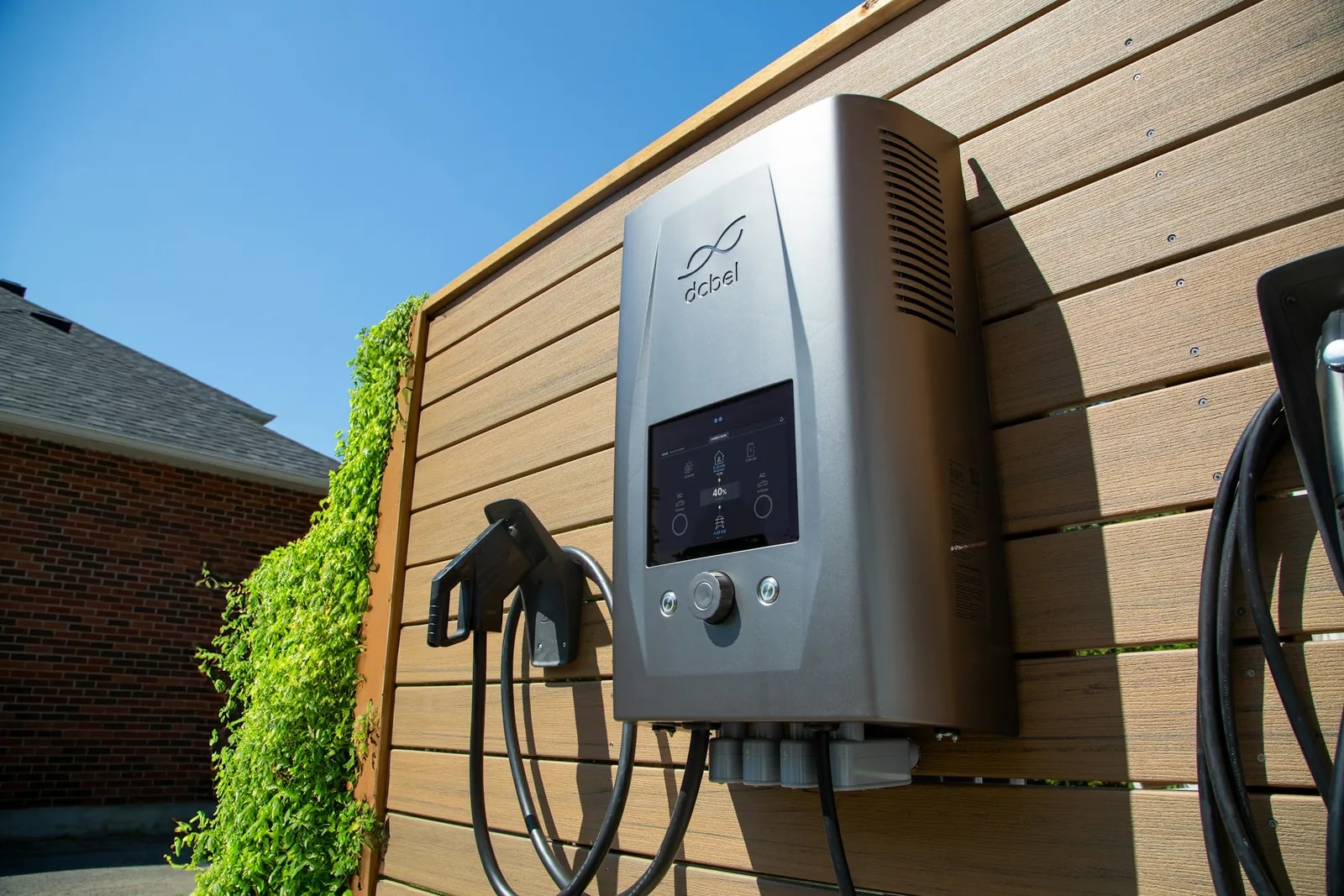
Whether a wallbox survives a Dubai summer depends on its datasheet and on the wall. DEWA's EV charging technical regulations ask that chargers run at full capacity up to 55°C[1]. Several popular wallboxes publish full output only to 40°C and slow down above it[18][20]. Read the temperature line on the datasheet before you choose a unit for a sunny wall.
Slowing down is called derating: the charger lowers its current to protect itself, and the car charges more slowly. Tesla advises siting its Wall Connector where the air stays below 50°C[23]. Of the units we checked, only Autel's MaxiCharger AC is rated to 55°C[26].
A charger in a carport, or on a wall shaded in the afternoon, starts each evening cooler than one in full sun. The zappi datasheet, for example, gives its range for a unit kept out of direct sunlight[16].
Check the enclosure too. DEWA asks for IK10 impact protection[1], while the Pulsar Plus datasheet lists IK08[18], so ask your contractor whether that matters for your wall.
Why does the cable run decide the installation price?
The cable run is the part of the job that is different at every villa. A 22 kW charger needs cable sized for 32 A on each phase, all the way from your distribution board to the bay[1]. A longer route means more cable, more conduit and more labour.
Spare capacity comes first. BYD's Charge2MOOV page says a villa job is simple once standby power availability is confirmed[3], meaning there is room at your board for the charger. If there is not, load management or a supply change enters the quote.
After that, the route decides the work. Surface conduit along a garage wall is quicker than trenching under a driveway.
A long run can cost far more than the charger. On Reddit's r/dubai forum, one Palm Jumeirah apartment owner said a 170 m run from the parking to the flat was quoted at AED 18,000. That is a single report, not a villa price.
If you are building or renovating, ask for an empty conduit from the board to each bay at first fix, before the walls are closed. It saves chasing walls or lifting paving later.
Will an EV charger trip your villa's main breaker in July?
A charger can trip the main breaker in July if nothing manages the load. On a July evening your AC, pool pump and charger can all run at once, and a 22 kW charger alone can draw 32 A on each phase[1]. Dynamic load management reads the house load and cuts the charging current before the main breaker trips.
Wallbox Power Boost turns charging down as the house draws more, using a CT clamp, a sensor clipped round the supply cable[19]. Autel's dynamic load balancing adjusts its output to the load[26]. ABB's Terra AC pauses and resumes instead[22]. Tesla's Wall Connector shares power only between Wall Connectors and does not read the rest of the house[24]. A charger that turns down keeps the car gaining some charge through a busy evening, while one that pauses stops it.
Our energy page builds dynamic load management into its AED 2,400 to 5,000 band, so the main breaker holds[27]. Scheduling the AC through smart lighting and climate control also frees headroom, because the units no longer all start at once. Pool pumps can run by day under pool and outdoor automation, away from the evening charging window.
If your board already struggles in summer, ask for a site survey and load study before you choose a charger.
Can you charge from a normal 13A socket instead?
Yes, a 13A socket can charge an EV, but slowly. A UAE Type G socket is rated to 13 A, about 2,990 W at 230 V[5]. A portable Type 2 cable plugged straight into it adds at most about 3 kW. DEWA's technical regulations restrict Mode 1 and Mode 2 charging cables used with extension cords[1].
At 3 kW, a 60 kWh top-up takes about 20 hours, which can still suit a low-mileage driver. Portable cables with a UK-style plug and current adjustable from 6 to 13 A were listed at AED 379.99 to 689.99 on amazon.ae on 2 October 2026[4].
The American "Level 1 at 120 V" idea does not apply here. UAE homes run on 230 V, as our guide to Dubai's 230 V supply explains. The limit that matters is the socket's 13 A, covered in our smart plug and socket load guide.
Common mistake: running the cable through an extension lead from an upstairs socket. DEWA's regulations restrict it on safety grounds[1]. Plug straight into a wall socket and keep it free for the car. If the plug feels hot after a few hours at 13 A, stop and have the circuit checked.
The cheapest honest upgrade is a dedicated outlet on its own circuit, used with a portable cable. It is still fixed wiring, so have an approved contractor put it in.
Do townhouse owners, tenants and gated communities face extra steps?
Townhouses, tenancies and gated communities add steps when the wall or the parking bay is not yours alone. Some gated communities and master developers ask for their own approval before a charger is mounted on an exterior wall or in a shared car park. Check with your community management before work starts.
In a townhouse, check whether the exterior wall comes under community rules, and whether your supply is single-phase. Single-phase caps a wallbox near 7.4 kW[1], which still refills 60 kWh in about 8 hours.
If you rent, get the landlord's written consent before any wiring, and agree who pays, whether the charger stays and who removes it. The power runs behind the meter on the home's DEWA account[2], so the account holder pays. Our landlord's guide to smart home technology shows the owner's side.
In an apartment, BYD notes that building-management approval comes first[3], and the charger connects behind your own meter[2]. If your bay is far from the meter room, the run length and the building's rules decide whether it is practical.
How do you read an EV charger quote, and which lines are red flags?
A good EV charger quote names the charger model, the cable size and run length, the isolator and RCD, the load management method and the contractor. A red flag is any fee DEWA does not publish for a home charger, such as a "DEWA approval fee", or a subsidy deducted from the total[2].
These lines should be on every quote:
- The charger's make, model, power and datasheet heat rating.
- The cable size and route length, board to bay.
- A 4-pole isolator and a 30 mA class A RCD, DEWA's minimum[1].
- The load management method, and where the CT clamp sits.
- The contractor's name, which you can check on DEWA's enrolled list[12].
Treat these as red flags:
- A "DEWA approval fee" or "registration fee" for a home charger. DEWA publishes none[2].
- The AED 500 Green Charger deposit and AED 20 card fee shown as home costs. They belong to DEWA's public charging account[7].
- A DEWA subsidy subtracted from the total.
- "Off-peak" savings. DEWA's home tariff has no peak or off-peak hours[8].
- A 22 kW charger quoted for a single-phase supply.
If your quote has one of these lines, send it on WhatsApp and we will review it line by line.
What goes wrong with home EV chargers in Dubai?
Home chargers in Dubai go wrong in six predictable ways, and each one is decided before the charger goes on the wall. A site survey and a datasheet check catch most of them before any money is spent.
- No load study. A 22 kW charger adds up to 32 A per phase on top of the July AC load[1]. Fix: load management.
- A sunny wall. Several units give full output only to 40°C[18], so the car charges more slowly on hot evenings. Fix: shade, or a unit rated to 55°C.
- An extension lead. DEWA restricts charging cables used with extension cords[1]. Fix: plug straight into the wall, or move to a wallbox.
- The wrong plug. The NEMA 14-50 Autel on amazon.ae at AED 2,484.98 suits North America, not a UAE villa[4]. Fix: buy a Type 2 unit through a UAE retailer or distributor and ask for its UAE conformity paperwork. The Ministry of Industry and Advanced Technology (MoIAT) runs the conformity scheme for regulated electrical products.
- A subsidy in the budget. DEWA lists none for a home charger[2], so a budget that counts on one is AED 10,000 short. Fix: budget the full cost.
- 22 kW on single-phase. DEWA's 32 A limit holds it near 7.4 kW[1]. Fix: check the board first.
A tripped main breaker takes the whole villa dark, and our guide to smart homes in a Dubai power outage shows which devices stop and which carry on.
How Dubai Smart Home helps with a villa EV charger
Three decisions matter more than the brand. Confirm your supply before you choose the power. Choose a unit whose datasheet suits a Dubai summer wall. And budget for the full cost, because DEWA lists no home-charger subsidy.
We survey the villa, run the load study, and specify the charger and its load management. We prepare the paperwork, coordinate the work through to handover and configure the charger's app with you. DEWA's FAQ says DEWA-approved electrical contractors should be used for home charging stations, and every charger we specify is installed that way. The workmanship carries a 12-month warranty, and the term can vary by product.
Our energy management and solar service lists a charger fitted with nothing else changed at AED 2,400 to 5,000, load study and load management included[27]. You receive an itemised quote after the free site survey. If the charger is part of a wider plan, our upgrade roadmap for villa owners sets the order.
We are rated 4.9/5 by Dubai homeowners. To get your charger priced, book a free site survey, or share a photo of your board and parking spot with us on WhatsApp.