Walk into an electronics shop in Dubai Mall and you will see a small "Works with Matter" badge on half the boxes. Almost nobody can tell you what it means. Shop staff often cannot either.
We install and support smart home automation across villas and apartments in Dubai, UAE, and have done so since 2016. This guide explains Matter from the install side: what it is, what version 1.6 added on 17 June 2026[1], and the parts that still break. For the full comparison of the radios underneath it, read our guide to smart home protocols in Dubai.
What is the Matter protocol, in plain English?
Matter is a shared language for smart home devices. It is a protocol, not a radio and not a brand. A Matter-certified plug, bulb, or lock can be added to Apple Home, Google Home, and Amazon Alexa, and it behaves the same way in each one.
In plain English: the radio is the phone line. Matter is the language both sides speak on the call. Wi-Fi, Thread, and Ethernet carry the signal. Matter decides what the words mean once they arrive.
That single idea clears up most of the confusion at the shelf. Matter does not replace Wi-Fi, Zigbee, or Z-Wave. It sits on top of them. Our protocols comparison puts those radios side by side on range, battery life, and price. This article is about Matter alone, in depth.
Who runs Matter, and can you trust it?
Matter is run by the Connectivity Standards Alliance (CSA), an industry group whose members include Amazon, Apple, Google, Samsung, Signify (Philips Hue), Schneider Electric, Lutron, Huawei, and IKEA[3]. It began in December 2019 as Project Connected Home over IP, founded by Amazon, Apple, Google, and the Zigbee Alliance, which later renamed itself the CSA[4].
That founding list is the reason to take it seriously. Three companies that spent a decade building walled gardens agreed to one shared standard. In this industry, that does not happen often.
Matter is an open standard. The specification and its reference code are published by the CSA, and manufacturers join the alliance and pay to have each product tested against the spec.
What "Matter-certified" actually guarantees: the device passed a test suite for a defined set of commands. On, off, dim, set colour, lock, unlock, read a sensor. It guarantees the basics work in every ecosystem. It does not guarantee that the clever feature in the maker's own app comes with it. That gap gets a full section below.
When did Matter launch, and what version is current in 2026?
Matter 1.0 was published on 4 October 2022. The current version, as of July 2026, is Matter 1.6, released on 17 June 2026[1]. The CSA has settled into roughly two feature releases a year, with smaller maintenance updates in between.
Matter 1.6 is mostly about setup, and about homes that own more than one hub. Four parts stand out[1]:
- NFC setup. Tap a device with your phone to start pairing, even before the device has power.
- Joint Fabric. Two ecosystems can co-administer one shared network instead of each building its own.
- Thermostat Suggestions. A hub proposes a temperature change, and the thermostat decides whether to accept it.
- Capability reporting. A device tells the app what it can and cannot do, instead of the app guessing.
Matter 1.6 also shipped alongside a companion specification, Product Security 1.1[1].
Real talk: a new spec version is not a new feature in your house. It reaches you only when Apple, Google, Amazon, or Samsung update their own app to expose it. That delay is one of the seven limits covered further down.
What is the full Matter version history, 1.0 to 1.6?
Matter's version history runs from 1.0 in October 2022 to 1.6 in June 2026, and each release added device types or fixed something homeowners complained about. The table below lists the releases whose dates we could confirm against the CSA's own announcements or a cross-checked public record.
| Version | Released | What it added |
|---|---|---|
| Matter 1.0 | 4 October 2022 | The first public release: lighting, plugs, locks, thermostats, blinds, and sensors |
| Matter 1.4 | 7 November 2024 | Home energy devices: batteries, solar, and EV chargers |
| Matter 1.4.2 | 11 August 2025 | Security hardening, plus a rule that network routers support at least 150 devices |
| Matter 1.5 | 20 November 2025 | Cameras with live video and two-way audio, a Closures type for blinds, curtains and gates, soil sensors, and tariff and energy tools |
| Matter 1.5.1 | March 2026 | A maintenance update following the camera release |
| Matter 1.6 | 17 June 2026 | NFC setup, Joint Fabric co-administration, Thermostat Suggestions, capability reporting, and security sensor event history |
A note on the gaps. The CSA also shipped 1.1, 1.2, and 1.3 between 2022 and 2024. We have not printed release dates for those three, because we could not confirm each one against a primary CSA announcement. What they added is in the device table further down, which is the part that changes what you can buy.
Dates for 1.4 and 1.4.2 are worth separating, because they get merged a lot. The 150-device router rule and the security hardening belong to the 1.4.2 maintenance release in August 2025, not to Matter 1.4 itself[4].
Not sure which version your hub is actually running? Ask an engineer and get a free site visit →
How does the Matter protocol actually work?
Matter runs over three carriers: Wi-Fi, Ethernet, and Thread. Bluetooth is used only for the first setup, to hand the device its network details[3]. Every Matter device speaks standard internet language (IP), which is why one app can see all of them at once.
Which carrier a device uses is decided by its maker, not by you:
- Wi-Fi: mains-powered devices. Plugs, many bulbs, cameras, appliances.
- Ethernet: a small number of hubs, bridges, and TVs.
- Thread: battery devices. Sensors, locks, buttons, small blind motors.
- Bluetooth: setup only. It hands over once the device is on the network.
Matter is also local by design. A certified device must accept commands from inside your home, with no round trip to a server. In practice some devices still push their extras through the maker's cloud, so the promise is real but only partly delivered.
Common mistake: buying a Matter device and expecting it to fix a weak signal. Matter has no radio of its own. If your Wi-Fi does not reach the guest room, Matter will not reach it either. That is a network job, and it is the heart of our home networking and IT work.
What is Thread, and what is a Thread border router?
Thread is a low-power wireless mesh for battery devices, and a Thread border router is the box that joins that mesh to the rest of your home network. If you own a recent Apple TV, HomePod mini, Amazon Echo, or Google Nest Hub, you very likely own a border router already.
The Matter vs Thread confusion exists because they arrived together. They are different layers. Thread is the road. Matter is the language spoken on it. The Thread Group passed 1,000 certified products in November 2025[9].
A border router does two jobs. It passes traffic between the Thread mesh and your Wi-Fi, and it lets your phone reach a battery sensor that has no Wi-Fi radio at all. Mains-powered Thread devices also relay for each other, so the mesh gets stronger as you add them.
How Thread compares with Zigbee and Z-Wave on range, cost, and battery life is a separate question, and our smart home protocols guide has that full table. Here, the only point that matters is that Thread is one of Matter's two main carriers, and the one your battery devices will use.
What is a Matter controller, and what is multi-admin?
A Matter controller is the device that adds gear to your home and sends it commands. An Apple TV, a HomePod mini, an Echo, a Nest Hub, a wall panel, or a SmartThings hub all count. Multi-admin is the feature that lets more than one of them control the same device at the same time.
This is Matter's best trick. One front door lock can sit in Apple Home for you and in Alexa for the rest of the family, live, with no bridge and no second lock. Before Matter you picked a side. If you are still choosing between the three platforms, our guide to Alexa vs Google Home vs HomeKit in Dubai covers that decision in full.
Multi-admin has a rough edge, and Matter 1.6 is the fix. Each ecosystem builds its own fabric, meaning its own network of trust, over the same devices. Joint Fabric lets two ecosystems co-administer one shared fabric instead[1].
Ecosystem support is already broad. Apple has supported Matter since iOS 16.1 and the matching HomePod, Apple TV, and Mac releases[6]. Google supports it across nearly every Nest speaker, hub, and Wi-Fi system, while noting on its own developer site that Matter is not yet supported for all device types[5]. Broad support and complete support are two different things.
What devices are Matter compatible in 2026?
Matter compatible devices cover most everyday home categories in 2026, and the list grew with each release. Lighting, plugs, locks, thermostats, blinds, and sensors were there from version 1.0. Cameras only arrived in November 2025[2].
| Matter version | Device types it added |
|---|---|
| 1.0 | Lighting, plugs and switches, door locks, thermostats, blinds and shades, sensors |
| 1.2 | Appliances and alarms: air purifiers, dishwashers, robot vacuums, smoke and CO alarms |
| 1.3 | Energy and water reporting, plus standardised scenes |
| 1.4 | Home energy devices: batteries, solar, and EV chargers |
| 1.5 | Cameras with live video and two-way audio, the Closures type for blinds, curtains and gates, soil sensors |
| 1.6 | Thermostat Suggestions, capability reporting, security sensor event history, unmounted alarm state |
Common mistake: reading the spec as if it were the shelf. A category existing in Matter does not mean your app supports it, and it does not mean the shops here stock it. Matter 1.5 added cameras in November 2025[2], yet almost every camera on sale in Dubai today predates the standard and connects its own way. That is why our security and surveillance work still specifies cameras on Wi-Fi or wired PoE.
The one category that still does not fit a Dubai home is air conditioning. That gets its own section below, because it is the gap we field the most questions about.
What does Matter not solve? Seven honest limits
Matter does not yet deliver one app for everything, and anyone who tells you it does has not lived with it. It fixes pairing and cross-brand basics, and that is worth a lot. Here are the seven gaps we still design around on Dubai jobs in 2026.
- Your app lags the spec. The CSA can publish 1.6, but a feature only reaches you when Apple, Google, Amazon, or Samsung update their own app. Google Home was still running Matter 1.0 with partial 1.2 support long after the spec moved on, so whole categories added in 1.2 simply did not appear in it[12]. One reviewer's Matter air purifier sat as a blank tile in Apple Home for months for the same reason[11].
- Feature stripping. A Govee light with dozens of effects and multi-zone gradients drops to on, off, dim, and one solid colour over Matter. An Aqara lock still needs its own app to enrol fingerprints, because Matter's lock commands do not carry that function[11].
- The popcorn effect. Ask ten Matter lights to switch on together and they often go on one after another, with a visible stagger. Proprietary systems solved group commands years ago, which is why a Lutron scene still looks tidier[11].
- Border routers can fight each other. Collect a Nest Hub, an Apple TV, and an Echo and you can end up with competing Thread meshes instead of one. Matter 1.6's Joint Fabric exists because this complaint was common enough for the CSA to prioritise a fix[1][11].
- Setup is still uneven. Some devices pair first time. Others need repeated attempts, or drop off the network weeks later. Certification is a baseline test, not a grade for firmware quality[11].
- The box does not tell you the version. A label says "Works with Matter". It does not say 1.2, 1.4, or 1.6. Standing in the shop, you cannot tell whether your hub has caught up to what that device needs[12].
- Old Zigbee and Z-Wave gear needs a bridge. Matter does not reach those devices directly. A bridge works, and we fit them often, but it is one more box, one more firmware line, and it may quietly stop passing certain features through.
Matter standardises the common denominator: on, off, dim, lock, unlock. It does not standardise the advanced feature that sold you the device in the first place.
Real talk: we still recommend Matter, and we still specify it. Read this list as a floor, not a ceiling. Buy Matter for cross-brand basics and for keeping your options open. Do not buy it expecting your Hue effects or your Lutron scenes to arrive with it.
Does Matter work with Dubai's Wi-Fi and concrete walls?
Matter works fine on a Dubai home network, but it inherits every weakness that network already has. In a Marina or JLT tower, the 2.4 GHz band is packed with dozens of neighbouring networks. Matter cannot help with that, because Matter has no radio of its own.
There is one piece of good news specific to the UAE. TDRA opened an extra 500 MHz of the 6 GHz band, 5925 to 6425 MHz, for indoor Wi-Fi. The UAE was the first country in the region to do it[8]. A Wi-Fi 6E or Wi-Fi 7 router puts your Matter-over-Wi-Fi devices on a band that is close to empty.
The nuance nobody mentions: 6 GHz does nothing at all for Matter over Thread. Thread runs on the same crowded 2.4 GHz band as Zigbee and classic Wi-Fi. Buying a Wi-Fi 7 router will not fix a laggy Thread lock in a villa.
What fixes a Thread problem is mains-powered Thread devices placed through the home, so the mesh has hops to work with. Dubai villas and towers are built from dense reinforced concrete, which is harder on 2.4 GHz than the timber-frame homes these products were designed around. Planning the mesh is the job, not buying a bigger router.
Want the network mapped before you buy any devices? Book a free site visit and quote →
Does Matter work with Dubai's split AC, FCU, and district cooling?
Matter mostly does not work with the split AC, FCU, and district cooling systems that cool Dubai homes, and this is its biggest gap here. Matter's thermostat model was built around a simple heat and cool relay, the kind of ducted system common in North America. Most Dubai homes run split units, fan coil units (FCU), or VRF systems fed by district cooling from providers like Empower and Emicool.
Those systems speak their own building-level control languages. A plain Matter thermostat does not talk to them. The working answer in the UAE market today is a dedicated HVAC gateway. It sits between the smart home layer and the cooling hardware, and connects through a professional control system's own driver. We found no evidence of a Matter-certified VRF or FCU gateway as of July 2026. Treat that as a current gap, not a settled fact.
Matter 1.6 did add Thermostat Suggestions, where a hub proposes a setpoint change and the thermostat decides whether to take it[1]. That is useful groundwork for tariff-driven cooling. It needs both a Matter thermostat and an FCU gateway that presents itself as one, and that pairing is not on Dubai shelves yet. It is coming, not here.
Quick math: this gap costs real money, because cooling is the biggest line on a Dubai DEWA bill in summer[13]. Zone AC and lighting control cuts cooling costs 20 to 30 percent, so a villa paying AED 4,000 a month saves AED 800 to 1,200[14]. We get that result today through smart lighting and climate control with proper AC gateways, not through a Matter thermostat.
Can you buy Matter devices in Dubai, and what should you watch?
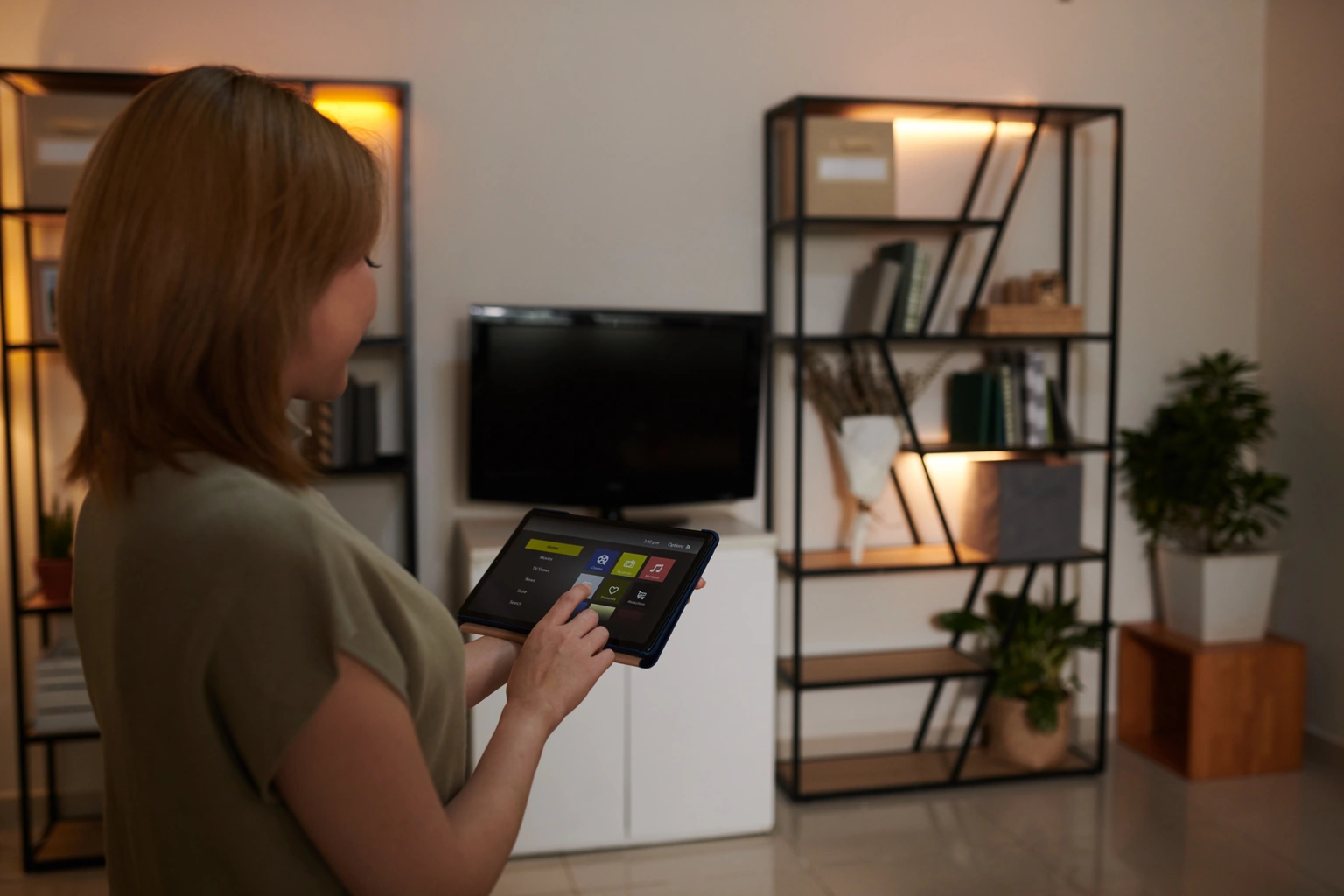
Yes: Matter compatible devices are widely sold in Dubai, and you probably own a Matter controller already without realising it. An Apple TV, HomePod mini, Amazon Echo, or Google Nest Hub bought in the UAE in recent years is very likely Matter-capable, and a Thread border router too. The real question is usually the generation, not whether to buy a new box.
Two cautions stand out, and both are about where the box came from.
TDRA type approval. The UAE requires type approval for radio equipment before it is sold or distributed here[7]. That covers the Wi-Fi, Thread, and Bluetooth radios inside a Matter device. The UAE has no Matter-specific rule, because the Matter standard is not a radio. Anything bought through normal UAE retail is already compliant, so the exposure sits with personally imported and grey-market stock.
Voltage and plug shape. The UAE runs 220 to 240 volts on the UK-style three-pin Type G socket. A US-market Matter smart plug is built for 120 volts and a US socket. That is a physical and electrical mismatch, not a protocol one. Buy the UK, EU, or Middle East version of any plug-in device. Our protocols guide covers the parallel trap for Z-Wave, which is a radio frequency problem instead.
| What you are buying | Where it stands in Dubai | What to watch |
|---|---|---|
| Apple HomePod mini or Apple TV 4K | Sold through Apple UAE stores and major electronics retail | Doubles as a Thread border router; check the generation before you rely on it |
| Amazon Echo, 4th generation and newer | Widely sold on Amazon.ae and in UAE electronics shops | Only the models with a Thread radio act as a border router |
| Google Nest Hub | Third-party UAE retail only, no official Google store here | Works as controller and border router; account region setup may be needed |
| Aqara Hub M100 or M3 | Low-cost dedicated Matter controllers with Thread built in | Check the current local listing for price; Aqara is a brand we already install |
| Any Matter smart plug | Buy the UK, EU, or Middle East version | US models are 120 V on the wrong socket shape and will not fit |
| Any Matter device | UAE retail stock carries TDRA type approval and local warranty | Grey imports may have neither, and support becomes your problem |
Entry-level speakers and hubs from Apple, Amazon, and Google generally sit in the few-hundred-dirham range in UAE retail. Promotions move those prices a lot, so check the current listing rather than trusting a figure in any article, including this one.
Is Matter relevant if you have KNX, Control4, Crestron, or Lutron?
Yes: Matter fits a KNX, Control4, Crestron, or Lutron home as a bridge at the edges, not as the brain. It is a consumer and retrofit layer. A Dubai villa built on KNX, Control4, or Crestron already runs a control language that does more than Matter does, and keeps working when the internet drops.
KNX is the clearest win. KNX-to-Matter bridges are real products in 2026, not a promise. The 1Home IoT Gateway maps around 100 Matter devices into a KNX install through ETS. The Atios KNX Bridge exposes up to 200 devices, and doubles as a KNX IP interface and DALI gateway[10]. A wired KNX villa can now answer to Apple Home or Alexa without giving up its wired core.
Lutron is the surprise. Lutron sits on the alliance's member list[3] and has still not brought its main Caseta line to Matter. Its approach is direct support for Alexa, Google, Apple, Ring, and Sonos instead. The one Matter-ready Lutron product we found is the Aurora dimmer add-on, not the Caseta or HomeWorks lines we install in Dubai villas.
Control4 and Crestron sit above the consumer ecosystems rather than inside Matter. We found no evidence of native Matter certification for either as of July 2026. In that case, a bridge or the system's own gateway is how they meet Siri or Alexa. If you are comparing those platforms, our guide to Control4 vs Crestron vs Savant in Dubai works through it properly.
Should you wait for Matter, or start now?
Start your smart home now, and use Matter where it helps rather than waiting for it to be finished. Matter has been shipping for close to four years and gets roughly two feature releases a year. There is no version where it is done, so waiting has no end date.
How we would decide it, room by room:
- Buying a new plug, bulb, sensor, or lock? Prefer Matter-certified. It keeps your options open across Apple, Google, and Amazon at no extra cost to you.
- Already own Zigbee or Z-Wave gear? Keep it. Add a bridge when you actually need cross-brand control, not before.
- Building or renovating a villa? Wire the core. Pre-wiring during construction costs 60 to 70 percent less than retrofitting a finished home[14]. Matter is not a reason to skip cable.
- Renting an apartment? Matter over Thread suits you well. Nothing is drilled, and it all comes off clean at move-out.
- Need something Matter does not carry yet? Air conditioning is the honest Dubai example. Use the gateway that works today.
Prefer to ask before you buy anything? Message an engineer on WhatsApp →
How does Dubai Smart Home design around Matter?
Dubai Smart Home treats Matter as one ingredient, not the plan. Our in-house Dubai engineers map the home first and check the walls and the tower congestion. Then we pick the carrier per device, and add Matter where cross-brand control earns its place. We do not subcontract, and every system runs in English and Arabic.
On a typical villa that means a wired core for lighting and climate, Thread for battery sensors and locks, and Wi-Fi for cameras. A gateway handles the FCU or VRF air conditioning, and Matter ties the retrofit devices into one app. Voice sits on the ecosystem layer, above Matter, never inside it. That is why our voice control and AI work is specified separately.
Since 2016, Dubai Smart Home has completed 100+ projects across Dubai villas and apartments, and we install and support 12 smart-home systems. We are rated 4.9/5 by Dubai homeowners, and sales enquiries are answered within 2 hours.
Want a plan that uses Matter where it helps, and does not pretend it does more? Book a free site visit and quote → or message our team on WhatsApp →.
Keep reading: start with the complete smart home guide for Dubai, compare the radios underneath Matter in our smart home protocols guide, and see what AI actually does in a smart home.