A deposit to a smart home, CCTV or gate company is often the biggest payment you make before anything arrives. If the company goes quiet, no escrow account or state fund stands behind it. What you control is who you pay, what the payment buys and how you pay.
This guide draws on 100+ smart home projects our team at Dubai Smart Home has worked on since 2016. We also checked the licence registers, the Central Bank's rules, Visa's dispute rules and three banks' dispute pages on 24 November 2026. The planning side is covered in our complete smart home guide for Dubai.
This is general information, not legal advice, so talk to a UAE lawyer before a big contract or as soon as a company holding your money goes silent.
How do you avoid losing a smart home deposit in Dubai?
You avoid losing a smart home deposit in Dubai by doing three things before you pay. Check that the quote, the trade licence and the bank account all name the same company. Tie the first payment to named equipment on a document. Then pay by card to the company's own account, so your bank has a route to dispute it.
Federal Law No. 15 of 2020 on Consumer Protection has no article that caps or protects a deposit[1]. An off-plan buyer's payments go into a project escrow account under Dubai Law No. 8 of 2007[2]. A smart home deposit has nothing like it, so these checks are your protection.
Cards have a catch. The Central Bank of the UAE's refund rule covers only payments you did not authorise[3]. A deposit you chose to pay is authorised, so getting it back runs on the card network's rules and your bank's short deadlines.
Real talk: a licence does not make a company safe. In March 2025, The National reported that a licensed Dubai renovation firm closed with 84 live projects, and one owner had paid about 92% of the bill[4]. The checks cut the risk of a fake company; the way you pay limits the damage if a real one fails.
How do you check a smart home company in 10 minutes?
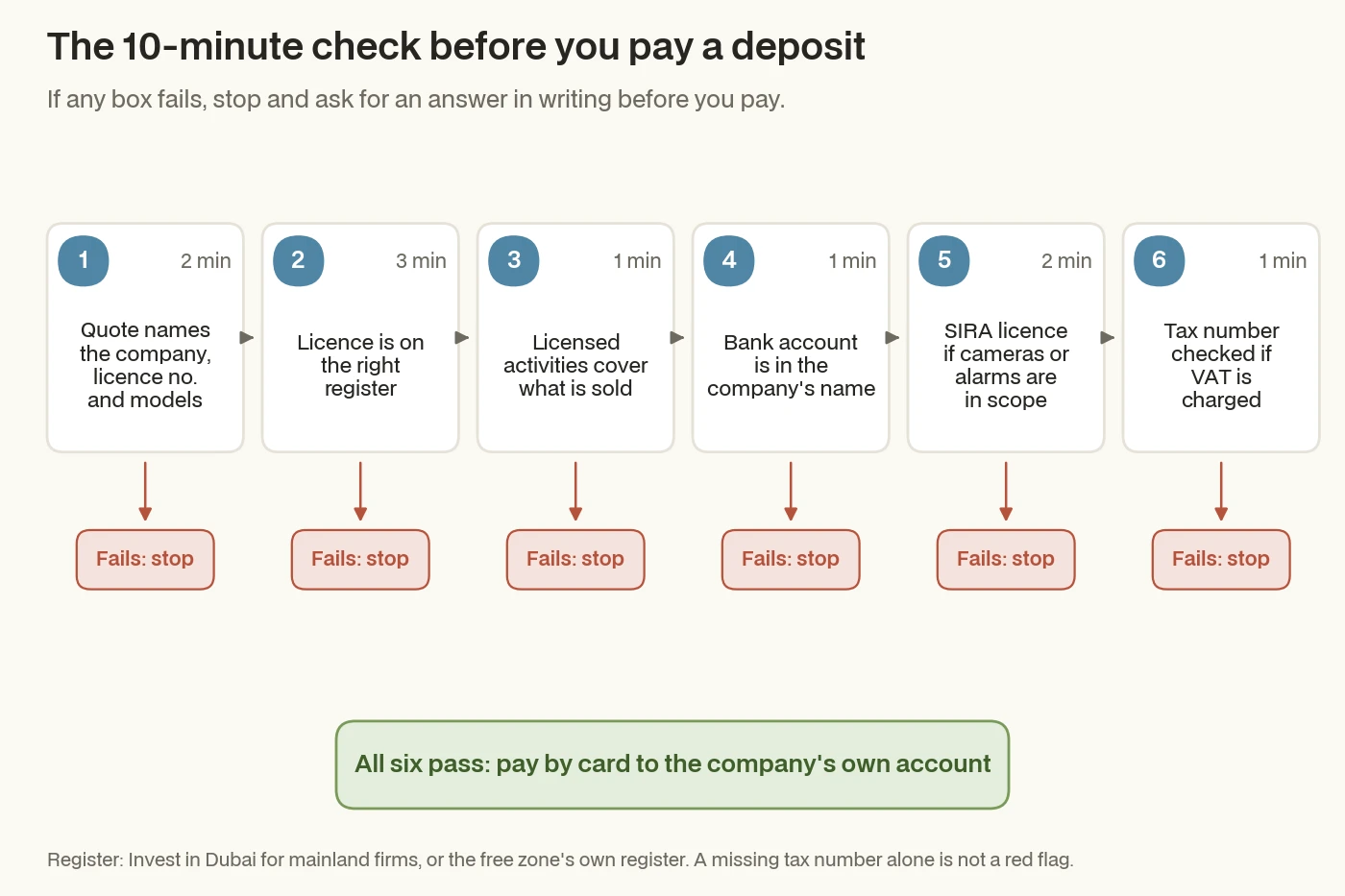
You can check a smart home company in about 10 minutes on free official portals. Look up the licence where it was issued, and confirm the same legal name on the quote, the licence and the bank details. Then check the Security Industry Regulatory Agency (SIRA) for camera or alarm work, and check the tax number if the invoice adds VAT.
Start with the commercial registration number, which the Consumer Protection Law's Executive Regulation requires on a supplier's invoice[5]. The UAE Government portal lists the official licence searches for every emirate[6].
The table puts the six checks in order, with the time each one takes.
| Step | Where to check | What to look for | Time |
|---|---|---|---|
| 1. Read the quote | The quote and any proforma | Full legal name, licence number, address, and a brand and model on every line | 2 minutes |
| 2. Find the licence | Invest in Dubai for mainland Dubai; the issuing free zone for a free zone company | A current licence under the same legal name | 3 minutes |
| 3. Match the activities | The licence record or copy | Activities that cover what this company is selling you | 1 minute |
| 4. Match the payee | The bank details on the quote or invoice | An account in the licensed company's own name, not a person or another firm | 1 minute |
| 5. Security work | SIRA's website, or SIRA directly | A SIRA licence if cameras, alarms or access control are in the scope | 2 minutes |
| 6. VAT number | The Federal Tax Authority's TRN check | Only if VAT is charged: the tax registration number (TRN) on the invoice matches the company | 1 minute |
If any row fails, ask the company to explain in writing before money moves. Our guide to home automation in Dubai shows what a properly itemised quote looks like.
Which payment method gives you the most recourse in the UAE?
A credit card gives you the most recourse for a smart home deposit in the UAE, because your bank can raise a dispute for services not received. A bank transfer to the licensed company's own account comes next. A post-dated cheque and cash give you the least, each for a different reason.
Recourse means a real route to get the money back without going to court.
| Method | Paper trail | Route back if the company fails | Weak spot |
|---|---|---|---|
| Credit card | Bank statement with the merchant name | A dispute for services not received, raised by your bank under the card network's rules[7] | Short bank deadlines; fails while the company still says it will do the job |
| Bank transfer to the company named on the licence | Transfer record with the payee name | Evidence for a complaint, a claim or a police report | Your bank usually cannot reverse a payment you chose to send to a real company |
| Post-dated cheque | A copy of the cheque | Very little: the company can cash it on its date | You cannot lawfully stop it because the job is late[8] |
| Cash | A receipt, if you get one | Almost none outside a police case | Nothing ties the money to the licensed company |
So pay by card where you can, and by transfer only to an account in the licensed company's own name. Ask in writing whether a card fee applies. For a second opinion on what the first payment covers, book a free design consultation and bring the quote.
What does a smart home deposit actually pay for?
A smart home deposit should pay for something you can name, such as design work or equipment ordered for your project. Equipment-led projects often take a larger first payment, because that payment orders equipment built or configured for the job. What protects you is a document that lists those items by brand and model.
If a company cannot say what the first payment buys, you have nothing to point to when you ask for it back. Ask for these documents at each stage:
- Before you pay. A quote or proforma listing every item by brand, model and quantity, with the licence number.
- When the order is placed. The supplier's order confirmation, or a dated note of what was ordered and from whom.
- When the kit arrives. A signed delivery note with the serial numbers of the main devices, so you can register them in your own name.
- In the contract. The date the equipment becomes yours, and what happens to the deposit if you cancel before anything is ordered.
Our smart lighting and climate control page shows what a lighting and climate system includes, so you can judge whether a first payment buys real items or a vague "package".
How big should the deposit be when UAE law sets no cap?
No UAE law we read sets a maximum deposit for a smart home job. The Consumer Protection Law has no deposit cap[1], and its Executive Regulation only asks for a schedule of payments when a service runs in phases[5]. Your protection is the contract, the way you pay and the routes in this guide.
The real danger is rarely the first payment. It is later payments that move ahead of the work. In a Gulf News Ask the Law column in July 2025, a villa owner had paid about 50% of the price. Only about 30% of the work was done when the contractor left[9].
After the first payment, each payment should follow something you can see: equipment on site, devices working, a handover done. Our guide to smart home contract clauses in Dubai covers staging and what to hold back. For spreading a larger bill, see our guide to smart home financing in the UAE.
Real talk: you will read that any deposit over 30% is a red flag. That is renovation habit, not law, and on an equipment-led job it can flag an honest quote. Ask two better questions instead. Is this payment tied to named items on a document? Is it going to the licensed company's own account?
How do you read a Dubai licence: mainland, free zone and activities?
A Dubai trade licence is checked with the authority that issued it. Mainland Dubai companies appear on the Invest in Dubai licence search, while a free zone company is checked with its own free zone. In both cases, read four things: the legal name, the status, the expiry date and the licensed activities.
The Invest in Dubai search takes a licence number, a Dubai Unified Licence number or the business name in English or Arabic, and asks you to pass a security check[10]. Compare what it returns with the licence copy and the quote.
Each Dubai Unified Licence carries a QR code that pulls up the latest record[11]. Still, type the number in yourself rather than scanning a code on a PDF someone sent you, because a copied document can carry a copied code. Do the same for a company you found on Instagram or dubizzle.
Dubai's mainland search may not show a company licensed in a free zone, so ask which authority issued the licence and check it there. DMCC, for example, runs a public register and can verify a document from the code printed on it[12]; other zones may ask you to contact them. The federal National Economic Register also searches licences and activities[13].
Then read the activities. They should cover what that company is selling you, whether equipment, design or a service. If another licensed company will carry out the installation, ask for its name and licence and check it the same way. To compare the companies that pass, use our guide on picking a smart home company in Dubai.
Common mistake: using the Dubai Land Department's trade licence search. That tool is for real estate offices, not smart home or CCTV companies[14]. One AI search answer we tested in November 2026 sent a home automation buyer there and called it the economic department. Use the register of the authority that issued the licence.
What extra checks apply to CCTV, alarm and gate security work?
Security work in Dubai needs a licensed company, not an approved homeowner. Dubai Law No. 12 of 2016 counts selling and installing security equipment and systems as security services. No one may provide them without a licence from the Security Industry Regulatory Agency (SIRA)[15]. You need no SIRA approval for cameras on your own home.
SIRA's licence for the activity "Installation of Security Devices and Equipment" needs a valid base licence and at least three qualified staff. The base can be a trade licence, an initial approval or a free zone no-objection certificate (NOC)[16]. So a free zone company is not ruled out; it needs the SIRA licence on top of its own.
SIRA publishes a company search on its website[17]. If the company is not there, ask for its SIRA licence and confirm it with SIRA before you pay for the security part of the job. On a mixed job, such as lighting plus cameras, pay the security part to the SIRA-licensed company that contracts for it. The name on that part of the invoice should match the SIRA licence.
The rules on home cameras are covered in our guide to SIRA CCTV rules for Dubai homes. Our security and CCTV design page shows how cameras and alarms are planned. Gate motors and door readers sit under gate automation and access control. To test a quoted camera price, compare it with our security camera range.
Does a missing VAT number mean the company is a scam?
A missing VAT number is not, on its own, a sign of a scam. The Federal Tax Authority (FTA) makes VAT registration compulsory only once taxable supplies and imports pass AED 375,000, and allows it by choice above AED 187,500[18]. A small, honest company below that line may have no tax registration number (TRN) at all.
The red flag is different: an invoice that adds 5% VAT but shows no TRN. The FTA says a tax invoice must show the supplier's name, address and TRN[19]. A company charging VAT should print its TRN.
The FTA's website has a free TRN check[20]. Enter the number from the invoice and check that the result matches the company you are paying. A TRN shows tax registration, not a licence for your job.
Quick math: 5% VAT on a AED 40,000 quote is AED 2,000. If that line appears with no TRN, the company either left its number off or is adding a tax it may not be registered to collect. Ask for the TRN in writing and check it yourself.
Which red flags should stop you paying?
Stop before you pay if the bank account is in a person's name or another company's name. Stop too if the company wants cash with no invoice, or if the first payment is not tied to named items. Those signs matter more than a low price, a polished website or a long list of star reviews.
Dubai Police warn about fake ads and cloned websites, and advise confirming who you are paying before you transfer, as Khaleej Times reported on 14 August 2026[21]. That warning was not about home contractors, but the trick is the same: a copied page and a changed account number.
Watch for these signs too:
- A quote by phone or voice note only. No written scope means nothing to hold the company to.
- Pressure and no address. A discount that ends tonight, or a new social page with no office or past job you can see.
- "Non-refundable in all cases". The Executive Regulation lists terms that free a supplier from its duties, including not refunding the price of a service, as void[5]. Whether a specific cancellation charge is fair is a question for a lawyer.
- Admin access kept by the company. The app account, the admin login or the project file staying in the company's name after handover.
- Prices far below UAE retail. That can mean grey imports or second-hand stock with no local warranty.
Reviews cut both ways. In October 2026, The National reported that Dubai Police arrested a group over false negative Google Maps reviews posted against a company[22]. Look at how many reviews there are and how they are spread over time, not the star score, and ask to see a finished job.
Online sellers are covered too. Cabinet Resolution No. 166 of 2026, issued on 24 September 2026, applies the consumer regulation to goods and services sold through modern technology, including offers made on a platform[23]. If a hardware price looks too good, compare it with UAE listings such as our smart locks and access range.
Can your bank reverse a card deposit if the company never delivers?
Your bank can dispute a card deposit if the company never delivers, but the route is the card network's rule for services not received, not a legal refund right. Visa's rules let your bank raise it once you have tried the company and the company is unwilling or unable to do the job[7].
The Central Bank of the UAE's Consumer Protection Standards cover unauthorised payments. You get at least 30 business days to report one, and a refund within 30 calendar days or at the end of the investigation, whichever is shorter[3]. A deposit you chose to pay is authorised, so ask your bank for a dispute, often called a chargeback, for services not received.
Visa's rules dated 24 October 2026 set these limits[7]:
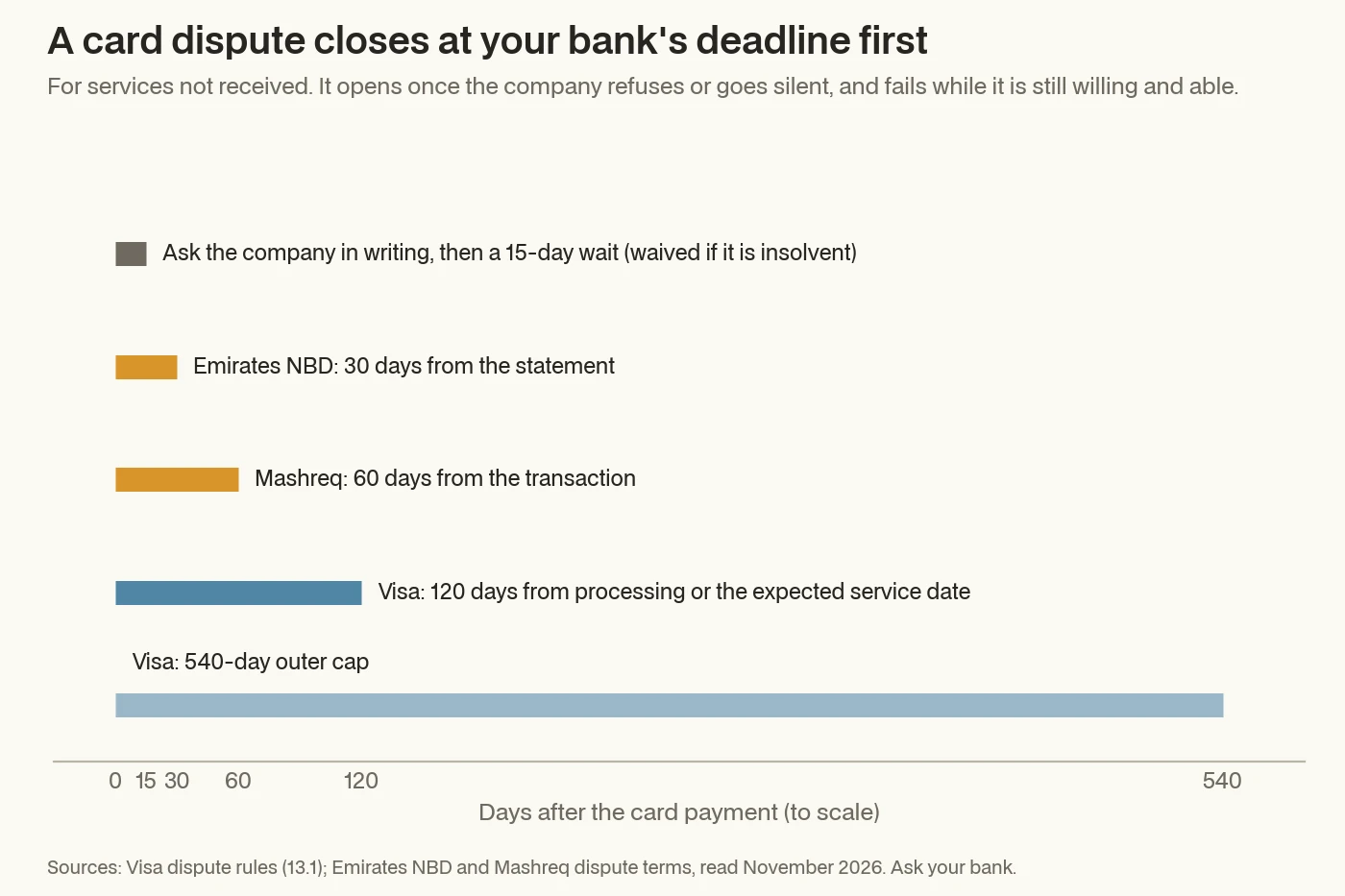
- A 15-day wait. The bank waits 15 calendar days before disputing, unless the company is insolvent or bankrupt.
- An outer limit. The dispute must start within 120 days of processing or of the last date you expected the service, and never more than 540 days after processing.
- What it does not cover. Poor quality, a change of mind before the service date, or a claim of fraud. Nor a part payment while the company is still willing and able to do the work.
The deadlines banks published in November 2026 are short, and they are the ones to beat. Emirates NBD says 30 days from the statement date, or 30 days from the service date for a service complaint[24]. Mashreq says 60 days from the transaction date, and a dispute can take up to 180 days to settle[25]. Mastercard has its own rules for services not received, so ask your bank for its deadline whichever card you used.
A written completion date in the quote helps, because Visa's 120 days can run from the date you expected the service[7]. If the company proves the payment was valid, you may pay a fee. Emirates NBD's published form listed AED 25 per transaction[26], and First Abu Dhabi Bank's 2020 form listed AED 100 plus 5% VAT[27].
Common mistake: telling the bank the deposit was fraud. You did authorise it, and Visa's rule excludes a claim that the payment was fraud. Describe what happened instead: the date you paid, the date the work was promised, your messages asking for it, and the company's refusal or silence.
If your bank mishandles the dispute, complain to it in writing. The Central Bank's Standards give a bank 2 business days to acknowledge a complaint and 30 business days for a final written reply[3]. If it turns you down or stays silent, Sanadak, the Central Bank's free ombudsman, takes complaints about banks once the bank has had its chance to reply[28].
Why is a post-dated cheque the weakest way to pay a deposit?
A post-dated cheque is the weakest way to pay a smart home deposit because the company can cash it on its date even if the job is late. Under the cheque rules in force since 2 January 2022, you may stop payment only for loss of the cheque or the holder's bankruptcy, not because the work is behind[8].
Since that date, a cheque returned for lack of funds is mostly a civil matter that goes straight to the execution judge. Stopping a cheque without a legal reason, or closing the account before it is presented, are still crimes[8]. Ask a lawyer which applies to your case.
That civil route also works for you if a refund cheque bounces. Present it within six months of its date, or you can lose recourse against the person who signed it[8]. And never hand over a "security" cheque you would not be happy to see cashed on its date.
What should you do in the first week if the company goes quiet?
If a smart home company goes quiet after taking your deposit, use the first week to build a record and protect your deadlines. Gather the evidence, send a dated written notice, call your bank, stop any further payments and check the licence again. Go to the police only if there are signs of deception.
- Day 0, about an hour: build the evidence pack. Save the quote with model numbers, WhatsApp messages on scope and dates, and payment proof showing the payee. Add any proforma, supplier order, delivery notes, serials and site photos. Note whose name the app and maker accounts are in.
- Day 1, about 30 minutes: send a written notice. Email it and send it on WhatsApp. State what you paid, what was promised and by when, and give a clear deadline with a date. No law sets the period, and lawyers often allow about a week.
- Day 1 or 2, about 20 minutes: call your bank. For a card, ask about a dispute for services not received and the bank's deadline. If a transfer went to a fraudster, ask the bank the same day to contact the receiving bank. A recall is not guaranteed, and a payment you chose to make to a real company is usually a matter for that company, not your bank.
- Day 2, 10 minutes: stop further payments. Do not pay the next stage, or hand over a cheque, while the first stage is undelivered.
- Day 2, 10 minutes: check the licence again. A cancelled or expired licence changes which route fits.
- Day 3 onward: keep the site as it is. If work has started, photograph it before another company touches it. Once a new company finishes the job, it can be harder to show what the first one left undone.
- Day 7: choose the route. If the deadline passes with no answer, pick the route in the next section.
Which route fits your case: DET, the Ministry, the police or the courts?
The right route depends on where the company is licensed and what went wrong. Equipment never delivered by a Dubai-licensed seller fits Dubai's consumer channel best. Free zone and other-emirate companies can go to the federal Ministry. Deception goes to the police. A money claim in Dubai up to AED 500,000 starts at the Centre for Amicable Settlement of Disputes.
Dubai's Department of Economy and Tourism (DET) lists construction companies among the businesses its consumer channel does not cover[29]. Press guides add contracting disputes and cases that need technical expertise[30]. Equipment you paid a Dubai-licensed seller for and never received is a closer fit than a dispute about installation work, so check on consumerrights.ae before you file.
The federal consumer law applies across the UAE, free zones included[1]. Its Executive Regulation lets you choose the full price back when a service is not provided[5]. That is a right you claim through a complaint or a court, not money held for you. Any fine the company pays goes to the State, not to you[1].
If the company is licensed in a free zone or another emirate, the Ministry of Economy and Tourism's free complaint service, on 800 1222, is the federal route. Its service page gives an average of 8 working days, and unsettled cases can go to a disputes committee and then the consumer courts[31]. An emirate's own economic department can also take complaints about businesses it licenses, as Abu Dhabi's does[32].
Report a deposit taken by deception to Dubai Police at a police station, or through the eCrime platform if the scam ran online[33][34]. Call 999 only in an emergency. Taking a deposit with no intention of doing the work can be fraud under the UAE Crimes and Penalties Law[35]. A company that is late or doing poor work is usually a civil dispute, not a crime. The consumer law's duties fall on companies[1], so a seller with no company behind it leaves you mainly with the police and the civil courts.
The table compares the five routes.
| Route | When it fits | Cost to you | What it cannot do |
|---|---|---|---|
| DET consumer complaint (consumerrights.ae) | A Dubai-licensed seller, with goods paid for and not received | Check on consumerrights.ae | Take construction companies or, per press guides, contracting disputes |
| Ministry of Economy and Tourism, 800 1222 | A free zone or other-emirate company | No fee[31] | Force a deal: unsettled cases move to a committee and the courts |
| Dubai Police, station or eCrime | A fake company, a cloned page, or a deposit taken with no plan to do the work | Free to report online[34] | Settle a civil claim about late or poor work |
| Centre for Amicable Settlement of Disputes | Dubai claims up to AED 500,000[36] | AED 250, refunded if a settlement is approved[37] | Make the company agree; without a deal, the claim goes to court |
| Dubai Courts | Claims not settled, or above the centre's remit | 6% of the claim, minimum AED 500, under the 2019 fee text[38] | Turn a judgment into cash if the company has closed |
In Dubai, a claim within the centre's remit cannot go to court before it, and time limits pause while it runs[37]. A payment order is a faster court route for a debt that is in writing, due and of a fixed amount, after a written demand. A disputed claim usually goes to a full case[39].
When is a lawyer worth it, and what does recovery really cost?
A lawyer is worth it when the amount is large, the company still trades and you hold a clear paper trail. Dubai court fees are a share of the claim with a minimum: 6%, with at least AED 500, under the 2015 fee law as amended in 2019[38]. Check the current fee with Dubai Courts before you file.
A Chambers commentary on UAE small claims suggests three questions before you sue: can you prove it, what will it cost, and can the other side pay[40]?
When a Dubai renovation firm closed in December 2024, one creditor expected recovery to take at least 2.5 years, The National reported[4]. In one Dubai card-fraud case reported by Khaleej Times in December 2025, the money came back after about three months[41]. That was fraud on the card, not a company that failed to deliver.
Real talk: a court win is not cash. In April 2026, Gulf News reported a Dubai court order against a holiday-package seller: a refund of AED 8,268.20 plus AED 5,000 compensation[42]. DET had already found the company shut down. The report does not say whether the money was ever collected. The buyer had paid by card, and no card dispute is reported.
Two traps follow a loss. One is a stranger offering to recover the money for a fee; deal only with your bank, the police or a lawyer you chose. The other is naming the company online in anger. The National's report on the fake-review arrests cites Article 43 of Federal Decree-Law No. 34 of 2021 on online defamation[22]. Report the company instead.
How Dubai Smart Home helps
Three choices decide whether a deposit is safe: who you pay, what the payment buys and how you pay it. Check the name on the quote, the licence and the bank account on official registers. Tie the first payment to named items. Pay by card, or by transfer only to the licensed company's own account.
We survey the home, design and specify the system, and coordinate the work through to handover. Your system gets a 12-month workmanship warranty that can vary by product, and our team is rated 4.9/5 by Dubai homeowners. Before you pay anyone, we can review the quote with you. We will say what the first payment covers, whether every item is named and whether the paperwork lines up.
Our area guides cover approvals community by community. Villa owners can start with smart home planning in Arabian Ranches. For a tower apartment, read smart home planning in Dubai Marina.
Ask every company, us included, to show its deposit terms in writing before you pay. If you cancel after the deposit and before procurement, our Refund and Cancellation Policy says we refund "the deposit minus the design fee already earned"[43].
If a quote is on your table now, book a free design consultation, or send the quote to us on WhatsApp before you pay the deposit.