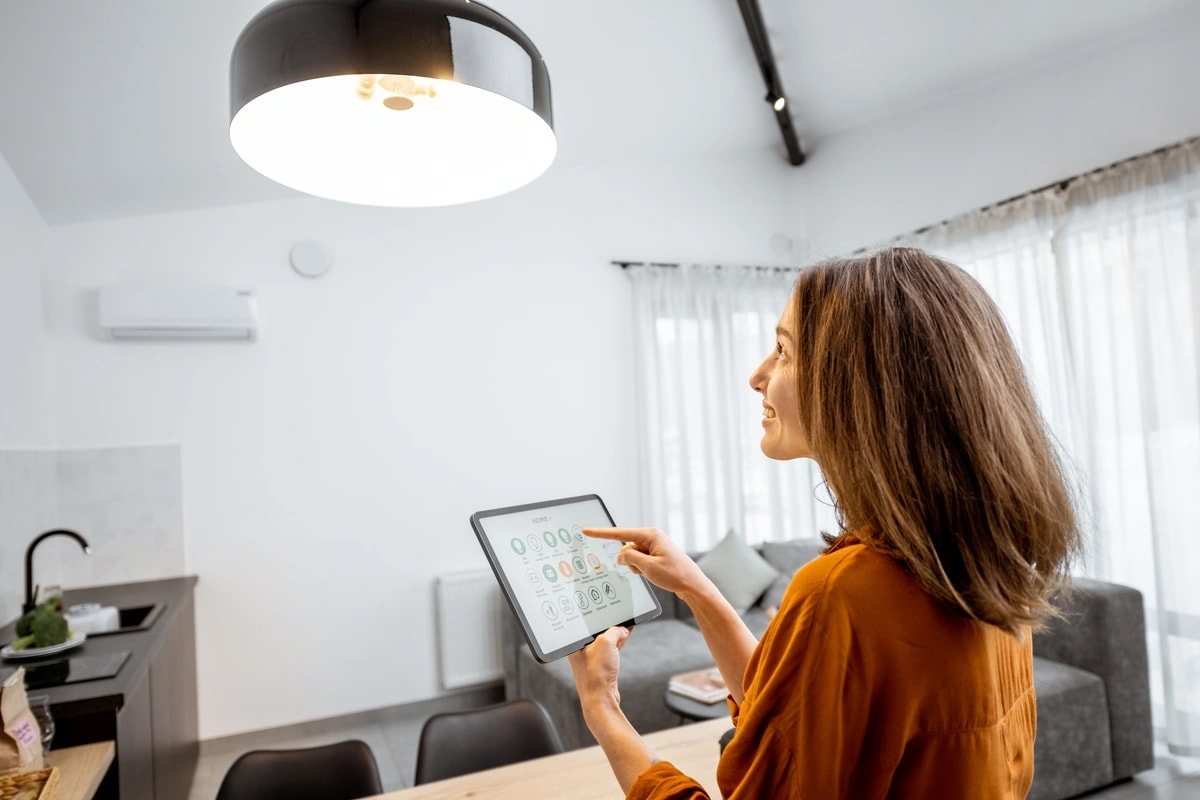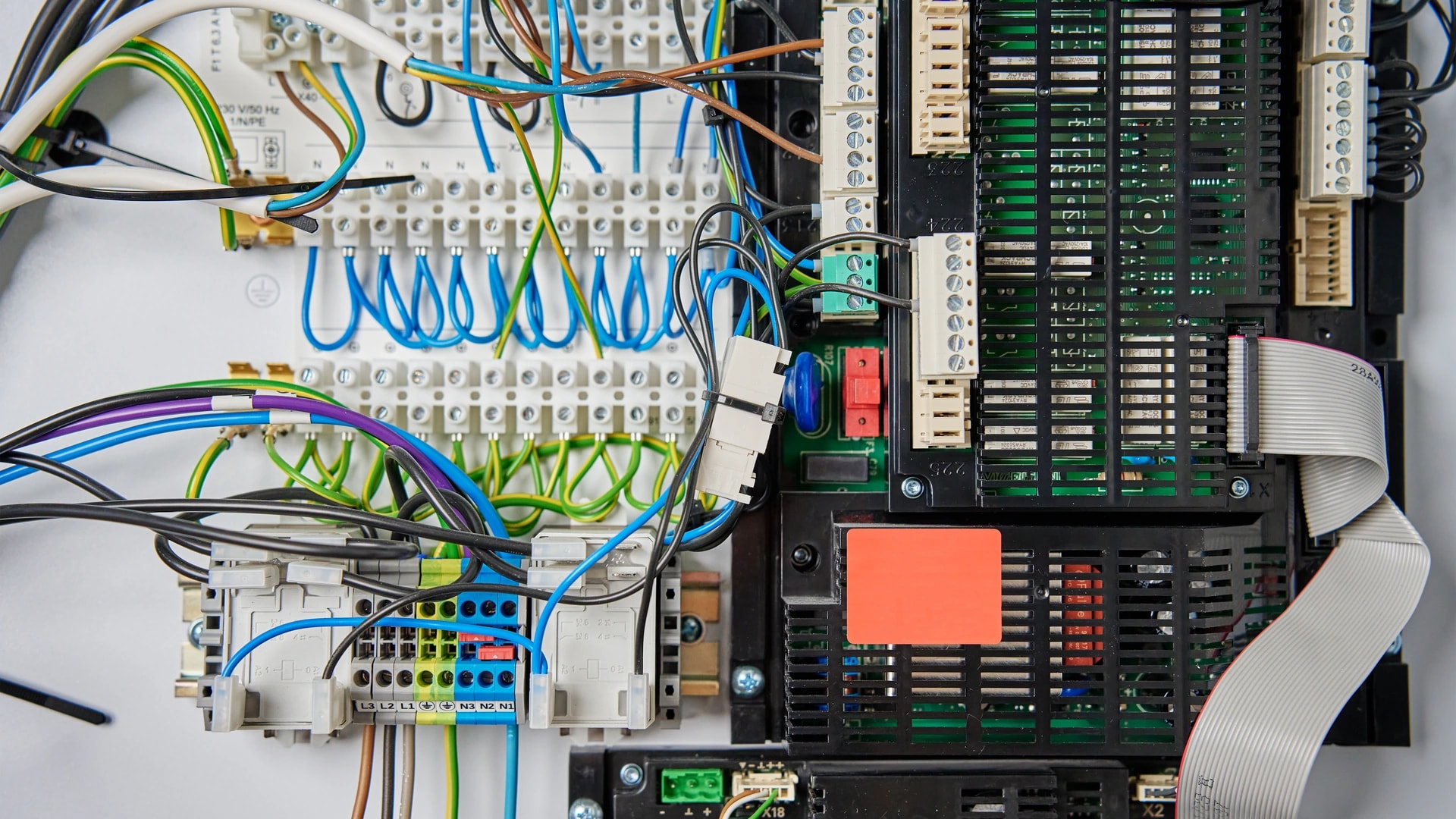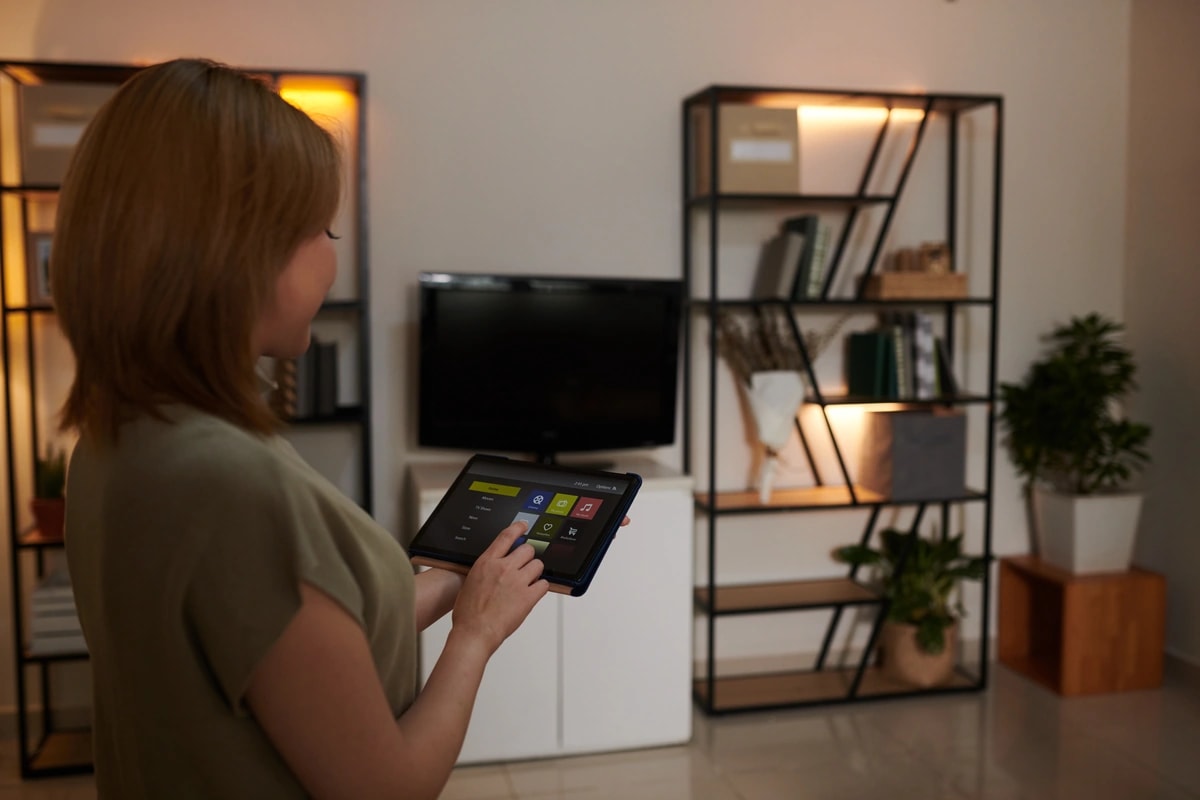
Philips Hue is the smart bulb most Dubai homeowners have already heard of. It turns up in Marina apartments and Dubai Hills villas, and it is usually the first smart thing a family buys.
This is a review of one product, not a shootout. If you are still choosing brands, read our full Dubai smart lighting guide first, because it ranks Hue against Govee, Yeelight, and IKEA properly. This page asks a narrower question: what are you actually buying when you buy a bulb rather than a system?
Is Philips Hue worth it in Dubai? The quick answer
Hue is worth it for lamps, pendants, and cove lighting where colour quality is part of the design and no wiring work is possible. It is a poor fit for a villa room with a grid of downlights on one circuit. There, one smart switch does the same job for a fraction of the money.
That split is the whole review. Hue prices per fitting, so it wins where fittings are few and visible, and loses where they are many and identical.
Real talk: Hue's genuine weakness is not build quality. It is the physics and economics of being a bulb. It needs power at the wall switch to do anything. It charges per light rather than per room. And its outdoor gear carries a lower published heat ceiling than a Dubai summer average. None of that is a manufacturing flaw. All of it changes what you should buy.
If your rooms are downlight-heavy, the honest answer is dedicated lighting scenes and keypads, not thirty bulbs.
What is Philips Hue, exactly?
Philips Hue is a range of smart bulbs, strips, and outdoor fittings, controlled from an app, a voice assistant, or a dimmer remote. It launched in October 2012 as the first iOS-controlled lighting product. It is made by Signify, which was Philips Lighting until it rebranded in 2018[1].
The Philips name on the box is a licence. Signify builds it, sets the prices, and decides the policies. Worth knowing when you look up support.
The range covers three groups. Colour bulbs in standard E27 and GU10 fittings, which drop into the pendants and lamps used in Dubai homes. Light strips for gypsum coves. And outdoor fittings such as the Lily spot.
Hue also does tunable white, which shifts light from warm evening tones to cold daylight on a schedule. We do not cover the sleep science here. If that is your reason for buying, read our piece on circadian and tunable white lighting.
How Hue actually works: Bridge, Zigbee, and Bluetooth-only mode
Hue runs in one of two modes, and the difference is the most misunderstood thing about the product. The full system needs the Hue Bridge. The cut-down system runs on Bluetooth from your phone and gives up most of what Hue is known for.
The Bridge is a small white box that plugs into your router. Signify's own FAQ calls it "the heart and brain" of Hue. It talks to your bulbs over Zigbee, a low-power wireless mesh on its own private network rather than your Wi-Fi. The standard Bridge handles up to 50 lights and 12 accessories[2]. For the mesh mechanics, how Zigbee actually works covers them in full.
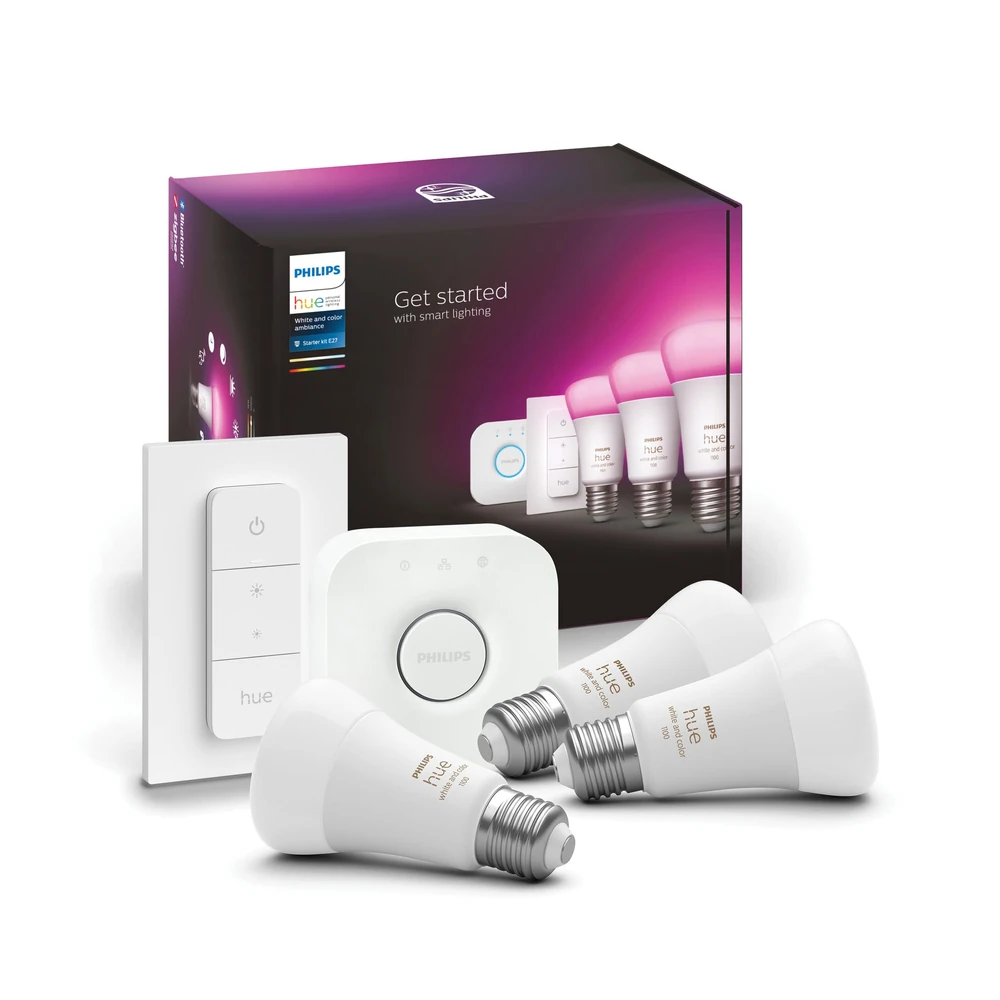
Bluetooth-only mode skips the Bridge entirely. You pair bulbs straight to your phone, and the limits are published plainly: 10 lights per control device, about 10 metres of range, local control only[3]. No control from outside the home, no full automation set, and none of the entertainment sync from the adverts.
Common mistake: buying two Hue bulbs on Bluetooth, deciding Hue is overrated, and returning them. You bought the demo, not the product. Almost everything people like about Hue lives behind the Bridge.
The newer Hue Bridge Pro raises the ceiling to 150 or more lights, 50 or more accessories, and 500 stored scenes, and it acts as a Matter border router[4]. Matter is the shared standard that lets one device work across Apple, Google, and Amazon; what Matter actually does is a separate read.
Where Hue genuinely gets it right
Hue's strength is quality of light and breadth of compatibility. It is the bulb we specify when the light itself is part of the interior, and it works with all three major voice platforms without any extra hardware.
| Strength | Why it is real | What it means for you |
|---|---|---|
| Colour and low-brightness dimming | A Hue strip at 10 percent holds a clean warm white, where budget strips shift colour or step visibly | In a majlis cove, that difference is the entire reason to do the job |
| Scenes live on the Bridge, not only in a cloud | The Bridge holds scenes and automations on your own network[2] | Your evening scene still fires when the internet drops |
| Native Apple, Alexa, and Google support | Voice control across all three arrives with the Bridge, no converter needed[3] | Mixed-phone households do not have to pick a side |
| Real headroom for a large villa | Bridge Pro covers 150 plus lights, 50 plus accessories, 500 scenes[4] | A six bedroom villa does not run out of room at the hub |
| A genuine no-hub way in | Bluetooth mode needs no Bridge for up to 10 lights[3] | A renter tests one bedroom for the price of two bulbs |
| Official UAE distribution | Signify supplies Hue here through Sharaf DG, Virgin Megastore, and Gulf Electronics | A warranty claim is handled locally, not shipped abroad |
| Standard fittings, no electrician | E27 and GU10 bases match the pendants and spots already in Dubai homes | A tenant installs it in an afternoon and takes it at the end of the lease |
Every line above is checkable. Now the other half of the review, which is longer.
The Bridge is a single point of failure, and that is by design
If the Hue Bridge dies, unplugs, or drops off your network, every Zigbee-paired light stops being smart. Scenes, automations, voice control, remote access, and entertainment sync go with it, because the Bridge is where they live[2].
The bulbs do not go dark. Mains power still reaches them, so they light when their wall switch is on, at whatever brightness and colour they held last. What you lose is every layer above simple on and off.
This is not a defect. It is what a hub architecture is. Signify calls the Bridge the heart and brain of the system, and a heart is not a thing you have two of. Take that at face value and plan for it.
From our projects: most "my Hue has gone stupid" calls are not dead Bridges. They are network calls. A router reboot that changed the Bridge's address, or a guest network the Bridge was never meant to sit on. The lights are fine; the layer underneath them is not.
So keep the Bridge on a wired port on your main network, not a range extender, and treat home networking as part of the lighting job. In a villa it usually is.
Does Hue need a subscription? What Hue Secure actually gates
No. Philips Hue lighting does not need a subscription, and never has. Bulbs, strips, the Bridge, scenes, automations, schedules, and voice control are included in what you paid for the hardware. No paid tier stands between you and your own lights.
The confusion comes from a different product with a similar name. Hue Secure is Signify's separate line of security cameras and a video doorbell, and that line does carry a subscription with three tiers[5].
- Free, at 0 dollars a year: 24 hour video history, live streaming, alarms, notifications, end-to-end encryption, and auto arm or disarm.
- Basic, at 39.99 dollars per camera a year: 30 day video history, activity zones, and smarter alerts, for up to two cameras.
- Plus, at 99.99 dollars a year flat: 60 day history, up to 10 cameras on one plan, and AI detection of people, animals, vehicles, and packages.
Read that list again and notice what is missing. Not one line touches a bulb. Every gated feature is camera storage or camera intelligence[5].
Real talk: "Hue requires a subscription" is the most repeated wrong thing said about this product in Dubai showrooms. Buy bulbs and never buy a Hue camera, and you will never see a payment request. Buy the cameras, and the free tier is genuinely usable, with the paid tiers buying longer footage retention.
Does Hue need an account? The 2023 sign-in requirement
Yes. Using the Hue app needs a free Signify account, and that has been true since 2023. It is free, but it is no longer optional, and for some buyers that is the deal breaker rather than the price.
The history is short and public. An account used to be optional; you could run the app locally and never sign in. In September 2023 Signify announced it would become mandatory, and the original plan bundled it with consent to share usage data with Signify's cloud and its partners. After a loud reaction, Signify updated the approach on October 2, 2023, so data sharing became a separate optional consent instead of a condition of using the app[6].
The data-sharing part was walked back. The account requirement was not, and it still stands in 2026.
Day to day it is narrower than the headlines suggested. Hue's own accounts page says you can control lights without internet once the system is set up, and frames the account plus an internet-connected Bridge as what unlocks control from outside the home[7]. Setup needs the sign-in. Flipping a lamp on in your living room does not.
Common mistake: assuming Bluetooth-only mode is the account-free route. It is not. The account gate is in the app, and the app is how you set up either mode.
Does Philips Hue work without internet?
Yes, for local control, once it is set up. Turning lights on and off, dimming, and running a scene you trigger inside the home all work over your own network with no live internet[7]. Your Bridge is not asking a server in Europe for permission to dim a lamp.
What stops is anything that leaves the house. Checking the villa from your office in Business Bay, an away-mode routine while you are in Abu Dhabi, or any voice command routed through a cloud assistant.
This is better than most Wi-Fi bulbs and worse than a wired system. A KNX or Lutron circuit ignores your router entirely, because the wall switch is physically wired to the light. Hue's local control still needs a working home network, even when the internet itself is down.
Set expectations with the family. During a Dubai internet outage, the app and the Hue dimmer still work. The voice assistant probably will not, and that is the part everyone notices first.
Do Hue bulbs work with a normal wall switch?
Only while that switch stays on. This is the biggest practical weakness of Hue, and of every bulb system ever made, and it is worth being blunt about because no product listing leads with it.
A Hue bulb is a computer that needs mains power. Flip the wall switch off and it loses power entirely. It disappears from the app, ignores voice commands, and cannot be turned back on except by walking over and flipping the switch again. Our own Hue Starter Kit listing says so plainly, because customers deserve to read it before they buy.
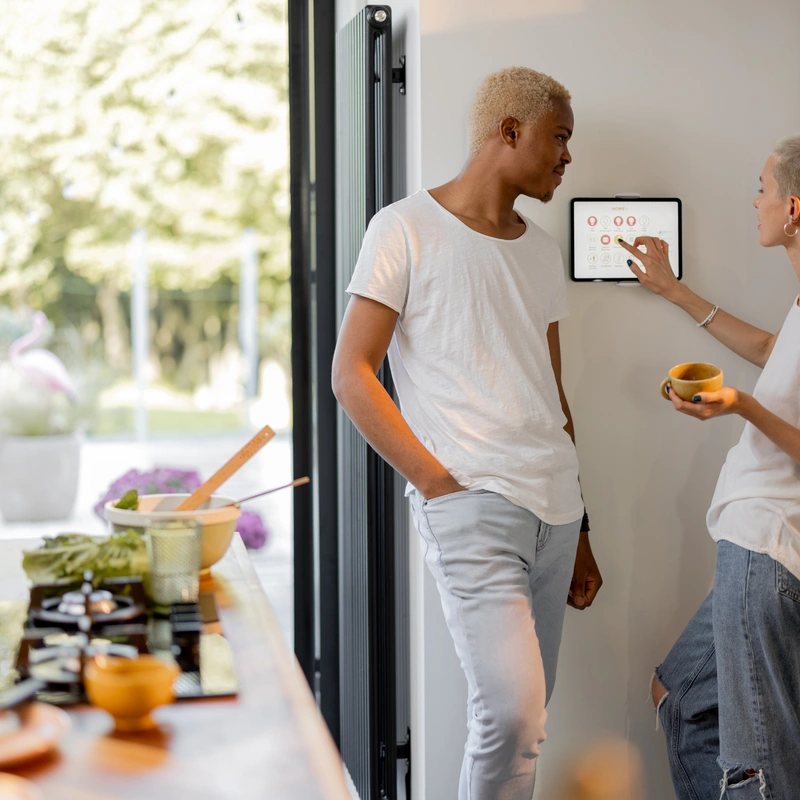
In a Dubai household this matters more than it sounds. Cleaners, guests, and children all use wall switches, because that is what a light has always had. One habit beats one app every time.
There are three ways out: retrain the household, fit a battery scene button over the old switch, or fit a smart switch that keeps the circuit live. The switch problem section of our lighting guide covers each fix with the hardware and the costs, so we will not repeat it here.
Real talk: the structural point is bigger than the fix list. If a room's lights are used daily by people who did not choose the system, control belongs in the wall, not in the bulb. That is the honest argument for wired lighting and climate control on a main circuit, and it is an argument Hue cannot win by being a better bulb.
Can Hue handle a Dubai summer? What the spec sheet says
Indoors, yes. Outdoors, check the number on the fixture before you place it, because Hue's own published rating for its outdoor spot sits below the UAE's published summer average.
Here are the two numbers, both from Signify's own product pages. The indoor White and Colour Ambiance A21 bulb lists an operating range of minus 20 to 45 degrees C[8]. The outdoor Lily spot light lists a narrower minus 20 to 40 degrees C, with an IP65 rating for dust and water jets[9].
Now the local number. UAE July average high temperatures run around 43.8 degrees C, per the National Center of Meteorology[10]. That is shaded ambient air, before any sun falls on the fixture itself.
Dubai's published July average of 43.8 degrees C already sits above the 40 degrees C ceiling Hue publishes for its own outdoor Lily spot light.
We will not tell you what that does to a specific light, because nobody has published it and we will not invent it. The gap between two published numbers is the fact. What you do with it is a placement decision.
For a Dubai garden that means three things. Put outdoor fittings in shade or under planting rather than in open midday sun. Leave air around them instead of burying them in a sealed housing. And read the operating range on the exact model, since it varies across the outdoor range.
Common mistake: putting Hue bulbs in sealed decorative fixtures indoors. Hue advises against enclosed fittings, and the reason is the same physics. That 45 degrees C figure assumes air moving around the bulb[8]. A closed glass shade traps heat, so the bulb runs hotter than the room ever gets.
The full list of genuine Hue weaknesses
Here are Hue's real weaknesses in one place, including two we have not covered above. None is a reason nobody should buy Hue. All are reasons some people should not.
| Weakness | The honest version | Source or basis |
|---|---|---|
| The Bridge is a single point of failure | Lose it and every paired light loses scenes, automations, voice, and remote access. Bulbs still light on mains power, nothing more | Hue's own Bridge FAQ[2] |
| A bulb system fights the wall switch | The bulb responds only while its switch is on. One habit from one family member removes the smart layer from that room | Structural to bulbs, stated on our own Hue product pages |
| Price scales badly on a fitting-heavy circuit | Fourteen downlights need fourteen bulbs to do what one smart switch does. Hue wins on lamps and pendants, loses on downlight grids | Our own product catalogue notes |
| A free account is mandatory, even locally | Since 2023 the app needs a Signify sign-in. Local control without internet still works, but account-free operation is gone | Home Assistant and Hue's accounts page[6][7] |
| Dubai summer sits above Hue's outdoor ceiling | The Lily spot is rated to 40 degrees C. The UAE July average high is around 43.8 degrees C in the shade | Hue's Lily spec and the National Center of Meteorology[9][10] |
| Bluetooth-only mode is genuinely limited | Ten lights per phone, about 10 metres, local only. One bedroom, and nothing larger | Hue's own Bridge FAQ[3] |
| The headline features are Bridge-gated | TV sync, away mode, and full voice routines all need the Bridge, which most bulb packs do not include | Hue's own Bridge FAQ[3] |
| No published price for a system | Signify prices bulbs, strips, and hubs. Nobody publishes a number for a Hue-lit villa, so you add it up one fitting at a time | The structure of Hue's own product range |
What does Philips Hue actually cost in the UAE?
A Hue White and Colour Starter Kit runs about AED 435 to 440, and a Hue Lightstrip Plus starts at about AED 319, from our own product catalogue[11]. Both are device-only figures. They cover the box, not fitting, not extra strip, and not switch work.
| Product | Approx AED, device only | What is included |
|---|---|---|
| Hue White and Colour Starter Kit | 435 to 440 | Three E27 colour bulbs plus the Hue Bridge, the cheapest route into the full system |
| Hue Lightstrip Plus | From 319 | One cuttable strip. Bridge, mains driver, and cove work all separate |
| Hue Bridge Pro | Not in our catalogue | The upgrade path for a large villa: 150 plus lights, 500 scenes[4] |
| Hue dimmer switch | About 99 | The battery remote that answers the wall switch problem, priced in our lighting guide |
Quick math: a lounge with two pendants and three table lamps is five bulbs, so one starter kit plus two spares, Bridge included. The same lounge with fourteen downlights is fourteen bulbs, and at that point a switch is the cheaper and better answer.
Note the shape of that pricing. Hue sells products, not projects. A wired install is quoted once for a scope, with wiring, programming, and commissioning inside the number. Hue leaves the addition to you.
Signify distributes officially here through Sharaf DG, Virgin Megastore, and Gulf Electronics, so the warranty is local rather than an import claim[11]. Retailer prices move with promotions, which is why we quote our own catalogue figure instead.
Want a real number for your rooms? Book a free site visit and quote and we will count the fittings with you first.
How Hue compares to cheaper bulbs and to wired control
Hue costs more per bulb than Govee, Yeelight, or IKEA, and it earns that in one place: colour accuracy and smooth dimming at the low end, where cheap strips shift green or step visibly. Behind a television, nobody is judging that. In a designed majlis cove, it is the whole point. Our brand-by-brand comparison ranks them all, so we will not re-run it here.
Against wired lighting control the comparison flips. Hue is far cheaper to start and needs no electrician, but it does not solve the switch problem, and a KNX or Lutron circuit does. One buys flexibility today. The other buys a wall that behaves correctly for twenty years.
One thing neither buys you is a lower bill. Smart lighting has no credible energy payback in Dubai, and that is not our finding to claim here: see our full smart-device payback verdicts for the sourced version across all 16 device categories.
Who Hue is a good fit for
Four kinds of buyer get real value from Hue, and for them it is genuinely the right product rather than a compromise.
- Renters and apartment dwellers. Proper colour on lamps and pendants with no wiring work, and the whole lot comes off the fittings when the lease ends.
- Anyone doing cove or accent lighting. Where the light itself is part of the finish, Hue holds its colour at low brightness where a budget strip does not, and that shows every evening.
- Mixed-ecosystem households. One person on iPhone, one on Android, an Echo in the kitchen. Hue works natively with all three once the Bridge is in.
- Anyone testing the idea in one or two rooms. A starter kit is a cheap way to find out whether your family uses smart lighting before you spend on a wired system.
The pattern across all four: few fittings, visible fittings, colour matters, no walls opened.
Who should NOT buy Philips Hue
Seven kinds of buyer should skip Hue. No retailer listing publishes this list, which is exactly why it belongs in a review.
- Anyone lighting a villa room with many downlights on one circuit. Fourteen bulbs to replace one switch is bad economics in any currency. That room wants a smart switch.
- A household that will not retrain off the wall switch. Without a scene button or a smart switch, the family loses control every time someone flips the switch out of habit, which in most Dubai homes is daily.
- Anyone who wants to avoid a cloud account. The app has needed a free Signify sign-in since 2023, even for Bluetooth-only setups[6]. Hue no longer offers account-free operation.
- A buyer who wants outdoor lighting rated for open Dubai sun. Hue's outdoor spot is rated to 40 degrees C, and the UAE July average already sits above that[9][10]. Shade it, ventilate it, or pick a fitting rated for this climate.
- Anyone buying Hue for the DEWA bill. Smart lighting has no credible payback in Dubai. It is a convenience and design purchase, and our device-by-device review says so with the numbers.
- A buyer who wants one quoted price for a whole-home project. Hue prices per product. If you want a single scoped figure for a villa, you are asking for a wired install, not a bulb range.
- Anyone who wants scenes and voice without buying the Bridge. Bluetooth mode is 10 lights and about 10 metres of local control[3]. Skipping the Bridge means skipping most of what Hue is known for.
Hue's real weakness is not build quality. It is being a bulb: it needs power at the switch, it prices per fitting rather than per room, and its outdoor gear has a lower published heat ceiling than a Dubai summer average.
How Dubai Smart Home helps
Dubai Smart Home lists Philips Hue in our own product catalogue and installs both retail smart lighting and wired lighting control, KNX and Lutron included, across the 12 systems we work with[11]. We are not tied to one manufacturer, so if bulbs are the wrong answer for your room, we will say so before you spend anything.
In practice that usually means a mixed answer. Hue on the lamps, pendants, and coves where colour is part of the design. Dedicated lighting scenes and keypads on the downlight circuits the family uses every day.
One thing we will not claim: this review states no Hue dealer status, partner level, or certification for us. We stock the product and we install lighting. Judge the work and the honesty of the advice, not a badge on a website.
Our engineers are in-house and based in Dubai, and we do not subcontract installs. Support runs 24/7 in English and Arabic, and enquiries are answered within 2 hours. We have completed 100+ projects since 2016 and are rated 4.9/5 by Dubai homeowners.
Earlier in the process? Start with our complete smart home guide for Dubai, or see what Dubai Smart Home covers across lighting, climate, security, and cinema.
Ready to decide bulbs against switches room by room? Ask an engineer for a free site visit, or send your floor plan on WhatsApp and we will tell you where Hue is worth it and where it is not.