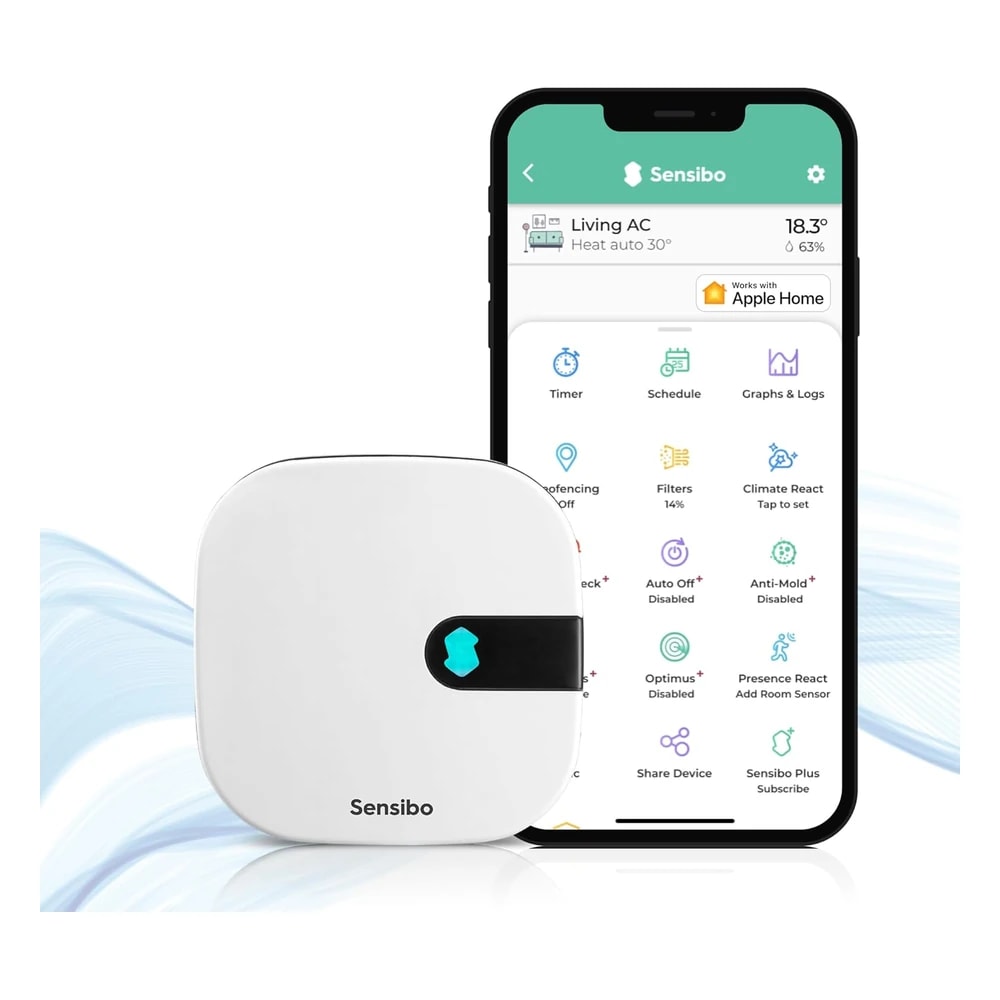
Sensibo Air is the smart AC controller Dubai renters ask us about most. It is cheap, needs no wiring, and makes an ordinary split unit answer to a phone.
Before anything else, one hard filter. Sensibo's own compatibility page states it needs an air conditioner or heat pump with an infrared remote control[1]. If you live in a district cooling apartment served by Empower, Emicool, or Tabreed, your cooling comes through a wired wall panel with no remote. Sensibo has nothing to copy and nothing to point at. It will not work in your home at all. Read our district cooling smart thermostat guide instead.
This review is not a shootout. If you are still choosing between brands, our full smart thermostat comparison puts Sensibo next to Cielo, Tado, and wired units. This page asks a narrower question: what does Sensibo actually know about your AC, and what does it not know?
Sensibo Air review verdict: is it worth it for a Dubai home?
Sensibo Air is worth it for a Dubai home if your AC is a split, window, or portable unit with a handheld remote. It is not worth it, and will not function, on district cooling or on a villa panel with no remote.
Sensibo does not replace your remote. It becomes a second remote that never leaves the room and takes orders from your phone, a schedule, or your location. At AED 625 to 700 per indoor unit, that is worth owning.
The trade-off is certainty. Infrared travels one way. Your original remote never knew whether the AC heard it, and neither does Sensibo. You gain control without an electrician. You do not gain proof the command landed.
What is Sensibo, exactly?
Sensibo is an infrared controller, not a thermostat. It is a small box that mounts facing your indoor unit. It learns the codes your handheld remote sends, then resends them from an app, a timer, or an automation[2].
Infrared is the invisible light your TV remote and AC remote already use. It carries a short burst of code across the room in a straight line, and the receiver either sees it or does not.
Nothing gets wired. It plugs into a standard socket and never touches the AC's electrics. That is why a tenant can fit one without asking a landlord, and take it down clean on move-out day.
Sensibo also carries its own temperature and humidity sensor[2]. The sensor inside a split unit reads return air near the ceiling. In a Dubai bedroom in August, that air runs warmer than the air around your bed. Sensibo reads the room at the height it is mounted, so the number you set is closer to the number you feel.
A split unit is the common Dubai setup of an indoor wall unit plus an outdoor compressor, worked by a handheld remote. That remote is the whole requirement. No remote, no Sensibo.
Does Sensibo work with district cooling? No, and here is why
No. Sensibo does not work with district cooling, because a district cooling wall panel has no infrared remote for it to copy. This is not a setup problem you can solve with a better mounting position or a firmware update. It rules the product out for a large share of Dubai apartments before any other feature matters.
Sensibo's compatibility page covers mini split, high mount, window, portable, and central air conditioners run by an infrared remote[1]. A district cooled apartment has none of those. Chilled water arrives from a plant outside the building, and a wired panel opens a valve to let it through. No remote, so no code to copy, and no infrared eye on that panel to receive one.
Common mistake: this is the most expensive wrong purchase we see in Dubai climate control. Someone reads a good Sensibo review, buys it for a Marina or Business Bay apartment, and only then realises the flat never had a remote. The device is not faulty. It was the wrong category.
A ten second check. Does your building bill a separate cooling charge from Empower, Emicool, or Tabreed? Is your only control a panel screwed to the wall? Then you are on district cooling. Our district cooling guide covers what actually works on a fan coil unit.
The same wall stops a villa owner with ducted or VRF central AC and no handheld remote. The question is never the brand of your AC. It is whether a remote came with it.
Sensibo Sky, Air, and Air Pro: what is actually different
The difference between Sensibo Sky, Air, and Air Pro is sensors and HomeKit support, not how they control the AC. Sky is the entry model, Air adds Apple HomeKit and a better build, and Air Pro adds air quality sensing on top[3]. All three are sold new today; the Sky is the cheapest and is stocked in the UAE alongside the Air.
| Model | Price tier | Onboard sensors | Apple HomeKit | Best for |
|---|---|---|---|---|
| Sensibo Sky | Entry | Temperature, humidity | No | A second bedroom or a maid's room where you only want a schedule and app control |
| Sensibo Air | Middle | Temperature, humidity | Yes, native | Most Dubai apartments and villa bedrooms, and any household already on Apple Home |
| Sensibo Air Pro | Highest | Temperature, humidity, air quality (TVOC and estimated CO2) | Yes, native | A bedroom or nursery where you want air quality readings, not just cooling |
Apple HomeKit is Apple's own smart home system. A HomeKit device shows up in the iPhone Home app and answers Siri, with no third party bridge in the middle.
The spec sheet does not put this in bold: the control mechanism is identical across all three[3]. Every one sends infrared, and not one receives a status back from the AC. Paying more buys sensors and ecosystem support. It does not buy certainty.
For most Dubai homes the Air is the sensible middle, and it is the model we stock. The Air Pro earns its premium only if you will act on an air quality reading.
What is it like to live with Sensibo day to day?
Day to day, Sensibo is quiet and close to invisible, which is the right outcome here. You set it up once, and after that the AC is already on when you get home.
Setup takes minutes, not a site visit. The box goes on the wall facing the indoor unit, with a clear path between them. It pairs to your Wi-Fi in the app, then fires test commands until the AC beeps back.
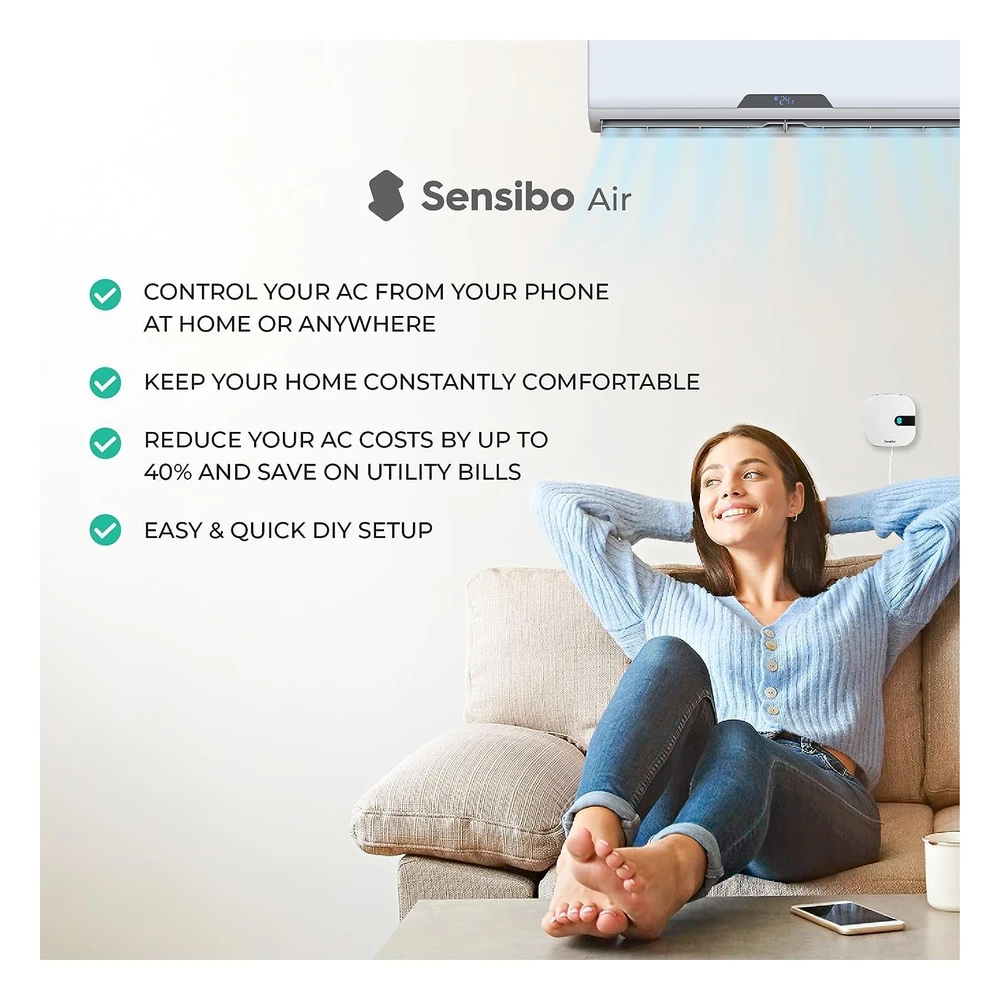
The feature people actually use is Climate React. It watches the room with Sensibo's own sensor, then switches the AC on or off when temperature or humidity crosses a line you set. In a Dubai July, that is a bedroom cooling from 26 degrees down to 23, instead of a compressor running flat out all night.
Geofencing is the second habit that sticks. The app notices when your phone leaves a set radius, shuts the AC down, and starts it again on the way back. A villa with four controllers shows four tiles on one screen. For the step by step version, our guide on how to set up AC automation walks through it.
Where Sensibo genuinely gets it right
Sensibo's real strength is how little it asks of you: no wiring, no technician, no permission, no commitment.
- No wiring and no electrician. Bracket, socket, app. A room goes from dumb to scheduled in under half an hour.
- Brand agnostic. It copies remote codes rather than brand specific wiring. Daikin, LG, Gree, Midea, O'General, and Carrier split units all behave the same to it[1].
- Its own sensor. The controller reads the room rather than trusting the AC's ceiling level sensor, which is what makes holding a setpoint work at all[2].
- The core features cost nothing extra. App control, timers, schedules, Climate React, activity graphs, geofencing, and family sharing are free on every current model[4].
- Native Apple HomeKit on Air and Air Pro. Real HomeKit support, not a bridge you have to keep alive[2].
- Fully reversible. It comes off the wall clean, which matters on a Dubai tenancy cycle where you may move within a year.
An independent consumer body has reviewed it too. CHOICE Australia covered the Sensibo Sky and confirmed the features do what the marketing says, including voice control, Climate React, scheduling, and geofencing[5]. That sets the floor before the criticism starts: the device works. The complaints below are about what it cannot know.
Doing a whole villa rather than one bedroom? Our smart lighting and climate control work zones AC across every room. Book a free site visit and quote →
The one thing Sensibo cannot tell you: does the AC actually listen?
Sensibo cannot confirm your AC received a command. It fires infrared out, exactly as the handheld remote does, and nothing comes back. This is the most important sentence in this review.
What the app shows is not the state of your AC. It is the state Sensibo believes it set. Most of the time the two match. Then something blocks the path: a closed door, a person in front of the unit, a dusty infrared eye. They stop matching, and nothing tells you.
A Home Assistant community thread documents it in an owner's own words. Sensibo sends a turn on command, the AC does not start, and the app keeps showing it as on[6]. An independent reviewer puts the same limit the other way round. Because most AC units only receive infrared, there is no fully reliable way to verify the unit actually turned off[7].
Real talk: this is not a claim that Sensibo fails often. That reviewer says he never hit a failure himself. The point is narrower and harder: it cannot know. One way infrared with no return path is a limit of the design, not a bug a firmware update clears.
It matters because of what sits on top of it. Schedules, Climate React, and geofencing all act on the believed state, not the real one. If the app thinks the bedroom AC is already off, the 3am shutdown has nothing to do. A unit that never stopped runs until morning. In a Dubai August that is nine hours of compressor time on your DEWA meter.
You can reduce the risk without removing it. Mount it with a clean, permanent line of sight, and keep furniture and doors out of the path. Wipe the indoor unit's receiver when you clean the filter. That is housekeeping around a design choice, not a fix.
Here is the full weakness list in one place, to weigh before you spend anything.
| Weakness | The honest version | Where it comes from |
|---|---|---|
| One way infrared, no feedback | No confirmation comes back that the AC received or ran the command. The app can say off while the unit is still cooling | Owner reports in the Home Assistant community[6] and an independent review[7] |
| Drifted state breaks the automation on top of it | Schedules, Climate React, and geofencing act on the believed state, so a room can keep cooling after the app thinks it stopped, or never restart | The same thread, including the manual workaround owners use to force the state back[6] |
| Marketed features sit behind a paid plan | Energy Statistics, Optimus, Anti-Mold, AC Health Check, the AI assistant, Advanced Statistics, Auto-Off, and open window detection all need the Energy Saver Plan | Sensibo's own Energy Saver Plan page[4] |
| Geofencing depends on eleven phone conditions at once | Location set to Always, precise location on, battery optimisation off, power saving off, the app alive in the background, and more, all at once | Sensibo's own geofencing troubleshooting page[8] |
| No offline or local control | App control, schedules, Climate React, and geofencing all need internet. There is no local fallback inside the home | The device architecture and the absence of any documented offline mode |
| Needs an unobstructed line of sight | Anything in the path to the indoor unit blocks the signal, the same limit the remote always had | Independent review, listed as a stated drawback[7] |
| Does not work on district cooling at all | A wired fan coil panel has no remote and no infrared receiver, so there is nothing to copy or talk to | Sensibo's own compatibility requirement[1] |
| One controller per indoor unit | No single box runs four split units. A four bedroom villa is four purchases at full price | Sensibo's product structure[2] and our catalogue, priced per indoor unit |
| The app pushes the subscription | An independent reviewer flags the in app upsell as more insistent than it needs to be on a device you already bought | Independent hands on review[7] |
Does Sensibo need a subscription?
No. Sensibo's core features work with no subscription on every current model. Control from anywhere, timers, schedules, Climate React, activity logs, geofencing, and filter reminders are all in the purchase price[4].
The paid tier is the Energy Saver Plan, sometimes written as Sensibo Plus. It runs about 2.49 dollars a month billed yearly, roughly 30 dollars a year, or close to 3 dollars a month paid monthly. Sensibo says there is no long term commitment and you can cancel it whenever you want[4].
| Feature | Free with the device | Energy Saver Plan |
|---|---|---|
| App control from anywhere, timers, schedules | Yes | Included |
| Climate React temperature and humidity triggers | Yes | Included |
| Geofencing and basic activity graphs | Yes | Included |
| Energy Statistics and Advanced Statistics | No | Yes |
| Optimus optimiser and the AI climate assistant | No | Yes |
| Anti-Mold protection and AC Health Check | No | Yes |
| Auto-Off failsafe and open window detection | No | Yes |
| Extended 12 month warranty and a 5 percent purchase discount | No | Yes |
Real talk: the gate is not the price, it is the placement. The features Sensibo leans on hardest in its marketing, the AI recommendations, the energy dashboard, the mold protection, are the ones missing from the box[4]. A buyer who assumes AED 625 to 700 covers everything on the product page will be annoyed on day two. An independent reviewer also found the in app push toward the plan more insistent than it needs to be[7].
Our view: buy it for the free tier. Scheduling, Climate React, and geofencing are what actually change your DEWA bill. Add the plan later if you want the statistics.
Is Sensibo's geofencing reliable?
Sensibo's geofencing works, but it depends on eleven separate phone conditions holding at once. Sensibo's own troubleshooting page lists them, and that list is the honest answer[8].
All eleven have to be true at the same time[8]:
- Location services on, permission set to Always, precise location enabled
- No battery optimisation on the app, and power saving mode off
- The app left running in the background
- A good GPS signal and a stable internet connection
- Wi-Fi or mobile data on, and the correct date and time
- A geofence radius of at least 100 metres
None of those is unreasonable on its own. The problem is that they form a chain, and a phone breaks chains quietly. An Android handset with aggressive background app management closes the Sensibo app to save battery and tells nobody. An operating system update can reset a location permission from Always back to While Using. The geofence stops firing with no error message, only an AC that did not come on.
Common mistake: blaming the device when the phone changed. If your arrival trigger stops after an update, check the permission and battery settings before assuming the controller failed. If geofencing has to work every time without you thinking about it, this is genuine friction.
What happens to Sensibo when the internet drops?
When the internet drops, Sensibo stops being smart. App control, schedules, Climate React, and geofencing all run through Wi-Fi and the cloud, so none of them work. There is no local control path inside the house.
The fallback is the AC's original remote, used the old way, standing in the room. Fair enough for one bedroom. Poor if you were counting on a schedule to cool the house before the family arrives home.
This is the clearest split between a plug in controller and a wired system. A KNX installation, the wired backbone we put into Dubai villas, keeps running its climate logic with the internet completely down. The logic lives in the wall, not in a data centre. Sensibo made the opposite trade, and got a far lower price and an easier install for it.
Common mistake: running a cloud dependent device on a weak home network. Sensibo sits at the far end of your Wi-Fi, in a bedroom, behind a wall, next to a metal AC casing. If that corner is where your signal dies, the device looks unreliable when the real fault is coverage. Good home network design fixes more smart home complaints than swapping devices does.
What does a Sensibo smart AC controller cost in Dubai?
Sensibo Air costs AED 625 to 700 per indoor unit in Dubai on the Dubai Smart Home catalogue, checked on 19 July 2026[9]. That is the device only. It does not include a subscription or a second unit for a second room.
Sensibo is also sold here through Amazon.ae, Jarir, and Noon, where prices move with stock, model, and promotions. We are not printing a live retail number for those, because it would be wrong by the time you read it. Check our own Sensibo Air listing or the wider smart product catalogue for what we stock.
Quick math: the per unit pricing is what surprises people. One bedroom is AED 625 to 700. A four bedroom villa with a split unit in every room needs four controllers. That is AED 2,500 to 2,800 before a single light is automated.
Set against that, a wired thermostat retrofit needs a technician, sometimes a voltage adapter, and a callout fee. For a split unit with a remote, Sensibo is far cheaper, and the only option a tenant can take with them.
Sensibo Air costs AED 625 to 700 per indoor unit on our catalogue, device only. A four bedroom villa needs four of them.
Do Sensibo's energy saving claims hold up?
Sensibo's energy saving percentages are vendor claims, printed in its own materials and its paid plan. Nobody independent has measured them in a Dubai home.
What is established is the category, not the brand. Our own project data on smart AC control sits in our full smart device payback verdicts. The whole bill picture is in how a smart home cuts a DEWA bill. Those figures belong to those articles. They are not a Sensibo result.
What Sensibo does well on energy is mechanical and easy to believe without a percentage attached. It stops an AC running all night at 19 degrees because someone forgot. It stops a bedroom cooling an empty flat from 8am to 7pm. That is where the money actually is.
Real talk: the device saves nothing by existing. A Sensibo left on a permanent 20 degree schedule can cost more than the remote it replaced. The saving comes from the schedule you set, and from the AC being off while you are out of the room.
Who Sensibo is a good fit for
Sensibo fits anyone with a remote controlled AC who wants scheduling and app control. No electrician, no landlord conversation, no five figure quote.
- Renters in split unit apartments. No wiring, nothing permanent, and it comes off the wall clean at the end of the tenancy.
- Villa bedrooms and the majlis. Rooms with their own remote controlled split unit, where you want a schedule without touching the main system.
- Apple Home households. The Air and Air Pro carry native HomeKit, so the AC appears alongside your lights in the iPhone Home app[2].
- Budget conscious buyers. At AED 625 to 700 a room, it is the cheapest honest route from remote to app.
Who should NOT buy Sensibo
Seven kinds of buyer should skip Sensibo, starting with anyone on district cooling, where it will not work at all. A retailer page will never print this list.
- Anyone in a district cooling apartment. If Empower, Emicool, or Tabreed bills your cooling, your wall panel is wired with no remote and no infrared receiver. Sensibo has nothing to copy[1]. Start with what actually works on a fan coil unit instead.
- Villa owners with ducted or VRF central AC and no remote. Same wired panel problem, same answer.
- Anyone who needs the app's state display to be right every time. Think an elderly parent's room, a nursery, or a pet home alone. If a wrong off reading while the AC keeps running would be a real problem, this is a genuine risk[6].
- Anyone assuming everything in the marketing is included. Energy statistics, AI recommendations, mold protection, and the auto off failsafe all need the paid plan[4]. Budget for it, or decide the free tier is enough.
- Owners of phones that kill background apps. If geofencing has to fire every time with no troubleshooting, the eleven condition chain will find you eventually[8].
- Households wanting one device for the whole home. It is sold per indoor unit. Four bedrooms is four purchases, not one hub.
- Anyone who wants a system that works without internet. There is no offline path. A wired KNX climate controller keeps working through an outage. Sensibo does not.
If two or more of those describe your home, spend the money on the right category instead. Not sure which one your building has? Message us on WhatsApp with a photo of your AC control →
How Dubai Smart Home helps
Dubai Smart Home stocks Sensibo Air on our own catalogue and installs climate control across every AC type found in Dubai[9]. That means we can tell you in one conversation whether this device fits your home or wastes your money.
Dubai Smart Home has run 100+ projects since 2016 across 12 smart home systems, with in house engineers and no subcontracting[10]. Support runs 24 hours a day in English and Arabic, enquiries are answered within 2 hours, and homeowners rate us 4.9/5.
For one bedroom, an infrared controller is often the whole answer and you do not need us. For a villa, our smart lighting and climate control work zones the AC across rooms and ties it to lighting and shading. That starts from AED 4,500. Earlier in the process? Our complete smart home guide for Dubai covers one room to a full villa.
Want a straight answer about your own AC before you spend? Book a free site visit and quote →