An unheated villa pool in Dubai is likely too cold for a long swim from mid-December to March. Of the nine AI answers we checked on 9 November 2026, none showed the kWh, the tariff or the heat pump's efficiency behind its heating cost. This guide works it out from the tariff of the Dubai Electricity and Water Authority (DEWA), 50 Hz maker datasheets and official climate data.
The worked example is one pool: 8 x 4 m, 1.4 m deep on average, about 45 m³, held at 28°C from December to February. Dubai Smart Home designs and specifies pool and outdoor automation; 100+ projects our team has worked on since 2016 sit behind this guide. Pumps and dosing are in our pool automation cost guide for Dubai, and the whole villa in our complete smart home guide for Dubai.
Is a pool heat pump worth it in Dubai?
A pool heat pump is worth it in Dubai if you swim several times a week from December to March and will use a pool cover. In our worked example, an inverter unit on an 8 x 4 m pool costs AED 317 to 620 in electricity from December to February with a cover, and AED 1,057 to 1,239 without[1].
Villa-size heat pumps are sold by quote in the UAE, so compare running cost, size and supply.
- Swim most weeks all winter: an inverter heat pump plus a cover.
- Swim on warm weekends only: a cover and a schedule first.
- Away for much of the winter, or renting: usually no heat pump.
The table compares options for the example pool (DEWA's November 2026 tariff; prices checked 9 November 2026).
| Option | UAE price (AED) | December to February cost | Notes |
|---|---|---|---|
| Inverter heat pump, 50 Hz | Quote only | AED 317 to 620 covered; 1,057 to 1,239 uncovered | COP about 4.6 to 5.9 at 15°C air |
| On/off heat pump | Quote only | AED 417 to 815 covered; 1,391 to 1,631 uncovered | COP about 3.8 at 15°C air |
| Electric resistance heater | Quote only | AED 5,286 to 6,198 uncovered | About 8 kW round the clock |
| Bubble cover on its own | 542 to 1,776 (noon.com sellers) | Cuts the heat needed 50 to 70% | Adds no heat; not a safety cover |
In the cost column, the cover moves the bill more than the machine does. Check the supply too, as some US-market units are 60 Hz only and UAE mains is 50 Hz[2][3].
What does a pool heat pump cost to run in a Dubai winter?
An inverter pool heat pump on an 8 x 4 m pool costs about AED 106 to 413 a month to run in a Dubai winter, in our worked example. DEWA's home slabs start at 23 fils a kWh on each month's first 2,000 kWh, then rise to 28, 32 and 38 fils[1].
A 6 fils fuel surcharge applies in November 2026, DEWA changes it monthly, and 5% VAT goes on top[1]. So the next kWh you use costs 30.45 fils in the lowest band, 35.70 in the second, 39.90 in the third and 46.20 above 6,000 kWh a month. The model has three inputs:
- Heat loss. Our worked example assumes the January evaporation rate that a 2025 Palm Jumeirah study calculated for open water, about 5 mm a day, and 8 mm a day for a windy, exposed pool. A heated pool evaporates more than unheated water, and shade or a walled garden less[4]. One US study found evaporation carried 56% of a heated pool's overnight loss[5]. That gives 193 kWh of heat a day in the middle case, 108 in the low case and 309 in the high case.
- Efficiency. COP 5.0 at 15°C air for an inverter unit, the middle of the datasheets we read, and 3.8 for an on/off unit, Fluidra's EVOLine figure[6][7].
- Cover. US government guidance says a cover saves 50 to 70% of pool heating costs[8][9].
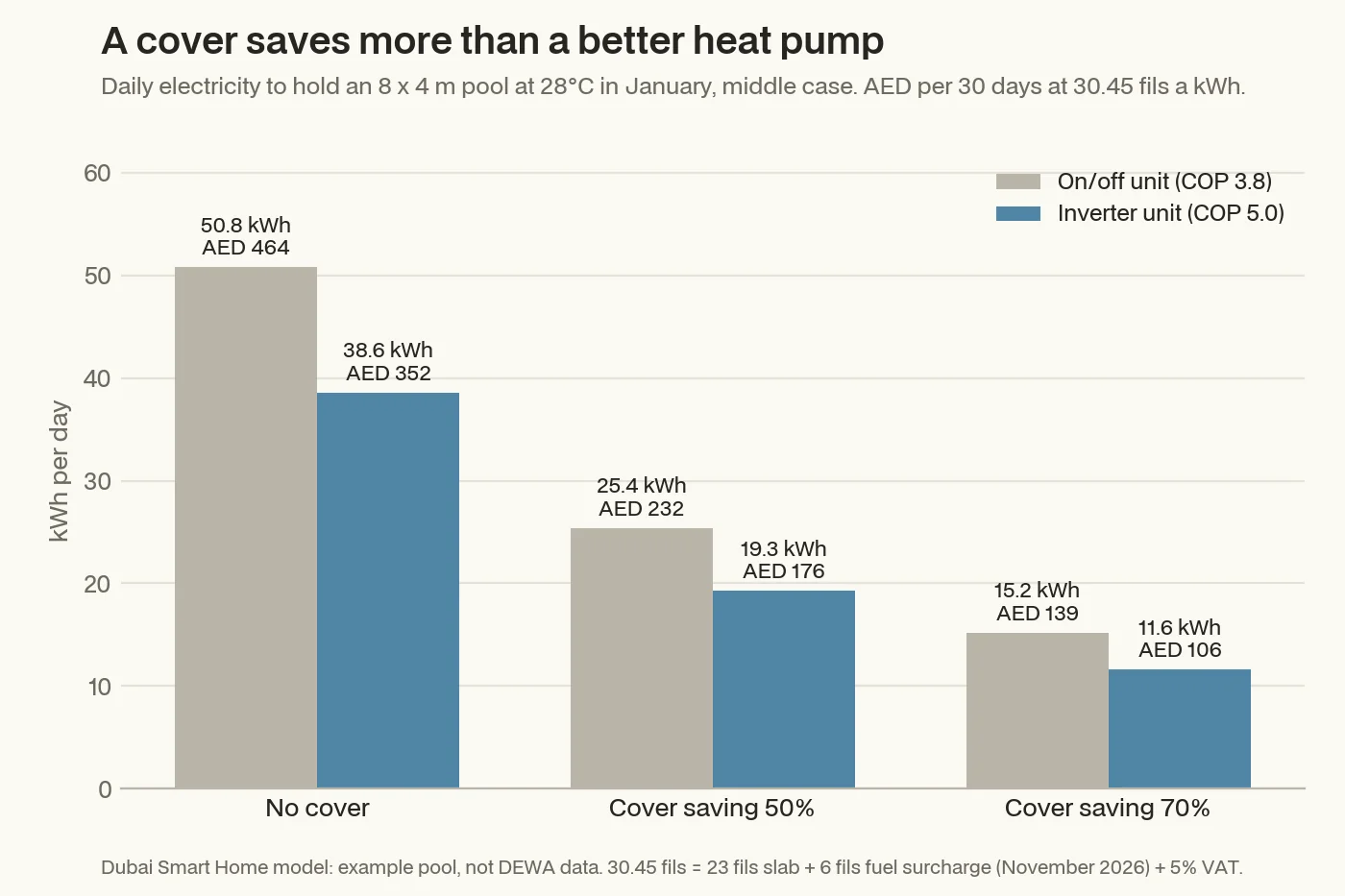
The table shows the middle case in the two lower DEWA bands, with a month counted as 30 days.
| Scenario | kWh a day | AED a month | December to February (AED) | Notes |
|---|---|---|---|---|
| Inverter, no cover | 38.6 | 352 to 413 | 1,057 to 1,239 | 1,157 kWh a month |
| Inverter, cover saves 50% | 19.3 | 176 to 207 | 529 to 620 | Cautious cover case |
| Inverter, cover saves 70% | 11.6 | 106 to 124 | 317 to 372 | Best cover case |
| On/off, no cover | 50.8 | 464 to 544 | 1,391 to 1,631 | 1,523 kWh a month |
| On/off, cover saves 50% | 25.4 | 232 to 272 | 695 to 815 | Cautious cover case |
Across the low and high cases, the same pool costs AED 178 to 2,609 a winter. Above 4,000 kWh a month, each figure rises by 12 to 30%. These are modelled figures for one assumed pool, not meter readings. Winter sun on the water lowers the real loss on clear days, and wind raises it. An energy monitor on the heat pump circuit is the only way to know your own number.
Quick math: the heat pump's kWh land on top of what the house already uses. Add the uncovered 1,157 kWh to a villa already at 1,000 kWh a month and it pays about AED 361 more. At 1,500 kWh it pays AED 387, at 2,500 kWh AED 413 and at 3,500 kWh AED 441. With a cover, the villa at 1,500 kWh pays about AED 180 more. The base figures are examples, not DEWA data.
Our pool automation guide prices a heat pump at AED 2.22 to 3.83 per compressor hour, for 140,000 Btu/h-class machines of about 41 kW. A 50 Hz unit sized for this pool draws 1.61 kW (Zodiac Z400iQ MD4) to about 1.87 kW (Hayward ENPI7M) at 15°C air, so AED 0.49 to 0.67 an hour[10][6].
Common mistake: trusting an hourly figure without doing the sum. One UAE pool page prices a 24 kW electric heater at AED 25 an hour on a 32 fils rate; the sum is AED 7.68. Another quotes AED 25 to 50 an hour for a 6 to 12 kW heat pump: about AED 4.20 per kWh, nine times DEWA's top band.
To have this worked out for your own pool, ask us for a pool heating estimate, or send the heat pump's model plate on WhatsApp. Our energy management and solar work puts the heat pump's kWh beside the rest of the house.
How cold does a Dubai pool get in winter?
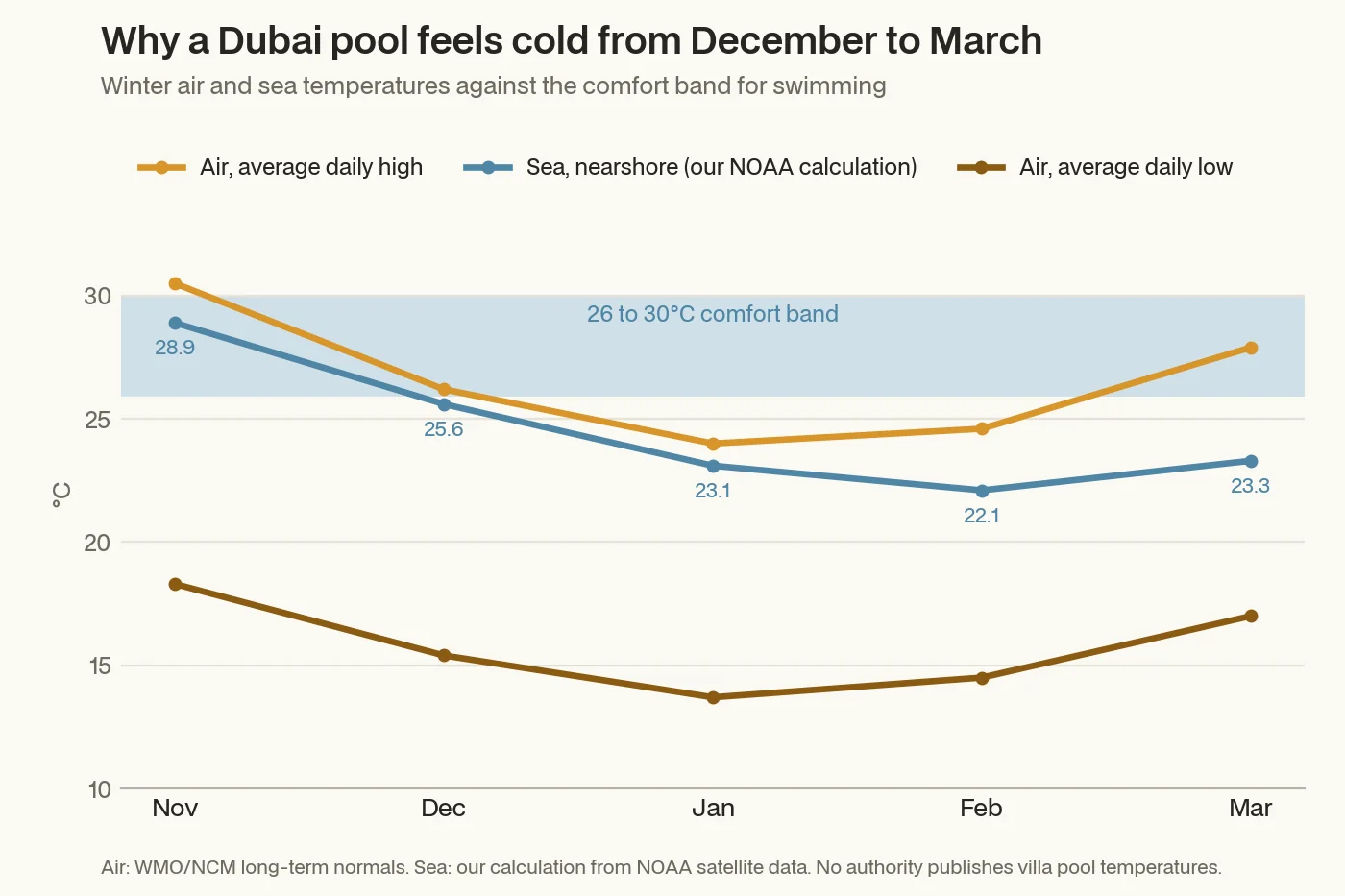
No authority publishes how cold a Dubai pool gets, but the sea off Dubai falls to about 22 to 23.5°C in January and February, on our calculation from satellite data. The long-term averages the World Meteorological Organization (WMO) publishes from National Center of Meteorology (NCM) data give January a mean daily high of 24.0°C and a low of 13.7°C[11].
Recent years at Dubai Airport ran warmer at night, with January's average low about 17°C against 13.7°C, on our calculation from National Oceanic and Atmospheric Administration (NOAA) data[12].
We could not find an official monthly sea-temperature table either[13], so the sea figure comes from NOAA satellite data[14]. A shallow villa pool loses more heat on a clear night than the sea does, so treat any pool figure, including the 22°C starting point in our worked example, as an estimate.
On our sea figures, the Gulf off Dubai sits below the 26°C comfort floor from about mid-December to March. Our table prices December to February; heating in March adds a milder fourth month.
Why does a pool cover save more than a bigger heat pump?
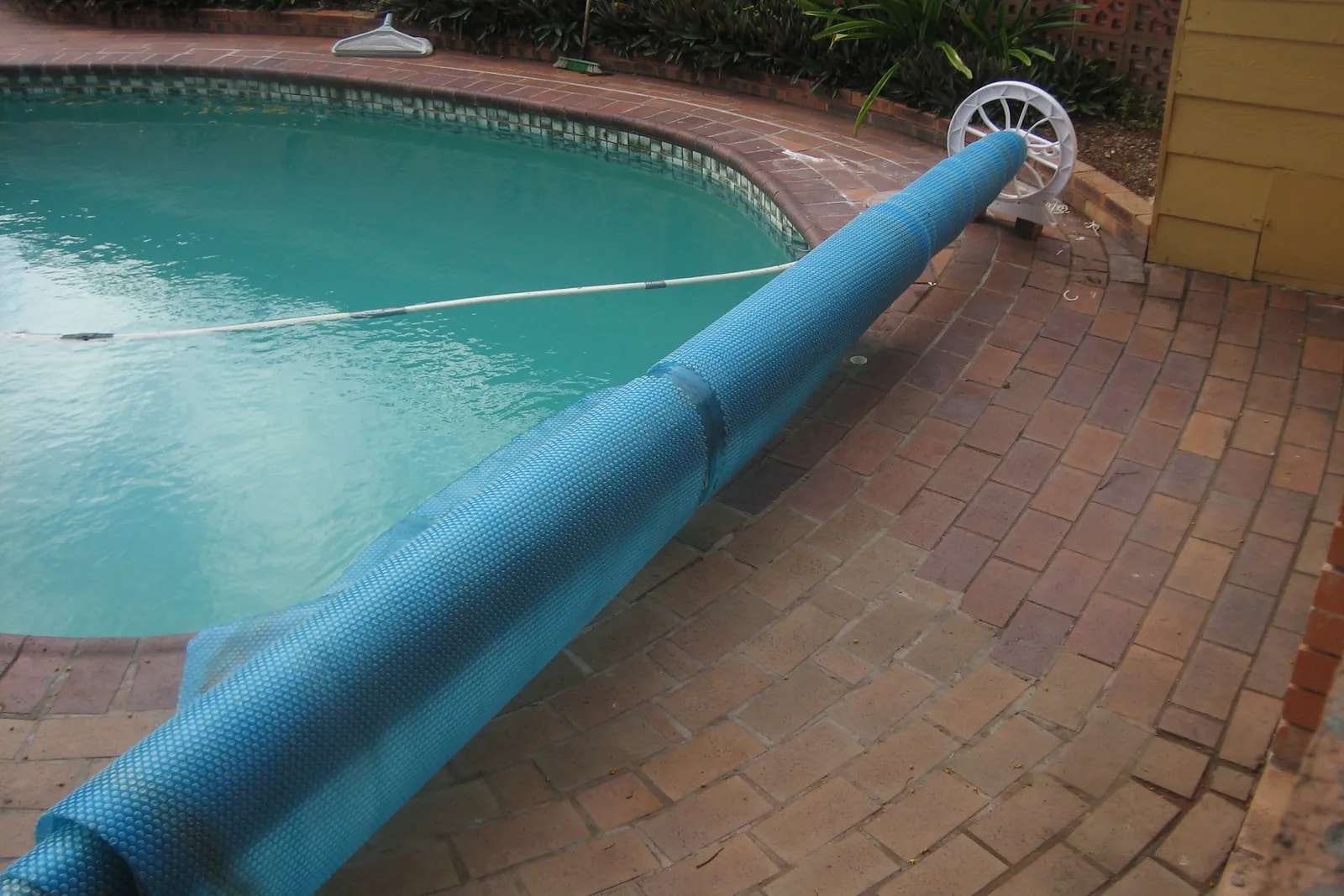
A pool cover saves more than a bigger heat pump because most of a heated pool's heat leaves by evaporation, and a cover stops it at the surface. US government guidance says a cover saves 50 to 70% of pool heating costs[8][9]. In our worked example that is AED 528 to 867 a winter with an inverter unit.
One US study split a heated pool's overnight loss into 56% evaporation, 26% radiation and 18% convection[5].
The US Environmental Protection Agency (EPA) says bubble and thermal covers cut evaporation by 50 to 95%, depending on fit, and cannot serve as safety covers[9]. DEWA's own advice is to "use a pool cover to reduce evaporation"[15].
On 9 November 2026 noon.com sellers listed an 11 x 5.5 m bubble cover at AED 542 to 1,776, cut to size at home[16]. Against a saving of AED 528 to 867 a winter, it pays for itself in under one to about three and a half winters. Sellers publish no replacement interval for bubble covers, so budget for one when it starts to break up.
An automatic safety cover, AED 95,000 to 145,000 fitted on our pool page, saves the same heat while closed, but you buy it for safety[17]. Dubai Municipality's private-pool guideline asks for an enclosure and treats a safety cover as an extra layer, while the Dubai Building Code lists a power safety cover to ASTM F1346 as one case where a fence is not required[18][19]. A bubble cover is neither. Ask your consultant which applies to your plot.
Real talk: buy the cover before a bigger heat pump. Moving from a 10 kW to a 15 kW unit does not cut a single kWh of loss. A bubble cover cuts the heat the pool needs by half or more.
What temperature should you heat a Dubai pool to?
No authority sets a water temperature for private pools in Dubai. Dubai Municipality's private-pool guideline asks only that the water be tested daily, before use, for pH, chlorine and temperature[18]. A setpoint of 26 to 28°C sits inside the comfort range Dubai Municipality quotes, and the lower end costs less to hold.
Dubai Municipality's public-pool guideline quotes the World Health Organization: "the thermal comfort bounds of water range between 26-30 °C"[20]. US Department of Energy guidance says to keep to the lower end of 78 to 82°F, about 26 to 28°C[8]. DEWA's guide for hotels suggests 22.5°C, because heating pools "can be quite costly"[21].
Warming water takes 1.163 kWh of heat per m³ per 1°C, so this pool needs about 52 kWh of heat per degree[22]. At COP 5 that is about AED 3 to 4 of electricity, before the extra overnight loss. The chemistry bands in the private-pool guideline, such as free chlorine of 1 to 2 mg per litre, do not change with temperature[18]. Only the public-pool guideline ties chlorine to heat, doubling the minimum free chlorine above 26°C, and that rule covers public pools, not villas[20].
What size heat pump does an 8 x 4 m pool need?
An 8 x 4 m pool of about 45 m³ needs roughly 9 to 13 kW of heat output measured at 15°C air, used with a cover. That band comes from the makers' own sizing once it is put on a winter basis: Fairland lists a 9 kW unit for 25 to 50 m³, and Fluidra sizes 12.9 kW for 45 m³[23][7].
Makers size on different bases:
- Hayward Europe and Zodiac: covered pools used from May to September, a European summer[6][10].
- Fairland: a pool "well covered" with the unit running at least 15 hours a day[23].
- Fluidra: 26°C water in 15°C air with a heat retention cover, close to a Dubai winter night[7].
On the winter bases, that is about 0.2 to 0.3 kW of output at 15°C air per m³, with a cover. For a 9 or 12 metre pool, multiply its volume in m³ by that range.
Size also sets the warm-up. Lifting this pool from 22°C to 28°C takes 312.6 kWh of heat. A unit giving 9.84 kW at 15°C air needs about 54 hours with a cover saving 50%, and about a week with no cover. Zodiac's manual warns that heating up "may take a few days"[24].
Pro tip: ask every supplier for kW and COP at 15°C air and 26°C water, not the headline figure measured at 26 to 28°C air. Hayward's ENPI7M gives 12.1 kW at 27°C air but 9.84 kW at 15°C; across the six sizes on that sheet, output at 15°C is 66 to 81% of the 27°C figure[6].
What does COP mean at Dubai winter air temperatures?
COP, the coefficient of performance, is the heat a heat pump delivers divided by the electricity it uses. A COP of 5 means 5 kWh of heat for 1 kWh of power. At 15°C air and 26°C water, the 50 Hz inverter units we read rate about 4.6 to 5.9[6][23][25].
COP falls as the air cools. The Hayward ENPI7M drops from 7.59 at 27°C air to 5.25 at 15°C[6]. From December to February, Dubai nights sit near the 15°C test point and afternoons near 24 to 26°C on the WMO normals[11].
Fluidra describes the EN 17645 seasonal rating as built from COP tests at 7, 15 and 26°C air[26]. We found no UAE energy label for pool heat pumps. The European EN 17645 rating (A to F, from a seasonal COP) on a maker's datasheet is the nearest comparable figure[27].
Common mistake: reading a "COP 16" or "COP 20" headline as the unit's efficiency. Madimack gives its 10 kW InverELITE V4 a COP of 19.5 to 7.0 at 27°C air, and Zodiac gives the Z250iQ range 5.4 to 16.4[25][28]. The top number is the compressor at its slowest speed. At full speed in 15°C air Madimack's range gives about 5.0 to 5.3, the figure to compare.
Inverter or on/off: which works better in a Dubai winter?
An inverter heat pump works better in a Dubai winter. It slows its compressor to match the heat the pool is losing, instead of running flat out and stopping. At 15°C air, the inverter units we read rate COP 4.6 to 5.9, against 3.8 for Fluidra's on/off EVOLine at the same point[6][7].
The inverter figures come from Hayward's EnergyLine Pro Inverter (4.55 to 5.87 across sizes), Fairland's InverX (5.0 to 5.1) and Madimack's InverELITE V4 at full speed (5.0 to 5.3)[6][23][25].
With no cover, the on/off unit costs AED 1,391 a winter at 30.45 fils against AED 1,057 for the inverter, AED 334 more. With a cover saving half, the gap falls to AED 166. Hayward says its full-inverter range gives "up to 30% energy savings in regulation mode", once the pool is warm[6].
Should you buy a heat-only unit or a reversible heat pump?
A reversible heat pump heats in winter and chills in summer with the same outdoor unit, which suits Dubai, where our sea figures run near 34°C in August. The catch is summer air. The maker limits we read end at 40 to 43°C, below many Dubai July afternoons[24][23][25].
The smaller Z400iQ models stop when the air rises above 40°C[24]. Fairland and Madimack publish 43°C. Hayward's European datasheet gives no maximum air temperature; ask for it in writing if the unit will chill in summer[6].
Cooling output is also smaller. At 35°C air and 28°C water, Madimack's 10 kW model gives 4.8 kW of cooling and its 14 kW model 6.7 kW, about 45 to 49% of rated heating output[25]. If summer chilling matters, the cooling figure may decide the size.
What chilling costs to run is in our pool chiller and automation cost guide, and the rest of the garden in our outdoor smart home guide for Dubai.
What does automation add to a pool heat pump?
Automation adds control, not a cheaper rate. Dubai homes pay the same slab rate at any hour, so a schedule saves kWh, not tariff[1]. A good setup runs the heat pump in the warm afternoon, heats only ahead of planned swims, keeps the filter pump running whenever it heats and shows the kWh it uses.
Running the compressor in the warm afternoon lifts its COP from about 5 at 15°C air to about 7 near 25°C on the inverter datasheets we read, so the same heat takes about 30% less electricity[6][23]. With a cover saving half, that is 13.8 kWh a day instead of 19.3, about 497 kWh less a winter: AED 151 to 177. January afternoons average 24°C, so treat it as an upper estimate[11].
The wiring decides what the app can do:
- Remote on and off. A licensed electrician wires a relay with a potential-free (dry) contact to the heat pump's remote on/off terminals[24]. The heat pump documents we read offer an app and this dry contact; none lists Modbus or another smart-home protocol.
- Heating priority. The heat pump keeps the filter pump running while the water is below setpoint, and its flow switch stops it when no water flows[24][6].
- A pool controller. Hayward's OmniLogic has heater outputs "including heat pumps and chillers", but a 120 V logic board[29]. Pool controllers switch the heat pump through a dry contact; confirm the pairing with both makers.
- The app. Check that the maker's app installs and works on a UAE account before you buy.
Our catalogue lists the Shelly EM at AED 153.56 (amazon.ae, 19 July 2026); it reads the heat pump circuit at the board[30]. Shelly rates it for -20 to 40°C, so it goes in the board, not on the pump pad[31]. Our Shelly EM energy monitor page lists what it measures, and our DEWA smart meter guide covers the whole-home reading.
Forum posts from Dubai villa owners describe a pool heater switched on by someone else in the household and found only on the DEWA bill; an app schedule and an energy alert close that gap.
Pro tip: give the heat pump a heating window in the warmest eight hours of the day, and tie the setpoint to when the family swims. Raise it two to three days before a planned weekend, with the cover on, and drop it back afterwards.
Our pool controller retrofit starts from AED 6,800 and brings the pump, heater and lights into one app[17]. Our pool and outdoor automation service designs that layer, and our home networking and Wi-Fi service plans a reliable link to the pump pad.
What does a pool heat pump cost to buy and run over five years?
Over five winters, an inverter heat pump on the worked example pool costs about AED 1,585 to 3,100 to run with a cover and AED 5,285 to 6,195 without, on DEWA's November 2026 tariff held flat[1]. The purchase price is the open number, because villa-size units are sold by quote in the UAE.
We found no villa-size pool heat pump with a public UAE retail price on 9 November 2026: noon.com and Ace UAE list only accessories and small plug-in heaters, and the amazon.ae listings could not be opened[16][32]. UAE pool sites and AI answers quote anywhere from about AED 4,500 to AED 60,000, usually without the unit's kW, the pool size or VAT, so ask for a quote that names all three.
| Line | Five winters (AED) | Notes |
|---|---|---|
| Heat pump and installation | Quote only | Ask for kW at 15°C air, 50 Hz and VAT |
| Inverter, no cover | 5,285 to 6,195 | COP 5.0, middle case |
| Inverter with a cover | 1,585 to 3,100 | Cover saves 50 to 70% |
| Inverter, cover, afternoon running | 1,135 to 2,210 | COP about 7; upper estimate |
| On/off, no cover | 6,955 to 8,155 | COP 3.8 |
| Resistance heater, no cover | 26,430 to 30,990 | COP 1 |
| Bubble cover | 542 to 1,776 each | noon.com, 9 November 2026; replace when worn |
| Energy monitor and controller | 153.56; from 6,800 | Shelly EM (catalogue); our controller retrofit |
Makers publish warranties, not lifespans: Zodiac's European leaflet lists 3 years on the unit, 5 on the compressor and 10 against condenser corrosion, and Hayward Europe 2 years plus 2 more through its network[10][6]. Terms in the UAE may differ, so ask who honours the warranty here. Before comparing quotes, ask for a site survey so the unit is sized for your pool and supply.
What should you check before you buy a pool heat pump in the UAE?
Before you buy a pool heat pump in the UAE, check the supply. The US-market heat pump documents we read list 60 Hz supplies, while UAE mains is 230 V at 50 Hz; get the maker's written confirmation of a 50 Hz model before you buy one for a UAE villa[2][3].
| Check | What to ask for | Why it matters in Dubai |
|---|---|---|
| Supply | 230 V, 50 Hz, in writing | Some US units are 60 Hz only |
| Phase and current | Single or three-phase; maximum current | Sets the breaker and cable |
| Winter output | kW and COP at 15°C air, 26°C water | Winter nights sit near 15°C |
| Summer limit | Maximum air temperature when cooling | Limits we read end at 40 to 43°C |
| Exchanger and casing | Titanium exchanger; coastal casing | Salt pools and sea air |
| Noise | dB(A) at 1 m and 10 m | Side gaps to neighbours are short |
| Controls | Dry contact, heating priority, UAE app account | Lets a schedule run it |
| Warranty | Authorised UAE distributor | Leaflet terms are European |
Fluidra, the group behind Zodiac and AstralPool, has a Middle East base in Dubai[33].
Ask which refrigerant the datasheet names (several current models use R32, others R410A) and ignore "eco-friendly" labels. The UAE regulates HFC refrigerants under Ministerial Decree No. 138 of 2023 and plans to ban them by 2040, but we found no ban on selling a unit charged with R32 or R410A[34]. Titanium heat exchangers are the norm for salt pools; coastal air also attacks the casing and fasteners, which is why Zodiac sells a stainless-steel front-panel version[10]. Ask what the warranty says about corrosion.
What power supply and breaker does a pool heat pump need in a Dubai villa?
A pool heat pump in a Dubai villa needs its own circuit, with the breaker and cable sized by a licensed electrician from the unit's nameplate. Single-phase 230 V models reach about 20 kW of heat, with maximum currents of 10 to 35 A on the sheets we read; larger units are three-phase[24][6].
The Dubai Building Code's nearest rules are for air-conditioning circuits and for water heaters, jacuzzis and saunas (a double-pole isolator beside the equipment); it does not name pool heat pumps[19]. Dubai Municipality's pool-plan guideline asks for an earth circuit breaker on each pool circuit[35].
DEWA's wiring regulations decide the exact earth-leakage rating for the pool circuit, and a DEWA-enrolled electrical contractor confirms it. The figure is not the same across the UAE: Abu Dhabi's code asks for 30 mA on pool circuits and the Northern Emirates code for 10 mA[36][37]. For a three-phase unit, our energy management range lists the Shelly 3EM Gen3 at AED 243.40 (amazon.ae, 19 July 2026)[30].
Where should the unit go, and how loud is it?
A pool heat pump goes outdoors near the pump and filter, with free air around its fan. Villa-size units measure about 36 to 56 dB(A) at 1 m and 16 to 39 dB(A) at 10 m on the maker sheets we read[6][25].
Dubai Municipality sets noise limits for building works and entertainment venues, and the Dubai Building Code asks that plant noise be controlled. We found no decibel limit written for a villa pool heat pump[38][19]. Community rules, Emaar's among them, deal with noise from equipment such as AC units, so check yours.
Pool works need your community's NOC, and community rules differ. Check your developer's modification guide before ordering an outdoor unit[39]. We found no published rule that names pool heat pumps. Pool plans filed with Dubai Municipality include the pump-room layout and an electricity diagram, so ask your consultant whether an added unit needs updated drawings[35]. Our Arabian Ranches area page shows one community's approvals, and our Palm Jumeirah area page covers a plot where salt air reaches the casing.
When is a pool heat pump not worth it?
A pool heat pump is not worth it if you swim in winter only now and then, will not use a cover, or are away for much of December to March. Heat pumps are slow, and our worked example needs one and a half to seven days for the first warm-up. Without a cover, an on/off unit costs AED 1,391 to 1,631 a winter.
- A renter. In a rented villa, who pays for and maintains pool equipment depends on the lease; get the landlord's written consent before any new equipment or wiring goes in. Our landlord smart home guide covers consent.
- A plug-in heater. A Bestway Flowclear 2,800 W heater was AED 485 in a noon.com 11.11 deal and AED 599 at Ace UAE, where it showed as out of stock on 9 November 2026. It is rated for pools up to 17,035 litres[32]. On a 45 m³ pool it delivers at most 67 kWh a day, about a third of the middle-case loss.
- A resistance heater. AED 5,286 to 6,198 a winter uncovered; Fluidra calls electric heaters "a big energy user"[40].
Solar collectors suit sunny climates but need roughly as much panel area as the pool's surface; we found no UAE retail price, so ask for a quote[40]. Rooftop solar PV is the other route, in our villa solar panel cost guide.
Real talk: the cheapest winter upgrade is a bubble cover and a 26°C setpoint, not a machine. If the family swims a handful of times between December and March, a cover alone for under AED 1,800 keeps more of the sun's heat in the water.
How Dubai Smart Home helps with pool heating
Four decisions matter most. Put the cover on first. Size the unit by its output at 15°C air. Get 230 V and 50 Hz in writing. Then schedule it for the warm afternoon, when its COP is highest. The figures in this guide are our own calculations from the sources cited[41].
We survey the pool and the pump pad, size and specify the heat pump and its controls, and prepare the paperwork your community asks for. Through to handover we coordinate the work, then configure the schedules, the app and the energy readings. Handover includes a 12-month workmanship warranty that can vary by product. Controls come under our pool and outdoor automation service, and the metering under our energy management work; the wider villa is in our smart home guide for villa owners. Our design work is rated 4.9/5 by Dubai homeowners.
For a heat pump sized to your own pool, book a free design consultation, or send the pool's size and a photo of the pump pad on WhatsApp.