UAE installer pages advertise a 10 kWp villa solar system at anything from AED 20,000 to 60,000 (29 pages from 19 companies, read on 13 October 2026). Most show no date, no model numbers and no tariff behind their payback.
This guide comes from the design team at Dubai Smart Home, with 100+ Dubai smart home projects worked on since 2016. It sits within our complete smart home guide for Dubai. We read every rule and tariff on the Dubai Electricity and Water Authority (DEWA) website on 13 October 2026. DEWA requires a villa solar system to be installed and connected by a DEWA-enrolled contractor. Our part is sizing, specification, and the energy monitoring and automation around it.
How much does a solar panel system cost for a villa in Dubai in 2026?
A villa solar system in Dubai costs AED 12,500 to 17,500 for 5 kWp, AED 25,000 to 35,000 for 10 kWp and AED 37,500 to 52,500 for 15 kWp. That is our published installed range of AED 2.50 to 3.50 per watt[1]. DEWA's connection fee, AED 1,500 in its FAQ, comes on top[2].
A kWp (kilowatt-peak) is the panels' rated power in full test sunlight. A kWh (kilowatt-hour) is one unit on your DEWA bill. The inverter turns the panels' DC power into AC for your home.
Our range is a per-watt guide for a villa array without a battery, quoted after a survey. Small systems sit at the top of it or above it, because the inverter, the protection gear and the DEWA paperwork cost much the same at any size. Our solar panel, inverter and battery range lists each product.
The table sets three different solar panel prices side by side. Parts are hardware only, excluding VAT, as listed by Maxima Solar in Dubai on 13 October 2026[3]. The fourth column is a market range from 29 installer pages by 19 UAE companies, read the same day, not our price. Never add or average the columns.
| System size | Parts only, ex-VAT | Our published installed range | What UAE installers advertise | Notes |
|---|---|---|---|---|
| 5 kWp | AED 12,137 to 12,965 | AED 12,500 to 17,500 | AED 10,000 to 30,000 (median about AED 19,900) | Parts: 9 panels of 580 W, one 15 kW inverter. Expect the top of our range or more |
| 10 kWp | AED 16,451 to 18,015 | AED 25,000 to 35,000 | AED 20,000 to 60,000 (median about AED 39,850) | Parts: 17 panels, same inverter |
| 15 kWp | AED 21,173 to 23,565 | AED 37,500 to 52,500 | AED 30,000 to 90,000 (median about AED 59,800) | Parts: 26 panels, same inverter |
| On top, at every size | Not included | Add DEWA's AED 1,500 fee[2] | Check each quote | From year one, a mandatory maintenance contract. DEWA publishes no price[4] |
The gap between parts and our installed range pays for design, DEWA paperwork, labour, access equipment, commissioning, margin and VAT. DEWA offers no subsidy: its FAQ says the incentive is the saving on your bill[2].
How long does solar take to pay for itself on a Dubai villa?
Solar on a Dubai villa pays for itself in about 4.5 to 6.5 years at 3,000 kWh a month. At 7,000 kWh a month it takes about 3.5 to 5 years. That is simple payback before running costs, on our published installed range plus DEWA's AED 1,500 fee, at the October 2026 tariff[5].
DEWA bills electricity in slabs, price bands that rise with monthly use. The first 2,000 kWh cost 23 fils each, the next 2,000 cost 28, the next 2,000 cost 32, and anything above 6,000 costs 38. A fuel surcharge, which moves with fuel prices, added 6 fils per kWh in October 2026, and 5% VAT comes on top[5].
Net metering is how DEWA credits your panels: exported kWh come off imported kWh, then the slabs apply to what is left[2]. So solar removes your most expensive kWh first.
Quick math: one offset kWh is worth roughly the slab rate plus 6 fils, times 1.05 for VAT. On 23 fils that is 0.290 x 1.05 = AED 0.3045. It is AED 0.357 on 28 fils, AED 0.399 on 32 and AED 0.462 on 38, which is 52% more than on the bottom slab. Check these against a recent bill.
The table works three sizes at two bill levels: a 3,000 kWh month, about AED 966 in electricity, and a 7,000 kWh month, about AED 2,583. They are our examples, not typical-villa figures, derived by Dubai Smart Home from DEWA's tariff and two modelled Dubai yields[6][7].
| Monthly use | System | Slabs the solar kWh remove | Yearly saving | Simple payback, before running costs | Payback if upkeep costs AED 1,000 a year |
|---|---|---|---|---|---|
| 3,000 kWh | 5 kWp | 28 fils | AED 3,058 to 3,168 | 4.4 to 6.2 years | 6.5 to 9.2 years |
| 3,000 kWh | 10 kWp | 28 fils, then 23 | AED 5,846 to 6,035 | 4.4 to 6.2 years | 5.3 to 7.5 years |
| 3,000 kWh | 15 kWp | 28 fils, then 23 | AED 8,454 to 8,737 | 4.5 to 6.4 years | 5.0 to 7.2 years |
| 7,000 kWh | 5 kWp | 38 fils | AED 3,957 to 4,100 | 3.4 to 4.8 years | 4.5 to 6.4 years |
| 7,000 kWh | 10 kWp | 38 fils, then 32 | AED 7,591 to 7,838 | 3.4 to 4.8 years | 3.9 to 5.5 years |
| 7,000 kWh | 15 kWp | 38 fils, then 32 | AED 11,008 to 11,379 | 3.4 to 4.9 years | 3.8 to 5.4 years |
One row in full: a 10 kWp array makes about 1,428 to 1,479 kWh a month. On a 3,000 kWh month, the first 1,000 kWh come off the 28-fils slab at AED 0.357 and the rest off the 23-fils slab at AED 0.3045. That saves AED 5,846 to 6,035 a year. With the AED 1,500 fee, simple payback before running costs is 26,500 / 6,035 = 4.4 years and 36,500 / 5,846 = 6.2 years.
Each sum assumes even use and output all year, an unshaded array tilted near 25 degrees and no panel ageing. Real villas use more in summer, as our summer DEWA bill guide shows.
DEWA's upkeep rule of thumb is 0.5 to 1% of the installation cost a year[2]. Counting that cost, payback is about 4.5 to 6.8 years at 3,000 kWh and 3.4 to 5.2 at 7,000. For 5 kWp, plan on the slow end.
Installers advertise a median of about AED 3,985 per kWp (29 pages, 13 October 2026). At that price the same sums, before running costs, give 6.8 to 7.3 years at 3,000 kWh and 5.2 to 5.6 at 7,000.
What does each part of a villa solar system cost?
The hardware for a 10 kWp villa system cost AED 16,451 to 18,015 at Dubai retail prices on 13 October 2026, excluding VAT. Panels were AED 6,800 of that and the inverter AED 6,930. Mounting, cable and protection made up the rest.
The table splits that system line by line, as listed by Maxima Solar.
| Line | UAE price | Share of the parts | Notes |
|---|---|---|---|
| Panels | 17 x AED 400 = AED 6,800[3] | 38 to 41% | The AE Solar 580 W panel, the one such panel with a public UAE price |
| Inverter | AED 6,930[8] | 38 to 42% | The Growatt WIT 15K-HU hybrid inverter. A Fronius Symo 8.2-3-M inverter was AED 9,480[9] |
| Mounting | AED 1,666 to 3,230[10] | 10 to 18% | AED 98 to 190 a panel on tilted flat-roof stands. A pitched or tiled roof uses a different fixing, has no public price, and needs the structural check to cover wind loading |
| Cable, connectors, protection | About AED 1,055[11] | 6% | Cable at AED 5 a metre, surge protectors, a breaker, isolators |
| DEWA connection fee | AED 1,500[2] | Extra | DEWA's FAQ figure. It can be lower if the generation meter is waived under 10 kW. The exact amount comes with DEWA's estimate |
| Design, DEWA paperwork, labour | No published line | Extra | About AED 7,000 to 18,500: our arithmetic for the gap to our installed range, not a quoted price |
| Structural assessment | AED 6,000 to 12,000 | Extra | Our energy page's budget, only where a fresh assessment is needed |
| Year two onward | AED 125 to 350 a year by DEWA's rule of thumb | Extra | Maintenance contract and cleaning. Get the real price quoted |
At 10 kWp the panels are only 19 to 27% of our installed range, below the 30 to 50% in DEWA's FAQ[2].
To have these lines priced for your roof, send twelve months of DEWA bills and a roof photo on WhatsApp, or book a free design consultation.
Three things move the price per watt.
- The inverter costs much the same at any size, so at 5 kWp it is 53 to 57% of the parts.
- Big-brand panels from Jinko, Trina, JA Solar and LONGi are quoted, not listed, in the UAE: the one distributor page we found sells by the container[12]. Expect them to cost more than the AED 400 panel.
- A 3-panel stand costs AED 190 a panel against AED 98 on a 10-panel stand, so a broken-up roof costs more.
What do DEWA's Shams Dubai rules do to your payback?
Shams Dubai is DEWA's net-metering programme for rooftop solar, and its rules set what each solar kWh is worth. Every month, one exported kWh cancels one imported kWh before the slabs are applied. Surplus carries forward with no expiry, is never paid in cash, and is lost when the account closes[4].
The programme rests on Executive Council Resolution No. 46 of 2014[13]. The current rulebook is DEWA's Shams Dubai Connection Conditions, Version 4.1 of November 2025[4].
- The offset comes first. DEWA deducts your exports and any carried-forward credit from your imports, then applies the slabs and the fuel surcharge[2]. Credit is counted in kWh; there is no export rate.
- Surplus never expires. It is carried forward with no limit of time or quantity, so winter surplus can offset summer bills[4].
- No cash, ever. The 2014 resolution bars any payment for surplus[13]. Credit cannot move to another person or another plot. It can offset your other DEWA accounts on the same plot, such as a guest house or pool meter[4].
- Credit ends with the account. On a sale or new tenancy the system can pass to the new owner or tenant by joint request; the credit cannot[2].
Real talk: under DEWA's monthly netting, the hour you use the power does not change the bill; the number of kWh does. Run the pool pump at noon or at midnight and a net-metered DEWA bill comes out the same. Timing matters only where exports are not netted, as in Abu Dhabi.
Our Shams Dubai net metering explainer works through one August bill line by line and shows why a credit used in summer is worth more than one used in winter.
How much electricity does one kWp of panels produce in Dubai?
One kWp of panels in Dubai produces about 1,713 to 1,775 kWh a year on an unshaded, south-facing array tilted near 25 degrees. The lower figure is from the European Commission's PVGIS model and the higher from the World Bank Group's Global Solar Atlas[6][7]. A 10 kWp array makes 17,130 to 17,750 kWh a year.
Both are modelled, not measured on a Dubai roof.
| Line | Figure | Source | What it means on a villa roof |
|---|---|---|---|
| Modelled yield | 1,713 to 1,775 kWh per kWp a year | PVGIS, Global Solar Atlas | 5 kWp makes 8,565 to 8,875 kWh a year. 15 kWp makes 25,695 to 26,625 |
| Month by month | 134 kWh per kWp in December, 161 in May | Global Solar Atlas | The weakest month makes 83% of the best |
| Low tilt, or panels close to the roof | 1,594 to 1,665 kWh, 2.8 to 6.9% less | PVGIS[14][15] | Leave an air gap under the panels |
| Heat | 12.4 to 16.3% a year | PVGIS | Already inside the yield figures |
| Dust, by days since cleaning | 3% at 10 days, 5% at 20, 7% at 30, 13% at 90 | UAE University study, Al Ain[16] | One clean a year is far too few |
| Flat against tilted panels | 10.79% dust loss laid flat, under 1% at 25 degrees | Study at Dubai's latitude[17] | Tilt the panels. Never lay them flat |
| Ageing | 0.5% a year, the long-run median | NREL review of field studies[18] | About 95.6% of first-year output in year 10, 88.7% in year 25. An NREL study reported by pv magazine found hot sites age faster[19] |
The dust figures come from UAE test sites inland and at Dubai's latitude, and a roof near construction, the desert edge or the coast can gather dust faster. Panels close to a flat roof add about 0.3 to 0.5 years to the slow end of each payback range before running costs.
How big a solar system can your villa take?
DEWA caps a villa's solar at 100% of the first 100 kW of its connected load, measured at the inverter[4]. Your own figure is the approved load on your DEWA account, so ask your contractor to read it from your connection records before anyone sizes the roof.
- DEWA's cap. It is measured on the inverter's AC output, so ask your DEWA-enrolled contractor how DEWA treats a panel array larger than the inverter rating. DEWA can impose a lower cap where the local grid requires it[2]. We found no minimum size in its conditions.
- Your roof. The glass alone takes about 4.5 square metres per kWp: about 23 square metres for 5 kWp and 67 for 15 kWp[20]. A real roof needs more, for row spacing, parapet setbacks, tanks and chiller units, and only a survey gives the figure. DEWA's conditions do not envisage ground-mounted systems[4].
- Your bill. Add up twelve months of kWh from your bills. An array that makes more than that only banks credit DEWA never pays out. Size the array so its kWh come off your upper slabs. An electric car adds kWh too, as our home EV charger guide for Dubai villas explains.
As an illustration, two 1.5-ton split units listed by UAE retailers in October 2026 draw about 1.8 kW while cooling[21][22]. Check your own unit's nameplate; ducted and inverter units differ. A 5 kWp array averages 23.5 to 24.3 kWh a day, enough for 13 to 14 hours of one such unit. The panels need not run the AC hour by hour, because the meter nets kWh across the month.
What does a villa solar system cost to run each year?
DEWA's rule of thumb puts yearly maintenance on a villa solar system at 0.5 to 1% of the installation cost, about AED 125 to 350 at 10 kWp[2]. Every Shams Dubai system must hold a maintenance contract with a DEWA-enrolled contractor, inspected at least every 12 months and cleaned at least once a year[4]. DEWA requires the contract but publishes no price for it.
Installers advertise about AED 300 to 3,000 a year (five pages, read on 13 October 2026). Get the yearly price, the number of cleans and the cost of an extra clean in writing before you sign.
A fixed yearly cost hurts a small system most. At AED 2,000 a year on a 3,000 kWh month, payback is 12.0 to 18.0 years for 5 kWp. It is 6.6 to 9.5 years for 10 kWp and 5.8 to 8.4 for 15 kWp. The AED 2,000 is an illustration, not a quote.
DEWA's floor is one clean a year, but the UAE University study proposed cleaning about every 15 days[16].
Quick math: at the study's 13% loss after 90 days without cleaning, a 10 kWp array is down about 186 to 192 kWh a month. That is worth AED 57 on the 23-fils slab and AED 89 on the 38-fils slab, every month the dust stays.
Budget one inverter replacement inside the panels' 25 to 30 year life. DEWA's FAQ describes a general inverter guarantee of 10 years[2]. No UAE source publishes a replacement price, so get the UAE warranty terms in writing.
Do you need a battery with solar panels in Dubai?
No. DEWA's FAQ says a grid-connected system does not need storage[2], and a battery cannot lower a net-metered DEWA bill. DEWA has no time-of-use rate for homes[5], and it already banks your surplus kWh for kWh with no expiry. A battery adds backup power in an outage, not bill savings.
DEWA's customers lost an average of 0.82 minutes of supply each in 2025, about 49 seconds[23], though one street can lose power for longer. A grid-connected system without a battery stops in a power cut, because an automatic device disconnects it when the grid is down[2].
The one home battery with a public UAE price is the Pylontech US5000. A 4.8 kWh module was AED 4,750 excluding VAT at Maxima Solar on 13 October 2026, before racks, cabling and fitting[24].
Choosing the inverter chooses the battery. The US5000 needs a 48 V hybrid inverter (one that also runs a battery) such as the Growatt WIT 15K-HU[25]. A Huawei SUN2000-M1 takes only Huawei's own high-voltage LUNA2000 battery[26]. The US5000 is an IP20 indoor unit[27], so it belongs in a cooled room.
Common mistake: buying a battery to cut the bill. Three US5000 modules cost AED 14,250 in hardware alone, and under DEWA's netting that money has no payback from the bill. If you want backup, first ask your DEWA-enrolled contractor how DEWA treats a battery on a Shams Dubai system.
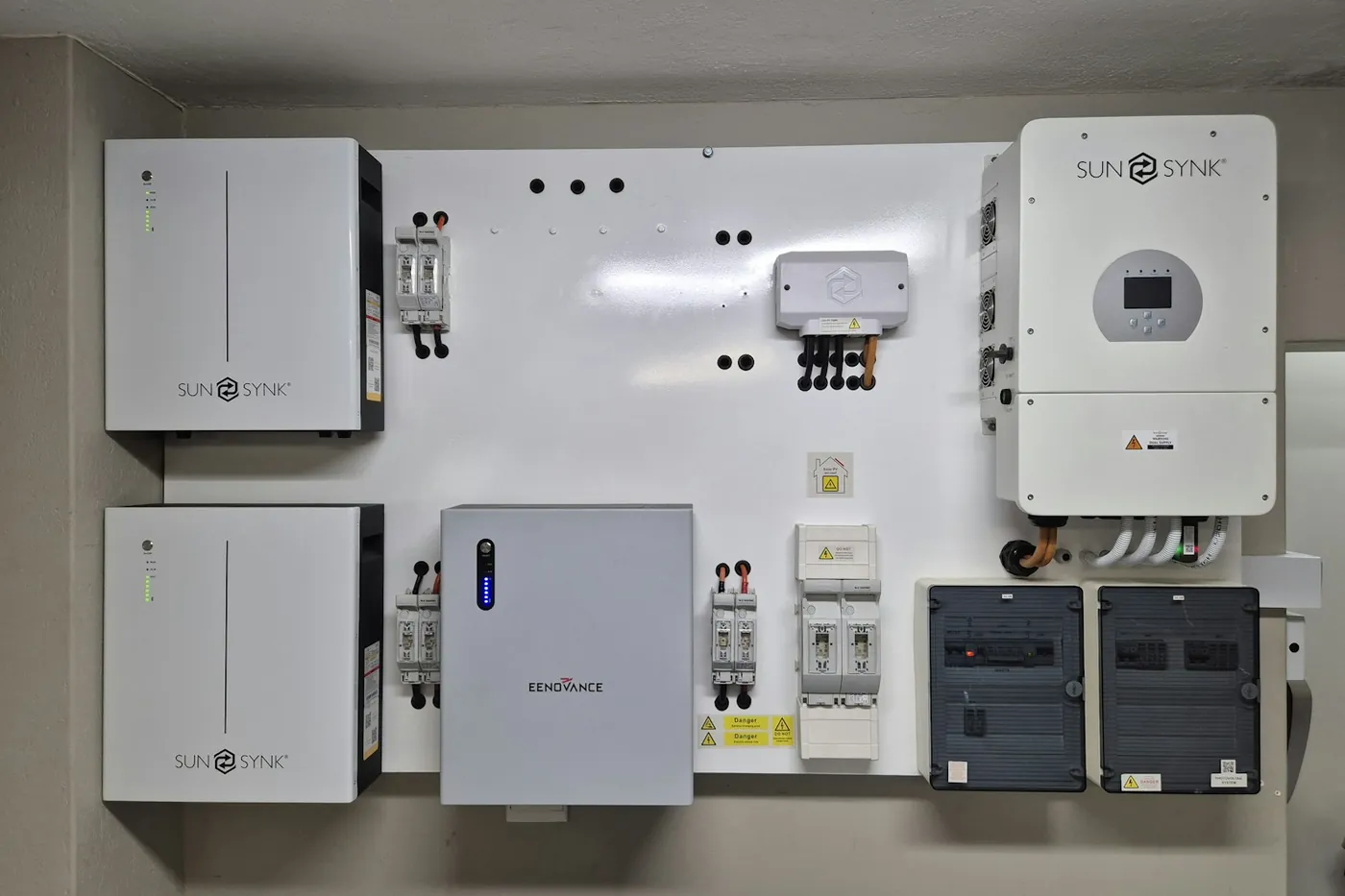
To keep a few devices running, a unit from our portable power station range costs less than a home battery.
When does solar not pay on a Dubai villa?
Solar pays slowly on a villa whose whole bill sits inside the 23-fils slab. At 1,500 kWh a month, about AED 457, a 5 kWp system saves AED 2,608 to 2,702 a year. Simple payback is 5.2 to 7.3 years before running costs, and 8.2 to 11.8 years if upkeep costs AED 1,000 a year.
At AED 2,000 a year of upkeep, the same system takes about 20 to 31 years. DEWA's FAQ says the case is more attractive for customers with larger consumption and bigger systems[2].
- An oversized array. On that villa, the saving from 15 kWp stops at the whole electricity charge, AED 5,481 a year. The other 7,695 to 8,625 kWh a year sit as credit that is never paid out.
- A tenancy. DEWA allows a tenant's system on the tenant's own account, but the roof is the landlord's. Get the owner's written agreement first, and agree who keeps the equipment when the lease ends.
- An apartment. DEWA does not offset one system's output against other customers' accounts[2], so a building's roof array cannot cut each flat's bill. See who can install solar, villa or apartment.
- A planned sale. Credit does not pass to the buyer, so the payback must fit the years you keep the villa.
- A shaded or crowded roof. The yield figures assume no shade, and chiller units and tanks take roof space.
The cheapest honest step is to cut the kWh first. Our guide to cutting a DEWA bill with smart home controls starts there, and a monitor from our energy monitoring range shows where the kWh go.
Which panels and inverters suit a Dubai roof, and which do not fit together?
Rooftop panels lose 0.26% to 0.35% of their power for each degree C the cells heat up, on the five makers' datasheets we read[20][28]. That figure, the temperature coefficient, and the warranty are the two lines to compare. The bigger risk is a panel, an inverter and a stand that do not fit together.
Product warranties run 12 years on the Jinko and JA Solar panels, 15 on the AE Solar and 25 on the Trina[29][30][31]. Our Jinko Tiger Neo panel page lists its heat and warranty figures. Three fit problems come up.
- Panel current. A 580 W panel delivers about 13.4 to 13.5 A. A standard Huawei SUN2000-M1 input takes 11 A and the High Current Version 13.5 A[32], so the quote must name the version.
- Frame, phase and voltage. The priced stands take panels up to 30 mm thick, and the JA Solar frame is 35 mm. Many Dubai villas have a three-phase supply, so check your DEWA meter before anyone quotes an inverter. DEWA limits a villa's array to 600 V DC[33].
- Inverter heat. Makers rate these inverters to 60°C ambient but publish no heat-loss curve. DEWA's standard allows no more than a 25% drop at 50°C, so mount the inverter in shade with air around it[33].
Ask for exact model numbers and check each against DEWA's list of eligible equipment. The list is per model, and DEWA says it is not an endorsement[34].
What approvals do you need besides DEWA's, and how long does it take?
A villa array needs DEWA's approval, a building permit for the structural part and, in most master-developer communities, a no-objection certificate. DEWA lists 17 working days for its own approval service and says a small system can be fitted within a week once every authorisation is in hand[35][36].
- DEWA. Only DEWA-enrolled consultants and contractors may design, install and maintain a system, and only they can submit the application, which is free[36]. If DEWA's annual connection cap is reached, approved systems wait for the next calendar year[4], so ask whether a queue applies.
- Building permit. DEWA's FAQ says the structural part needs a building permit from Dubai Municipality or the authority for your area, then a completion certificate[36]. We found no published fee or timeline for a villa array, so ask the contractor who files it.
- Fire safety. DEWA's standard does not ask a one- or two-family villa for the manual emergency disconnect it requires on larger buildings[33]. We found no separate Civil Defence rule for a villa array, so ask your contractor.
- Your community. Ask your community management what it needs, and its view on panels visible from the street, before you sign.
Emaar says owners need its alterations team's permission before work starts, plus any Dubai Municipality, DEWA or Civil Defence approvals that apply[37]. Our Arabian Ranches area page and Dubai Hills Estate area page name the approval bodies there.
These approvals add to DEWA's 17 working days, so ask for the whole timeline in weeks. DEWA's process has six steps[38], and our solar and smart home guide walks through them. On a new build, have a conduit run from roof to distribution board before the walls close.
What should a solar quote include, and what are the red flags?
A solar quote for a Dubai villa should state the panel kWp and the inverter kW, the exact model numbers and the expected kWh a year. It should also give the yearly maintenance price and who files each approval.
- Size, twice. Panels in kWp and inverter AC output in kW, since DEWA's cap is measured on the second.
- Model numbers. The exact panel and inverter models, each checked on DEWA's list.
- Expected kWh a year. The contractor must give DEWA this figure in the application[35].
- Maintenance. The yearly price, the number of cleans and the price of an extra clean.
- VAT and warranties. VAT as its own line, and UAE warranty terms in writing.
- Enrolment. The firm's name on DEWA's register of enrolled contractors[39]. DEWA does not vouch for the listed firms' work.
Pro tip: divide the quoted kWh a year by the kWp. Dubai's two published models give 1,713 to 1,775 kWh per kWp for an unshaded, well-tilted array. A quote far above 1,775 needs explaining before you trust its payback.
Watch for four red flags. A promise that DEWA buys your surplus. A deducted government subsidy. A battery sold as a bill saver. A payback worked at one flat rate per kWh.
If you hold a quote already, ask us to review it against this list, as part of our energy management and solar design work.
What do people get wrong about solar in Dubai?
The most common mistake is expecting solar to clear the whole DEWA bill. At best the electricity consumption charge reaches zero. Water is billed on its own slab tariff as before[5], and surplus kWh are carried forward as credit, never paid out.
- An export rate of 84%, or of AED 0.38 per kWh. DEWA has no export rate. One exported kWh cancels one imported kWh.
- Credits that reset on 31 December. Surplus is carried forward indefinitely.
- A tariff of AED 0.42 per kWh above 2,000 kWh. That slab is 28 fils plus the 6 fils surcharge, about AED 0.357 with VAT.
- A plug-in kit on the grid. The 2014 resolution forbids connecting any generator without DEWA's prior consent[13]. A 150 W panel would make 257 to 266 kWh a year, worth AED 78 to 123.
Common mistake: sizing the array for a zero bill. A villa that exports more than it imports can still receive a bill: DEWA's conditions keep any minimum charge on the account, and water is billed as before[4]. Extra kWh only sit as credit.
Does solar work the same way in Abu Dhabi, Sharjah and the Northern Emirates?
No. Dubai's net-metering terms stop at Dubai's border. Abu Dhabi's Department of Energy brought in a solar self-supply policy on 5 February 2026 and announced a second phase for villa owners on 31 March 2026[40][41]. That policy does not net exports against imports, so the payback figures here do not apply there.
In Abu Dhabi, ask the Department of Energy or TAQA Distribution (formerly ADDC) how an exported kWh is treated before you size a system. We found no published rooftop-solar rulebook from the Sharjah Electricity, Water and Gas Authority or Etihad Water and Electricity, so ask your utility first.
How do you check that the system saves what the quote promised?
Compare three numbers after the first year: the kWh a year the quote promised, the kWh the inverter app reports, and the import and export totals on DEWA's bi-directional meter. A whole-home energy monitor adds a fourth reading that the inverter maker does not control.
The monitor we list for a three-phase villa is the Shelly 3EM Gen3 energy monitor, AED 231.09 on amazon.ae (checked 14 October 2026). It measures import and export and is fitted at the distribution board by a licensed electrician.
Automation then cuts the kWh you use, alerts you when output drops and keeps a record to hold against the quote. Our guide to solar and smart home automation in Dubai shows how the two work together.
How Dubai Smart Home helps with a villa solar project
Three decisions matter more than the brand of panel. Size the array to your bill and your roof, so no credit sits unused. Get the yearly maintenance price in writing before you sign. Leave the battery out unless you want backup.
As DEWA requires, the system is installed and connected by a DEWA-enrolled contractor. Around that, we survey the villa, size the array slab by slab from your bills, specify the panels and inverter, review your quotes and coordinate the work through to handover. Then we configure the energy monitoring and support you.
That is our energy management and solar service, from a team rated 4.9/5 by Dubai homeowners. The payback sums here are our own arithmetic from DEWA's published tariff and rules[42].
To have your villa sized against your own slabs, book a free design consultation or send your bills on WhatsApp.