Most of what you read about Shams Dubai gets the money part wrong. Solar pages and AI answers quote a flat "AED 0.38 retail rate", a year-end expiry or a cheque for your surplus from the Dubai Electricity and Water Authority (DEWA). None of that is in DEWA's rules, and believing it leads to an oversized array or credit lost on the day you sell.
Dubai Smart Home's design team, with 100+ projects behind it since 2016, checked every rule below on DEWA's own pages on 3 November 2026. This page belongs to our complete smart home guide for Dubai.
What is Shams Dubai net metering, and how does a solar credit work?
Shams Dubai is DEWA's net-metering scheme for rooftop solar. In each monthly billing cycle, the kWh you export are deducted from the kWh you import, and DEWA bills only the difference on its slabs[1]. If you export more than you import, the surplus carries forward as a kWh credit.
The scheme is based on Executive Council Resolution No. 46 of 2014[2]. DEWA's current rulebook is its Connection Conditions, Version 4.1 (November 2025)[1].
Import is power you take from DEWA's grid. Export is solar power your home is not using, flowing out through the meter. Net import is import minus export over the month. DEWA builds the bill in this order:
- It reads import and export on your bi-directional meter for the billing cycle, currently one month[1].
- It deducts the month's export, plus any carried credit, from the import[3].
- Only then does it apply the slabs and the fuel surcharge to what is left, with 5% VAT on top[4].
- If export was bigger, the consumption charge is zero and the difference becomes next month's credit[1].
Solar power used the moment it is made never reaches the meter; it lowers the import. The netting wording in Version 4.1 matches DEWA's first conditions, Version 1.1 of August 2015[5]. DEWA may amend the conditions. Under Article 10 of the Resolution, a change normally takes effect 30 days after it is announced[2].
What is one exported kWh worth on your DEWA bill?
One exported kWh is worth whatever the last kWh of that month's bill would have cost: the slab rate, plus the fuel surcharge, plus 5% VAT. At November 2026 rates, that is AED 0.3045 to 0.462 per kWh[4]. DEWA publishes no export rate, because the credit is counted in kWh, not in dirhams[1].
A DEWA home pays 23 fils a kWh on its first 2,000 kWh each month, then 28, 32 and 38 fils above 6,000. The fuel surcharge was 6 fils per kWh in November 2026 and changes monthly[4]. Since the deduction comes first, an export always removes the month's most expensive kWh. DEWA's FAQ says what is left is billed at lower slab rates[3].
The table applies DEWA's published slabs, the November 2026 fuel surcharge of 6 fils and 5% VAT to one netted kWh. Check the arithmetic against the consumption line on your own bill.
| Net import that month | Slab rate | Fuel surcharge | One credit kWh is worth, with 5% VAT | Notes |
|---|---|---|---|---|
| 0 to 2,000 kWh | 23 fils | 6 fils | AED 0.3045 | The floor; mild months |
| 2,001 to 4,000 kWh | 28 fils | 6 fils | AED 0.3570 | Where 1,216 of the August example's 1,479 solar kWh land |
| 4,001 to 6,000 kWh | 32 fils | 6 fils | AED 0.3990 | Cleared first in the August example (263 kWh) |
| Above 6,000 kWh | 38 fils | 6 fils | AED 0.4620 | The ceiling; only if net import stays above 6,000 kWh |
A credit kWh at the top slab is worth about 50% more than one at the bottom slab. These sums use DEWA's standard residential slab table; if your account is billed on a different tariff, use the rates on your bill.
Common mistake: pricing every solar kWh at a flat AED 0.38. AED 0.38 is the top slab rate alone, with no fuel surcharge or VAT, and most villa kWh never reach that slab. A payback built on one flat rate is too optimistic for a small villa and too pessimistic for a big summer bill.
What does a villa's DEWA bill look like with solar, line by line?
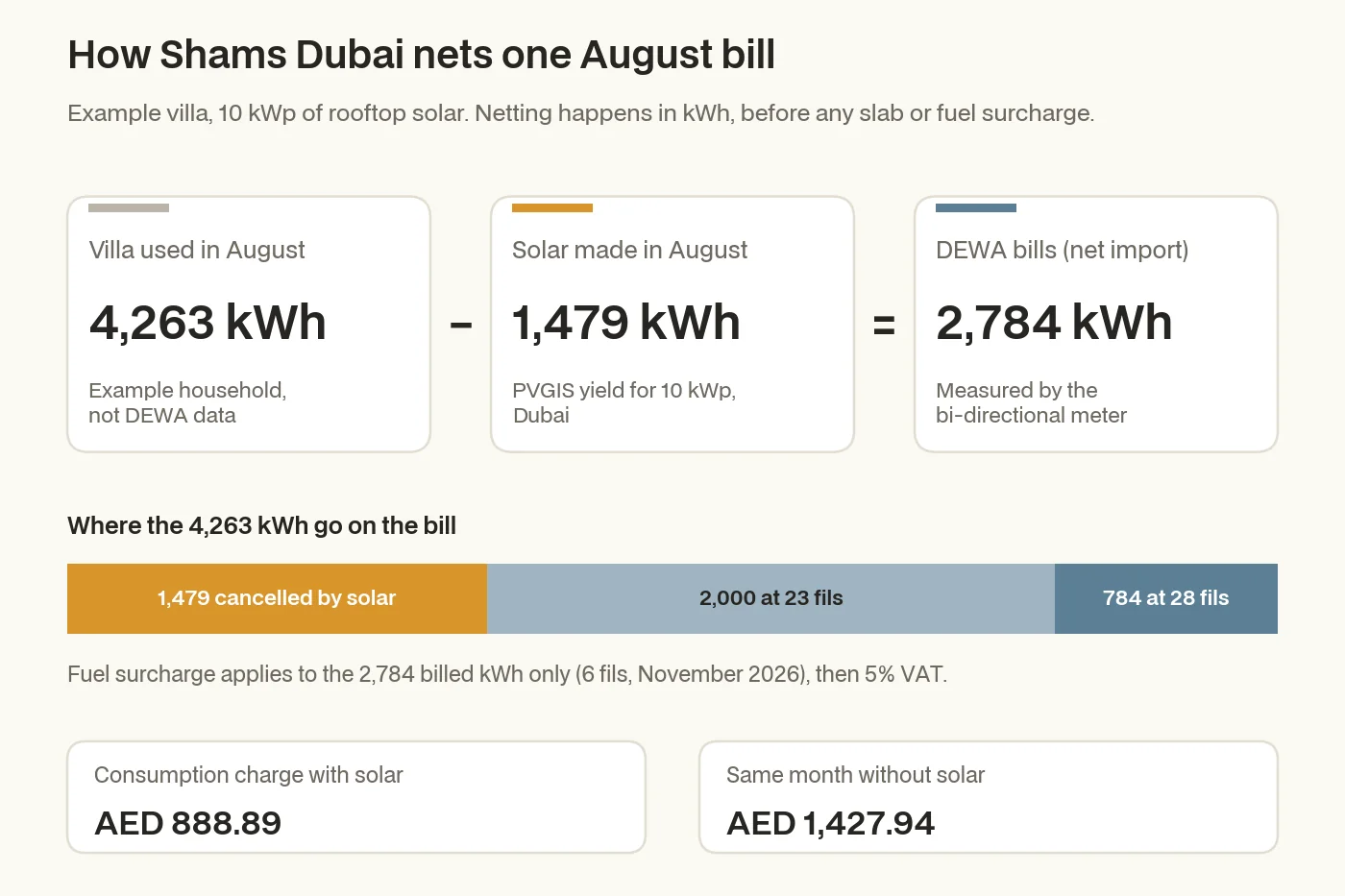
In our August example, a villa using 4,263 kWh with a 10 kWp array pays AED 888.89 for electricity instead of AED 1,427.94. The panels made 1,479 kWh, so each solar kWh saved about AED 0.3645. That beats the 23 fils base rate, because the saved kWh came off the 28 and 32 fils slabs[4].
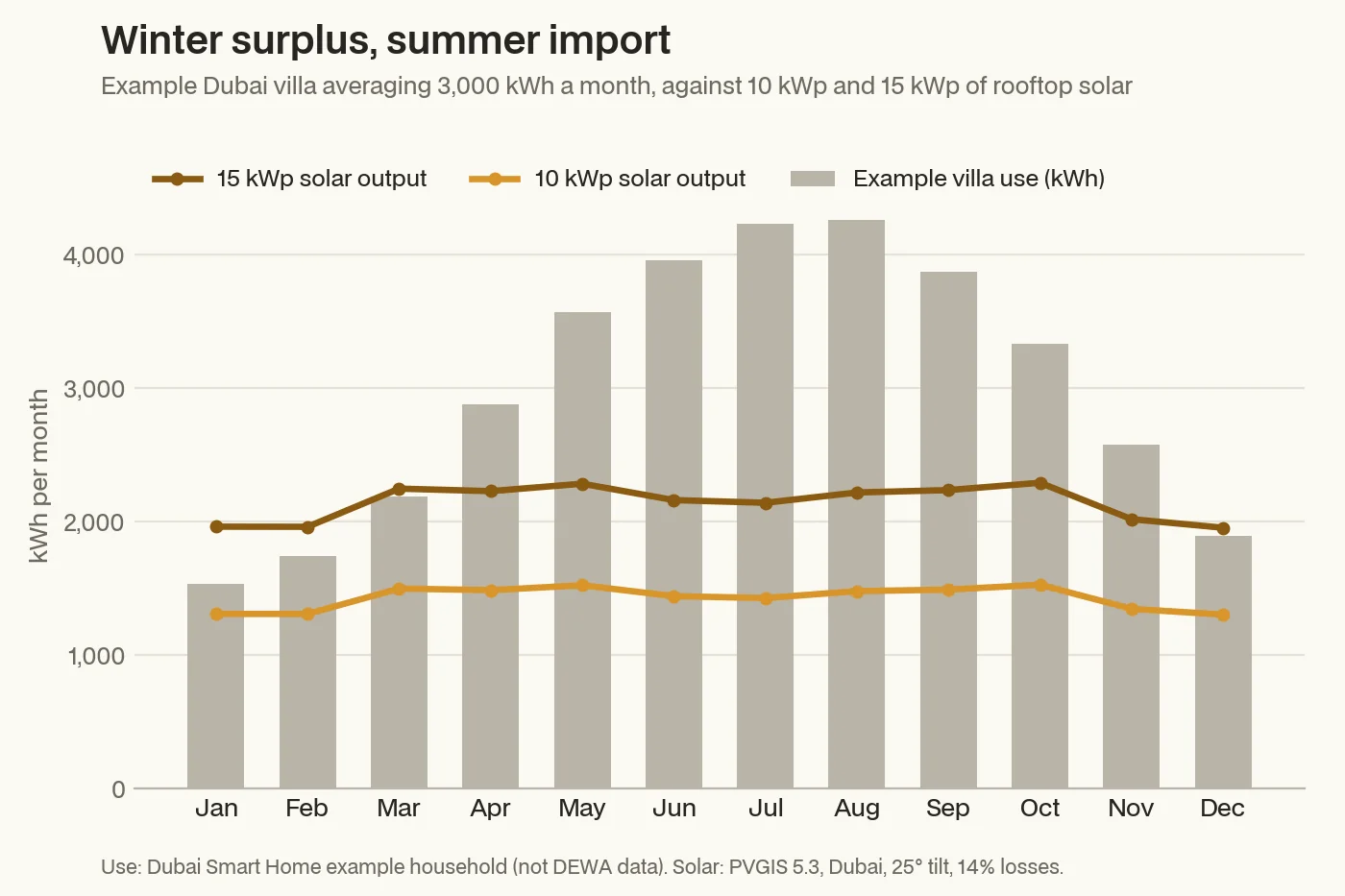
The monthly use figures are an example household built for this article from Dubai's seasonal temperatures, not a DEWA statistic, so use your own last twelve DEWA bills. Solar output is the European Commission's PVGIS model for Dubai: 147.9 kWh per kWp in August, 130.8 in January[6]. The table follows DEWA's order: net first, then slabs, surcharge and VAT[3].
| Bill line | August, no solar | August, 10 kWp | January, no solar | January, 15 kWp |
|---|---|---|---|---|
| Home use | 4,263 kWh | 4,263 kWh | 1,544 kWh | 1,544 kWh |
| Solar made | 0 | 1,479 kWh | 0 | 1,962 kWh |
| Net import billed | 4,263 kWh | 2,784 kWh | 1,544 kWh | 0, with 418 kWh carried forward |
| 23 fils slab (first 2,000 kWh) | AED 460.00 | AED 460.00 | AED 355.12 | AED 0 |
| 28 fils slab (2,001 to 4,000 kWh) | AED 560.00 | AED 219.52 | AED 0 | AED 0 |
| 32 fils slab (4,001 to 6,000 kWh) | AED 84.16 | AED 0 | AED 0 | AED 0 |
| Fuel surcharge at 6 fils | AED 255.78 | AED 167.04 | AED 92.64 | AED 0 |
| 5% VAT | AED 68.00 | AED 42.33 | AED 22.39 | AED 0 |
| Electricity consumption charge | AED 1,427.94 | AED 888.89 | AED 470.15 | AED 0 |
In August, the 1,479 solar kWh emptied the 32 fils band and pulled 1,216 kWh out of the 28 fils band, leaving the 23 fils band untouched.
In January, the 15 kWp array made 418 kWh more than the home used. DEWA's FAQ says the invoiced value of electricity is then zero, with the surplus shown as credit for the next bill[3]. Neither month includes the meter service charge, water or housing fee. Our energy management and solar design work runs this on your own twelve months of bills.
Why is a solar credit worth more in summer than in winter?
A carried credit has no fixed value. DEWA adds it to the export of the month you use it in, before the slabs apply[1]. So 100 kWh of winter credit spent in a 1,500 kWh month saves AED 30.45. The same 100 kWh spent in a summer month above 6,000 kWh saves AED 46.20.
In Dubai, use peaks in summer with the AC, while panel output barely moves. In the PVGIS model, the weakest month, December, still makes 85% of the best, October[6]. So winter exports build a kWh balance that later cancels part of a warmer month's import.
In our 15 kWp example, five months reach a zero electricity charge: January to April, plus December. The credit grows to about 709 kWh by the end of March and is spent in spring, while net import sits in the 23 fils band. Each carried kWh is then worth AED 0.3045, about AED 216 in all. With 10 kWp, the same home never reaches a zero month.
Quick math: take 100 kWh of credit into three months. With 1,500 kWh of net import, it removes 23 fils kWh: 100 x (0.23 + 0.06) x 1.05 = AED 30.45. With 4,500 kWh, it removes 32 fils kWh and saves AED 39.90. Above 6,000 kWh, it saves AED 46.20.
That holds while the credit fits inside the month's top band; a bigger credit steps down the bands. An electric car charged at home is more kWh in the same netted month, as our EV charger guide for villas explains.
Does DEWA ever pay cash for surplus, and do credits expire?
No to both. Under Executive Council Resolution No. 46 of 2014, DEWA may not pay a producer anything for surplus power[2]. DEWA's Connection Conditions roll surplus forward indefinitely, with no cap on how long or how much, and bar using it to claim money from DEWA[1]. For a home, only closing the account ends a credit.
Common mistake: trusting a quote that says DEWA buys your surplus, or that credits reset on 31 December. Both ideas come from schemes abroad. Dubai has no buy-back price and no yearly cash settlement, so an array sized to "sell" power only builds a balance that is never paid out. Ask for the DEWA clause behind the claim, in writing.
The one DEWA scheme that buys exports is not for homes. The D33 Solar PV Initiative is for companies holding a D33 certificate, such as industrial firms, data centres and agri-tech businesses[7]. DEWA pays them a flat 10.5 fils per kWh, excluding VAT, from 1 March to 30 November, nothing from December to February, and nets nothing[8]. Moving a plot to D33 ends its Shams contract and forfeits any surplus[8].
Why is your DEWA bill not zero even with solar panels?
A DEWA bill stays above zero because solar can only cancel the electricity consumption charge, and only in months when export beats import. A surplus month shows no electricity consumption charge, but fixed lines such as the meter service charge, plus water and any housing fee, can still appear. Check the lines on your own bill.
- Summer import. In August, 10 kWp still left 2,784 kWh to pay for. Night cooling runs on grid power.
- Minimum charge. DEWA applies any minimum-charge rule to the electricity you import from the grid, not to your net position[1].
- Water. DEWA bills water on its own monthly slabs[4], and panels do nothing for it.
DEWA's consumer FAQ says Shams adds no further specific charges to later bills[9].
Real talk: "zero bill" is a winter claim about one line. Our 15 kWp example villa reaches a zero electricity charge in five cool months and pays in the other seven. If anyone promises a zero DEWA bill all year, ask for it month by month on your readings.
To cut the summer import solar cannot reach, our guide to lowering a DEWA bill with smart home controls starts with the AC. Our summer DEWA bill guide shows why July and August jump.
What happens to your solar credit when you move out, sell or close the account?
Your credit is forfeited when the DEWA account that hosts the system closes with a final bill, and DEWA owes nothing for it[1]. On a sale or a new tenancy, you and the new owner or tenant can jointly ask DEWA to move the solar system to their account. The credit itself never transfers[3].
The table lists each account event and its clause in DEWA's Connection Conditions, Version 4.1[1].
| Event | Your carried credit | What you can do | DEWA rule |
|---|---|---|---|
| Move out and close the account | Forfeited at the final bill, with no payment | Use it down before the final bill; avoid an oversized array | Clause 2.4 H |
| Sell the villa | Not transferred to the buyer; lost when your account closes | Ask DEWA, jointly with the buyer, to move the system to the buyer's account | Clause 2.4 I |
| Rent the villa to a tenant on their own account | Not transferred to the tenant | The same joint request moves the system to the tenant's account | Clause 2.4 I |
| Another account of yours on the same plot | Can offset it, after the hosting account | Set the order through DEWA's Credit Transfer service; 90-day lock after a change | Clauses 2.4 B and G |
| Someone else's account, or another plot | Cannot be used | Nothing; it stays on your account | Clause 2.4 E |
| Supply cut for an unpaid bill | No new credit; DEWA stops all import and export | Keep the hosting account paid | Clause 2.4 J |
If a sale or move is likely, size the array so the winter balance is spent by summer. A buyer gets your panels, not your kWh. On a lease, ask in writing who is the producer on DEWA's records. Also ask what happens to the system and any credit if you sell or move, and what an early exit costs. Our cost guide covers when solar does not pay on a Dubai villa.
Can you use solar credit on another DEWA account, or share it with a tenant?
Solar credit can move to your own DEWA accounts on the same plot, but never to anyone else. DEWA's Shams Dubai Credit Transfer service sends surplus from the hosting account to one or more accounts held by the same account holder within the same plot. DEWA approves a request within three working days[10].
The hosting account is always offset first, then your other accounts in the order you set[1]. DEWA's FAQ suggests putting the highest-use accounts first[3]. Offsetting starts from the next billing cycle, there is no fee, and an approved order is locked for 90 days[10]. Accounts that host public EV charging cannot receive credit[1].
Landlords and building owners. DEWA says PV output cannot be offset against electricity used by different customers. A building owner can offset only common areas on meters it owns[10], and renting out roof space so tenants use Shams output is not acceptable[1].
Tenants. DEWA's FAQ says a tenant can install a system tied to the tenant's own DEWA account. The roof and the building permit belong to the owner, so get the landlord's written consent first. The credit stays on the account that hosts the system. Our guide to who can install solar, villa or apartment covers the building side.
How big a solar system will DEWA let you connect to a villa?
DEWA's Connection Conditions allow solar up to 100% of the first 100 kW of a plot's Total Connected Load, and a smaller share above that. The ceiling is 1,000 kW per plot, measured on the inverters' AC output[1]. For a villa, the connected load on your DEWA records is the limit that matters, not the plot ceiling.
Because the cap counts inverter AC output, 12 kWp of panels on a 10 kW inverter counts as 10 kW[1]. DEWA can also set a stricter limit at your connection point where the local grid needs one[3]. The same rules put panels on rooftops, facades and other existing structures; ground-mounted installations are not envisaged. One account hosts one generator, and redrawing plot boundaries to dodge a limit is not acceptable[1].
The ceiling has moved once. DEWA's May 2020 notice capped a plot at 2,080 kW[11]; the June 2022 Connection Conditions (Version 4) set the ceiling at 1,000 kW, which Version 4.1 (November 2025) keeps[12]. Old "Dubai restricts net metering" headlines describe that 2020 notice, not household credit. Oversizing is costly: Resolution 46 of 2014 sets a fine of AED 6,000 to 60,000 for exceeding the allowed capacity[2].
Common mistake: reading "1 MW per plot" as the villa limit. The 1,000 kW figure is the ceiling for any plot; only huge connected loads come near it. The opposite myth is wrong too: DEWA does not cap your array at what you consume.
Which meters, fees and contracts come with a Shams connection?
A Shams Dubai connection brings two DEWA meters, a one-off fee and a yearly maintenance contract. DEWA's FAQ sets the fee at AED 1,500 for each generator, less if the generation check meter is waived on a system under 10 kW. The exact amount arrives in DEWA's estimate after design approval[3][9].
The meters. DEWA fits a bi-directional tariff meter for import and export at no extra cost, plus a PV generation check meter, which the fee mainly pays for[1]. DEWA does not publish the reduced fee for a waived check meter, and the waiver may not be offered in areas with many solar homes[9].
The contract. You must present a signed operation and maintenance contract to connect[9]. The contractor must be DEWA-enrolled and inspect the panels, inverter and wiring at least every 12 months, with six-monthly checks recommended. Clause 3.3 C also calls for routine maintenance at least once a year, including cleaning the panels[1]. Repairs also go through an enrolled contractor. DEWA can ask for the contract and reports within five working days, and can inspect the system on one working day's notice[1].
Who does the work. DEWA's rule is that design, installation and verification are carried out by DEWA-enrolled consultants and contractors; otherwise the system cannot connect or net meter[3]. DEWA publishes the register but takes no responsibility for their work[13]. The enrolled firm files the application, which is free. DEWA lists 12 working days for design approval and the estimate, 1 for inspection and 1 for metering[14], plus 3 for a performance test above 100 kW[15]. DEWA's FAQ says a small 10 or 20 kW system can be installed within a week once the approvals are in place[3]. DEWA may also set an Annual Connection Cap; once it is reached, approved systems connect the following calendar year, first approved, first connected[1]. Our step-by-step guide to the DEWA solar connection covers the six stages.
DEWA's FAQ also says you need a building permit for the structure, from Dubai Municipality, Trakhees or your area's authority, then a completion certificate[3]. Check your community's rules on rooftop panels before you apply; the community NOC sits outside DEWA's process. Our Arabian Ranches area page sets out the Emaar NOC-then-permit order, as does The Springs area page.
The equipment. DEWA lists eligible equipment model by model and says a listing is not an endorsement, so have your contractor check each model number on the day[16]. DEWA caps a villa's PV array at 600 V DC at 0°C[17], which limits panels per string. Our solar panel and inverter range notes each model's limits. To have an O&M contract or quote checked first, ask for a site survey.
Does a battery, load shifting or export limiting change the bill?
A battery, load shifting or export limiting does not lower a net-metered DEWA bill. DEWA nets kWh across the whole month, carries surplus forward with no expiry and has no time-of-use rate for homes[4]. A kWh stored at noon and used at night saves exactly what the same kWh exported at noon and imported at night saves.
DEWA's FAQ says a grid-connected system needs no storage[3]. A battery buys backup in an outage; see what keeps working in a Dubai power cut. For a router and a few lights, our portable power station range does the job without touching the DEWA connection.
Batteries and DEWA. DEWA's published Shams Dubai documents do not set out rules for home batteries or owner-set zero export. A battery or export limiter is checked at design approval, so ask your DEWA-enrolled contractor to confirm with DEWA before you buy.
Load shifting. Running the pool pump at noon instead of night leaves the month's net kWh, and the bill, unchanged. Controls save money by cutting kWh, mostly from cooling. Schedules and setbacks on the loads you control are the job of our smart lighting and climate control design work.
Export limiting. Fronius limits feed-in through its smart meter and covers the home's own use first[18]. Growatt's WIT hybrid range has a zero-export mode[19]. Export limiting needs the inverter maker's power sensor or smart meter at the grid connection point. Under Shams every export is a credit, so limiting it mostly throws kWh away. DEWA keeps its own control: plants of 10 kW and above must accept a remote signal to cut power within one minute[17].
Going off-grid is not the way round it. DEWA's Connection Conditions say that, under Law No. 27 of 2021, off-grid generation by third parties is not permitted in Dubai. The exceptions are backup during emergencies and cases with DEWA's prior written approval[1].
What payback should a villa expect once credits are valued correctly?
On our example villa using 3,000 kWh a month, a 10 kWp system pays back in about 4.6 to 6.3 years before upkeep. With DEWA's 0.5 to 1% upkeep figure it takes 4.7 to 6.7 years[9]. With its older figure of roughly 5% a year, it takes 5.9 to 9.1 years[3].
Our published installed range is AED 2.50 to 3.50 per watt for a villa system without a battery, with DEWA's fee on top. Treat the low end as the optimistic case[20]. Our breakdown of what each part of a villa solar system costs has the full build-up.
DEWA's consumer FAQ puts annual upkeep at 0.5 to 1% of installation cost; its Shams Dubai FAQ, in an answer dated 2021, says roughly 5%. The table shows payback at both, with today's tariff held flat.
| Example villa use | System | Cost with DEWA fee | Payback before upkeep | Upkeep at 0.5 to 1% a year | Upkeep at 5% a year | Notes |
|---|---|---|---|---|---|---|
| 3,000 kWh a month | 10 kWp | AED 26,500 to 36,500 | 4.6 to 6.3 years | 4.7 to 6.7 years | 5.9 to 9.1 years | Year-one saving about AED 5,779. No month reaches a zero charge |
| 3,000 kWh a month | 15 kWp | AED 39,000 to 54,000 | 4.6 to 6.4 years | 4.7 to 6.8 years | 5.9 to 9.2 years | Saving about AED 8,492 and five zero-charge months, yet no faster payback |
| 5,000 kWh a month | 10 kWp | AED 26,500 to 36,500 | 4.0 to 5.5 years | 4.0 to 5.8 years | 4.9 to 7.4 years | More solar kWh come off the 28 and 32 fils slabs |
| 7,000 kWh a month | 10 kWp | AED 26,500 to 36,500 | 3.6 to 5.0 years | 3.7 to 5.3 years | 4.4 to 6.6 years | The biggest bills earn the highest value for each credit |
These are simple paybacks on example households, with no panel ageing, inverter replacement or tariff change. Send your last twelve DEWA bills on WhatsApp and we will size the array to the slabs you reach, or book a free design consultation.
On the 10 kWp villa, DEWA's lower upkeep figure is AED 125 to 350 a year and adds 0.1 to 0.4 years. The 5% figure is AED 1,250 to 1,750 a year and adds 1.3 to 2.8 years. The 15 kWp row shows why bigger is not faster. Its extra winter credit is spent at the floor value, so payback barely moves while the outlay rises by AED 12,500 to 17,500.
Panels also age. DEWA's FAQ says makers usually guarantee 90% of output after 10 years and 80% after 25[3]. Current N-type datasheets promise 1% loss in year one, then 0.4% a year[21]. On that curve, the 3,000 kWh villa's 10 kWp saving falls to about AED 5,723 in year one, AED 5,522 in year ten and AED 5,185 in year 25. Inverters carry what DEWA calls a general guarantee of 10 years[3], so plan on one replacement.
Real talk: if your bill stays under 2,000 kWh in most months, every credit earns the floor value of AED 0.3045. DEWA's fee and the yearly contract then weigh heavily on a small system. Cut the kWh first, then size solar to what is left. For some townhouses, the honest answer is not yet.
Do Abu Dhabi, Sharjah and the Northern Emirates credit solar the same way?
No. Shams Dubai's netting rules apply only to DEWA accounts. Federal Decree-Law No. 17 of 2022 lets each emirate's competent authority set its own tariff for exported power and excess capacity[22]. So credit value, expiry and size caps differ by utility.
Northern Emirates. Etihad Water and Electricity (EtihadWE) issued its Distributed Solar Systems conditions in September 2024. Phase 1 covers segments named Residential Local, Industrial and Agricultural. It caps a system at 10% of connected load and 1,000 kW, and forfeits remaining credit when the account is disconnected. They do not explain how credits are valued in the text we read, so ask EtihadWE[23].
Abu Dhabi. Abu Dhabi's Department of Energy extended its solar self-supply policy to villas from 31 March 2026, according to press reports[24][25]. Coverage does not describe an export credit like Shams Dubai's, so check with TAQA Distribution or the Department of Energy before you assume one.
Sharjah. We could not find a household net-metering scheme published by the Sharjah Electricity, Water and Gas Authority (SEWA) as of November 2026; ask SEWA before you plan around one.
How can you check your own solar credit and generation?
Start with the DEWA bill. DEWA's FAQ says the monthly bill reflects only the net energy you consumed, and in a surplus month shows the surplus as a credit brought forward to the next bill[3]. DEWA does not publish what its app shows for exported energy, so work from the readings on your bill.
Compare three readings: the inverter's generation, DEWA's import and export, and an independent meter at the distribution board. If DEWA cannot read the meter in full, it estimates from your history and reconciles later[1]. Output problems go to your contractor; meter or billing problems go to DEWA[3].
For the independent reading, use a three-phase meter that records both directions. The Shelly 3EM-63W Gen3 was AED 243.62 on amazon.ae on 3 November 2026 and handles 63 A per phase[26]. The DIN-rail Shelly Pro 3EM takes clamps up to 120 A; its 63 A clamp kit was AED 753.08[27]. Check your incomer rating against the meter's current limit before you buy. A licensed electrician wires either one in. Our energy monitoring range lists other options, and our guide to what a DEWA smart meter can tell you covers the utility side.
Pro tip: divide the yearly kWh a quote promises by its kWp. Two public models put an unshaded, well-tilted Dubai array at 1,713 to 1,775 kWh per kWp a year[6][28]. A promise well above 1,775 needs a reason, and a first year well below 1,713 on an open roof is worth raising with the contractor.
How Dubai Smart Home helps with Shams Dubai solar
Three decisions matter. Size the array to the slabs your bills reach, so credits land on 28 to 38 fils kWh, not mild months. Price the yearly maintenance contract before you sign, since DEWA's two upkeep figures move payback by years. And never bank credit you will leave behind on a sale.
DEWA's rule is that a DEWA-enrolled consultant or contractor carries out the design DEWA approves, the installation and the verification. Around that, our team surveys the roof and your DEWA history, models your bills slab by slab, recommends a size, and specifies the panels, inverter and monitoring. We review the quotes and the O&M contract, coordinate the work through to handover, then configure the monitoring and support you. The workmanship is covered by a 12-month warranty, which can vary by product.
That is our energy management and solar service, rated 4.9/5 by Dubai homeowners. Every worked bill, credit value and payback above is our own sum, built from DEWA's tariff page and Connection Conditions[29]. To see your villa on the same numbers, get your solar sized against your DEWA bills, or message a photo of your latest bill on WhatsApp.