Buy the wrong backup and you either overspend by thousands of dirhams, or learn mid-call that your "UPS" never kept the fibre box alive. At Dubai Smart Home, we size backup on two numbers: the watts that must stay on, and for how long.
This guide compares a small UPS, a portable power station and a fixed home battery on switchover, runtime, heat, sockets, warranty, prices and DEWA rules. It sits in the energy part of our complete smart home guide for Dubai, and our post on what a smart home does when Dubai power drops covers outage behaviour.
Power station, UPS or home battery: which does a Dubai home actually need?
For most Dubai flats, a small UPS on the router and fibre box is the right buy. It costs from AED 115 for a 12 V mini UPS to AED 495 for an APC unit with UK sockets on amazon.ae[1]. A power station earns its place only when you need hours. A fixed battery mainly suits a villa with Shams Dubai rooftop solar.
The reason is the grid. The Dubai Electricity and Water Authority (DEWA) recorded an average of 0.82 minutes lost per customer in 2025, roughly 49 seconds in the whole year[2]. Backup that covers minutes covers almost every event on DEWA's side.
A power station buys hours, from AED 1,449 for an EcoFlow RIVER 2 on noon to AED 4,649 for a DELTA 3 Plus on amazon.ae[3][1].
Real talk: think minutes against hours. If a 30-second router drop is all that annoys you, spend AED 115 to 495 and stop. If you want a fridge and a laptop through an afternoon, buy a power station. If the whole villa must carry on, that is a solar project, not a gadget.
UPS vs power station vs home battery at a glance
A UPS, a power station and a home battery differ on runtime, switchover and wiring. An AC UPS bridges minutes and switches in 10 ms or less. A power station runs for hours and switches in under 10 to under 30 ms, by model. A fixed battery backs up whole circuits but needs an electrician and DEWA questions answered.
Prices are from amazon.ae and noon.
| Option | Price (17 Nov 2026) | Switchover | Heat rating | Sockets | Voltage correction | UAE warranty | Wiring and rules |
|---|---|---|---|---|---|---|---|
| Mini DC UPS (APC CP12036LI) | AED 115, amazon.ae | No figure listed | 0 to 40 C | 12 V DC tips, 36 W max[4] | Fed by the router's adapter, not mains | Seller's card | None |
| Plug-in AC UPS (APC BE650G2-UK) | AED 495, amazon.ae | 6 ms typical, 10 ms max[5] | 0 to 40 C | 8 UK outlets | AVR only on line-interactive types[6] | Seller's card | None |
| Online UPS (Eaton 9SX1000i) | AED 2,424.42, amazon.ae | 0 ms by design[6] | See data sheet | IEC outlets | Full: output does not follow mains | Seller's card | None; fan noise suits a comms rack |
| Power station (EcoFlow RIVER 2 to DELTA 3 Plus) | AED 1,449 to 4,649 | Under 10 to under 30 ms, by model[7][8] | Up to 45 C | Check for 220 to 240 V and UK sockets | Surge or AVR only if listed | EcoFlow says 5 years; sellers list 1 to 5 | No approval step found |
| Fixed battery (Huawei LUNA2000, 5 to 15 kWh) | Quote-only | Set by the inverter | -20 to +55 C[9] | Wired to the board | Set by the inverter | Ask for UAE proof | Electrician; DEWA questions[10] |
The cheapest box that covers your real outage wins, and only the fixed battery brings rules. To compare capacities, our portable power stations range lists the EcoFlow, Anker and Bluetti units sold in the UAE.
How often does Dubai lose power, and how long should you plan for?
Dubai loses very little power on DEWA's side: 0.82 minutes per customer in 2025, against about 15 minutes that DEWA cites for leading EU utilities[2]. Plan your runtime around DEWA's fault targets instead. Its service guide aims to attend an electricity fault within 2 hours, or within 4 hours for a major cable failure[11].
The figure fell from 6.88 minutes in 2012[2], and it is the average time a customer's supply was interrupted[12] across DEWA's whole network. It does not count a tripped breaker, a fault inside your building or a storm that hits one feeder. It is a reason to buy small, not a promise that nothing will ever go off.
Building faults go to building maintenance or an authorised electrical technician; DEWA's 991 line is for network faults[13]. In April 2024, residents of Al Barsha buildings without water and power spent most of two days at Mall of the Emirates[14].
So plan for two windows: seconds in a normal year, which any UPS covers, and 2 to 4 hours waiting for DEWA on a bad day. No portable unit runs your AC through a multi-day building outage.
What is the real difference between a UPS, a power station and a home battery?
A UPS is a small battery that sits between the wall and your gear and takes over within milliseconds. A power station is a larger lithium battery with its own sockets, and some models add a UPS mode. A home battery is wired into the distribution board and backs up chosen circuits, usually through a solar inverter.
UPS performance is set by the International Electrotechnical Commission (IEC) standard IEC 62040-3:2021[15]. Schneider Electric, which owns APC, describes three designs[6]:
- Standby: mains passes through until it fails, then the battery takes over in "almost 10 ms". Schneider says many consumer units below 2 kVA are this type.
- Line-interactive: adds automatic voltage regulation (AVR) to correct voltage swings.
- Online double conversion: the load always runs from the inverter, so the transfer is 0 ms.
Power station makers disagree on words. EcoFlow uses EPS (emergency power supply) for a slower auto-switch "meant to power non-critical loads"[16], while Bluetti uses EPS for building life-safety power[17]. Anker says pass-through "does not necessarily provide automatic outage protection"[18].
Grid-tied solar goes dark in a cut. DEWA's standards require loss-of-mains protection, so a grid-tied system shuts down when the mains fails[19]. Without a hybrid inverter and a backup circuit, panels give nothing in an outage. A big power station is still not a home battery: UL Solutions says portable packs are not residential energy storage systems[20].
How fast does the switchover need to be for your router, PC, NVR or fridge?
Switchover speed matters for computers and network gear, and much less for a fridge. EcoFlow says a gaming PC needs a true UPS rated at 10 ms or faster, and a router or NAS needs a UPS mode under 20 ms[16]. Anker warns that a PC may handle 10 ms but fail at 20 ms, especially under heavy load[18].
The table matches loads with maker guidance.
| Device | What a gap does | Maker guidance | Backup that fits |
|---|---|---|---|
| Router and fibre box | Drops and reboots | Under 20 ms (EcoFlow) | Mini DC UPS, AC UPS, or a station with a stated UPS figure |
| Desktop PC | Shuts off; work is lost | 10 ms or faster (EcoFlow); may fail at 20 ms (Anker) | AC UPS, or a station listing 10 ms or less |
| NVR (network video recorder) and PoE (power over Ethernet) cameras | A recording gap and a reboot | Treat as network gear: under 20 ms | AC UPS for minutes, station for hours |
| Laptop, lights, fans | Nothing, or a flicker | EPS is for non-critical loads (EcoFlow) | Any station |
| Fridge | The compressor stops and restarts | Capacity and start-up headroom matter more than speed | A station sized in Wh |
Claims vary within one brand. EcoFlow lists under 10 ms for the RIVER 3 Plus[8], under 20 ms for the DELTA 2 Max[21] and under 30 ms in EPS mode for the RIVER 2[7]. Bluetti's manual gives 10 ms or less for the Elite 100 V2[22]. For the DELTA 2, EcoFlow says "almost instant switchover", with no number[23].
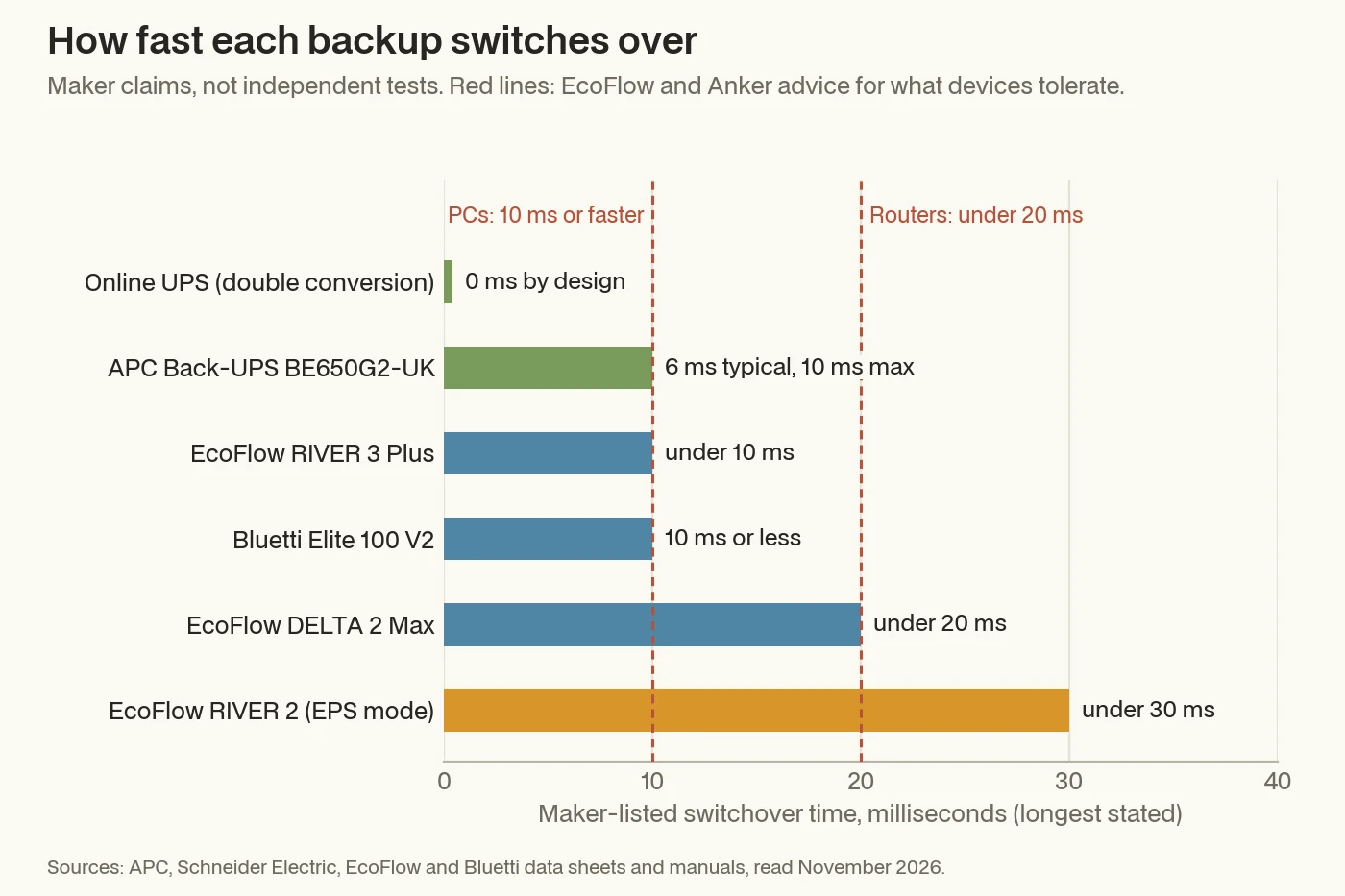
In one independent oscilloscope test published on YouTube in December 2023, six stations switched in about 10 to 18 ms. The slowest was an EcoFlow DELTA 2 Max at 17.5 ms after a firmware update, and some units gave a distorted wave at the swap[24].
Wave shape matters as well as speed. APC's data sheet calls the Back-UPS BX750MI a standby unit with a "stepped approximation to a sinewave" on battery[25], and Schneider says standby units give a step or square wave[6]. EcoFlow lists pure sine wave for the RIVER 3 Plus[8], and the Eaton 9SX1000i online UPS is pure sine too[1].
A UPS with a USB data port can also tell a PC or NAS to shut down cleanly before the battery runs flat. If a station's spec sheet lists no such port, assume it cannot.
Common mistake: trusting "UPS" in a listing title. Some noon titles for the DELTA 3 Classic say "10ms UPS", but we found no EcoFlow figure for that model. Buy on a millisecond figure from the maker's own page; if there is none, assume it is too slow for a PC.
What does each option cost in the UAE, today and over five years?
On 17 November 2026, a 12 V mini UPS cost AED 115 and an APC UPS with UK sockets AED 495 on amazon.ae. EcoFlow power stations ran from AED 1,449 on noon to AED 4,649 on amazon.ae[1][3]. Fixed home batteries are quote-only. All prices are supply only.
Five years adds battery wear and standby power.
| Option | Buy price (17 Nov 2026) | Battery over 5 years | Standby power (our estimate) | Notes |
|---|---|---|---|---|
| APC CP12036LI mini DC UPS | AED 115, amazon.ae | Lithium-ion; APC designs its lithium-ion UPS batteries for 10 years[26] | 2 W: about AED 5 to 8 a year | 12 V only |
| APC BE650G2-UK | AED 495, amazon.ae | Lead-acid, 3 to 5 years: plan one swap[5] | About AED 2.70 to 4 per idle watt a year | An RBC110 cartridge was AED 48.22 on noon; match the RBC number in your manual |
| EcoFlow RIVER 2 (256 Wh) | AED 1,449, noon | LiFePO4 (lithium iron phosphate), 3,000 cycles to 80%[7] | Measure it | EPS under 30 ms |
| EcoFlow DELTA 3 (1,024 Wh) | AED 3,750, amazon.ae | Check cycles on the maker page | Measure it | DELTA 3 Plus AED 4,649; DELTA 3 Max AED 6,389 on noon |
| Fixed battery and hybrid inverter | Quote-only | Brand warranty terms | Ask for the standby draw | Installation and DEWA paperwork priced after a survey |
Quick math: one watt left on all year is 8.76 kWh. DEWA's residential slabs run from 23 to 38 fils per kWh, the fuel surcharge was 6 fils in November 2026, and 5% VAT sits on top[27]. So each always-on watt costs about AED 2.70 to 4 a year, by our estimate on 17 November 2026. The CP12036LI's 2 W standby draw[4] comes to AED 27 to 40 over five years.
A battery cannot earn from cheap night power, because Dubai has no residential time-of-use rate[27]. Battery modules and hybrid inverters sit in our solar energy range.
To get your backup sized for your own loads, book a free design consultation, or message us a photo of the router cupboard and its adapter labels on WhatsApp.
How long will a UPS or power station run your real loads?
Runtime is the battery's watt-hours, less conversion losses, divided by the watts you run. By our estimate, a 256 Wh EcoFlow RIVER 2 runs a 20 W router and fibre box for about 11 hours. That is almost three times DEWA's 4-hour target for a major cable fault.
- Add up the watts. A router and fibre box together usually draw roughly 15 to 30 W; a plug-in meter gives your real figure. TP-Link's Archer AX55 uses a 12 V 2 A adapter[28], and Huawei's EG8145V5 fibre box 12 V at 1.5 A[29].
- Take off the losses. We assume about 15% is lost in conversion, so usable Wh is about 0.85 times the rated Wh.
- Divide usable Wh by the load in watts to get hours.
Our estimates, using that factor:
- Router and fibre box, 20 W: about 11 hours on a 256 Wh RIVER 2, or 33 hours on a 768 Wh RIVER 2 Pro.
- Four-camera NVR, about 40 W: about 5 hours on a RIVER 2, or 16 hours on a RIVER 2 Pro.
- Router, fibre box and NVR, about 60 W: about 14 hours on a 1,024 Wh DELTA 3.
Quick math: to cover DEWA's 4-hour attendance target at 20 W, you use 80 Wh. Divide by 0.85 for losses and you want roughly 95 Wh of rated battery. Our smart home office guide uses the same rule from the other side: about 5 hours per 100 usable Wh at 20 W.
Which small UPS keeps a du or e& router and fibre box online?
A 12 V mini DC UPS keeps a router and fibre box online when both run on 12 V. APC's Back-UPS Connect CP12036LI gives 12 V DC at up to 36 W, listed at AED 115 on amazon.ae[4][1]. Read both adapter labels first: the volts, the amps and the plug tip.
A mini DC UPS skips the inverter, so it wastes less than an AC UPS, but it must match exactly. The CP12036LI does not suit a 9 V or 19 V router or a PoE injector. Three types were on sale on 17 November 2026:
- 12 V only: APC CP12036LI, AED 115 on amazon.ae.
- Multi-voltage with PoE: NCTS NU60WP, AED 210 on amazon.ae. It gives 9 or 12 V DC plus 15 or 24 V PoE, up to 60 W, and the seller states a 1-year warranty.
- Power-bank style: Green Lion 10,000 mAh with 5 to 24 V outputs, AED 88.36 on noon[3]. A wrong voltage setting can damage a router.
Common mistake: reading mAh as if it were measured at 12 V. Battery mAh is quoted at the cell voltage, often 3.7 V, so a 10,000 mAh unit holds about 37 Wh, not 120. At 20 W that is roughly an hour and a half, by our estimate. Treat "up to 8 hours" on a listing as a best case.
If your provider's own network loses power, a home UPS cannot bring the internet back. In the April 2024 storm, residents in Mudon lost internet from 7pm on 16 April while their power stayed on[30]. Ask your provider what its network does in a power cut.
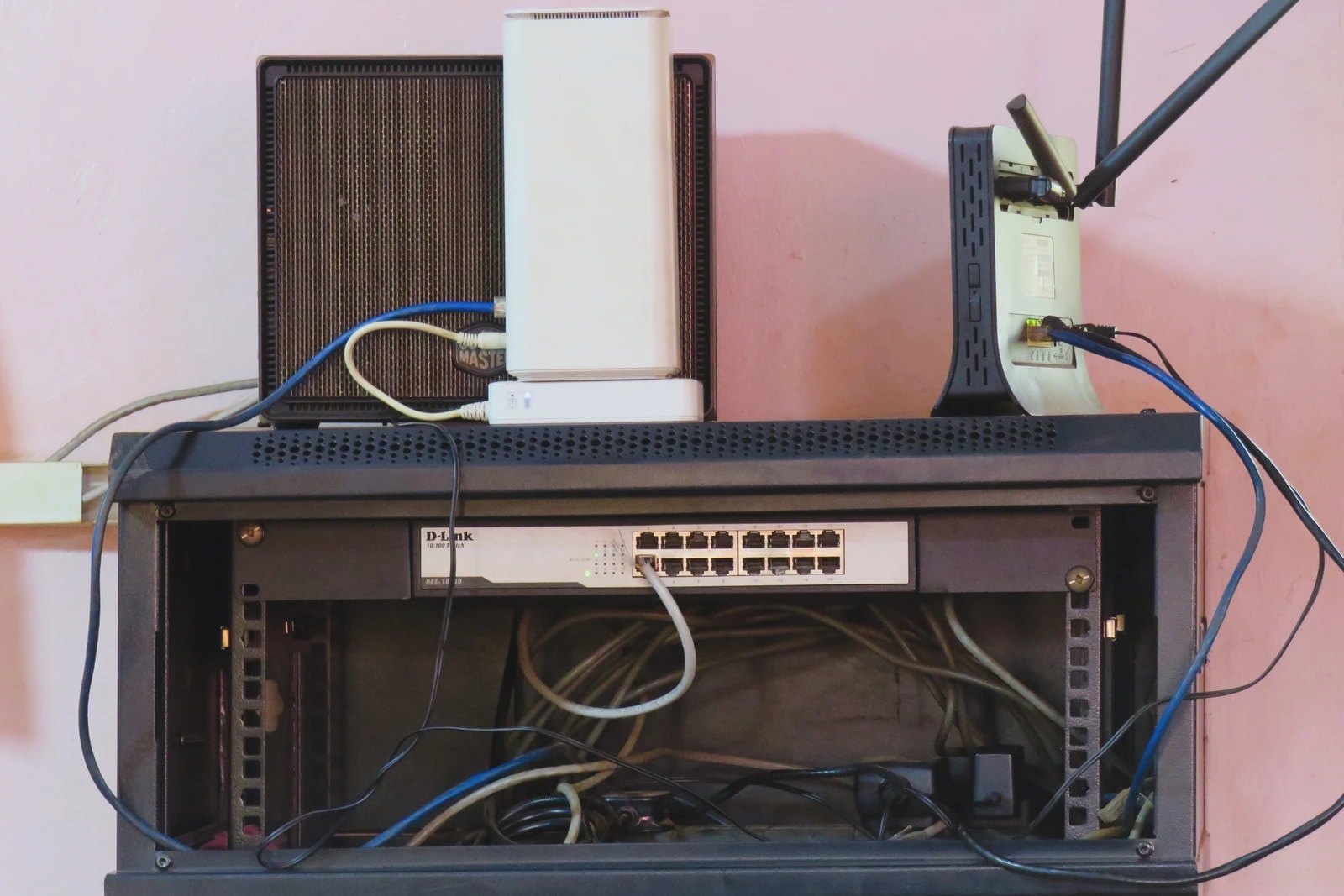
If your router shares a cupboard with a switch and access points, our networking and Wi-Fi range covers the gear. A UPS for the network rack, planned with the cabling, is part of our home networking and IT design work.
Can a UPS or power station keep CCTV recording through a cut?
Yes, a UPS or a power station keeps CCTV recording, and the load is small. Hikvision lists its 4 MP DS-2CD2143G2-I dome at 5 W maximum and its 8-channel PoE recorder, the DS-7608NI-K2/8P, at up to 15 W before camera load and the hard drive[31][32]. Four cameras and the recorder come to about 35 W plus the drive.
Size on the cameras' own watts. The recorder's PoE budget is a ceiling, not a draw. An AC UPS covers the short events of a normal year; an EcoFlow RIVER 2 Pro gives about 16 hours at 40 W, by our estimate. Put the router on the same backup if you view the cameras remotely.
Check whether the backup can tell the NVR to shut down cleanly; if the spec sheet is silent, assume it cannot. Bluetti's manual says its UPS mode is not for servers or workstations that need a high-performance UPS[22].
If you are planning cameras, our security cameras range lists models with their power draw. Recorder backup is planned inside our security and CCTV design work, and our villa CCTV cost guide covers recorder sizing.
Can a power station run a fridge, a fan or the AC in a Dubai outage?
A power station can run a fridge or a fan for hours, but not your AC for long. For a fridge, battery capacity and start-up headroom matter, not switchover speed. Work it out from the energy label: the kWh a year divided by 8.76 gives the fridge's average watts.
As an example only, a fridge labelled 400 kWh a year averages about 46 W. A 1,024 Wh EcoFlow DELTA 3 would run it for roughly 19 hours, by our estimate.
The station must also cover the compressor's start-up surge. The UK-edition spec table for the DELTA 3 Plus lists a 3,600 W surge[33], while the RIVER 2 is rated at 300 W. Check the fridge maker's start-up figure, and its manual for how it restarts after a cut.
The AC is where portable backup stops. Any load near 1,000 W empties a 1,024 Wh station in about 52 minutes, by our estimate. Run that sum with your AC's nameplate watts first. A station does have one job a UPS cannot do: it goes camping at the weekend.
Where can you safely keep a battery backup in a Dubai summer?
Keep any battery backup in an air-conditioned room. Most makers rate their units to 40 or 45 C: APC's Back-UPS to 40 C and EcoFlow's RIVER 2 to 45 C[5][34]. UAE outdoor air reached 51.8 C in Al Ain on 1 August 2025[35], so a balcony, a car or an uncooled store room is outside the rating.
The makers' own ceilings:
- 40 C: APC BX750MI[25] and CP12036LI; TP-Link Archer AX55 and Huawei EG8145V5; Bluetti Elite 100 V2[22]; Anker SOLIX C1000 Gen 2[36].
- 45 C: EcoFlow RIVER 2 and the UK edition of the DELTA 3 Plus[33]. EcoFlow names 20 to 30 C as the best range.
- 55 C: Huawei's LUNA2000 battery, rated IP66[9].
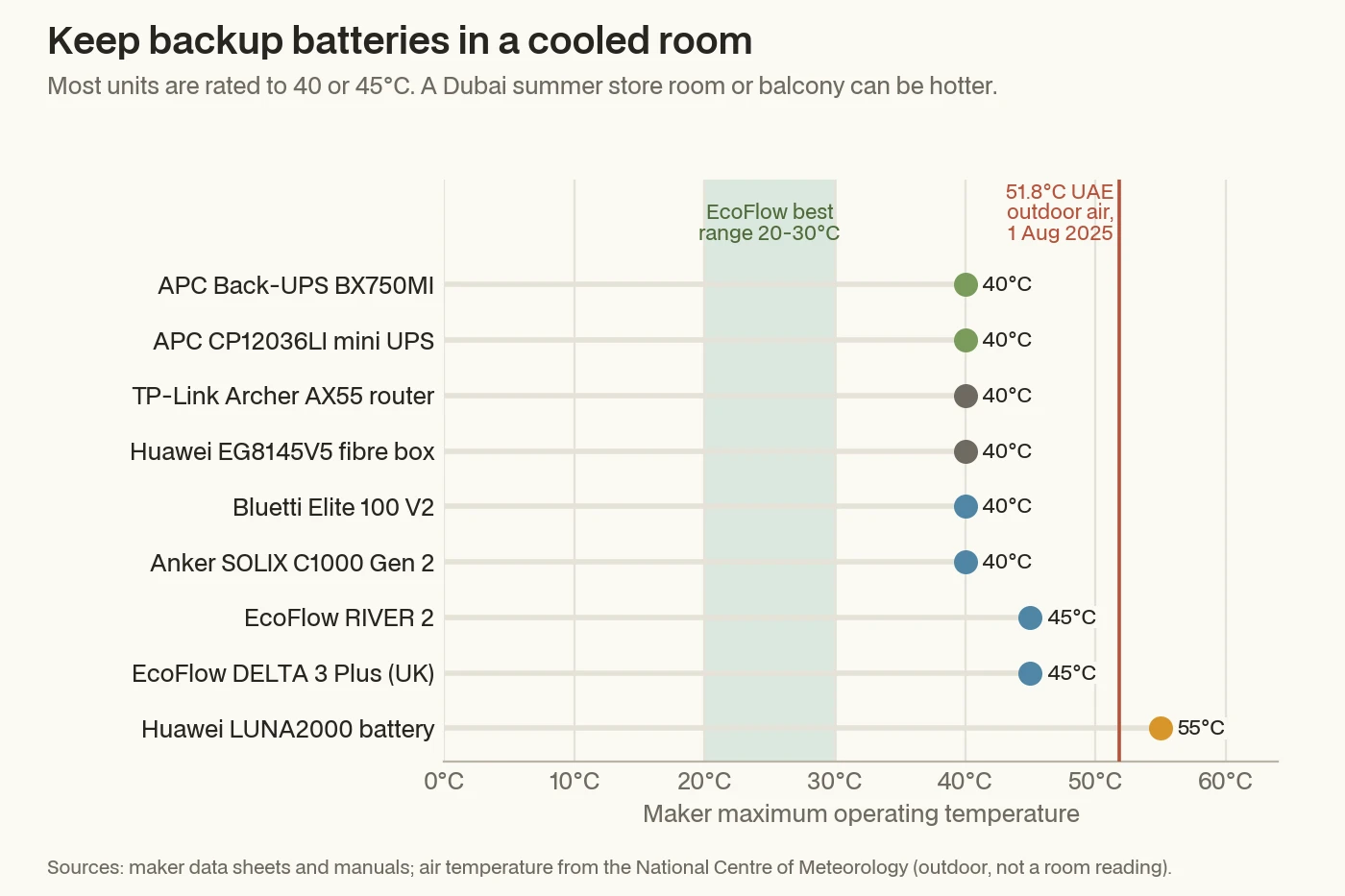
Treat any space without summer air conditioning as outside the rating unless you have measured it.
Lead-acid UPS batteries suffer most. Schneider rates them at 25 C and says life halves for every 8.3 C above that[37]. By our arithmetic, a 33 C cupboard halves a 3 to 5 year battery, and a 42 C one cuts it to a quarter.
Pro tip: keep the unit in a cooled room where you would notice heat or a smell. Abu Dhabi Civil Defence has warned against leaving devices plugged in for long periods while asleep or away[38], as general charging advice. Router cupboards cause the same heat trouble for Wi-Fi, as our guide to smart home Wi-Fi problems in Dubai explains.
Will a US or EU unit work on UAE Type G sockets?
A US or EU unit works on UAE sockets only if it is built for 230 V and your plugs fit it. UAE homes run 230 V at 50 Hz on Type G (BS 1363) sockets rated 13 A[39][40]. On 17 November 2026, amazon.ae listed APC UPS units with UK, IEC, German and US 120 V outlets side by side, so read the model suffix.
- BE650G2-UK, AED 495: eight UK BS 1363 outlets.
- BX750MI, AED 270: four IEC C13 outlets, which need C14-to-UK leads.
- BX1600MI-GR, AED 645: German Schuko outlets.
- BGM1500B-US, AED 1,786.02: 120 V with US NEMA outlets, not for a UAE socket.
Never cut a plug to make it fit. For power stations, check that the listing or box says 220 to 240 V and shows UK-style sockets, because US editions are sold on UAE marketplaces too. One 13 A socket tops out near 2,990 W, so a 2,400 W station fits one socket, while a 3,400 W boost figure does not.
Common mistake: reading the boost figure as the output. EcoFlow rates the RIVER 2 at 300 W, with X-Boost to 600 W[7], and the DELTA 2 Max at 2,400 W, with X-Boost to 3,400 W[21]. One amazon.ae title for the DELTA 2 Max still says 3,100 W. Size on the rated figure.
Electrical products sold in the UAE must meet the conformity rules of the Ministry of Industry and Advanced Technology (MoIAT), including BS 1363 plugs. We found no separate MoIAT category for power banks or power stations.
Wireless products sold by UAE retailers must be type-approved by the Telecommunications and Digital Government Regulatory Authority (TDRA). If you import one for your own use, TDRA's personal-use exemption applies[41].
Do you need DEWA approval for a power station, UPS or home battery?
We found no DEWA, MoIAT or TDRA registration step for a plug-in UPS or power station bought from a UAE retailer. A battery wired into your distribution board is different. DEWA's Shams Dubai conditions say DEWA gives design approval for off-grid systems, and a battery inside a Shams solar system relies on DEWA-enrolled consultants and contractors[10].
Law No. (27) of 2021 puts DEWA exclusively in charge of electricity generation projects[42]. The Shams Dubai conditions (Version 4.1, November 2025) rule out off-grid generation by third parties, with exceptions that include back-up systems during emergency operations[10]. The D33 solar conditions repeat the note[43].
They do not mention batteries, UPS units or power stations, and we found no DEWA connection procedure for a home battery. For anything wired into your distribution board, get the requirement confirmed in writing by DEWA or a DEWA-enrolled contractor before you buy.
DEWA's Shams FAQ says grid-connected systems "do not require any storage"[44], and the Shams documents we read include no battery connection standard[45]. Shams Dubai is written for solar generators, and we found no DEWA text on exporting battery energy, so do not plan a battery around export credits. Our guide to Shams net metering explains what solar does earn, and our Dubai solar and smart home guide shows where a battery fits.
Use a licensed electrician for any changeover switch or battery wired into the board.
We found no Dubai Civil Defence rule that names power stations or home batteries[46]. Building management can set its own house rules, so ask before keeping a large lithium unit in a flat; some Dubai buildings ban e-scooters inside units[47].
US standards such as UL 9540 and its 9540A fire test are what many makers cite[48], and IEC 62619:2022 covers lithium batteries for UPS and storage[49]. Neither is a UAE requirement we could find.
Abu Dhabi's second-phase solar policy (31 March 2026) lets villa owners generate and store electricity[50]. We found no published battery rule from SEWA or EtihadWE, whose solar standard is silent on storage[51], so ask your utility before you buy. Planning a wired battery? Ask for a site survey before any hardware is ordered.
What goes wrong with backup power in Dubai homes?
Most backup failures in Dubai homes come from the purchase, not the grid. A unit sits unused until its warranty lapses, or a 12 V UPS goes on a 9 V router. A boost figure is read as continuous output, or a power station gets wired into the board.
- A station left idle for a year. EcoFlow's RIVER 2 manual says to recharge a stored unit to 60% every three months, and the warranty excludes a unit "not charged or discharged for more than 6 months"[34].
- Buying on the warranty headline. EcoFlow advertises 5 years, but UAE sellers list 1 to 5 years for the same brand. APC's BX750MI data sheet says 2 years repair or replace[25]. The seller's card is the one that counts.
- A stabiliser bought as a UPS. An AVR has no battery, so it cuts out the moment the power goes.
- A station wired into the board. A portable pack is not a home storage system, and combining separately certified parts in the field does not make one[20].
- A UPS chained behind a station. Do not do it unless both makers say it is supported.
Real talk: the most expensive mistake is the oversized one. An AED 4,649 station buys hours for a flat whose only real risk is a short building fault. An AED 115 router UPS covers that. Buy for the outage you will actually have.
Which backup fits your home: rented flat, owned apartment, townhouse or villa?
A rented tower flat needs a router UPS for about AED 115 to 210. An owned flat with a desk PC suits an APC UPS at AED 495. A villa suits a UPS for the network rack plus a power station, and a fixed battery mainly makes sense alongside Shams solar.
Prices are as listed on 17 November 2026.
| Home type | What usually fails | Cheapest backup that works | When to step up | Approx AED |
|---|---|---|---|---|
| Rented tower flat | Router and fibre box | Mini DC UPS matched to the router's volts | You work from home on a desktop PC | 115 to 210 |
| Owned apartment | Router, fibre box, desk PC | APC BE650G2-UK | You want hours: a RIVER 2 from AED 1,449 | 495 |
| Townhouse or villa, no solar | Network rack, NVR, fridge | UK-socket UPS for the network rack, plus a power station | You want circuits backed up: a fixed battery | 495 plus 1,970 to 4,649 |
| Villa with Shams solar | The solar shuts down in a cut | UPS for the network rack; hybrid inverter and battery for solar in a cut | The inverter is due for replacement | Quote-only |
| Home with life-support equipment | Anything on mains | Tell DEWA; ask the equipment maker | Do not rely on a consumer station | Set by the equipment maker |
DEWA's fault service gives special focus to senior citizens, people of determination and people on life-support equipment[11], which makes DEWA the first call for that last row.
Renters have the easiest choice, since plug-in gear moves out with you; our guide to smart home upgrades for a rented apartment covers the rest. A fixed battery stays with the property, so off-plan buyers should ask whether the inverter can take a battery later. Huawei's LUNA2000, for one, pairs only with Huawei inverters[9].
Some home batteries sold abroad have no published UAE price or official UAE supply that we could find (checked 17 November 2026). Ask for proof of UAE warranty before you pay a deposit. EcoFlow showed home storage in Dubai in September 2026 with no UAE price[52].
How Dubai Smart Home helps
Three decisions settle most backup questions: the watts and hours you need, where the unit lives in summer, and whether you need sockets backed up or whole circuits. Get those right and the product choice in this guide follows.
We survey the home, list the loads that must stay on, and specify the backup with the network, CCTV or solar design. The UPS, cabling and cupboard ventilation are then decided together.
For a fixed battery, we design around the backup circuits and coordinate the work through to handover, with the DEWA-side work done by a DEWA-enrolled contractor. Backup work we coordinate earns a 12-month workmanship warranty that can vary by product.
That method sits behind 100+ projects our team has worked on since 2016, rated 4.9/5 by Dubai homeowners. Our home networking and IT work starts from AED 2,000, and security and surveillance systems from AED 10,000[53]. To get a backup sized for your floor plan, book a free consultation, or share photos of your router cupboard and distribution board on WhatsApp.