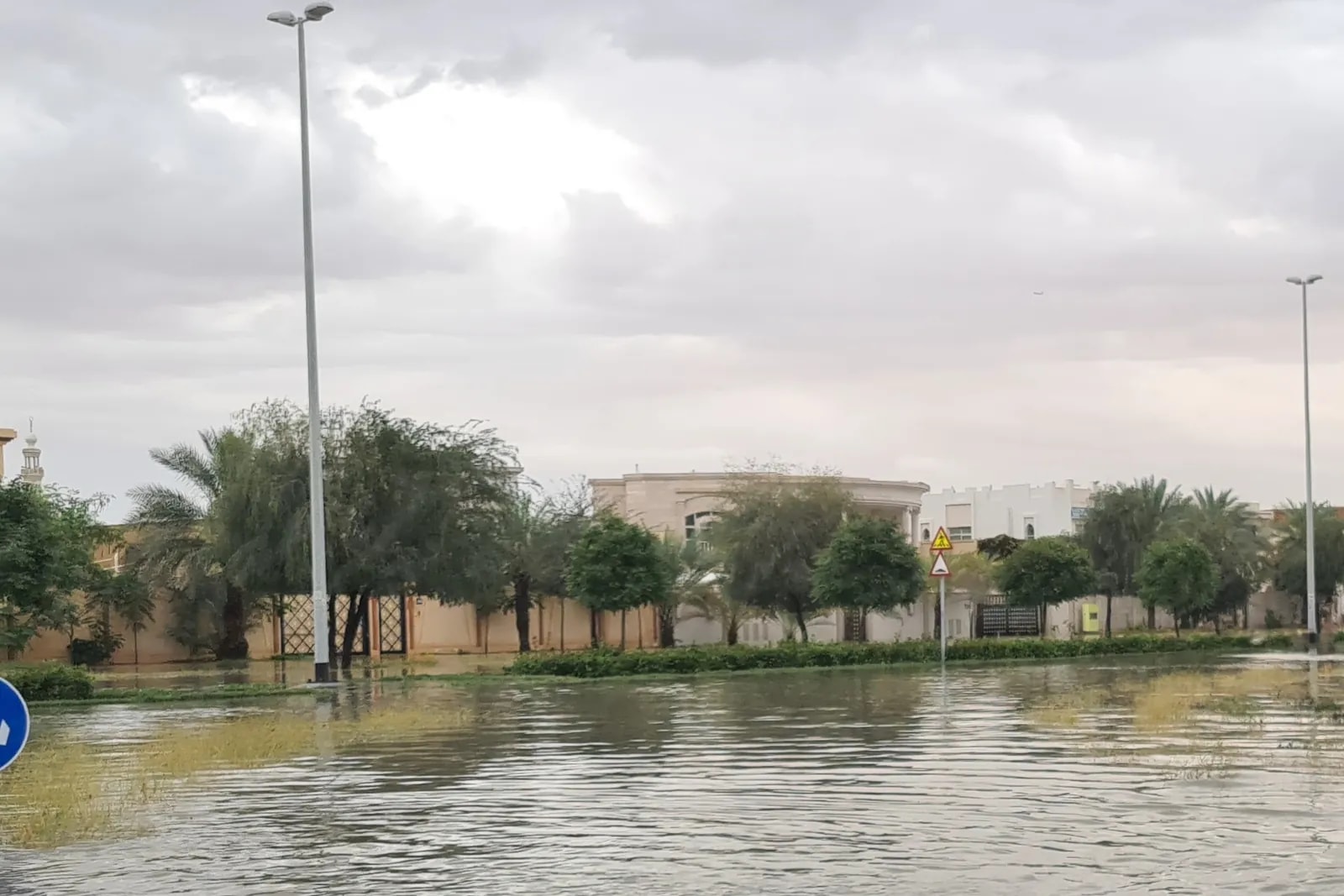
Rain is rare in the UAE, so it is easy to forget. In a big storm, water finds the lowest door, the garage ramp, a blocked roof outlet or a drain that flows back.
Our design team at Dubai Smart Home wrote this guide, and its advice reflects 100+ projects our team has worked on since 2016. You get NCM's April 2024 figures, the building code rule behind each fix and a heat-checked sensor kit. You also get the 2026 advice of the Dubai Electricity and Water Authority (DEWA), one insurer's wording and a dated AED checklist. For the bigger picture, see the complete smart home guide for Dubai we keep updated.
How do you flood-proof a UAE villa after the April 2024 rain?
You flood-proof a UAE villa in two layers. The physical layer keeps water out: clean drains and roof outlets, sound door and garage thresholds, non-return valves on drains, and a two-pump sump pit where there is a basement[1]. The alert layer tells you when that layer is losing: water sensors, a pump alarm, backup power and official NCM warnings.
The order matters more than the brand:
- Before the cooler months: clear roof outlets, gullies and channel drains.
- Before the season: have non-return valves on the lowest drains checked or fitted. Dubai Municipality asked owners with basements to check theirs on 22 October 2026[2].
- After community approval: fix low door sills, sliding-door tracks and the garage threshold.
- Any time: add sensors at low points, a pump alarm, and an uninterruptible power supply (UPS) for the hub and router.
- Today: turn on NCM's weather app and public safety alerts on every phone in the house.
Real talk: a sensor cannot stop water. If the road sits higher than your plot, a sensor at the front door only tells you the hall is wet. Spend on drains and thresholds first. The alerts cost far less: a Tapo T300 leak sensor was AED 79.00 at Sharaf DG on 9 November 2026[3].
What happened on 16 April 2024, by the official figures?
The National Center of Meteorology (NCM) said the rain that fell across the UAE in the 24 hours to 9 pm on 16 April 2024 was the largest amount since climate records began in 1949[4]. NCM called it an exceptional event[5]. Its highest station reading was 254.8 mm at Khatm Al Shakla in Al Ain, in less than 24 hours.
That 254.8 mm is a preliminary figure: NCM said "so far" when it gave it[6]. A peer-reviewed study later put it at about 75% of the area's probable maximum precipitation, the most rain scientists had estimated as possible there[7].
NCM did not call 254.8 mm the highest rainfall ever recorded in the UAE. Its Shuwaib station recorded 287.6 mm on 9 March 2016[6]. The 1949 line is about the total over the whole country in 24 hours, not about one gauge.
Agency reports put Dubai's total at more than 142 mm by the end of Tuesday 16 April 2024[8]. NCM gives the UAE's national average as about 100 mm of rain a year[9], so its top station reading was more than twice that. That comparison is ours, not NCM's.
Most of the UAE's rain falls in the cooler months, from late autumn to spring, and the heaviest recent storms came in April 2024, December 2025 and March 2026:
- 18 to 19 December 2025: 127 mm at Al Ghaznah in Ras Al Khaimah over two days. Dubai Police handled 39,299 calls[10].
- 23 March 2026: 93.3 mm in one day at Al Manama in Ajman[9].
- 21 to 28 March 2026: NCM stations recorded up to 244 mm at Jebel Yanas in Ras Al Khaimah over the episode[11].
How does rainwater get into a UAE villa?
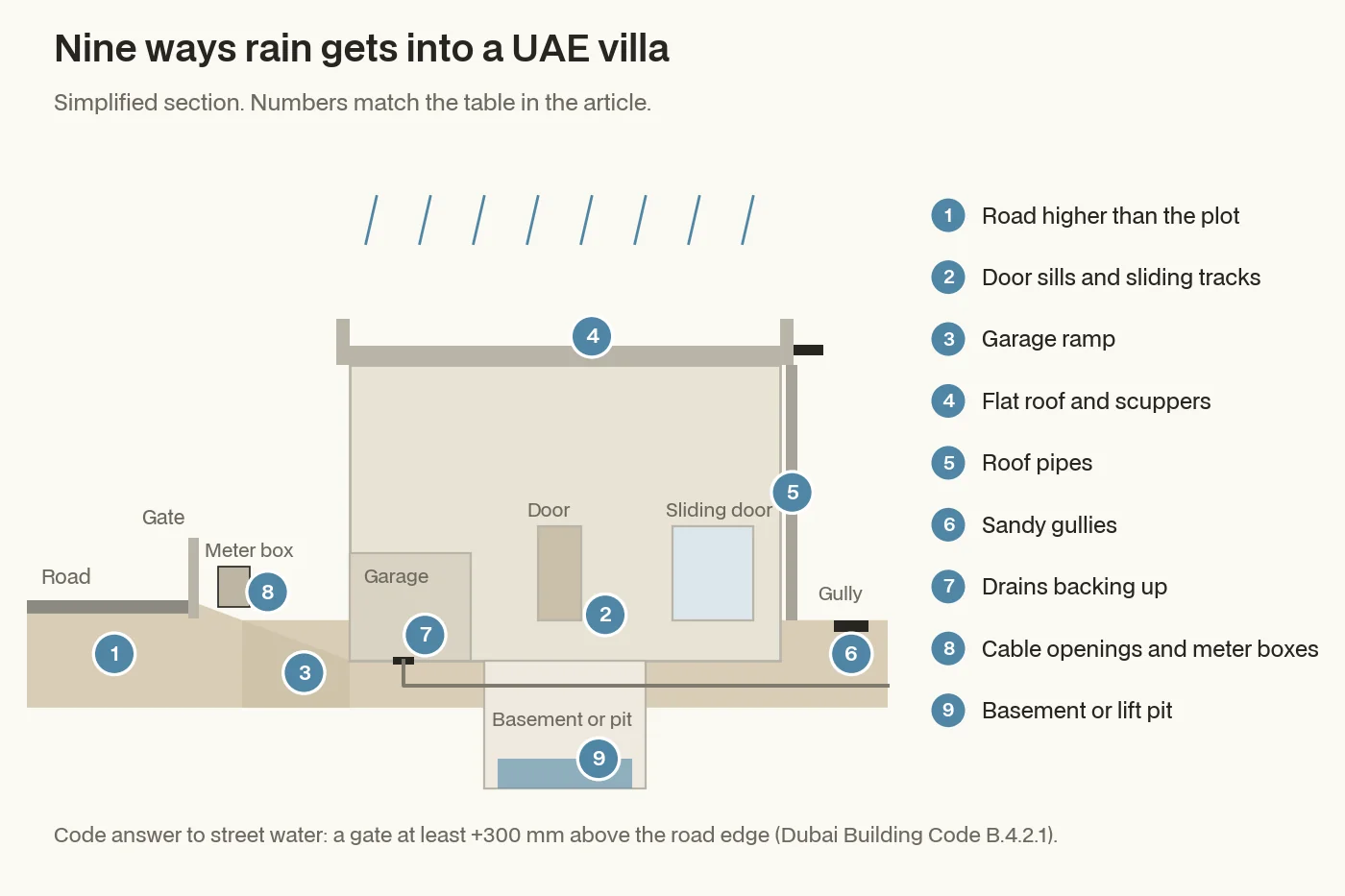
Rainwater gets into a UAE villa through nine common paths, from a road higher than the plot to a basement pit. The Dubai Building Code covers most of them with a clause[1]. The table maps each path to its rule, its fix and where a sensor helps.
| Where rain gets in | What you see | Why (code or source) | Physical fix | Smart-layer add-on |
|---|---|---|---|---|
| Road higher than the plot | Water runs down the drive | DBC B.4.2.1: gate at least +300 mm above the road edge, or a 2 to 5% slope | Regrade or add a gate-line channel drain, with a No Objection Certificate (NOC) first | Sensor at the lowest outside door |
| Door sills and sliding tracks | Water at the sill in wind-driven rain | No code sill height found | Clear track drain holes, reseal, raise the sill with approval | Cable sensor along the sill |
| Garage ramp | Water pools at the garage door | DBC K.5.6.3.2: ramps need rainwater drainage | Channel drain at the ramp foot | Sensor at the low point, outdoor camera |
| Flat roof and scuppers | Ceiling stains, drips from light fittings | DBC K.10.3.4: roofs drained for 75 mm an hour, emergency overflows | Clear outlets before the cooler months | Sensor in the room below |
| Roof pipes | Overflow, or pipes tied into a sewer | DBC K.10.3.4.3: never into sewer lines | Discharge to the ground or road | None needed |
| Sandy gullies | Standing water after rain | DBC K.10.3.4.2: paving drained for 65 mm an hour, with sand traps | Clean after every dust storm | None needed |
| Drains backing up | Water rising through floor traps | Dubai Municipality, 22 October 2026: check non-return valves | Non-return valve, fitted by a plumber | Sensor by the lowest floor trap |
| Cable openings and meter boxes | Water in boxes, breakers tripping | DEWA: seal unused openings and roof conduits[12] | DEWA's checklist, by a qualified technician | Sensor in the distribution board (DB) cupboard |
| Basement or lift pit | Water rising in the pit | DBC K.10.3.3.3: duty and standby pumps | Pit and pumps built to the code | Alarm from the panel's volt-free contact |
Dubai's building code sets a minimum +300 mm gate level at the plot entrance and says building ground should be raised above adjacent roads. We found no code figure for a door sill or garage threshold. If you are buying a villa, check all nine paths before you sign.
What does villa flood protection cost in the UAE?
Villa flood protection in the UAE runs from under AED 100 for one water sensor to several thousand dirhams for pumps and door barriers. On 9 November 2026, a Karcher 400 W float pump was AED 449.00 at Ace UAE[13].
Prices are supply only; fitting is priced after a survey. Prices marked "about" are amazon.ae search listings seen on 9 November 2026; marketplace prices move daily, so check on the day[14].
| Item | When | Who does it | Cost in AED (basis, retailer, date) | Notes |
|---|---|---|---|---|
| Clear roof outlets and gullies | Before the cooler months | You or a maintenance contractor | Priced after a site visit | The quote should name each outlet |
| Non-return valve | Before the season | Plumbing contractor | About AED 270, amazon.ae global store, 9 November 2026, valve only | Listing is for a 110 mm pipe |
| Door or garage barrier | Before the season, NOC first | Contractor | About AED 455 to 6,445, amazon.ae, 9 November 2026 | No flood rating shown |
| Sump pump with float, each | When the pit is checked | Plumbing contractor | Karcher 400 W AED 449.00 at Ace UAE; Pedrollo TOP 2 about AED 483 to 700 on amazon.ae; both 9 November 2026 | Two per pit under the code |
| Water sensor, each | Any time | Set up with the hub | AED 45.20 to 196 across brands, 7 October 2026[15] | Most models need a hub |
| Zigbee hub | Any time | Set up with the sensors | Aqara Hub M100 about AED 170 on amazon.ae, 1 November 2026[16]; Aqara Hub M3 AED 750 in our catalogue[17] | Both run on mains power |
| Mains UPS | Any time | You | About AED 495 on amazon.ae, 9 November 2026[18] | Type G outlets, kept indoors |
| Electrical check against DEWA's list | Before the season | A qualified electrical technician | Quoted by the technician you hire | DEWA lists trusted technicians in its app |
| Year two: batteries and a pump test | Every season | You or a maintenance contractor | Batteries per maker, not priced here | Lift each float and check the alert arrives |
Roof waterproofing and drain clearing are priced after a site visit. We found no published UAE rate card, so ask for an itemised quote that names the membrane, the area and the outlets.
Quick math: six Aqara Water Leak Sensor T1 units at AED 105 each come to AED 630. Add an Aqara Hub M100 at about AED 170 and a UPS at about AED 495. A basic rain-alert layer then costs about AED 1,295 to supply.
When sensors, sirens and cameras need to work as one alarm system, our security and surveillance design covers it, from AED 10,000 as listed on 9 November 2026. To see these numbers for your own plot, get this checklist priced for your villa, or send a few photos of where water gathers on WhatsApp.
Which drains, gullies and roof outlets need checking before the rain?
Check every roof outlet, scupper (the opening that drains a parapet roof), emergency overflow, gully and channel drain before the cooler months. The Dubai Building Code designs villa roof drainage for 75 mm of rain an hour and paved areas for 65 mm an hour[1]. Dubai Municipality asked owners in October 2026 to keep home rainwater drains clean and working[2].
The code requires emergency overflows on parapet roofs and roof slopes (falls) of 1/50 to 1/70. If an overflow is blocked, water finds the slab and the light fittings.
Gullies, the drains set into paving, are built to catch sand and dust, which is why they silt up after dust storms. Our guide to smart homes in Dubai sandstorms covers that side of the weather.
Follow each roof pipe to its end. The code says rainwater pipes must not connect to sewer lines, and Dubai Municipality has asked residents not to drain roofs into the sewage network[19]. The Abu Dhabi Housing Authority gave owners a similar list in October 2026, adding window seals and AC openings[20].
Pro tip: photograph every roof outlet, overflow and gully in October, with the date on the file, and again after the first dust storm. Dated pictures help a contractor quote and give you a record if you ever claim.
Do flood barriers and sandbags work on villa doors and garages?
Flood barriers and sandbags help with shallow water at a door, but they are a last line, not a fix. Removable door and garage barrier listings on amazon.ae ranged from about AED 455 to AED 6,445 on 9 November 2026, mostly unbranded and shipped from abroad, with no flood-performance rating shown[14].
A barrier holds water against the door, and with no drain behind it, the water waits for the next gap.
Water-activated socks swell when wet and are not made for salt water. UAE buyer reviews on amazon.ae are split, so treat them as puddle stoppers.
Most master communities want an NOC before exterior changes (Emaar's FAQ says so for its communities); ask your community office before raising a threshold or fixing a barrier frame[21].
Common mistake: waiting for the forecast to buy sandbags or a pump. Press reports from April 2024 and March 2026 describe stock selling out on the day. Even with no storm due, Karcher's 750 W pump was out of stock at Ace UAE on 9 November 2026[13]. Buy before the season starts.
How do you stop drain water coming back up into the house?
You stop drain water coming back up with a non-return valve, which lets water flow out but closes when the sewer side fills. Dubai Municipality's 22 October 2026 advice asks owners of buildings with basements to check that their non-return valves work[2]. A plumbing contractor sizes and fits the valve.
We found no clause in the 2021 Dubai Building Code on non-return valves for villa drains, so the municipality's advice is the clearest official line. The risk points are the lowest floor traps. A 110 mm stainless flap valve was about AED 270 on amazon.ae's global store on 9 November 2026[14], and the pipe size must match.
Common mistake: buying a smart shut-off valve as flood protection. The Aqara Valve Controller T1 turns a DN15 to DN25 valve (15 to 25 mm pipe sizes) on the supply pipe[22]. It stops a burst pipe, but rain and sewer water never pass through that pipe. For supply valves, see our water leak detection guide for Dubai homes.
Does your villa need a sump pump, and what should the pit have?
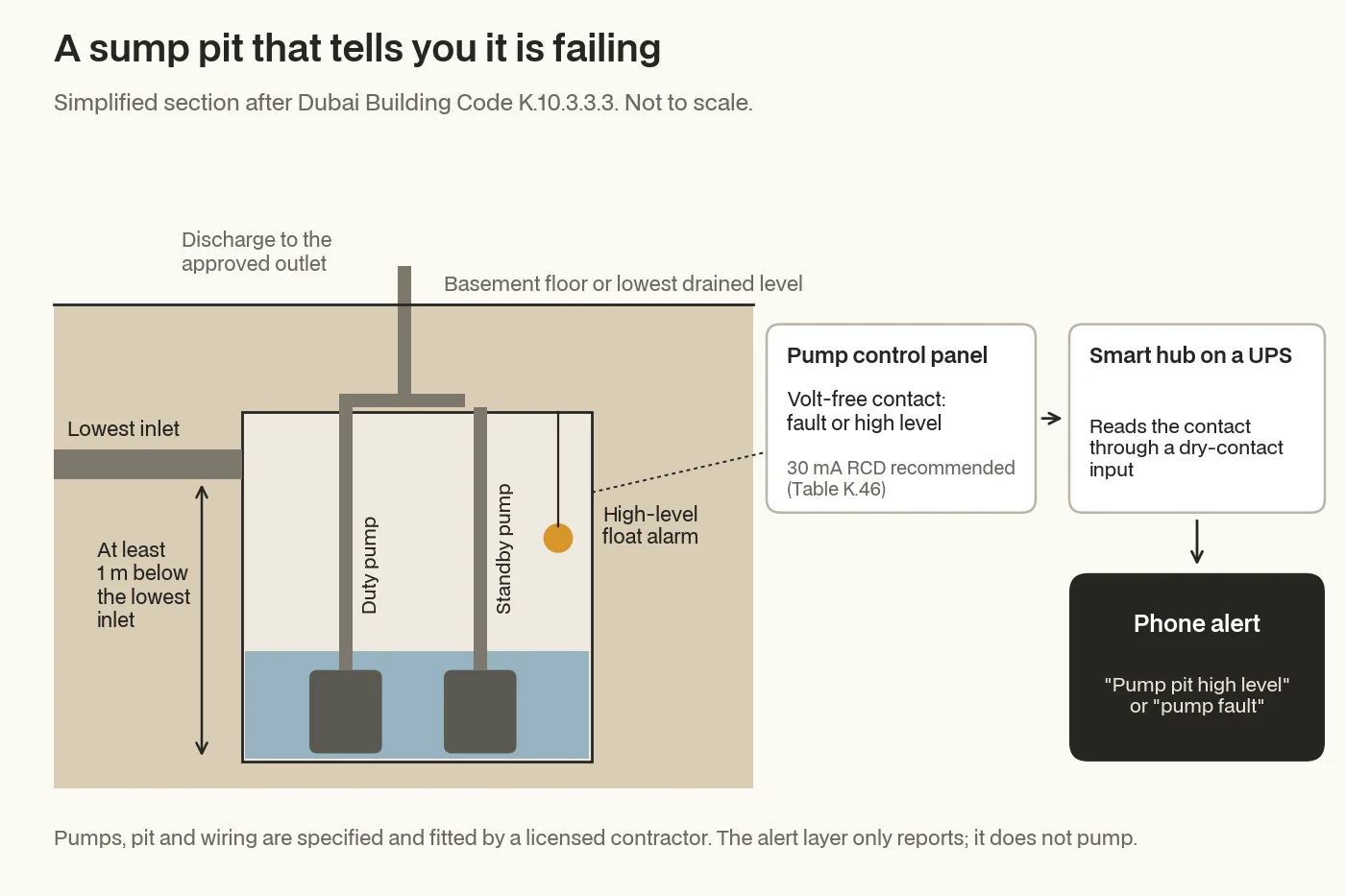
Where a villa has a basement, a sunken courtyard or a lift pit, the Dubai Building Code expects a sump pit with two pumps. Clause K.10.3.3.3 asks for pits at least 1 m below the lowest inlet and two submersible pumps in a duty/standby setup, each wired to a control panel with volt-free contacts[1].
Duty/standby means one pump works and the second takes over. A volt-free contact is a small switch in the panel with no mains voltage of its own, which a smart system can read safely as a pump-fault alert.
A villa with no basement is outside that clause. For a garage below the road, a portable float pump may be enough; Pedrollo describes its TOP pumps for emergency drainage of rooms, basements and garages[23]. Before buying, check:
- Voltage: many sump pumps and battery-backup kits on amazon.ae's global store are North American designs; check that the nameplate says 230 V 50 Hz before you buy one.
- Water type: the Pedrollo TOP 2 is a 0.37 kW clear-water pump with a float, rated IP68, for liquid up to 40 C. It is not for sewage.
- Liquid temperature: Karcher's float pumps list 35 C[13]. Grundfos's manual lists liquid temperatures up to 50 C for its 230 V Unilift KP models[24].
Pump and pit sizing is for a qualified plumbing contractor; the figures above are makers' limits only.
The code's Table K.46 recommends 30 mA residual current protection, the trip switch that cuts power on an earth fault, for domestic water pumps. Whether a pump runs from a socket or its own circuit is for a licensed electrician to decide.
If the pit sits near pool equipment, our pool and outdoor automation design can show pump status in the same app, from AED 6,800 as listed on 9 November 2026.
Where should water sensors go to catch rain, not plumbing leaks?
Water sensors for rain go where outside water arrives first: the lowest door sill, the garage low point, the sump pit's high level, the DB or plant room, and the room under the lowest roof outlet. Sinks and water heaters belong to a separate plumbing plan built around burst pipes.
A cable probe suits a long sill or a pit edge. The Shelly Flood Gen4's 2 m cable extends to 150 m, but its body is rated IP44, splash-proof rather than waterproof[25], so mount the body high. Heat matters too: a garage sensor must survive the summer.
| Device | Where it goes | Rated temperature | Hub needed? | UAE price (retailer, date) |
|---|---|---|---|---|
| Aqara Water Leak Sensor T1 | Garage low point, plant room | 0 to 55 C[26] | Yes, an Aqara Zigbee hub | AED 105, our catalogue (Amazon.ae, 23 September 2026) |
| Tapo T300 | Indoor low points | 0 to 40 C[27] | Yes, a Tapo hub | AED 79.00, Sharaf DG (9 November 2026) |
| Shelly Flood S Gen4 | Indoor low points | -20 to 40 C[28] | No, Wi-Fi | AED 150, noon.com (7 October 2026) |
| SONOFF SNZB-05P cable probe | Pit edge or cupboard | Not stated on the maker pages we could read | Yes, a Zigbee hub | From AED 45.20, amazon.ae (7 October 2026) |
| Aqara Hub M3 | Indoors, on a UPS | -10 to 50 C | It is the hub | AED 750, our catalogue (Amazon.ae, 13 September 2026) |
| Tapo H100 hub | Indoors, on a UPS | 0 to 40 C[29] | It is the hub | Quote-only |
| Tapo P110 smart plug | Indoors only | 0 to 35 C[30] | No | Quote-only |
Only the Aqara T1, which Aqara rates for 0 to 55 C, goes above 50 C in this set. Most of the rest stop at 40 C, and the plug at 35 C. That is our comparison of maker figures.
Check the radio region too. One UAE buyer review on amazon.ae says the 868/922 MHz Tapo T300 only works with the EU hub. Compare UAE-listed models in our sensors and safety range, where the Aqara Water Leak Sensor T1 page names the hub it needs.
For a picture with the alert, the Hikvision DS-2CD1043G2-LIU PoE bullet camera in our catalogue is IP67 and rated -30 to 60 C, at AED 199 (amazon.ae, 19 July 2026).
How do you get an alert when the pump fails or the power goes?
A pump-failure alert comes from the pit panel's volt-free contact, or a separate high-level float, connected to a smart-system input by a licensed electrician. To keep that alert working in a power cut, the hub and router need a mains UPS, because the hubs in this guide run on mains power. TP-Link lists no battery backup for its Tapo H100 hub[29].
A siren is for people at home; a push alert is for people away. The Tapo T300 has its own 90 dB alarm[27].
The APC Back-UPS BE650G2-UK (650 VA, Type G outlets) was about AED 495 on amazon.ae on 9 November 2026[18], while a 12 V router UPS cannot run a mains hub. Our guide to what stops in a Dubai power cut lists the rest.
The models in our portable power stations range suit a router and hub, not a fixed pump. Whole-home backup sits under our energy management and backup power design, from AED 2,400 as listed on 9 November 2026.
A Shelly EM with a 50 A clamp (AED 153.56 in our catalogue, amazon.ae, 19 July 2026), fitted at the board by an electrician, shows whether the pump draws current during rain.
Pro tip: before a long trip, read your policy's empty-home clause. One insurer's terms exclude loss or damage while the home has been unoccupied for more than 60 consecutive days[31]. Send alerts to a neighbour with a key too. Our guide to monitoring your Dubai home remotely covers that setup.
Which official rain alerts should be on your phone?
Two official alert channels belong on every phone in the villa. The UAE government portal u.ae lists NCM's UAE Weather app for Android and iOS[32]. NCM issues colour-coded weather warnings for each area; check the level on the NCM app or website when rain is forecast. Public safety alerts arrive by cell broadcast in Arabic and English[33].
Public safety alerts come only from government emergency bodies, such as the National Emergency Crisis and Disaster Management Authority (NCEMA) and the emirate police. A Dubai-wide alert went out at about 8.30 am on 18 December 2025. Phones more than three years old may not receive these alerts.
A warning covers a region, and your sensor covers your floor. Use the warning as your cue to move cars out of a low garage and lift valuables.
What should you do with the electrics when water gets in?
DEWA is clear: never handle electrical equipment with wet hands, never attempt electrical repairs yourself, and have a qualified electrical technician inspect the installation after water gets in[12]. Its Rainy Season booklet, dated 3 November 2026, covers before, during and after the rain.
Before the rain, DEWA asks owners to have a qualified electrical technician secure distribution boards and meter boxes, replace damaged covers, seal unused cable openings and spare roof conduits, and make outdoor fittings waterproof.
During a power cut, DEWA says to check your home's DB first and to call a licensed electrical contractor for internal faults. Report through Smart Response or DubaiNow, or call 991. DEWA says service fees may apply to a field visit.
A Dubai Media Office advisory, as reported by Gulf News, tells residents to switch off the main panel if water keeps rising and move to the highest safe spot, then call DEWA on 991 and Dubai Police on 999[34]. DEWA's rule still applies: never handle electrical equipment with wet hands. Switch off only if you can reach the board while standing dry.
After the rain, DEWA says not to operate equipment exposed to water and to inspect switches, sockets and appliances for damage. Dry the room fast, and have the electrics checked before you switch anything back on.
DEWA tells owners to keep distribution boards secured, sealed and easy to reach; moving a board is work for a licensed electrical contractor. The code also calls for weather-protected IP55 outdoor sockets[1]. The electrical advice here is DEWA's.
Does UAE home insurance pay for rain and flood damage?
UAE home insurance pays for rain damage only if your policy covers it. The Central Bank of the UAE said on 22 April 2024 that rain damage to homes is covered where there is a policy against loss and damage, often called comprehensive insurance. It also urged people to read their policy carefully[35].
The wording decides the claim. Sukoon's Home Umbrella terms, in the April 2025 version, show the questions to ask[31]. This is one insurer's wording, not a UAE-wide rule.
- Sukoon's wording excludes rainwater that enters through an open door, window or other opening; ask your insurer in writing whether surface water over a closed door sill is covered.
- The same document has no separate flood definition, and escape of water from tanks and pipes is a separate peril from storm and flood.
- None of the policy wording we read mentions sump pumps, so ask your insurer in writing how a pump failure is treated.
The law firm Afridi & Angell advised in April 2024 that owners keep clear, dated evidence of the damage and its cause, and limit the damage, ideally after telling the insurer[36]. It warned that insurers may reject claims if an owner's own steps worsen the damage.
Keep dated photos and your alert history. If your insurer refuses a claim, the Central Bank points policyholders to SANADAK, the financial and insurance ombudsman.
Who pays, and who do you call: owner, tenant, developer or municipality?
Who pays depends on where the water is and who owns that part. Under Dubai's tenancy law (Law No. 26 of 2007, as amended), maintenance and the repair of defects fall to the landlord unless the contract says otherwise[37]. Standing water on public roads goes to Dubai Municipality on 800900. A tenant's own belongings are a contents-insurance matter.
| Situation | Who is responsible | Basis | Who to call first |
|---|---|---|---|
| Standing water on the road or community land | Dubai Municipality, or the master developer inside a community | Dubai Municipality, 22 October 2026 | 800900 or the official WhatsApp service |
| Water rising inside the villa | You, for everyone's safety | Dubai Media Office advisory, via Gulf News | DEWA on 991, then Dubai Police on 999 |
| Repairs in a rented villa | The landlord, unless the contract says otherwise | Law No. 26 of 2007, Article 16 | Your landlord, in writing |
| A tenant's furniture and belongings | The tenant's contents insurance | Your contents policy wording | Your insurer |
| A refused insurance claim | The insurer, then the ombudsman | Central Bank of the UAE, 22 April 2024 | SANADAK |
| A UAE citizen's rain-damaged home in 2024 | The federal AED 2 billion package | UAE Cabinet, 24 April 2024[38] | The scheme's official channel |
Dubai Municipality also takes rainwater-removal requests through its official WhatsApp service (in 2024 its menu offered one), so report standing water early[2]. We found no promise that a crew will pump a private garden. For gullies, roads and drains outside your plot, ask your master developer or community management which part is theirs.
Dubai's code lets roof rainwater discharge to the ground or road and bars connecting it to the sewer or a neighbour's plot. We found no published rule on pumping out a basement, so ask Dubai Municipality on 800900 before you fix a pump outlet.
Help after April 2024 was targeted and time-limited. Besides the federal package for citizens' homes, Sharjah raised its compensation to AED 50,000 per affected house[39]. In Dubai, a one-off April 2024 directive had developers and management companies give affected residents free temporary housing until repairs were done[40].
Dubai Municipality's AED 30 billion Tasreef programme is expanding the public drains; its first four new projects are due by 2027[41].
Outside Dubai, use your municipality's channel, or the federal numbers 999 (police), 997 (Civil Defence) and 991 (electricity) in an emergency[32]. Landlords can read our smart home guide for Dubai landlords.
What goes wrong with villa flood protection?
Six mistakes undo villa flood protection. The first three are kit rated for 35 or 40 C left in a hot garage, a router mini-UPS expected to run a mains hub, and a shut-off valve sold as flood protection. The other three are barriers with no drain behind them, imported 120 V pumps, and sensors with no siren and nobody to act.
- Heat: the Tapo P110 plug is rated to 35 C[30]. Keep hubs and plugs indoors and use the 55 C Aqara T1 in the garage.
- The wrong UPS: a mains hub needs a mains UPS, not a 12 V router unit.
- The wrong valve: a supply-pipe valve never sees rain.
- A bare barrier: add a channel drain behind it.
- A 120 V kit: read the nameplate before you pay.
- Nobody acts: add a siren and a second person who holds a key.
Common mistake: reading the damp-proof course as a flood height. The code puts it at least 150 mm above the adjoining ground[1], but that layer stops ground moisture rising into walls. It was never meant to hold back 150 mm of standing rainwater.
How Dubai Smart Home helps with villa flood protection
Three decisions matter more than any single product: whether the water's path is fixed at the gate, the doors, the drains and the pit; whether the alert layer is rated for its room and powered through a cut; and who acts when an alert arrives at 3 am.
We survey the villa, find its low points and design the alert layer: sensors, hub, pump alarm contacts, power-loss alerts, cameras and the automations that link them[42]. Where you want one package, we also coordinate the drainage, valve, pump and threshold works, which are carried out by a suitably licensed contractor. We configure the alerts and walk you through them at handover. The finished work comes with a 12-month workmanship warranty that can vary by product.
If you need sensors, sirens and cameras on one system, start with our security and surveillance service. If the worry is losing power along with the pump, our energy and backup power service fits better. Before the next storm, book a free design consultation, or share pictures of the garage, door sills and roof outlets on WhatsApp.