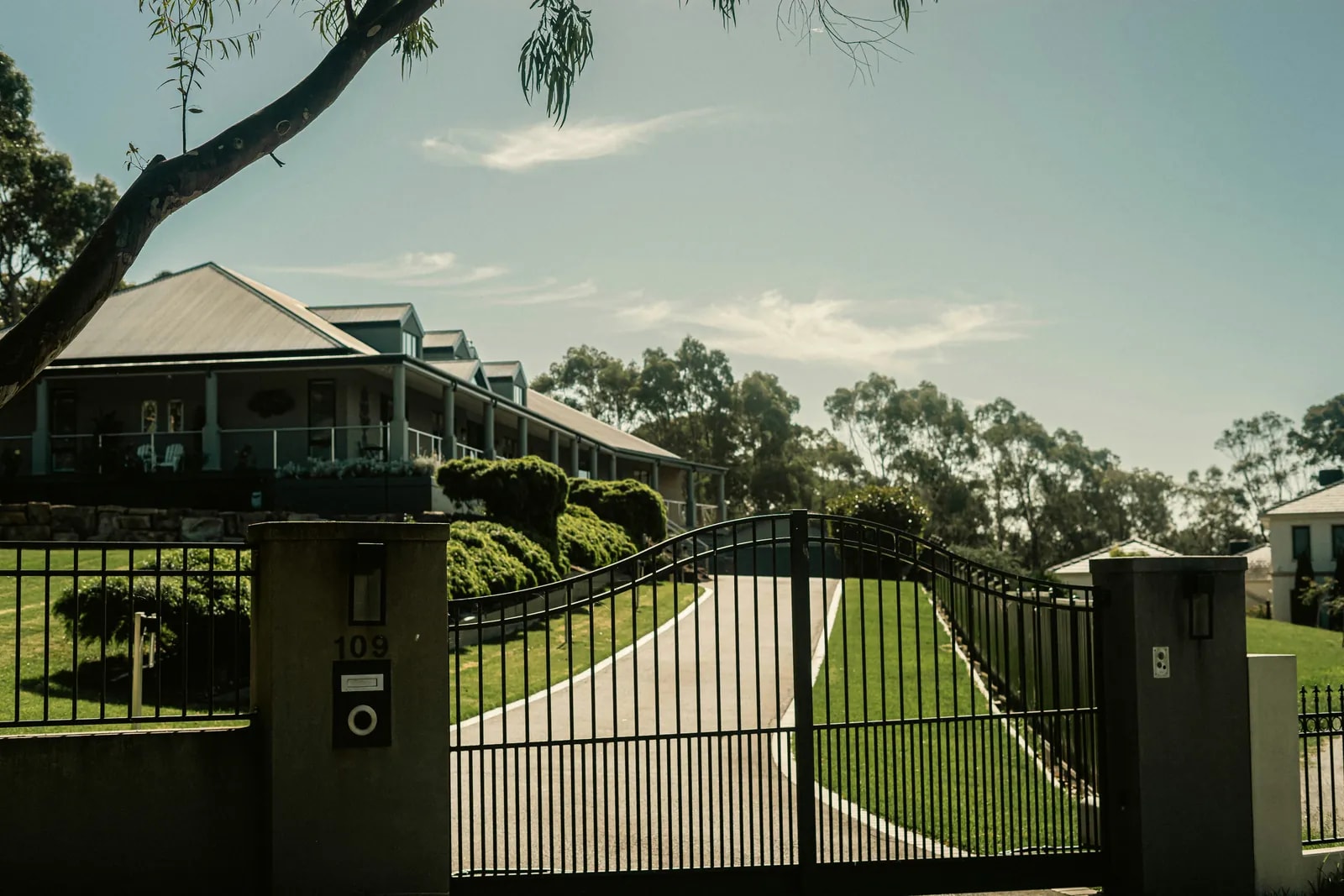
Pick the wrong gate type and it shows on day one. A swing leaf scrapes a rising drive, a sliding leaf has nowhere to go, or a shamal pushes a solid leaf back. A bigger motor fixes none of those.
Dubai Smart Home wrote this from the villa gates our design team surveys, the maker manuals and the UAE's own gate-safety law. Prices and running costs live in our automatic gate cost guide for Dubai, and the whole house in our complete smart home guide for Dubai.
Sliding or swing gate motor: which fits a Dubai villa driveway?
A sliding gate motor fits a Dubai villa when there is a straight wall run beside the opening, the drive rises behind the gate, or the leaf is heavy, long or solid. A swing motor fits when the side wall is short, the depth behind the gate is at least the leaf length, and the ground is level or falls away.
One common answer says swing suits heavier gates. That is backwards. CAME's sliding range runs to 3,500 kg on its BY-3500T[1], while a swing leaf's limit falls as the leaf gets longer.
Neither type is safer by design, and UAE Cabinet Resolution No. 37 of 2016 sets the same crush-force limits for both[2]. Our gate automation and access control service starts from the measurements below, because the motor is chosen after the driveway.
How do sliding and swing gate motors compare on a Dubai driveway?
Sliding and swing gate motors differ most in the space they need, how they cope with slope and wind, and how far their weight ratings stretch. A sliding motor needs a clear run along the wall; a swing motor needs clear ground behind the gate. Makers rate both types to a similar heat ceiling of 50 to 55°C[3][4].
A sliding motor sits on a base beside the opening and drives a toothed rack on the leaf, so the leaf rolls along the wall. A swing motor pushes each leaf on its hinges: a ram or an arm on the pillar, or a motor buried under the hinge.
Opening times in the table are our arithmetic from maker speeds.
| Factor | Sliding gate | Swing gate | What decides it in Dubai |
|---|---|---|---|
| Space | Wall run of the opening plus about 0.3 to 1 m (tracked)[5] | Depth behind the gate equal to the leaf length | Wall length against depth to the house or car |
| Slope | Level line across the opening | Level ground, or ground falling behind the gate | Which way the drive slopes |
| Weight ratings | 400 kg (CAME BX-74) to 3,500 kg (CAME BY-3500T)[3][1] | CAME ATI A5024N: 1,000 kg at 2 m, 400 kg at 5 m[6] | Leaf weight and length together |
| Wind on a solid leaf | Guide rollers take the load | A fully clad 3 m leaf is rated for 22 km/h (Centurion)[4] | How much of the leaf is solid |
| Sand | A ground track collects it; a cantilever has none | No track; underground pits must drain | Blown sand and rain run-off |
| Trap points | Closing edge and the run-back[7] | Hinge side, closing edge and the arc | Same UAE force limits for both[2] |
| Power cut | One release; a freed leaf can roll if its run slopes | One release per leaf; hold each leaf against wind | Battery backup and the release key |
| Opening time | 4 m in about 9 s (Nice RBS600HS) to 23 s (CAME BX-74)[8][3] | 10 to 20 s per 90° (CAME ATI); up to 45 s for some underground motors[9] | Safe force matters more than speed |
| Supply-only price, amazon.ae, 24 November 2026 | Branded kits AED 1,627.59 to 2,771.72[10] | Branded motors AED 1,388.68 to 2,369.03, one per leaf[10] | Fitting, power feed and safety devices are extra |
On most plots, one or two rows rule a type out before price comes up. Fitting is priced after a free survey, and our gate cost breakdown covers every price line and brand.
Which five measurements decide the gate for your driveway?
Five measurements decide the gate type for a Dubai villa. They are the wall run beside the opening, the clear depth behind it, the slope and its direction, the leaf weight and length, and how solid the leaf is. Take them before anyone quotes a motor, because each one can rule a type out.
Measure the opening as the clear width between the posts, and the depth behind it to the nearest parked car.
| Your driveway | Better fit | Why | Check before you order |
|---|---|---|---|
| Long wall on one side, short drive | Sliding | The leaf moves along the wall, not into the drive | Wall run for the leaf and any tail |
| Short walls, deep and level drive | Double swing | Each leaf needs half the opening as depth | Pillar depth and hinges |
| Drive rises behind the gate | Sliding | An inward swing leaf would hit the ground | A level line across the opening |
| Drive falls behind the gate | Swing, opening inward | The leaf clears the ground | The gap under the open leaf |
| Cross-fall along the gate line | Cantilever, or swing with raked leaves | A ground track must sit level | Levelling works and the maker's approval |
| Heavy, long, solid leaf on an open plot | Sliding | Swing ratings fall with length and wind | Guide rollers and end stops |
| Existing gate fits and moves freely | Keep the type, add a motor | A new type means a new leaf and foundations | Hand push under 150 N[11] |
| You rent the villa | Keep the type | Gate changes need the landlord's consent | Your tenancy contract |
| Off-plan villa or full renovation | Decide at design stage | Ducts and power are easy before paving | Community guidelines first |
Send a photo of the gate from the road and from the drive, with the opening width, on WhatsApp, or ask for a site survey and we measure all five.
A pedestrian gate beside the vehicle leaf is the natural post for an intercom. Our video doorbells and intercoms range lists models with their UAE prices.
How much room does each gate need beside and behind the opening?
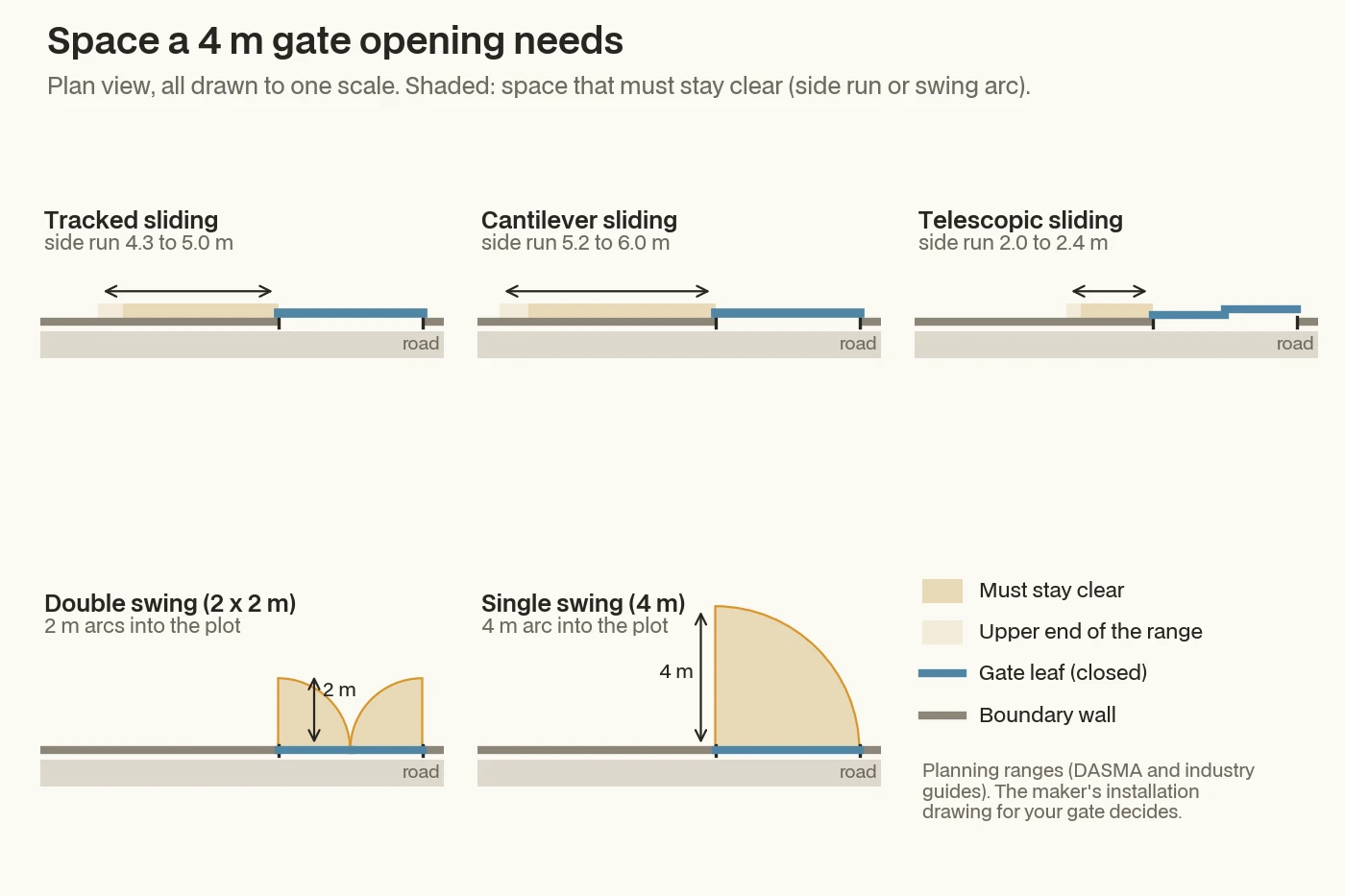
A tracked sliding gate needs a straight wall run of the opening plus about 0.3 to 1 m. A cantilever gate needs the opening plus 30 to 50% for its tail. A swing leaf needs clear depth behind the gate equal to its own length, so a double gate needs half the depth of a single leaf.
These are planning ranges. Industry guides disagree within them, so ask for the maker's installation drawing for your exact gate before you commit. The US Door and Access Systems Manufacturers Association (DASMA) puts a V-track panel about 0.9 m longer than the opening, and a cantilever gate at the opening plus 50%[5]. A telescopic gate, whose sections stack, needs roughly half to 60% of the opening.
Worked for a 4 m opening, the rule looks like this.
| Gate type | Side run for a 4 m opening | Depth behind the gate | Ground it needs | Basis |
|---|---|---|---|---|
| Tracked sliding | About 4.3 to 5.0 m | Leaf and motor width | A level rail across the opening and run | Opening plus 0.3 to 1 m[5] |
| Cantilever sliding | About 5.2 to 6.0 m | Leaf and motor width | A level roller beam; nothing in the drive | Opening plus 30 to 50%[5] |
| Telescopic sliding | About 2.0 to 2.4 m | Two leaf widths | Level rails for each section | Half to 60% of the opening |
| Double swing, 2 x 2 m | None | About 2 m, clear of cars | Level or falling ground in both arcs | Each arc equals its leaf length |
| Single swing, 4 m | None | About 4 m, clear of cars | Level or falling ground across the arc | The arc equals the leaf length |
A car parked inside a swing arc blocks the gate every day, and a 4 m inward arc can take most of a short driveway. Behind a sliding leaf, the run-back can trap or pull in fingers, and the UK Door and Hardware Federation's code of practice says to fence or guard it[12].
Which way does your driveway slope, and what does that rule out?
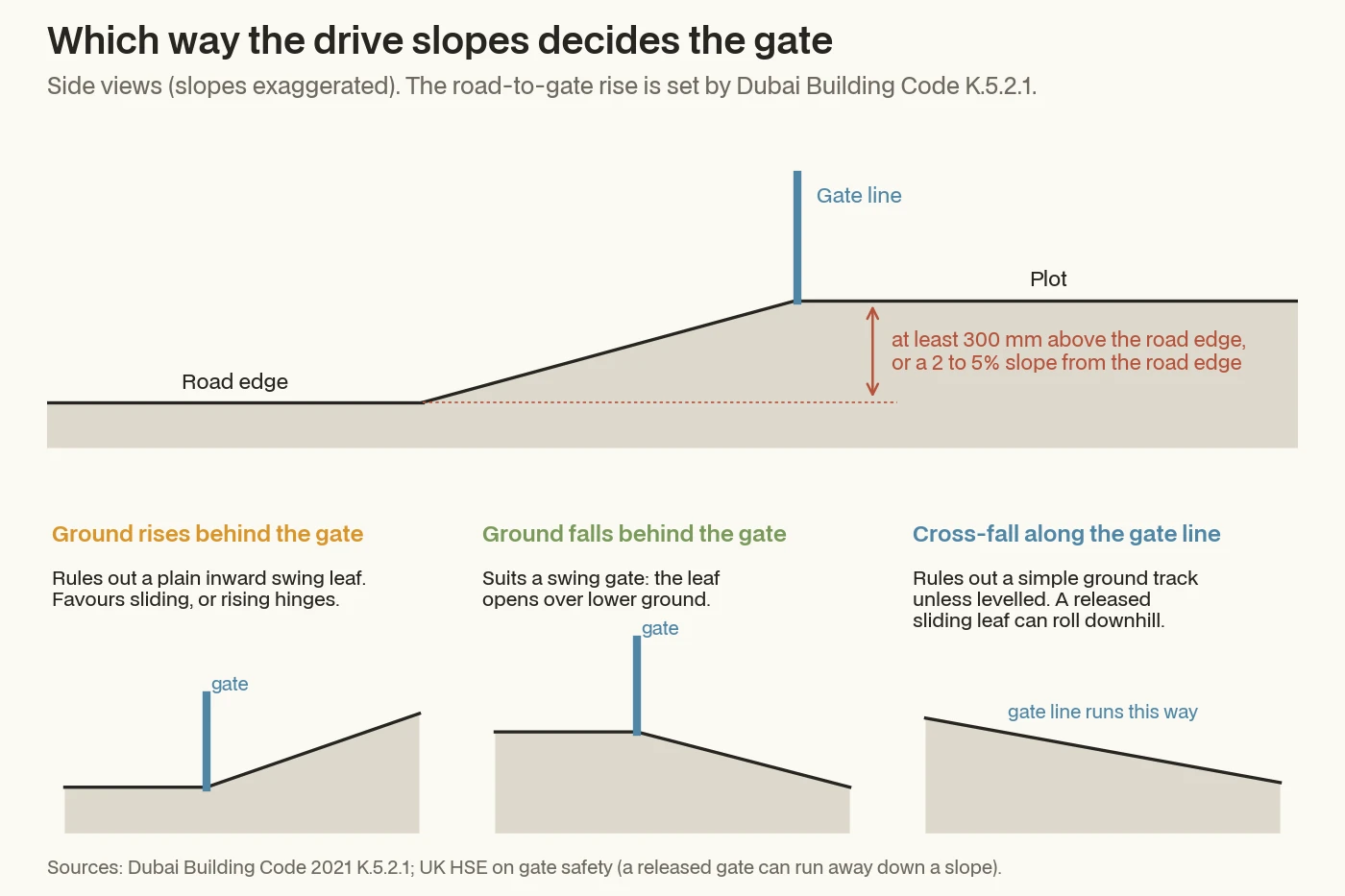
The direction of a driveway slope matters more than how steep it is. Ground rising behind the gate rules out a plain inward swing leaf and favours sliding. Ground falling behind the gate suits swing. A cross-fall along the gate line rules out a simple ground track unless the rail is levelled.
Dubai villas start with a slope built in. Clause K.5.2.1 of Dubai Municipality's Dubai Building Code 2021 sets the gate level at least 300 mm above the road edge. The other option is a 2 to 5% slope from the road edge to the plot access point[13]. So the approach outside usually falls toward the road. Inside the plot, the code caps parking slopes at 4% and ramps at 12%[13].
- Rising behind the gate. An inward swing leaf hits the ground. Rising hinges, a raked bottom rail or an outward swing can work, but outward needs your community's agreement. Sliding comes first if the side run exists.
- Falling behind the gate. An inward swing leaf clears easily. Watch the gap under it: the UK code lists 120 mm as the smallest gap that avoids crushing a foot[12].
- Cross-fall along the gate line. A tracked rail must sit level, which means a levelling beam or civil works, and the maker's approval. A cantilever can clear the high point, and swing leaves need raked bottoms. The UK Health and Safety Executive (HSE) warns that gates can run away down a slope[7], so a released sliding leaf on a cross-fall can roll downhill.
So a sliding gate does not work on any slope, as some answers claim.
Pro tip: measure the fall twice: once along the drive, and once across the gate line with a string pulled tight between the posts. The second number decides whether a tracked rail needs a levelling beam, so give both numbers to anyone who quotes.
How heavy and how long is your gate leaf, and which motor is rated for it?
A swing motor's weight limit falls as the leaf gets longer, while a sliding motor is rated mainly by total weight. CAME's ATI A5024N swing motor takes 1,000 kg on a 2 m leaf but 400 kg on a 5 m leaf[6]. CAME's sliding motors run from 400 kg to 3,500 kg[3][1].
The maxima on a product page are not limits you get together. CAME's family page lists the ATI at 1,000 kg and 5 m[9]. The manual pairs them: 1,000 kg at 2 m, 600 kg at 3 m, 500 kg at 4 m and 400 kg at 5 m[6].
Centurion's V-series shows the same pattern. At a 90° opening, the V400 takes 500 kg up to 2.5 m and 200 kg at 4 m; the V500 takes 750 kg and 310 kg[4]. Open a V400 leaf to 120° and the limit drops to 100 kg at 2 m. Gates over 3 m also need an electric lock to reach those values.
Sliding motors scale further. Nice's Robus RBS800 takes 800 kg[8], Beninca's BULL10M to 1,000 kg[14] and BFT's Ares Ultra BT B1500 to 1,500 kg[15].
Quick math: take a 3 m solid leaf weighing 450 kg. CAME's ATI A3024N is rated for 400 kg at 3 m, so it is out; the A5024N allows 600 kg at 3 m, so it is in[6]. A Centurion V400 at 90° allows 360 kg at 3 m, so it is out; the V500 allows 550 kg[4]. Size from the chart, not the box.
You will also see advice to oversize a motor by 30 to 50% for a solid gate. No maker we read uses that rule. Makers publish weight-by-length charts instead, and Centurion rates its duty on a gate that needs under half the motor's rated push force[4].
Articulated arm, linear ram or underground: which swing motor suits your pillars?
The depth of your pillar picks the swing motor. A linear ram suits a slim pillar with the hinge close to its face: CAME limits that offset to 120 mm on its ATI. An articulated arm suits deep masonry pillars, up to 380 mm on CAME's FERNI. An underground motor hides at the hinge, but its pit must drain.
The offset runs from the hinge centre to the pillar face where the bracket sits[6][9].
| Type | Maker examples and limits | Pillar offset it tolerates | Dubai watch-outs | Best for |
|---|---|---|---|---|
| Linear ram | CAME ATI to 5 m (weight falls with length); BFT Kustos Ultra BT A40, 500 kg and 4 m[15] | 60 mm (CAME AXI) to 200 mm (CAME ATS)[9] | Sun on the motor body; check the duty rating | Slim posts and medium leaves |
| Hydraulic ram | FAAC 400, leaves up to 7 m[16] | Per FAAC's mounting drawing | FAAC's pick when wind decides the choice[16] | Heavy, panelled or windy leaves |
| Articulated arm | CAME FAST, 300 kg and 2.3 m; CAME FERNI, 800 kg and 4 m; Nice Hyppo to 3 m[17] | 300 mm (CAME FAST) to 380 mm (CAME FERNI)[9] | Nice Hyppo is IP43, so keep it out of sprinkler spray | Deep masonry pillars |
| Underground | CAME FROG, 800 kg and 3.5 m[9]; FAAC 770N, 500 kg and 3.5 m[18]; Nice M-Fab to Big-Fab, 3 to 5 m[17] | Not limited by the pillar | The pit must drain; sand and water get in | A hidden motor on a new gate |
FAAC Middle East recommends its 413 ram for pedestrian passages or gates with small leaves, not for a heavy vehicle gate[16].
IP67 is a rating for temporary immersion, not for a foundation box that stays flooded, so ask how the pit drains and where the water goes before you choose an underground motor. Nice hangs its motor inside the box so deposits can drain[17]. Our villa flood protection guide covers drainage around the plot, and our pool and outdoor automation design keeps irrigation and pool lines clear of gate pits.
Tracked, cantilever or telescopic: which sliding gate copes with sand and a short wall?
A tracked sliding gate runs on a ground rail that collects sand, so it needs clearing after storms. A cantilever gate hangs from rollers beside the opening and leaves nothing in the drive, but it needs a longer tail and a lighter leaf. A telescopic gate suits a short wall but adds moving parts.
The cantilever's catch is weight. FAAC caps a cantilever leaf at 250 kg on its C4000I, against 400 kg for the same motor on a track[19]. A telescopic gate has two or more sections, so its maker's drawing decides the layout and the motor.
No maker we read sets a cleaning interval for a Dubai track; check and clear it after every sandstorm and at each service visit. Sand in a rail adds friction, and a gate that needs over 150 N to push by hand fails Somfy's check[11]. Dust ratings differ too: FAAC's C4000I is IP30, which is not dust-tight[19], while CAME lists its BXV at IP54[20]. Our sandstorm guide for Dubai smart homes covers the rest of the outdoor kit.
What does a shamal do to a solid gate leaf?
A solid gate leaf acts like a sail in a shamal, the Gulf's north-westerly wind, and a swing leaf takes that load on its hinges and motor. Centurion's manual rates a fully clad 3 m leaf for 22 km/h of wind, half the 44 km/h it allows for a leaf that is 25% covered. A sliding leaf is less exposed, not immune.
Centurion is the only maker whose wind-speed table we found. For a 1.8 m high gate, Centurion rates a 25% covered leaf for 94 km/h at 1.5 m long and 37 km/h at 4 m. Fully clad, those drop to 47 and 19 km/h[4].
Nice warns that gate shape, height and weather can considerably reduce its chart values[17]. FAAC Middle East points windy or panelled leaves to its hydraulic 400[16], and FAAC's spec sheet recommends a lock on leaves over 3.6 m[21]. The UK code adds that built-in force limiting is unlikely to stay safe on hinged gates in high winds[12].
DASMA advises against signs on cantilever panels, because wind on a leaf with no ground track can make its leading edge miss its catch[5].
We found no official National Centre of Meteorology gust statistic for shamal days in Dubai. For scale, the Dubai Building Code designs villas for 3-second gusts of 30 to 47 m/s (about 108 to 169 km/h)[13], and those are design figures for buildings, not everyday wind.
Real talk: if you want a fully solid leaf for privacy on an open plot, the motor is the wrong place to solve it. The UK Door and Hardware Federation's code says a gate with more than 30% infill already generates considerable wind resistance[12]. Choose slatted or perforated infill, split the opening into two leaves, or go sliding, before you pay for a bigger ram.
Will the motor cope with Dubai heat and how often your gate runs?
Most gate motors are rated to a maximum of 50 to 55°C, and UAE air reached 51.2°C at Bada Dafas on 5 August 2026[22]. A motor body in direct sun runs hotter than the air, so shade and the duty rating matter more than sliding versus swing.
Duty cycle is how many runs a motor can make in an hour before it must cool. CAME rates its BX for 17 cycles an hour at 20°C, and its 55°C curve sits below that[3]. Centurion rates 50% duty at 25°C, out of direct sun[4]. FAAC's manual for its 740 and 741 sliding motors says direct sun can reduce the use frequency, FAAC's term for duty, down to 20%[23]. Check the current manual for your model.
Big swing leaves lose duty too: CAME rates its 230 V ATI models for 5 m leaves at 10 to 15 cycles an hour[24]. On our site surveys, an unshaded gate pillar in July reads well above 60°C[25].
IP ratings cover dust and water, not heat. CAME's BX is IP44[3], and the Dubai Building Code's IP55 rule covers outdoor switches and sockets, not gate motors[13].
Common mistake: buying a motor built for another market. CAME's UAE site lists 110 V versions of its BXV and ATI motors[20], while UAE mains is 230 V, so read the supply line on the label. US kits on amazon.ae are built to UL 325, the US standard[26], not to the European standards the UAE names.
Which gate is safer for children, pets and cars?
Neither gate type is safer by design. A sliding gate traps at its closing edge and in the run-back behind the leaf; a swing gate traps at the hinge side, at the closing edge and across its arc. UAE Cabinet Resolution No. 37 of 2016 sets the same force limits for both, and both need photocells or safety edges.
The resolution covers automatic doors and barriers, and names EN 12453 and IEC 60335-2-103 as mandatory standards. It caps crush force at 400 N where the gap to a fixed object is under 50 cm, and at 1,400 N where the gap is wider. The force must fall below 150 N within 750 milliseconds, and hinged and sliding types need photocell, light-curtain or safety-edge technology[2].
Article 4 requires drives, safety edges, sensors and photocells to be registered under the Emirates Conformity Assessment Scheme (ECAS), and an accredited body to inspect each installation before commissioning[2]. We could not confirm how that is enforced for villa gates, so ask your supplier for the UAE conformity registration of the operator and its safety devices.
The current European edition is EN 12453:2017+A1:2021[27], which now includes the force tests that used to sit in EN 12445[28]. IEC 60335-2-103 covers the drives themselves, single-phase up to 250 V[29].
UK HSE's 2010 review found that the child deaths it examined at powered gates involved automatic sliding gates, with the child trapped at the closing edge against the post[30]. That is UK data from 2010, not a ranking, but it ends the idea that sliding is safer. HSE also says photocells are not usually high-integrity safety devices[7], so a safety edge on the leading edge carries the main load.
- Sliding gate: guard the run-back, and use a safety edge there rather than the motor's own force limiting[12].
- Swing gate: built-in force limiting is unlikely to stay safe near the hinges, so a safety edge is usually needed[12].
Our child-safe smart home guide covers the pool, windows and doors. A camera on the gate shows the zone you cannot see from the house, and our security and CCTV design places it to cover the full swing or run.
What happens to each gate type in a power cut?
In a power cut without battery backup, both gate types stop and must be released by hand, and UAE Cabinet Resolution No. 37 of 2016 requires the design to allow that[2]. A sliding gate has one release. A double swing gate has one per leaf, and each freed leaf must be held against the wind.
Once released, a domestic leaf should move with about 150 N, one person's push, under the UK code of practice[12]. A freed sliding leaf on a slope can roll on its own[7]. A freed swing leaf in a shamal can slam back, so the same code says hinged gates used by hand should be able to be secured open and closed[12]. A drop bolt does that job.
Battery backup keeps the gate running instead. FAAC notes that its 24 V operators can take emergency batteries[16], and Centurion rates its V-series for 70 operations on a 7.2 Ah battery[4]. The designs we specify plan for roughly 8 to 20 open-and-close cycles on battery[25]. For what locks and Wi-Fi do when Dubai Electricity and Water Authority (DEWA) power drops, see our guide to smart homes in a Dubai power cut.
Pro tip: agree where the release key lives before handover, and show everyone who drives. A key locked inside the house is no help when the gate is the only way out, and the UK code asks for a manual release at the gate in that case[12].
Can you motorise your existing gate, or should you change type?
Most owners can motorise the gate they already have if it moves freely by hand and the pillars are solid. Somfy's test is a push of under 150 N before any motor goes on[11]. Changing from swing to sliding means a new leaf, a foundation, a track or roller beam, and a clear run along the wall.
CAME's ATI manual sets the same start for a swing leaf: a sturdy gate, working hinges, no friction and a ground stop[6]. Pillars are the weak point. DASMA warns that decorative columns are usually not sturdy enough to carry a swing operator, and their footings are rarely strong enough[31].
The Dubai Building Code's general rules for underground armoured cable and outdoor fittings apply to the feed to the gate pillar, including heavy-duty ducts under driveways[13]. A DEWA-enrolled electrical contractor sizes it.
A new motor is the moment to add app control. Check the Wi-Fi at the pillar first; our home networking and Wi-Fi design extends it to the gate. A keypad at the gate talks to the motor's control board, so choose the board first. Our smart locks and access range lists the entry devices we specify.
Ask for the written UAE warranty term and who honours it locally; a cross-border kit shipped from Amazon Germany usually has no local route. Somfy states 3 years on its Elixo 500 3S io[32], and FAAC has a regional company, FAAC Middle East FZE, in Dubai Silicon Oasis[33].
Do you need community or RTA approval to change gate type or swing direction?
Neither the Dubai Building Code nor any official rule we could read fixes whether a villa gate slides or swings, or which way it opens. Your plot's development control regulations, affection plan and community guidelines decide, so ask your community before you change the gate type or its swing direction, and expect a community no-objection certificate (NOC) for any change.
The code does fix where the gate goes. Villas follow the plot's development control regulations and its affection plan, the official plot plan that sets setbacks and access locations[13]. At a local-road junction, vehicle access sits at least 6 m from the chamfered plot edge, subject to Roads and Transport Authority (RTA) agreement[13]. So a gate cannot simply move along the wall to make room for a sliding run. The code's only rule that gates open away is for pool fences[13].
In Dubai Development Authority (DDA) zones, DDA's FAQ says the gate level comes from the master developer, and access follows the affection plan or RTA approval[34]. Changes there follow DDA's building modification permit[35].
Some master communities write gate rules into their development control regulations (Al Raha Gardens in Abu Dhabi says boundary walls and their gates shall not be modified[36]), so read your own community's guidelines before ordering a new gate. In an established community such as Arabian Ranches, that check comes before any measurement.
Renting? Any gate change needs the landlord's written consent first. We prepare the community paperwork as part of the design, so send us your plot plan and we check the gate line against it.
How Dubai Smart Home helps you choose and coordinate your gate
Three decisions matter more than the brand: which type your driveway allows, whether the leaf sits inside the maker's chart for its length, and the safety devices and release plan that UAE Cabinet Resolution No. 37 of 2016 expects for both types.
We survey the plot and take the five measurements, then design and specify the gate type, motor, safety edges, photocells and backup by model. We prepare the community paperwork, coordinate each trade until handover, and set up the remotes, app and staff codes. Gate motors are not in our product range, so each one is specified for your gate after the survey, from makers such as CAME, BFT, FAAC, Nice and Centurion[37]. A 12-month workmanship warranty covers the work, and its terms can vary by product.
Pricing for our smart gate and access control service starts from AED 4,500[37]. Since 2016 our design team has handled 100+ smart home projects across Dubai; we are rated 4.9/5 by Dubai homeowners. The gate is one zone in our outdoor smart home guide, and staff codes are covered in our domestic staff access guide. For the right type on your driveway, book a free design consultation, or send two photos of the gate and its opening width on WhatsApp.