Most smart wall switches need a neutral wire in the switch box, and many older Dubai villas and flats do not have one there. Order first and you may end up with a switch that never powers on, or an offer to use the earth wire as a neutral, which is never safe.
In plain words, the live brings power to the switch and the switched live carries it on to the lamp. The neutral (نيوترال in Arabic searches) carries it back to the board. The earth is a safety wire, not a return path.
The Dubai Smart Home team wrote this guide, with 100+ smart home projects in Dubai since 2016. It covers the UAE wiring rules, four routes, the makers' own figures and AED prices. Our complete smart home guide for Dubai handles the rest of the house.
Can you fit a smart switch in a Dubai home with no neutral wire?
Yes. A Dubai switch box with no neutral can take a no-neutral smart switch such as the Aqara H1. A relay at the light fitting, or smart bulbs with a wireless button, also work. A fourth route is a new neutral, priced after a survey. A licensed electrician does the work, with the circuit off at the board.
Smart control itself is recognised: the Dubai Building Code (2021 edition) lists "a smart control system" among the lighting controls a villa may use[1]. Our smart switches and lighting range lists each part with the hub it uses.
Why do so many Dubai switch boxes have no neutral?
Many Dubai switch boxes have no neutral because UAE wiring rules follow British principles, and many homes have the lighting looped in at the ceiling rose. Only the live, the switched live and an earth then reach the switch. It varies by building and even by room, so each box has to be checked[1][2].
A ceiling rose is the round fitting where a light's cable connects. Loop-in means the cable runs from light to light through each rose, so the neutral stays in the ceiling. Etihad Water and Electricity's wiring book for the Northern Emirates gives roses terminals for the switched live, neutral and earth[3].
The third wire in a back box, the box behind the switch plate, is usually the earth. The Abu Dhabi Department of Energy's wiring rules require an earth at every connection point, even a plastic light switch[2]. No source gives a year when Dubai homes began getting a neutral at the switch.
Our retrofit vs new build guide explains why rooms differ. For a new build, our pre-wiring guide for Dubai shows how to ask for a neutral at every box.
What do DEWA and the UAE wiring rules say about a neutral at the switch?
The Dubai Building Code, which the Dubai Electricity and Water Authority (DEWA) says carries the electrical design rules of its regulations, says nothing about a neutral at a light switch[1][4]. Neither do Abu Dhabi's or the Northern Emirates' wiring rules[2][3]. Silence is not a permission: your electrician still works to the full rules.
DEWA's circular of 17 January 2022 says the electrical design clauses of its regulations are incorporated in the Dubai Building Code, mostly Parts G and K. The same circular keeps DEWA's 2017 regulations in force for operation, periodic inspection and maintenance[4]. A search of all 843 pages of the code found no clause that requires, forbids or mentions a neutral at a switch.
Online claims that DEWA requires a neutral at every switch, or has approved no-neutral switches, are not in the texts we read. The rules do say this:
- Neutral and earth stay apart. The Dubai code says they "shall not be connected together at the main earth terminal or at any other point" (clauses G.4.19.1 and K.9.1.18.1)[1]. Abu Dhabi clause 6.2.3 agrees[2], and so does the Northern Emirates' book[3].
- Licensed people do the work. Abu Dhabi clause 3.4.1 allows work on installations only by licensed contractors[2]. The Northern Emirates' clauses 5.4 and 6.1 say the same[3].
- Dubai. DEWA's permit and connection services are open only to enrolled contractors and consultants[5]. Whatever the emirate, use a licensed electrician and check your building's or community's rules first.
- UK guidance. The UK wiring standard's guidance, as reported by NICEIC, is that a neutral is often needed at switch positions for electronic switches[6]. It is not a UAE rule or a ban.
How do you check your switch boxes safely?
You check a switch box safely by not opening it yourself. The circuit is switched off at the distribution board, the panel of breakers that feeds your home. Then a licensed electrician opens the box and notes each wire. Never judge a neutral by wire colour, and never test live wires yourself.
Abu Dhabi's rules say tests are done on dead circuits, with the main isolator secured in the off position[2].
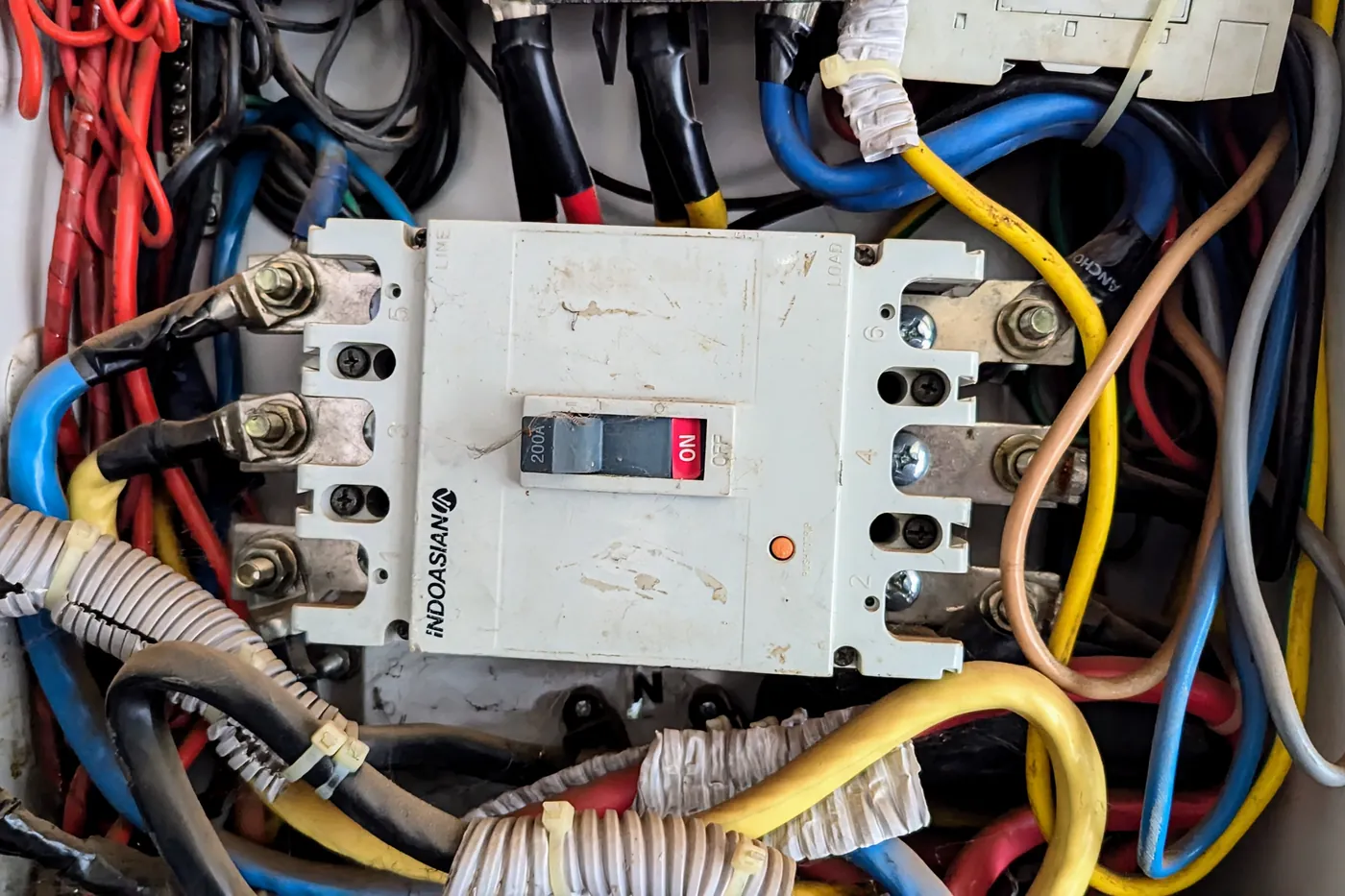
Ask the electrician to note these points for each box:
- Is there a neutral? If not, where is it: the ceiling rose, a junction box, or nowhere?
- The box depth in mm, and whether it is metal or plastic.
- Whether the switch is two-way, meaning two switches control one light, as on stairs.
- The lamps it runs, their watts, and any fan.
Common mistake: ordering a full set of smart switches before any box is opened. Two Dubai residents on Reddit, in 2019 and 2022, found there was no neutral only when they went shopping; a UK owner found out after buying a Sonoff switch. One box only tells you about that box, so have every box you plan to change checked.
Our DIY vs professional smart home guide shows where the line sits for other jobs. To have the boxes checked as part of a plan, ask for a site survey.
What are the four routes when the box has no neutral?
A box with no neutral has four routes. You can fit a no-neutral smart switch, put a relay at the light fitting, use smart bulbs with a wireless button, or run a new neutral to the box. The first three use parts sold in the UAE today. The fourth is rewiring, priced after a survey.
A relay is a small switching module hidden at the light, where the neutral usually is. A hub is the small box that links switches or bulbs to the app. Minimum load is the lowest lamp wattage a no-neutral switch needs to run. Shelly adds that a neutral must still exist at the lamp, and a circuit with none anywhere is unsafe and must be fixed by a professional[7].
| Route | How it works | What it needs | The catch | Who does the work | Best for |
|---|---|---|---|---|---|
| 1. No-neutral smart switch | Replaces the wall switch and powers itself through the lamp circuit | Enough lamp load, usually a hub, a deep enough box | Low-wattage LEDs can flicker or glow | Licensed electrician | Owners who want wall switches |
| 2. Relay at the light fitting | A module at the light; the old switch becomes its input | Live and neutral at the fitting, ceiling access | A reset means reaching the fitting again | Licensed electrician | Loop-in homes with false ceilings |
| 3. Smart bulbs plus a wireless button | Bulbs stay powered; a battery button or the app runs them | The wall switch left on, and a hub | Switch it off and the bulbs drop offline | You | Tenants |
| 4. New neutral to the box | A neutral is run to each switch box | A cable path to the box | No published price; may mean wall work | Licensed electrician | Renovations |
With a neutral at the ceiling rose, a relay there is the cheapest smart point in this guide. Sonoff's Wi-Fi MINIR4 costs AED 32.24 a circuit, and its Zigbee ZBMINIR2 AED 41.80 plus a gateway (Sonoff-ME on amazon.ae, 1 November 2026)[8]. Philips' Hue wall switch module is another option, with no UAE price found, and Philips says fitting it means handling live mains wires[9].
Our guide to the best smart lighting for Dubai homes compares bulbs and switches. For Hue bulbs, the Philips Hue Bridge is the hub they run from.
How does a no-neutral switch power itself, and what do you give up?
A no-neutral smart switch has no neutral to complete its own circuit, so it powers its radio and chip through the lamp it controls. Makers handle this with a minimum load, and some require a bypass at the light. Lamps that draw less can flicker or glow when they should be off[10].
A bypass is a small part fitted across the light, at the fitting, that gives the switch an easier path. Lutron shows why a tiny current matters: a 0.5 mA leakage through one of its switched-off 120 V modules can make low-wattage loads try to start[11].
What you give up:
- Overload protection. Aqara offers it only on the with-neutral H1[12].
- Energy readings. Aqara's H2 switch measures power only with a neutral[13], and so does Shelly's Dimmer Gen3[14].
- Isolation. Abu Dhabi's rules say "Semiconductor devices cannot be used as a means of isolation for safety"[2]. So the breaker is switched off before anyone changes a lamp, as Aqara's manual also asks before any wiring[10].
Which no-neutral switches are sold in the UAE, and how do they compare?
The no-neutral switches with maker spec sheets that we found on amazon.ae on 1 November 2026 were the Aqara H1, TP-Link's Tapo S210 and S220, and the Sonoff ZBMINI-L2 module. They cost AED 51.52 to 310.00 before a hub. Aqara's H2 and Shelly's no-neutral parts were not on the UAE listings we checked.
The figures are the makers' own. Prices are amazon.ae listings with the seller named, 1 November 2026, parts only.
| Model | Neutral needed? | Radio and hub | Minimum load | Maximum load | Router or end device | 2-way | Notes | UAE price (1 Nov 2026) |
|---|---|---|---|---|---|---|---|---|
| Aqara H1 EU, no neutral (WS-EUK01, WS-EUK02) | No | Zigbee 3.0, Aqara hub[15] | 3 W typical[10] | 8 A resistive | Router only with neutral (Aqara)[16] | Not stated | No overload protection; 37.55 mm deep | Single AED 154.99 (TECH MIDDLE EAST TRADING LLC); double AED 178.00 (Kendom)[8] |
| Aqara H1 Triple Rocker, no neutral | No | Zigbee 3.0, Aqara hub | Not stated | Not stated | Router only with neutral (Aqara)[16] | With the Aqara Wireless Switch H1 | Square 86 mm boxes | AED 310.00 (Kendom) |
| Aqara Light Switch H2 (EU) | Optional | Thread, Zigbee or Bluetooth | 5 W without a neutral | 8 A | Not stated | Not stated | 45 mm deep[13] | Quote-only |
| Aqara Dimmer Switch H2 (EU) | Optional | Thread or Zigbee | 4 W through Aqara Home via Matter, otherwise 9 W | 200 W dimmable LED | Not stated | Not stated | 55.45 mm deep[17] | Quote-only |
| Tapo S210 (1-gang) and S220 (2-gang) | No | 868 MHz, Tapo H100 hub | None (S210 page) | 600 W LED, 50 W fan, 4 A a gang | Not Zigbee | No, 1-way only | Two AAA batteries, 1+ year; 41 mm deep[18][19] | S210 AED 72.04 (Amazon UK, cross-border); S220 AED 87.64 (Amazon.ae); hub AED 90.00 (Gamerzhub) |
| Sonoff ZBMINI-L2 | No | Zigbee, gateway required | 3 W | 6 A; 300 W LED | End device, not a router | Through an external switch | Module behind the old switch; 18.4 mm deep; no fans[20] | AED 51.52 (Sonoff-ME) |
| Shelly 1L Gen3 | No, but a Bypass goes at the light for LEDs | Not on the page we read | Above 5 W with the Bypass; Bypass page says under 20 W needs one | 200 W | Not stated | Not stated | Bypass in the pack[21][22] | Quote-only |
| Shelly Dimmer Gen3 | Optional | Wi-Fi and Bluetooth | Bypass needed under 20 W without a neutral | 200 W; 150 W dimmable LED | Not Zigbee | Not stated | No metering without a neutral[14] | Quote-only |
Check the maximum against the circuit too. Dubai's code caps a new lighting circuit at 2,000 W on a 16 A breaker[1], ten times the Shelly parts' 200 W limit.
Aqara vs Sonoff for a no-neutral switch: Aqara replaces the plate, while the AED 51.52 Sonoff module sits behind your old switch. Both need a Zigbee hub.
Real talk: three facts are often wrong online. TP-Link's UAE pages say the Tapo S210 and S220 use 868 MHz to a Tapo hub, not Wi-Fi, and both are 1-way only[19]. Shelly says its Shelly 1 Gen3 and 1 Mini Gen3 need a neutral[23]. Aqara says its H2 switch works with or without one.
Some popular parts need a neutral. The Aqara Z1 Pro 4-gang was AED 300.00 (Kendom) and the Sonoff SwitchMan M5 AED 58.00 (Sonoff-ME) on amazon.ae[8], and our catalogue lists both as neutral required. The MOES Zigbee no-neutral 1-gang was AED 80.00 (SATYAMEV); we read no MOES spec sheet, so it is not in the table.
Some Aqara listings say "Global version" and state no UAE warranty, so check noon.com and Sharaf DG too. Bringing in a switch for your own use needs no registration with the Telecommunications and Digital Government Regulatory Authority (TDRA), though UAE technical standards still apply. Switches sold here need type approval for the model[24].
For a shortlist, see our pages for the Aqara H1 no-neutral switch and the Tapo S220 2-gang switch.
Is Lutron Caseta a no-neutral option in the UAE?
No. Lutron's Caseta documents rate every in-wall dimmer at 120 V with a US wallbox, and UAE homes run on 230 V[25][26]. We found no 230 V version, so Caseta is not a UAE no-neutral option. Online advice calling it the no-neutral fix was written for North American homes.
Caseta's PD-6WCL is a real two-wire dimmer with a 25 W minimum and 150 W of LED, and it may need Lutron's LUT-MLC bypass[25]. Lutron support names it and the PD-10NXD as the choices without a neutral[27], and both are 120 V. It needs a US wallbox at least 57 mm deep and lists North American approvals, with no CE or Gulf approval[26].
Lutron's UK site promotes a different system, RA2 Select[28]. Our own Lutron Caseta dimmer page warns that it is a 120 V US part, not for a 240 V circuit. The 230 V Lutron in-line dimmer in our catalogue needs a neutral, so confirm any Lutron part with the supplier.
Why do LEDs flicker, glow or buzz, and what does a bypass fix?
LEDs flicker, glow or buzz on a no-neutral switch when the lamps draw less than the switch needs to keep running. Aqara gives a typical minimum of 3 W for the H1 EU no-neutral switch, and lamps that draw less can flicker or glow[10]. The fixes are a better-matched lamp, the maker's bypass, or a neutral.
Makers disagree on the bypass, so follow your model's manual:
- Shelly requires one. Its 1L Gen3 page says the Bypass goes next to the light for LED lamps and lets the relay run bulbs above 5 W[21]. Its Bypass page says the Bypass is needed when the load is under 20 W[22].
- Sonoff forbids one. The ZBMINI-L2 handles loads as small as 3 W without an anti-flicker module, and an external one may damage it[20].
- Aqara lets you tune it. The H2 dimmer has user-set minimum and maximum brightness "to prevent flickering"[17].
- Legrand supplies one. Its European Valena Life with Netatmo switch runs 5 to 300 W loads without a neutral and ships with a bleeder, a bypass for LED lamps[29]. We did not find it on UAE retail sites.
Candeo, a UK maker, fits its bypass at the light fitting because the neutral is often not at the switch[30].
Owners on forums, not makers, report a safe load of anything from 5 W to 25 W. The worst cases they describe are circuits of tiny lamps such as G9 capsules.
| Symptom | Likely cause | Fix | Who does it |
|---|---|---|---|
| Faint glow when off | Lamp load below the switch's minimum | A better-matched lamp, the maker's bypass, or a neutral | You for the lamp; a licensed electrician for the rest |
| Blinks or flashes when off | Very small lamps such as G9s (owners report) | Fewer, larger lamps, or the maker's bypass | A licensed electrician for the bypass |
| Buzz from lamp or switch | Lamp and switch badly matched (owners report) | Another LED; on the Aqara H2 dimmer, change the dimming mode (trailing or leading edge)[17] | You, in the app |
| Switch restarts or drops off the app | Smart bulbs or a very low load behind it (owners report), or a weak mesh | Plain LEDs behind it; mains-powered Zigbee routers | You, with your system designer |
| Steady red light on an Aqara H1 | The panel does not match the in-wall power module (Aqara)[10] | Pair the right panel with its module | A licensed electrician |
| Trouble on a fan circuit | Fans not supported (Sonoff) or above 50 W (Tapo) | Keep the fan on a normal switch | A licensed electrician |
Never let anyone fit a home-made resistor or capacitor to stop flicker. A 50 ohm resistor across 230 V turns about 1,058 W into heat, because power is voltage squared divided by resistance.
Pro tip: before ordering for a whole villa, have one switch fitted on the circuit with your smallest lamps, and use it for a few days. If it glows, blinks or drops off the app, you found out for the price of one switch, not twenty.
Can a two-way stair or corridor circuit go smart without a neutral?
Yes, but rarely by swapping both switches. With no neutral, the usual 2-way smart switch answer is one smart switch plus a battery wireless switch at the other end, or a module that keeps the old switches. TP-Link's Tapo S210 and S220 are 1-way only, so they do not suit a two-way circuit[18][19].
Aqara pairs the H1 Triple Rocker with its Wireless Switch H1 for two-way setups[16]. The double version was AED 121.00 (ZXP Trading) on amazon.ae on 1 November 2026[8], and our Aqara Wireless Remote Switch H1 page lists it. It runs on a battery, so its end needs no wiring.
The Sonoff ZBMINI-L2 keeps the wired pair. Sonoff describes two-way control "for staircase and dual-switch setups" through an external switch[31], but lists no mode for three or more switch positions. A relay at the fitting is the other choice where the neutral is in the ceiling.
We print no wiring diagrams: two-way circuits differ from house to house.
What happens to your Zigbee mesh when every switch is no-neutral?
A Zigbee mesh can get weaker when every switch is no-neutral, because these switches often do not pass signals on. Sonoff says its ZBMINI-L2 is an end device, not a router[20], and Aqara claims the router function only for its with-neutral H1[16]. A villa needs some mains-powered routers spread through it.
Zigbee is a low-power wireless mesh. A router is a mains-powered device that passes messages on, while an end device only talks to its nearest router or the hub. Sonoff says range can be extended with routers such as its ZBMicro[20].
Tapo switches talk to the H100 hub on 868 MHz, not Zigbee, and TP-Link lists both on its UAE site[32]. Each brand wants its own hub. On amazon.ae, the Aqara Hub M100 was AED 170.00 and the M3 AED 750.00 (Kendom, 1 November 2026)[8].
Choose a villa-sized hub and check its device limit with the seller. Our Aqara Hub M100 page covers the smaller one. Our guide to smart home protocols in Dubai compares Zigbee with the other options.
Will it fit your back box and plate?
Box depth decides most fits. The Sonoff ZBMINI-L2 is 18.4 mm deep, the Aqara H1 EU 37.55 mm and the Tapo S210 41 mm. The Aqara H2 switch is 45 mm and the H2 dimmer 55.45 mm[20][15][18][13][17]. Have each box measured before you buy.
Aqara says the Triple Rocker fits square 86 mm boxes[16] and the H1 EU fits 86 mm square and round EU boxes. Some twin round boxes may not take several H1 EU switches[12]. The H2 switch fits standard 55 mm frames[13].
The Dubai code sets villa light switches at 1.25 m and allows only flush-type accessories with concealed wiring[1], so the existing box is the limit. A shallow box can still take the slim Sonoff module, or a relay can go at the fitting instead.
What does each route cost, from one room to a 20-circuit villa?
Parts for a 20-circuit villa ranged from AED 644.80 for relays at the fittings to AED 12,184.80 for Hue colour bulbs. Those are amazon.ae and IKEA UAE prices from 1 November 2026[8][33]. A no-neutral Aqara setup came to AED 2,434.00. These are parts only, and installation is quoted separately after a free survey.
The villa is our own model, with 20 switched lighting circuits. They pair up as 10 two-gang positions (two switches on one plate), 4 of them two-way, with 3 lamp holders per circuit, so 60 bulbs. A first room is one switch position, or one circuit of three bulbs. The workings are ours[34], and IKEA UAE stock varies by store.
| Route | First room (parts) | 20-circuit villa (parts) | What it leaves out | Year two |
|---|---|---|---|---|
| Aqara H1 no-neutral double rockers, M100 hub, 4 wireless switches | AED 348.00, then AED 178.00 a room | AED 2,434.00 (AED 3,014.00 with the M3 hub) | Labour; mains-powered Zigbee routers | Switches mains powered; wireless switches use batteries |
| Tapo S220 switches and H100 hub | AED 177.64, then AED 87.64 | AED 966.40 | The 4 two-way positions | Two AAA per switch; TP-Link says 1+ year |
| Sonoff ZBMINI-L2 behind existing switches | AED 103.04 for two circuits | AED 1,030.40 | A Zigbee gateway, not priced here | No batteries |
| IKEA TRADFRI bulbs, BILRESA remotes, DIRIGERA hub | AED 541, then AED 142 (AED 631 with colour bulbs) | AED 3,239 | Wall switches must stay on | Remote batteries, price not checked |
| Hue colour bulbs, Tap Dial switches (cross-border listing), Hue Bridge | AED 893.29, then AED 594.29 | AED 12,184.80 | Wall switches must stay on | Tap Dial batteries, price not checked |
| Sonoff MINIR4 relays at the fittings | AED 32.24 a circuit | AED 644.80 | Live and neutral at every fitting; on and off only | No batteries |
| New neutral to every box | Quote-only | Quote-only | No published rate in any source we read | None |
Quick math: the Aqara villa total starts with 10 double rockers at AED 178.00 (AED 1,780.00). Add one M100 hub at AED 170.00 and 4 wireless switches at AED 121.00 (AED 484.00) for AED 2,434.00. Swap in the M3 hub at AED 750.00 and it is AED 3,014.00. With 20 single rockers at AED 170.00 (the Kendom listing) and the M3, it is AED 4,634.00.
Our service pages publish a second kind of price, with installation included. Our smart lighting and climate control page starts from AED 4,500 for a two-bed apartment with smart switches and thermostat control. It lists a villa retrofit tier of AED 15,000 to 40,000[34]. The gap between parts and project is the survey, design, labour and set-up.
Advertised labour is the third kind. Two Dubai home-services marketplaces read on 1 November 2026 advertised a switch-board fitting from about AED 59 and wiring from AED 69 for up to 5 m. Hourly bookings ran from AED 69 to about AED 109, with a visit charge of about AED 49 if no job was booked[34]. Neither priced a neutral run, and a sample of two advertised rates is not a quote.
For your own figures, get your rooms priced after a free survey. Or send the room count and the switches you like on WhatsApp.
When is adding a neutral worth it, and when is it a rewire?
Adding a neutral is worth it when walls or ceilings are open anyway, or when no-neutral parts will not run your lamps. We found no published price for running a new neutral to a switch in Dubai. It depends on where the nearest neutral is and how a cable can reach the box, so it is priced after a survey.
Four things drive the cost. One is where the nearest neutral is: the rose, a junction box or the board. The others are the cable path (a false ceiling, or a wall cut open), the number of boxes, and the repainting.
Our smart lighting and climate page agrees that a neutral at the switches moves the price[34]. If most boxes need one and the ceilings are concrete, you are pricing part of a rewire. Then read our guide to KNX costs in Dubai.
A neutral can also fix what a bypass cannot. Lutron's support page says connecting a neutral can resolve minimum-load issues on its PD-10NXD[27], and one owner on Shelly's forum reported the same for a blinking 21 W lamp.
Common mistake: accepting a quick "neutral" from the earth wire, the next switch or a nearby socket. The Dubai code says neutral and earth must stay separate[1]. Abu Dhabi's inspection rules list a "borrowed neutral" from another circuit as a fail in the continuity test[2]. Answers online suggest both shortcuts. If an electrician offers either one, find another electrician.
Renting or owning: which route can you use?
Tenants can use the bulb route without touching any wiring: smart bulbs plus a battery wireless button, with the wall switch left on. Any switch or relay swap changes the building's wiring, so it needs the landlord's written consent and a licensed electrician. Owners can choose any of the four routes, based on where the neutral is.
Our smart home guide for rental apartments puts a wall switch in its ask-first tier for that reason[34]. Abu Dhabi's licensed-contractor rule names customers, owners and any other persons[2]. In Dubai, also check your building management's rules.
Tenants who asked on Reddit heard the same: it depends on the landlord, and the flat goes back as it was when you leave, so keep the old switches. Landlords can read our landlord's guide to smart homes in Dubai, and villa owners our smart home guide for villa owners.
What should you ask the electrician, and how can Dubai Smart Home help?
Ask the electrician for a written note of what was found in each box, which model they propose and why, and how its minimum load compares with your lamps. Dubai Smart Home handles the survey and design side, and coordinates the work through to handover.
Questions to ask first:
- Are you licensed for electrical work in this emirate?
- Where is the nearest neutral to each box?
- Will the proposed model fit the box, and is its minimum load below what my lamps draw?
- Is a bypass needed, and where will it go?
- Will you test each circuit afterwards and note what was done?
Our design team surveys the boxes, matches a route and a model to every circuit, and prepares the plan before anything is ordered. Once the hardware is in, we configure the app, scenes and wireless buttons, walk you through them and support you afterwards. Our design and coordination work is rated 4.9/5 by Dubai homeowners, and your project has a 12-month workmanship warranty that can vary by product.
For whole-home lighting with keypads and scenes, our lighting control system page starts from AED 10,000[34]. To see which route suits your rooms, book a survey of your switch boxes, or send photos of your switch plates and a floor plan on WhatsApp.