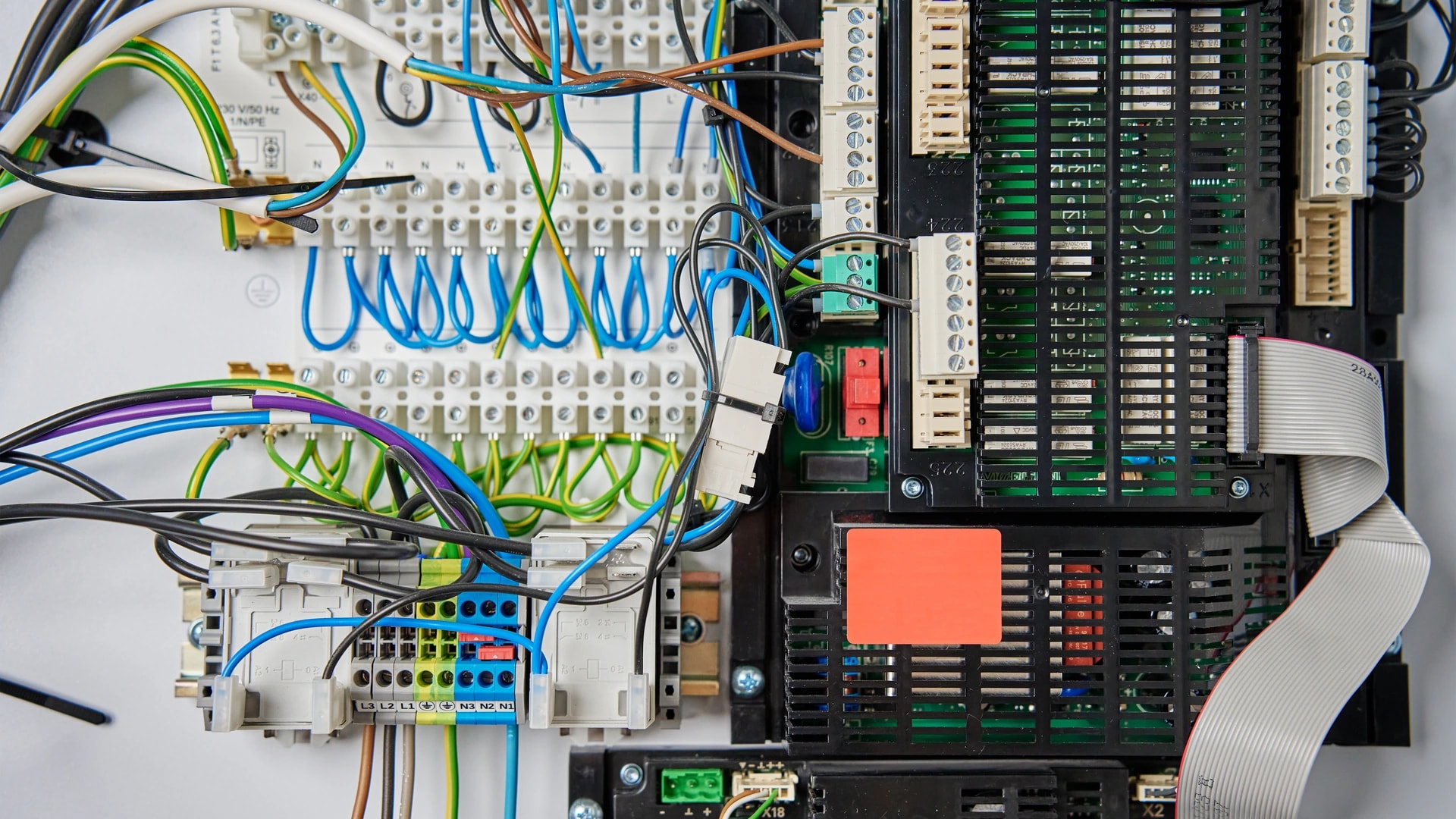
This is a smart home retrofit guide for Dubai. You have the keys, the walls are plastered and painted, and you want to know what is still on the table. Every verdict below assumes a finished villa or apartment.
Still off-plan? Read the off-plan buyer's pre-wire checklist first, then come back once the keys are yours. For the wider picture, start with our complete smart home guide for Dubai.
Real talk: most retrofit advice online is written around North American timber-frame houses, where fishing a cable through a hollow stud wall is the standard trick. It is not the trick here, and that difference changes half the answers below.[9]
Is your home a retrofit or a new build, and why does it matter?
The dividing line is whether your walls are still open, not villa versus apartment or KNX versus Control4. Open walls mean cable can go anywhere at almost no cost. Closed walls mean every new cable has to earn its disruption.
Anything running on a radio, a battery, or an existing cable retrofits well. Anything needing new cable behind finished plaster is the hard case. The exceptions, named up front:
- A wired whole-home lighting bus. A KNX keypad backbone needs bus cable behind every switch position.
- In-ceiling and in-wall speakers. Cutting a finished, painted ceiling is a building job, not a device swap.
- A gate motor or video intercom where no power run exists. House to boundary wall usually means trenching.
Everything else has a low-disruption path: lighting, curtains, AC, cameras, locks, irrigation, pool control, and energy monitoring.
What does it cost to wait until after move-in?
Pre-wiring during construction costs 60 to 70 percent less than retrofitting the same result into a finished home.[9]
The reason is physical, not commercial. At first fix, a cable run is a few extra metres of wire dropped into conduit before anyone plasters. After handover, the same run means chasing a channel into block, patching, and repainting.
The gap is widest on wired systems and narrowest on wireless ones. A battery sensor costs the same on day one and day one thousand. A KNX bus to twenty keypads does not.
Pre-wiring costs 60 to 70 percent less than retrofitting a finished Dubai home. The cable is not the expensive part. The plaster, the paint, and the days of access are.
For installed AED figures by home size and system, see the full AED cost breakdown. This page uses disruption as its measuring stick instead.
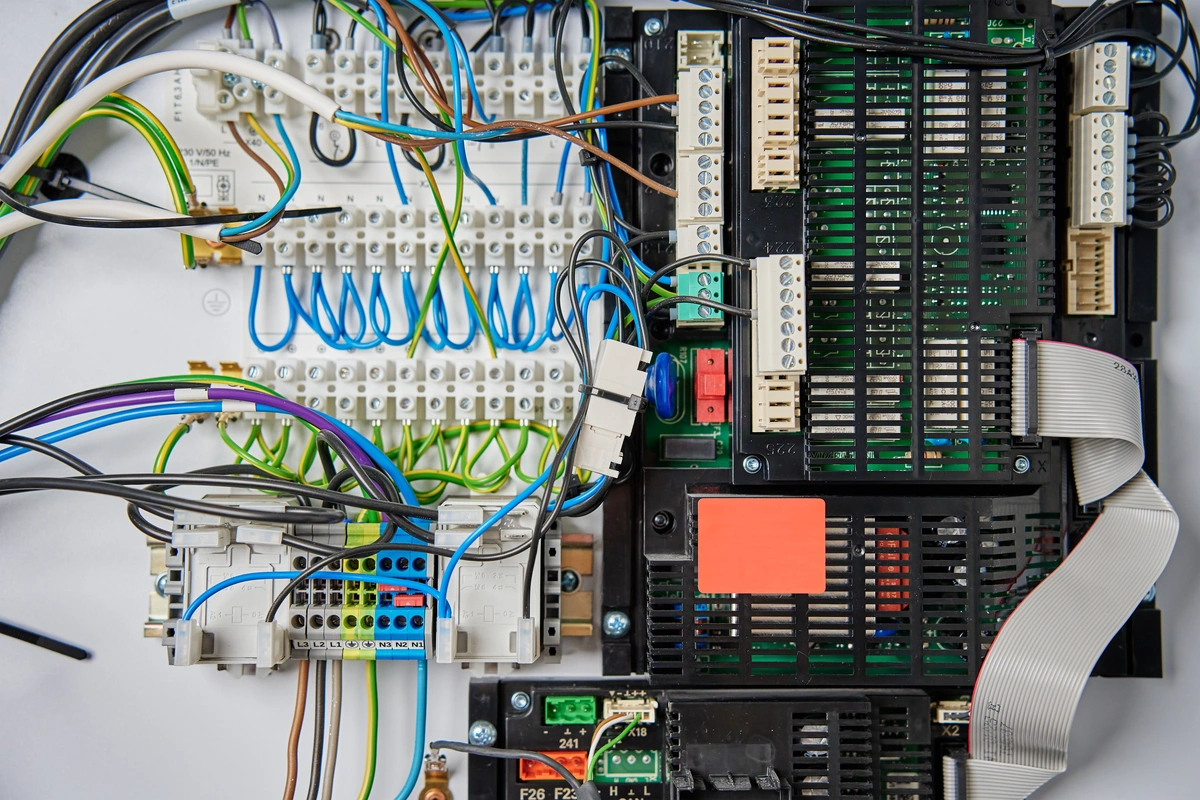
Do you have a neutral wire behind your switches? Here is how to check.
Many smart switches need a neutral wire at the switch box to stay powered when the light is off. You cannot tell from the switch plate, so check before you buy anything.
UAE wiring follows the British standard convention, where lighting circuits are commonly looped in at the ceiling rose, so only a switched live and an earth run down to the wall switch. Note the word commonly. Wiring varies by building age and electrician, so some Dubai properties do have a neutral at the switch. Check before you buy.
Loop-in at the switch brings live and neutral to every box. Loop-in at the ceiling rose sends only a switched live down. It can change room to room in the same home.
Common mistake: checking one box in the hallway and ordering switches for the whole villa. Have your electrician open a box in every room where you actually want a smart switch.
If a box has no neutral, two same-day fixes need no wall work. A no-neutral smart switch, such as the Lutron Caseta line, is built to install without one. Smart bulbs are the other route. Our device-by-device buy-instead matrix covers the trade-offs.
Why Dubai walls change what "just run a cable" means
In a Dubai villa or tower, wiring sits inside PVC conduit set into a block or concrete wall before the plaster went on. There is no hollow cavity behind the paint. That is why standard retrofit advice does not apply here.
In a timber-framed house an electrician drops a new cable down inside the wall from above. Dubai's reinforced concrete and block leaves nowhere for that cable to fall. You have four options instead.
- Reuse a spare conduit. The best case. An empty pipe already runs where you need it. Spare conduit is a pre-wire ask, not a standard developer inclusion, so most finished homes do not have one.
- Surface-mount trunking. A visible channel along the wall. Fast, cheap, and honest about what it is. Fine in a garage, harder to accept in a majlis.
- Chase the wall. Cut a channel into plaster and block, lay conduit, patch, repaint. This is why some jobs only make sense during a renovation you already planned.
- Go wireless. No cable at all. This carries most of a Dubai retrofit, which is why protocol choice matters more here.
One question decides most of it: is there already one place where new cable could end up? A media cabinet, a utility cupboard, a comms niche. If yes, jobs below move from "chase the wall" to "extend from that point." Our home networking and IT team checks this on the first visit.
Can you retrofit smart lighting control?
Yes, and it is one of the easier jobs in a finished home. How easy depends on the neutral wire you checked above.
With a neutral at the box: a wired-in smart switch or keypad goes in like a standard switch replacement. No chasing, no patching, no repaint. A room takes minutes.
Without a neutral: two paths, neither touching the wall. A no-neutral switch keeps physical wall control. The small current it draws through the lamp circuit can make some LED loads flicker or glow faintly. Smart bulbs avoid that, but the wall switch becomes a dumb on-off that nobody can flip, or the bulb loses power and forgets its scene.
The hard version is a wired keypad backbone. KNX is the wired standard that runs without the internet and lasts 30 years or more. A KNX lighting bus needs cable in conduit to every keypad position. In a finished villa that means chasing, room by room.
Only at renovation: pulling fresh neutrals to a run of switch boxes, or a KNX lighting bus across a floor. Batch both with work you already planned, such as new flooring or a repaint. We fit Lutron and KNX on smart lighting and climate control projects, from AED 4,500.
Can you motorize curtains and blinds without opening the wall?
Yes, and the deciding factor is power at the window head. If a socket or feed already sits above the window, a motor swap onto the existing track is straightforward.
Most finished Dubai homes have no window-head power, because it is a pre-wire ask rather than a default. That leaves three routes:
- A battery-powered motorized track. The no-drill answer. Rechargeable or swap-in cells, no mains feed. The trade is a recurring charging task a wired motor never has.
- A mains-adjacent track. If a nearby socket feeds the unit, you get wired reliability without a dedicated circuit. Cable management becomes the design problem instead.
- Chasing power to the window head. The disruptive one. The pelmet often has to come down first just to reach the wall, then the channel gets cut, patched, and painted.
Only at renovation: chasing power to every window head across a villa. One or two rooms is reasonable. House-wide is the same order of work as the lighting bus above. We fit Somfy and Lutron on motorized curtains and blinds, from AED 2,800.
Can you automate AC and thermostats in a home that is already finished?
Yes, in all three common Dubai setups, but they are three different jobs. Your AC architecture decides what is possible, not the thermostat brand.
| AC type | Retrofit path | Difficulty |
|---|---|---|
| Split unit with a handheld IR remote | An infrared controller (Sensibo-style) sends the same signals as the remote | Easy. No wiring change |
| Villa ducted or VRF central AC | A zone controller or the AC brand's own gateway, tied into KNX or Lutron | Moderate to hard. A professional integration |
| District-cooled fan coil unit (FCU) in Downtown, Business Bay and other Tabreed, Empower or Emicool buildings | An FCU-specific thermostat with 2-pipe or 4-pipe support, such as the Salus FC600 or Aqara Smart Thermostat S3 | Moderate. A swap at the existing wall stat, but device choice is unforgiving |
The district cooling row is the one people get wrong. A Nest or an Ecobee is built for a furnace or a heat pump. An FCU controls a chilled water valve and a fan speed, a different control model, so the generic device will not do the job. Read district cooling and smart thermostats and automating air conditioning in Dubai.
Check first: on district cooling, changing the wall stat can need your provider's permission, because the FCU is sometimes treated as shared building equipment. Ask before you order.
Matter does not rescue this. As of July 2026 we found no Matter-certified VRF or FCU gateway. See what Matter still does not solve.
Only at renovation: new ducting, new zones, or anything touching refrigerant lines. A thermostat swap does not go near that.
What about whole-home audio and a home cinema?
These split into an easy tier and a hard tier, with no real middle ground.
The easy tier is genuinely good. Wireless speakers on a shelf in the majlis, a bedroom, or a shaded terrace go in the same day with no wiring. A TV wall with a soundbar and surface-mounted speakers delivers a real result. A projector works where the throw distance and a blackout blind already exist. That is a different product from a dedicated cinema, not a lesser version of one.
The hard tier is honestly hard. In-ceiling and in-wall speakers are one of the most disruptive things to add after finishes. It means cutting a painted ceiling, pulling cable through an unplanned void, then patching and repainting. Surface-mount or joinery-integrated speakers give a built-in look without that, at the cost of a different sound profile.
A full cinema room is renovation-scale work even as the only room touched. A surround or Atmos layout needs concealed cable behind the AV wall and above the seating, plus acoustic treatment and often its own cooling. Our home cinema and whole-home audio teams will tell you which tier your room supports.
Only at renovation: in-ceiling runs across rooms, and any in-wall surround layout.
Can you retrofit security cameras, gates, and smart locks?
Cameras and locks retrofit well. Gates and video intercoms do not, when no cable exists.
Wireless and battery cameras mount anywhere with power or a charged cell, with no cable run. The Dubai catch is heat. Consumer battery cameras are commonly rated to about 45°C, below what a sunlit Dubai wall reaches in July, so buy hardware rated higher.
Wired PoE cameras are the professional standard, and SIRA, Dubai's security regulator, sets 1080p HD as the minimum with 31 days of footage retention.[1] Full villa coverage means a cable run per position, so it lands between moderate and disruptive. The practical answer is a hybrid: wired PoE at the three positions that matter, main entrance, driveway, back access, with wireless filling in the rest. See SIRA CCTV requirements.
The rule people miss: an exterior camera that sees beyond your own boundary needs Dubai Police permission. Community management guidance states that installing cameras on roofs or walls to film beyond the perimeter is forbidden without it. It also says SIRA-certified installers register and design the system.[2] Keep the view inside your plot and this step disappears.
Smart locks fit in an afternoon on a compatible door, with no wiring, since most run on batteries. Mortise locks and double-cylinder deadbolts are commonly incompatible with popular retrofit models. Check the lock body first, using smart locks in Dubai.
Gates and video intercoms are a power and data job, not a device swap. The run goes from the house to the boundary wall, outdoors, so it means trenching or surface conduit along a garden path. Price it as its own project. See smart gate and access control and security and surveillance.
Pool, irrigation, and energy monitoring: the retrofit-friendly surprises
These three are easier than people expect, because the wiring is usually already in the ground or the panel.
Irrigation. Most Dubai villas were built with wired irrigation valves, even with no smart layer on top. Automating them is usually a controller swap at the existing wiring, not a new cable run. Adding brand new zones is the harder job, because that means trenching and new pipe.
Pool. Pumps, filtration, and heaters from Pentair and Hayward run off a control panel at the equipment pad. That panel can generally be upgraded in place. Relocating the equipment is the expensive change, not automating it. Both sit under pool and outdoor automation.
Energy monitoring. The one unambiguous yes on the whole list. A clamp-style sensor at the distribution board gives whole-home data with no new cabling anywhere in the house. Circuit-level detail needs a sensor per circuit and room in the panel, but the work stays inside the enclosure. Smart plugs cover device-level detail with no wiring at all.
Cooling is the biggest line on a Dubai DEWA bill in summer, and smart AC plus lighting control cuts it by 20 to 30 percent. A villa paying AED 4,000 a month saves AED 800 to 1,200. Monitoring is what proves you got it. See energy management and solar.
Only at renovation: new irrigation zones and moved pool equipment. Neither touches your living space.
Which wireless protocol should you use for a smart home retrofit in Dubai?
Pick by what you are controlling. Wireless carries most of a retrofit, so protocol choice matters more here than in a pre-wired home. The full protocol comparison has the deep dive.
- Zigbee. Wireless mesh, no drilling, batteries last years. Mains-powered devices relay the signal hop by hop, which is what gets a command through Dubai's dense concrete. Our default for a no-rewire villa.
- Z-Wave. The same mesh idea on a lower frequency, which generally travels further per hop. The UAE runs Z-Wave at 868.4 and 869.85 MHz, not the US 908 MHz band, so US-bought gear will not pair with a UAE hub.
- Thread and Matter. Matter is the shared standard from 2022 that lets one device answer to Apple, Google, and Amazon. Thread is the mesh underneath, and it needs a border router first. Both suit lighting, plugs, and sensors. Neither fixes AC here.
- KNX-RF. The wireless version of KNX. A battery-powered KNX push-button, sensor, or actuator joins an existing wired KNX system with no new bus cable.[3] The KNX Association positions it for buildings where wiring after the fact is difficult or impossible.[4] This is how you extend a KNX villa into a room that was never wired.
- Lutron wireless. The Caseta dimmer and switch line is built to install without a neutral wire, which removes the main obstacle on a lighting retrofit. Lutron is a brand we already fit.
Which platform sits on top is a separate question we have already answered. See KNX vs Control4 vs Home Assistant before you commit to a controller.
Does DEWA need to approve your retrofit?
Not for most smart home work. DEWA, the Dubai Electricity and Water Authority, cares about two things: electrical load, and new or changed connections. It does not regulate Wi-Fi, Zigbee, Z-Wave, battery devices, or a like-for-like switch swap.
No DEWA step needed: smart bulbs, plugs, battery sensors, indoor cameras, an IR AC controller, a smart lock, or a smart switch replacing an existing one on the same circuit.
DEWA does get involved when the work raises demand or adds a connection. An EV charger, a solar array, or a new circuit all qualify. The route runs through a DEWA-approved electrical contractor, who prepares the load schedule, single-line diagram, and site drawings for DEWA to review.[5] Reported timelines run from about 3 weeks to a couple of months. Confirm cost with the contractor, since it is their work, not a portal fee.
Solar has its own programme. Shams Dubai supports panels on an existing villa, not just new builds. Net metering offsets what you export against what you use in the same billing cycle.[6] The application needs a site plan, your connection details, and the proposed panel layout.[7]
Real talk: DEWA can fine unpermitted electrical work, and an unapproved install can complicate an insurance claim. Do not let an installer skip approval on load-changing work to save a few weeks.
Do you need a permit or a community NOC to retrofit a smart home?
Usually not for device-level work, and often yes for anything structural or visible from outside. Read this as a rule of thumb from our own project experience, not legal advice.[9] Confirm with your own community management first, because every developer runs its own process.
Approvals in a finished Dubai home stack in layers, and which layers apply depends on the work:
- Community or master-developer NOC. The first gate in any managed community. Emaar, Nakheel, Meraas, and DAMAC each run their own home modification NOC process, covering exterior and visible changes as well as structural ones.
- Dubai Municipality, or Trakhees in Nakheel and PCFC-governed communities such as Palm Jumeirah, Jumeirah Islands, Jumeirah Park, Al Furjan, JVC and JVT. This layer is triggered by structural change, an extension, or a change to the building fabric, not by plugging in a device. In DDA-governed areas the equivalent is a building modification permit.[8]
- DEWA, when the work touches load, plumbing, or cooling capacity, as covered above.
Almost certainly no permit: swapping a switch plate for a smart one, adding battery or plug-in devices, indoor cameras, smart bulbs, or an IR AC controller.
Check first: chasing a wall for a new neutral or cable run, adding a circuit or load, and any exterior work. That means cameras pointing beyond your boundary, gate motors, satellite dishes, and lighting fixed to the building. Most Emaar communities run a shared SMATV system rather than allowing individual dishes.[2] See also smart home laws in Dubai.
We do not sell permitting or NOC services, and we do not give legal advice. What we do is tell you at the site visit which side of that line your job falls on.
What can and cannot be retrofitted: the full verdict table
Every system on one page, with an honest difficulty rating and the thing that pushes it into renovation territory. Screenshot it before you talk to any installer.[9]
| System | Retrofit difficulty | Disruption if no existing infrastructure | Only-at-renovation trigger |
|---|---|---|---|
| Lighting control | Easy to moderate | Low with a no-neutral switch, high with a wired KNX bus | A wired whole-home keypad bus across rooms |
| Curtains and shading | Moderate | Low with a battery track, high if you chase window-head power | Dedicated window-head power house-wide |
| AC, split unit | Easy | Low. An IR controller, no wiring | None |
| AC, ducted or VRF villa | Moderate to hard | Moderate. A professional gateway integration | New ducting or new zones |
| AC, district cooling FCU | Moderate | Low to moderate. A device swap at the existing wall stat | Refrigerant or ducting changes |
| Whole-home audio, portable | Easy | Low | None |
| Whole-home audio, in-ceiling | Hard | High | Any in-ceiling speaker run |
| Home cinema, TV-wall tier | Moderate | Low to moderate | None |
| Home cinema, dedicated room | Hard | High | Multi-speaker surround or Atmos, acoustic treatment |
| Security and CCTV, wireless | Easy | Low | None |
| Security and CCTV, wired PoE full coverage | Moderate to hard | Moderate to high | Full perimeter coverage with no spare conduit |
| Smart lock on a compatible door | Easy | Low | None |
| Gate motor and video intercom | Hard | High. Trenching to the boundary | A new power or data run to the gate |
| Irrigation, existing zones | Easy to moderate | Low | Adding new zones |
| Pool automation, existing equipment | Easy to moderate | Low | Relocating the equipment |
| Energy monitoring | Easy | Low. Contained to the distribution board | Essentially never |
Most rows sit at easy or moderate with low disruption. The hard cases are few and nameable.
Want this checked against your own home rather than a table? Book a site visit and we will open a switch box, look for spare conduit, and test coverage before quoting.
Buying off-plan or buying a finished home: which wins for a smart home?
Off-plan wins on cost and wired systems. A finished home wins on certainty, because you can inspect what is there instead of trusting a spec sheet.
| Factor | New build or pre-wired | Retrofit into a finished home |
|---|---|---|
| Cost | Pre-wiring costs 60 to 70 percent less than retrofitting the same result | Higher for wired work, near identical for wireless devices |
| Wall and ceiling access | Open. Cable goes anywhere before plaster | Closed. Spare conduit, surface trunking, chasing, or wireless |
| Typical extra timeline | Absorbed into the build programme | A wireless fit-out runs same day to a few days. Chasing adds patching and painting |
| How much rides on wireless | Little. The backbone is cabled, so radio is a convenience layer | Most of it. Mesh planning becomes the main engineering task |
| Neutral wire certainty | You specify a neutral at every switch box | Unknown until an electrician opens the box, and it differs room to room |
| DEWA and NOC involvement | Handled inside the developer's approvals | Yours, and only for load changes or exterior and structural work |
| Best-suited systems | KNX lighting bus, in-ceiling audio, cinema, gate and camera runs, window-head power | Lighting, curtains, AC, locks, cameras, irrigation, pool, energy monitoring |
The practical read: the off-plan unit is cheaper to wire properly, and the ready unit is safer to judge. Buy the home you want to live in, then plan around what it has.
Renting rather than owning? Your ceiling is lower, because wall work is off the table. Wireless and reversible is the whole menu. Read smart home for renters for the device list and landlord etiquette.
Also worth reading: our full villa upgrade roadmap for the order to do things in, 12 smart home mistakes to avoid, and DIY vs professional installation.
How Dubai Smart Home plans a retrofit
We start with a site visit, not a quote. Three findings decide the design, and none can be guessed from a plan.
- Neutral wires. We open switch boxes in the rooms you care about and check, rather than assuming.
- Spare conduit and a cable termination point. If one exists, half the job gets cheaper on the spot.
- Wireless coverage. We test through your actual walls, because concrete thickness varies by building.
Then we tell you which items are easy, which are disruptive, and which are not worth doing until you renovate. We install KNX, Control4, Crestron, Lutron, and Aqara among the 12 systems we support. Our engineers are in-house in Dubai, we do not subcontract, and enquiries are answered within 2 hours. Since 2016 we have completed 100+ projects and hold a 4.9/5 rating.[9]
Send us your address and a short list of what you want, and we will tell you what your walls allow. Get a free consultation or message us on WhatsApp.