A majlis is the formal room where a Dubai family receives guests, often with its own door off the drive. It sits empty for days, then fills with 30 people, coffee and bakhoor. An AC sized by floor area falls behind, a motion sensor turns the lights off on seated guests, and hard floors turn conversation into noise. (This guide is about that room, not the government's Smart Majlis platform.)
Dubai Smart Home treats the majlis as one system; a view shaped by 100+ projects our team has worked on since 2016. It covers the building code's real rules, guest heat, scenes, echo, bakhoor, the guest door, cameras, prayer times and cost.
What does a smart majlis control, and what does it cost in Dubai?
A smart majlis controls four things that change when guests arrive: scene-driven lighting, full-room cooling, clear sound, and a guest entrance that keeps the family side private. Our published starting prices are AED 4,500 for lighting and climate control and AED 4,500 for one or two audio rooms[1][2].
The AED 4,500 lighting and climate figure is our apartment-scale tier: a thermostat matched to the AC plus smart switches. Our wired lighting control tier for "a room or two" is AED 10,000 to 40,000[3], where a large majlis with many dimmed circuits sits. Where a villa has a men's and a women's majlis, each room needs its own zone.
If cooling worries you most, our smart lighting and climate control work gives the majlis a separate cooling and lighting zone that idles while the room is empty.
How should majlis lighting be layered and put on circuits?
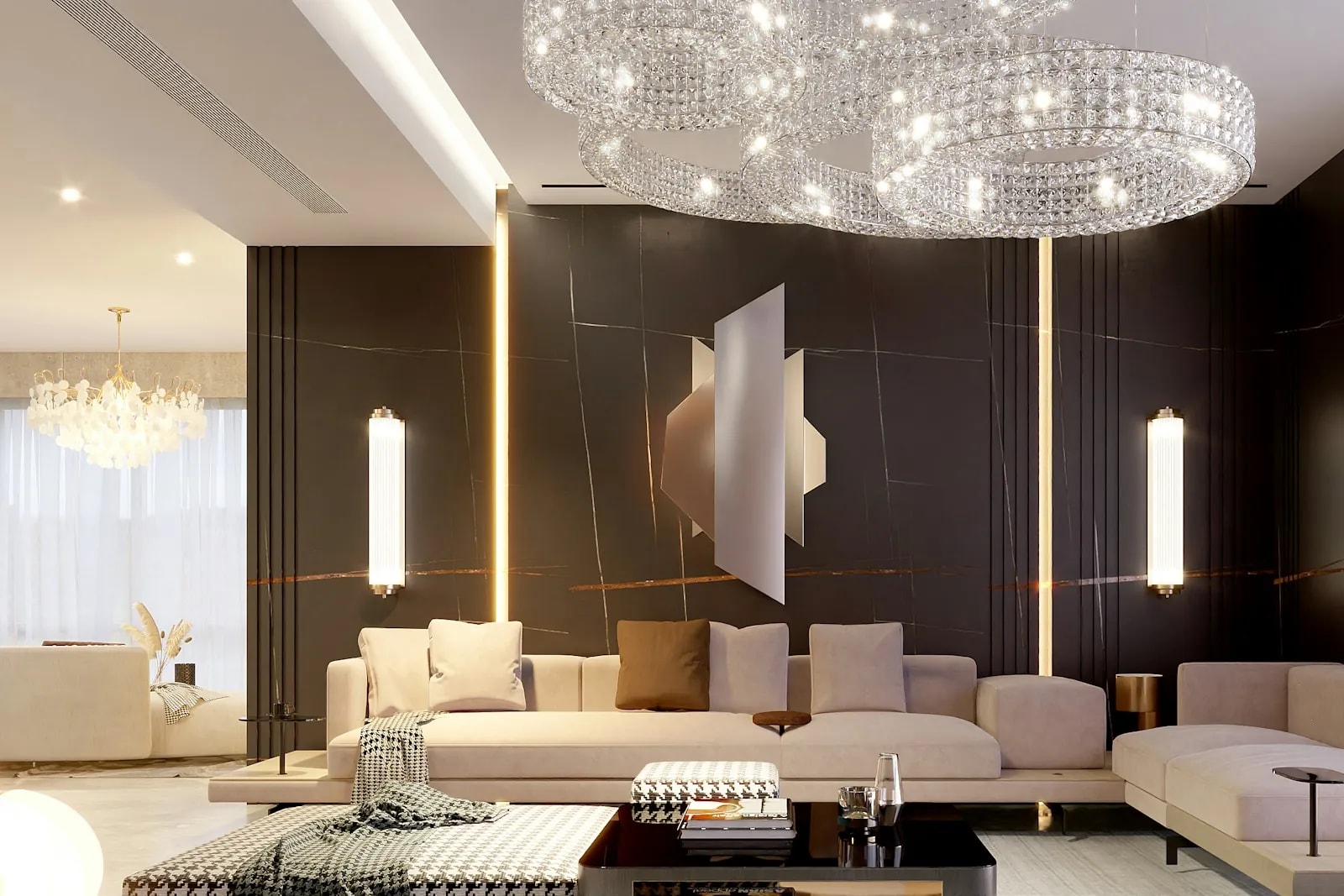
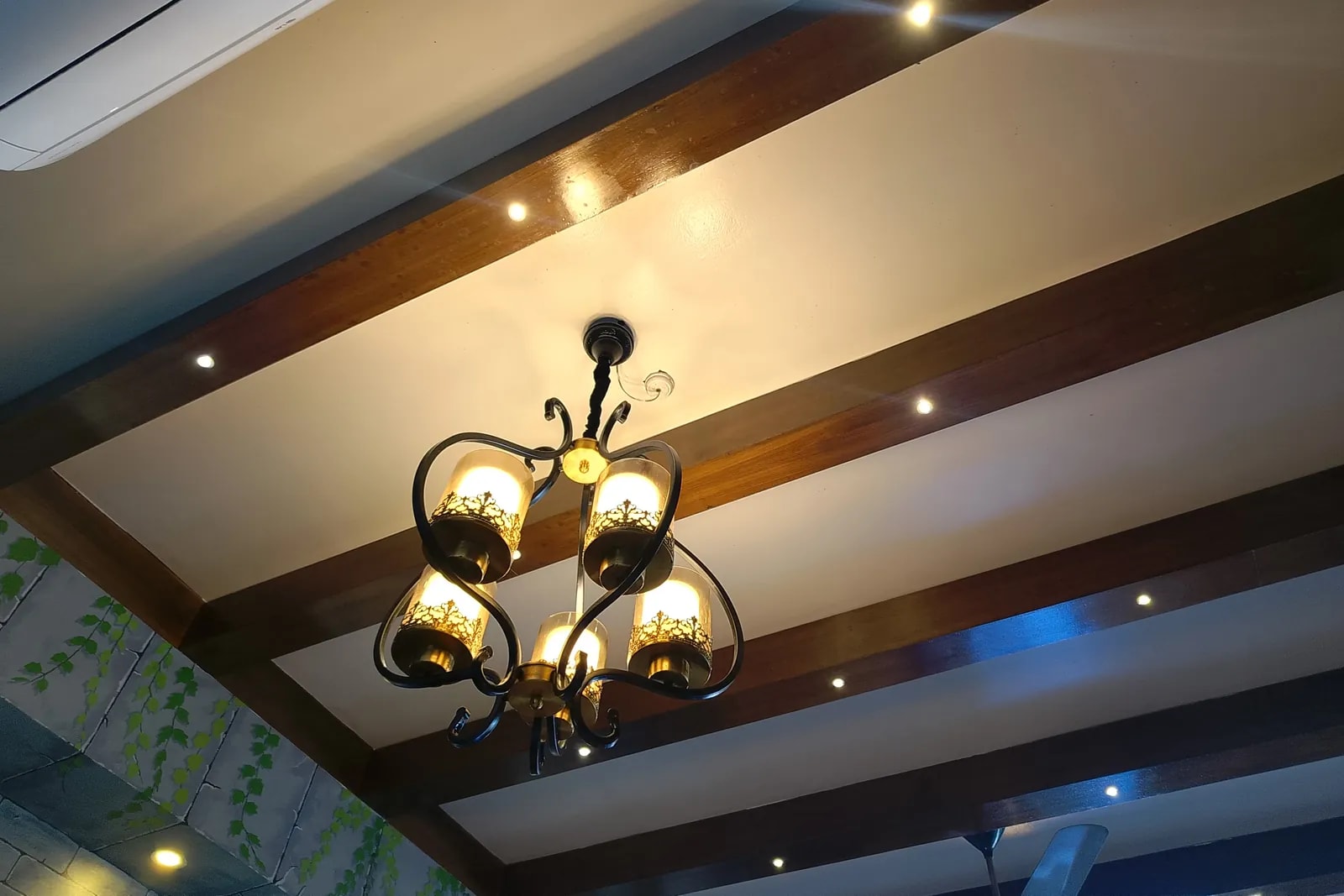
Majlis lighting works best in four layers, each on its own dimmed circuit: a chandelier or pendant, cove lighting in the ceiling, downlights, and wall lights near the seating. Dubai Municipality's Dubai Building Code (2021 edition)[4] allows dimmer switches or a smart control system in villas. It caps each lighting circuit at 2,000 W, on a breaker of no more than 16 A[5].
The code's only light-level figure for a home is a daylight floor of 150 lux in bedrooms and living rooms[5]. That clause names no majlis, and the code sets no electric-lighting target for any villa room, so how bright the majlis should be is your lighting designer's call.
What goes wrong is the match between lamp and dimmer. A dimmer lowers the power to a light; a driver is the small power unit inside or behind an LED that turns mains power into what the LED needs. Lutron's LED guide says the LED and the control "must be of the same control type"[6]. It also notes:
- Forward-phase dimming was not originally intended for LEDs.
- Reverse-phase dimmers always need a neutral wire. Lutron's US RadioRA 3 dimmers need one too[7]; confirm the 230 V parts on your bill of materials. The Shelly Dimmer Gen3 works without a neutral, but needs a Bypass on loads under 20 W[8].
- Default settings may not dim LEDs smoothly; a low end set too low causes flicker and drop-out[6].
Addressable lighting avoids most of this. With DALI, a wired lighting standard, each fitting has its own address, can be regrouped in software without rewiring, and reports faults[9]. One MDT DALI gateway handles up to 64 fittings and 16 groups per output, and tunable white needs DT8 drivers[10]. KNX is an open wired standard with 8,000+ certified devices from 500+ makers[11]. On KNX, MDT's AKD actuator takes dimmable 230 V LEDs over 2 W, up to 250 W a channel[12].
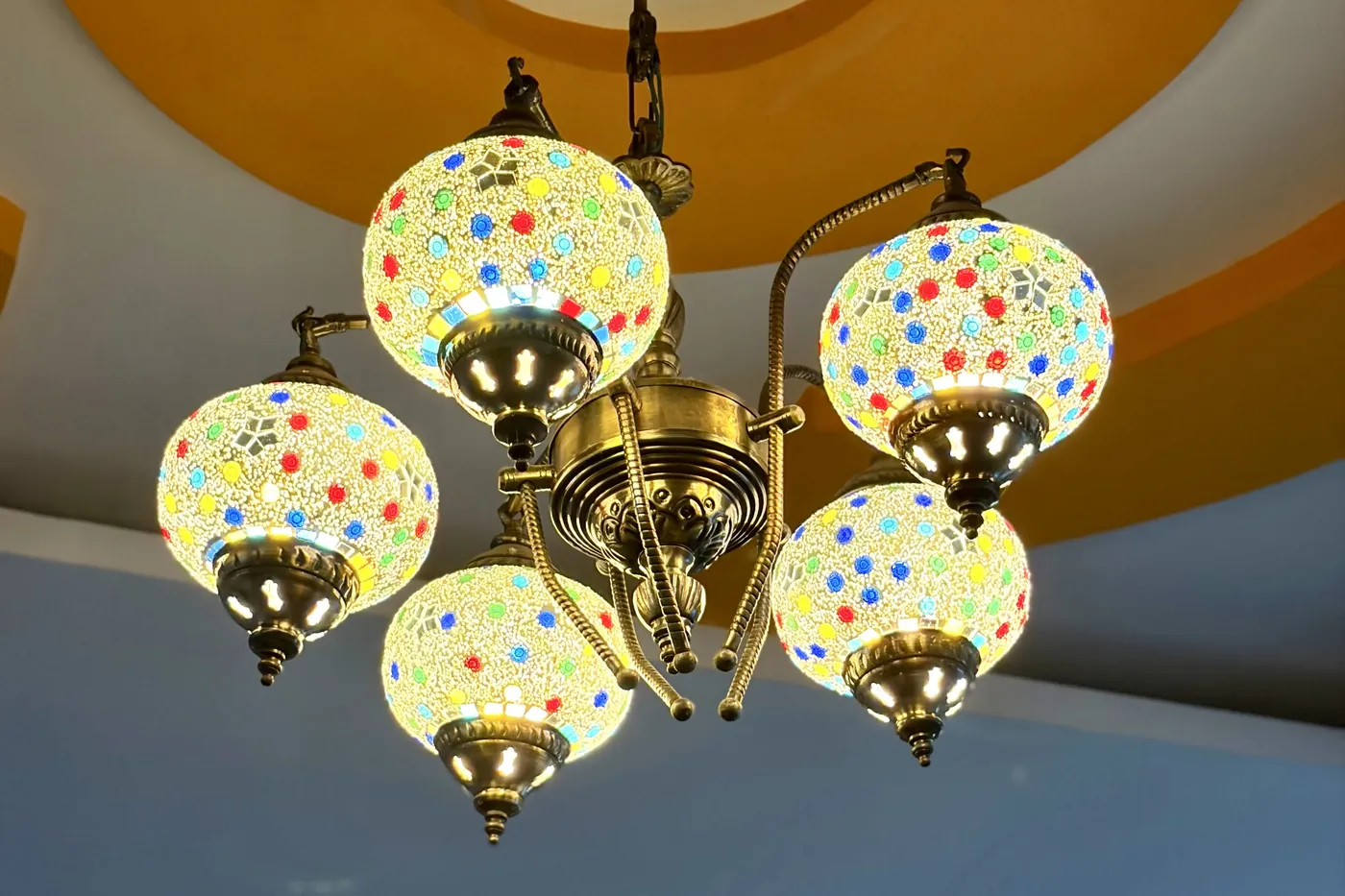
Chandelier size is design advice; lighting sites' rules disagree for one room. Our smart switches and lighting range lists UAE prices and which models need a neutral, and our guide to smart lighting in Dubai covers the brands.
Which lighting scenes does a majlis need, and who presses the button?
Majlis lighting automation comes down to a short list of scenes anyone can run: Welcome, Gathering, Prayer, Late night, Match and Empty. A scene is one button that sets several lights, the curtains, the AC and the audio at once. A keypad is the wall panel of engraved buttons that runs them, best placed at the host's seat and the guest door.
Light levels are set at commissioning, the final set-up in your room, not copied from a chart.
| Scene | What it does | Circuits used | How it starts |
|---|---|---|---|
| Welcome | Lights up, curtains close, AC to occupied setting | Chandelier, cove, downlights, entrance light | Guest-door keypad or gate |
| Gathering | Warm, steady light; background audio low | Cove, wall lights, chandelier dimmed | Host keypad |
| Prayer | Audio paused, lights held steady | Cove, wall lights | Host keypad, or a schedule set from published times |
| Late night | Low warm light, audio off | Cove and wall lights | Host keypad |
| Match | Glare off the screen, TV audio on | Downlights off near the TV, cove low | Host keypad or TV on |
| Empty | Lights off, AC back to its idle setting | All | Presence sensor after the room clears |
Six buttons run the room without an app. Colour is a design choice. Warm-white LEDs sit around 2,700K, and dim-to-warm products fall to about 1,800K, the colour of candlelight, as they dim[13]. Most majlis guides suggest 2,700 to 3,000K; that is design advice, not a rule.
Dubai's Building Code requires occupancy sensors only in corridors and bathrooms[5], so a sensor in the majlis is your choice. MDT's KNX presence detector covers a 5 m circle for presence[14], so a large room needs several. Aqara's FP2 radar sensor covers a room of up to 40 m2 and must be wall-mounted for zones[15]. Our Ramadan smart home guide covers this room on Ramadan nights.
Common mistake: a motion (PIR) sensor running the Empty scene. A PIR sensor sees movement, so a room of guests sitting still over coffee can look empty to it, and the lights go off mid-conversation. Radar sensors, as our catalogue notes, detect people who sit still. Compare models in our sensors range, and keep the Empty scene on a long delay.
What does a smart majlis cost: budget, mid and premium?
Parts for a smart majlis run from AED 4,098.78 for a wireless retrofit to AED 15,991.99 for scenes, radar sensors, curtains and ceiling speakers, before labour and programming. Most premium wired parts are quote-only in the UAE. Our published prices start at AED 4,500 for lighting and climate and AED 10,000 to 40,000 for wired lighting in a room or two[1][3].
Parts totals are hardware only, from UAE listings and our catalogue dated 19 July to 27 October 2026, without labour, programming or VAT. Re-check each price on the day you order[16][17][18]. Installation is quoted separately after a free site survey.
| Tier | What is included | UAE parts total (parts only) | Our published price | Notes |
|---|---|---|---|---|
| Budget: wireless retrofit | 3 Aqara Z1 Pro 4-gang switches, Aqara Hub M100, 2 Sensibo Air AC controllers, a pair of Sonos Era 100 speakers, a video doorbell | AED 4,098.78 to 4,408.78 | From AED 4,500 (lighting and climate, apartment-scale tier) | Assumes dimmable fittings, two split units with remotes and a neutral at each switch box. No lock included |
| Mid: scenes, radar, curtains, ceiling sound | Aqara: 2 S100 scene panels, Hub M3, 2 FP300 radar sensors, 4 E1 curtain motors, G410 doorbell, A100 lock. Plus 2 Sensibo Air AC controllers, Sonos Amp, two pairs of 6 in ceiling speakers, 48 m of cable | AED 15,991.99 | Audio from AED 4,500 for one or two rooms | Dimmer modules and cove LED strip not included: no mainstream UAE listing found |
| Premium: wired KNX and central audio | KNX power supply, 8-fold switch actuator, bus cable roll, Sonos Amp, two pairs of 8 in ceiling speakers, 48 m of cable | AED 14,532 for the priced parts only | Wired lighting control for a room or two: AED 10,000 to 40,000 | Quote-only: KNX dimming, DALI, sensors, keypads, Lutron, 2N intercom, curtain tracks, acoustics, programming |
| Year two and after | Subscriptions, batteries, sensor calibration, AC servicing | Not in the totals above | Quoted separately | Ring Protect for doorbell video history; Aqara E1 motors run up to 1 year a charge; CO2 sensors recalibrated every 12 months where the code applies |
Budget, without a lock: 3 x AED 300 + AED 163.78 + 2 x AED 549 + 2 x AED 999 + AED 249 = AED 4,408.78. The lower figure uses the Era 100 pair at AED 1,738 on amazon.ae and the eufy C30 doorbell at AED 199. Mid: 2 x 415 + 750 + 2 x 549 + 2 x 295 + 4 x 395 + 3,499 + 2 x 2,799 + 456 + 670 + 920.99 = AED 15,991.99. Premium: 799 + 930 + 450 + 3,499 + 2 x 4,199 + 456 = AED 14,532. Where the switch boxes have no neutral, three Aqara H1 No Neutral switches at AED 325 each add AED 75.
What UAE companies advertise: we read 64 pages on 27 October 2026, and only 2 publish an audio price that fits a majlis. One starts from about AED 2,500 for a single zone; the other gives AED 90,000 to 220,000 for an invisible two-zone majlis. These are advertised figures, not quotes.
For your own room, get your majlis priced after a free site survey, or send a photo of the ceiling or floor plan on WhatsApp.
How much heat do guests add, and why does an AC sized by floor area struggle?
Each seated guest gives off roughly 100 to 120 W of heat, so 30 guests add about 12,000 Btu/h (3.5 kW) and 50 guests add 20,000 Btu/h[19][20]. An AC sized by floor area alone cannot see the guest count.
Btu/h (British thermal units per hour) is the unit AC capacity is sold in. A tonne of refrigeration, or "ton", is 12,000 Btu/h. Sensible heat raises the temperature; latent heat is the moisture from breath and skin, which the AC must also remove.
Our calculation uses the "seated, very light work" value from the American Society of Heating, Refrigerating and Air-Conditioning Engineers (ASHRAE), as Autodesk's software applies it. That is 400 Btu/h a guest: 245 sensible plus 155 latent, about 72 W plus 45 W[19]. Guests talk and serve coffee, so it fits better than the "seated in theater" value of 330 Btu/h, 17.5% lower. The Chartered Institution of Building Services Engineers (CIBSE) puts a person seated at rest at 115 W, which agrees[20].
The table multiplies guests by 400 Btu/h, converts with 1 Btu/h = 0.2931 W, and compares two AC sizes. AC sellers' tables give 24,000 Btu/h (2 tons) for a 23 to 37 m2 majlis and 30,000 Btu/h (2.5 tons) for 37 to 51 m2.
| Guests | Heat added | kW (sensible + latent) | Share of a 24,000 Btu/h AC | Share of a 30,000 Btu/h AC |
|---|---|---|---|---|
| 10 | 4,000 Btu/h | 1.17 (0.72 + 0.45) | 17% | 13% |
| 20 | 8,000 Btu/h | 2.34 (1.44 + 0.91) | 33% | 27% |
| 30 | 12,000 Btu/h | 3.52 (2.15 + 1.36) | 50% | 40% |
| 50 | 20,000 Btu/h | 5.86 (3.59 + 2.27) | 83% | 67% |
This is body heat only: it leaves out sun, lights, the TV, fresh air and door openings, and an AC's rated output drops in peak Dubai heat.
Dubai's Building Code asks for a heat load calculation for each air-conditioned space at its own peak[5]. It also sets comfort at 22.5 to 25.5 C and 30 to 60% humidity for 95% of the year. That 60% ceiling is why the latent share matters in a crowded room.
Quick math: a 50 m2 majlis is 538 sq ft. At the 20 to 30 BTU per sq ft some AC sellers advise, it gets 10,764 to 16,146 Btu/h. Thirty guests alone add 12,000 Btu/h, which is 111% of the lower figure and 74% of the higher one. Fifty guests add 20,000 Btu/h, more than both. Across the sellers' pages we read, area rules ran from about 13 to 96 BTU per sq ft.
Split, ducted, fan coil or VRF: how should the majlis be cooled and controlled?
The cooling type decides what a smart control can do in a majlis. An infrared (IR) controller such as Sensibo Air works with any AC that has a handheld remote, one controller per unit[21]. A chilled-water fan coil, or a ducted unit with no remote, needs a wired thermostat instead.
A fan coil is an indoor unit that blows room air across a coil of chilled water, often from district cooling. A VRF system runs several indoor units from one outdoor unit. Each route has its own control:
- Split with a remote: Sensibo Air, AED 549 on amazon.ae (13 October 2026)[16].
- 2-pipe fan coil: a MOES Wi-Fi fan-coil thermostat, AED 127.20 on amazon.ae the same day[16], needing live and neutral. District-cooled homes need the provider's or owner's consent before controls change.
- Fan coil on KNX: a Siemens RDF800KN thermostat for 2-pipe or 4-pipe fan coils, quote-only.
- The villa's own VRF or splits on KNX: a gateway such as CoolAutomation CoolMaster, quote-only.
The Building Code requires every AC system to have a programmable controller and temperature sensors that are "simple and capable of operating independently"[5]. Pre-cooling schedules sit on top of that controller, not in place of it. No code or maker publishes a pre-cooling time for a majlis, so it is set at commissioning and tuned after the first gatherings.
The code points to ASHRAE's HVAC noise criteria for villa rooms[5], so ask for each indoor unit's sound level in its datasheet. Ask where the outdoor unit will sit and whether it is shaded. One Dubai resident reported an AC that stopped cooling; the technician blamed the heat around its outdoor unit. Our smart AC and climate range sorts controllers by the AC type they drive, including the Sensibo Air. For cooling elsewhere in the villa, read our AC automation guide.
Pro tip: the code says room sensors go on an interior wall, away from vents, doorways, windows, direct sunlight and bright lamps[5]. In a majlis that rules out the wall beside the guest door and any spot under a downlight. A sensor there reads the doorway or the lamp, not the seats, and the AC chases the wrong number all evening. Plan the supply and return grilles on the same drawing; a Gulf video on hidden AC warns that a room without a return "does not cool".
Does a crowded majlis need fresh air or a CO2 sensor?
A full majlis needs fresh air as well as cooling. Dubai's Building Code refers villas to ASHRAE 62.2 for outdoor air and says natural ventilation is permitted but must not be relied on[5]. For a crowded meeting-type room, ASHRAE's 62.1 table gives 2.5 L/s (litres a second) per person plus 0.3 L/s per m2[22]. That is a useful benchmark, not the villa rule.
Worked for a 50 m2 majlis, that is 2.5 L/s per guest plus 0.3 x 50 = 15 L/s. So 10 guests need 40 L/s, 20 need 65, 30 need 90 and 50 need 140. Your mechanical engineer sets the real figure.
A CO2 sensor measures the carbon dioxide people breathe out, a sign of how stale the air is. The code requires CO2-controlled ventilation in spaces over 100 m2 with at least 25 people per 100 m2[5]. The set-point stays below 800 ppm (parts per million), an alarm sounds above 1,000 ppm, and sensors are recalibrated every 12 months. That clause sits in the code's general part, not the villa part, so in most villa majlis rooms a CO2 sensor is a design choice. A reading of about 1,000 ppm is a long-standing rule of thumb for ventilation, not a health limit.
Check how any CO2 sensor calibrates. Airthings' Space CO2 Mini reads 400 to 5,000 ppm and updates its baseline weekly[23]. On a wired system, MDT's KNX CO2 and VOC sensor has its own air-quality controller, so it can drive ventilation without an app[24].
Why does a majlis echo, and how much absorption fixes it?
A majlis echoes because marble, plaster and a high ceiling reflect sound. Dubai's Building Code prints no echo target of its own: where speech clarity matters, it asks for enough sound-absorbing surface to meet the reverberation times in BS 8233[5]. Double the absorption and the echo time halves.
Reverberation time is how long a sound takes to die away after it stops. Sabine's formula is RT = 0.161 x V / A, where V is the room volume in m3 and A is the total absorption in m2[25]. Worked for an 8 x 6 x 4 m majlis (192 m3), it becomes RT = 30.9 / A:
- 25 m2 of absorption: about 1.24 seconds
- 50 m2: about 0.62 seconds
- 75 m2: about 0.41 seconds
Rugs, curtains and upholstery count toward that total; which mix with panels reaches it depends on each product's tested absorption data. Keeping sound inside the room is the other half of majlis acoustics: villa sound insulation follows Approved Document E[5], and panels on the walls do not replace it.
Our luxury smart home guide covers invisible majlis speakers in hard rooms.
Which speakers suit a majlis, and how do you keep speech and recitation clear?
Ceiling speakers spread around the room at moderate volume suit a majlis, because guests sit along the walls. For seated listeners, the Sonos In-Ceiling by Sonance manual spaces speakers 4.1 m apart under a 10 ft ceiling. The gap is 5.3 m under 12 ft and 6.6 m under 14 ft[26].
Those figures apply to that model only. A 3.5 to 4.5 m majlis ceiling is about 11.5 to 14.8 ft, so the 12 and 14 ft rows apply. A one-zone majlis sound system from the Sonos UAE store:
- Sonos Amp, AED 3,499 (27 October 2026): 125 W a channel at 8 ohms, up to two pairs of 8-ohm speakers, and HDMI eARC for the TV[17].
- Sonos In-Ceiling pair, AED 2,799 for 6 in or AED 4,199 for 8 in (19 October 2026)[27]. No back box is included.
Several zones, or recitation that must stay clear across a long room, call for a central amplifier such as Crestron DM NAX, which is quote-only. Our multi-room audio design starts from AED 4,500 for one or two rooms[2]. Per-zone costs are in our multi-room audio cost guide; speakers and soundbars are in our audio and voice range.
Pro tip: do your speakers pop or hum when the AC compressor starts? Ask your electrical contractor to check that the audio equipment and the AC are on separate circuits and properly earthed. We found no source that names one cause; separate circuits are easiest to plan before the ceiling closes.
Will oud or bakhoor set off the majlis smoke detectors?
Oud and bakhoor can set off smoke detectors. UL Solutions reported a high rate of UAE false fire alarms caused by burning bakhoor and incense, enough to stretch Civil Defence resources[28]. Every Dubai villa still needs smoke detection connected to Civil Defence through Hassantuk[5], so the answer is detector choice and position, never a covered detector.
UL launched a UL-AE mark for household fire alarm control units in the UAE, testing features to reduce false alarms[28]. No UL or Civil Defence page we found says which detector suits a room where oud is burned. Ask your fire alarm contractor which detector type and position suit your majlis.
We found no separate assembly-room rule for a home majlis. No scene should ever silence the fire alarm; our Hassantuk guide for villas explains the connected system.
Common mistake: covering the majlis detector before the bakhoor comes out, then forgetting it. A covered detector cannot sense a real fire. Hassantuk has been required in every UAE villa since 1 January 2024, and keeping it working is the owner's job, not the tenant's.
How do you run a separate majlis entrance without opening the family side?
A separate guest entrance works when the gate, door, entrance lights and majlis AC run as their own zone, so guests never pass the family rooms. In Dubai Municipality areas, the Building Code lets a majlis be built as a villa annex[5]. It must stand at least 1.5 m from the main villa and be no taller than 5.5 m.
The annex can cover up to 60% of the main building's gross area[5]; Trakhees or Dubai Development Authority communities may differ. At the guest door:
- Lock: the Aqara Smart Lock U200 is rated from -15 to 66 C with an IPX5 keypad[29]. On amazon.ae (13 October 2026), the Aqara A100 Zigbee lock was AED 920.99 and the Nuki Smart Lock 4th Generation AED 799[16]. Nuki needs a double euro cylinder with an emergency function.
- Intercom: the 2N IP Verso 2.0 runs from -40 to 60 C and is rated IP54 and IK08 against dust, water and knocks. It takes power over its network cable (PoE), has keypad and card-reader (RFID) modules[30], and is quote-only.
- Doorbell: the Aqara G410, AED 670 in our catalogue, is rated IPX3 and 50 C; its chime hub is rated to 40 C indoors.
Most keypad locks and intercoms can hold several codes; check that your model supports time-limited guest codes and an entry log before you buy. Exterior lights must also switch off automatically in daylight[5]. Check who controls the gate and facade lights; a landlord or the community may run them. Compare models in our smart locks range and our doorbells and intercoms range. Our room-by-room villa guide and smart locks guide cover the rest.
Can you put a camera in a majlis, and what does UAE law say?
Keep cameras out of the majlis itself. UAE Cybercrime Law Article 44 covers recording or photographing people to invade their private or family life without consent. The law sets six months or more in jail, a fine of AED 150,000 to AED 500,000, or both[31]. It turns on intent and consent; treat any camera facing guests as a legal risk.
The Penal Code, Article 431, also punishes recording conversations or taking photos of a person in a private place without consent[32]. It adds that consent is presumed for recording done openly during a meeting in front of those present. What that means for guests in a private majlis is a question for a lawyer, not a reason to record.
The UAE's data protection law is built on consent, with only a narrow exclusion for people processing their own data; it does not say private homes are exempt[33]. Homeowners need no SIRA approval for cameras on their own home: SIRA's CCTV specification governs the premises it licenses, and a company paid to install CCTV needs a SIRA licence[34].
Real talk: no camera inside the majlis, and no smart display with a camera, such as an Echo Show, on its side table. Use a radar presence sensor for lights and AC; it makes no image[15]. Cameras belong at the gate and guest door, which our security and CCTV design work covers from AED 10,000 for an eight-channel system[35]. Our smart home privacy guide has the detail.
Can the majlis follow prayer times, Ramadan nights and Arabic voice commands?
A majlis can follow prayer times only as a programmed schedule. Dubai's official prayer times come from the Islamic Affairs and Charitable Activities Department (IACAD), which also runs the DULOOK DXB app[36]. We found no public feed of those times, and no maker we checked documents an automatic adhan mute[37]. A prayer scene is set against the published times and checked as they shift.
On 27 October 2026, IACAD's page showed Fajr at 5:05, Maghrib at 5:45 and Isha at 7:00, and noted that other emirates may differ[36]. IACAD's open-data list has no prayer-times dataset[38].
Arabic voice depends on the assistant:
- Amazon Alexa: Arabic in the UAE since December 2021, in Modern Standard Arabic and Khaleeji[37].
- Siri: listed for the UAE in Arabic; Apple's new AI Siri is English only[39].
- Sonos Voice Control: US English and French only, and Alexa on Sonos speakers lists no Arabic[40].
- Gemini for Home: lists neither Arabic nor the UAE[41].
When Alexa's Arabic launched, Amazon said it could play the Quran and give daily prayer timings[42]. Check what your Echo does today before you rely on it. Our Arabic voice control guide covers dialects and naming.
Retrofit or new build: what has to be decided before the ceiling closes?
In a new build, the lighting circuits, AC type, speaker grid, sensor positions and guest-door cabling must be fixed before the majlis ceiling closes. In a finished villa, wireless switches, IR AC control and wireless speakers avoid most cutting. Clauses here come from the Dubai Building Code (2021 edition); check the current edition with your consultant before you build[4].
| Build stage | What to decide | Why it matters |
|---|---|---|
| Design drawings | Lighting layers, AC grilles, speakers and sensors on one ceiling plan | Each lighting circuit is capped at 2,000 W[5] |
| First fix (cabling before plaster) | Neutral at every switch box, KNX or DALI cable, speaker cable, data cable to the guest door | Neutrals are commonly missing at switch boxes in older UAE homes |
| Before the ceiling closes | Cove, speaker back boxes, grilles; drainage routed elsewhere | The code says drainage should avoid the majlis[5] |
| Commissioning | Scenes, the dimmer's lowest setting, pre-cool timing, guest codes | Set in the room and adjusted after the first gatherings |
In a retrofit, check each switch box for a neutral before choosing a dimmer. Our pre-wiring guide and KNX cost guide go further.
What should a majlis quote include, and what is not worth automating?
A majlis quote should list each lighting circuit and its dimmer type, and the control for each AC. It should also show sensor and speaker positions, acoustic data, guest-code features and what works without the internet.
- Circuits by layer, each under 2,000 W, with the dimmer and driver type for each load.
- Speaker model, count and spacing for your ceiling height.
- What is excluded: AC servicing, subscriptions, the fire alarm.
Real talk: some things are not worth automating in a majlis. Skip the indoor camera, the voice device with a camera and a keypad on every wall. If the room hosts guests a few times a year, two Sensibo Air controllers and a six-button keypad may be all it needs[43]. If the internet drops, a wired KNX or DALI system keeps its scenes in local devices; what stops is remote access. For upkeep, see our smart home annual maintenance contract (AMC) guide.
How Dubai Smart Home helps with a smart majlis
Three decisions matter most in a smart majlis. Cool it for its full guest count, not its floor area. Put each lighting layer on its own dimmed circuit with matched drivers. Keep cameras outside the room, at the gate and guest door.
We survey the majlis, design and specify its lighting circuits, cooling controls, speaker layout and guest-door hardware, prepare any paperwork, and coordinate the work through to handover. We configure the scenes and support you afterwards, with a 12-month workmanship warranty that can vary by product. We are rated 4.9/5 by Dubai homeowners. Our lighting control system design covers the wired route. For the rest of the villa, see our smart home guide for villa owners and the complete smart home guide for Dubai.
To plan yours, book a free design consultation, or send the majlis floor plan on WhatsApp.